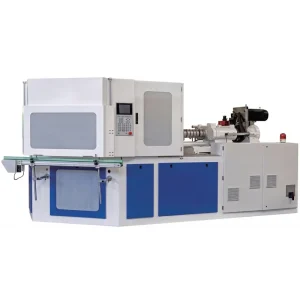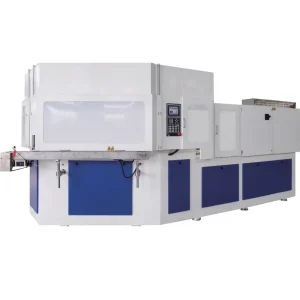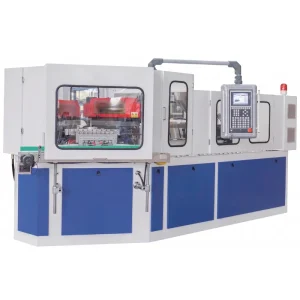
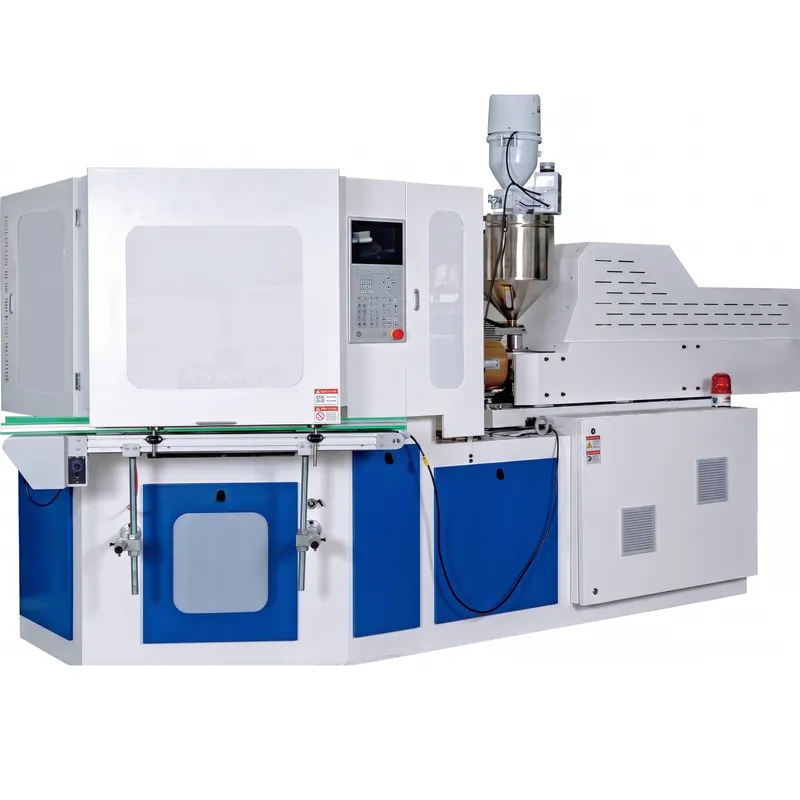
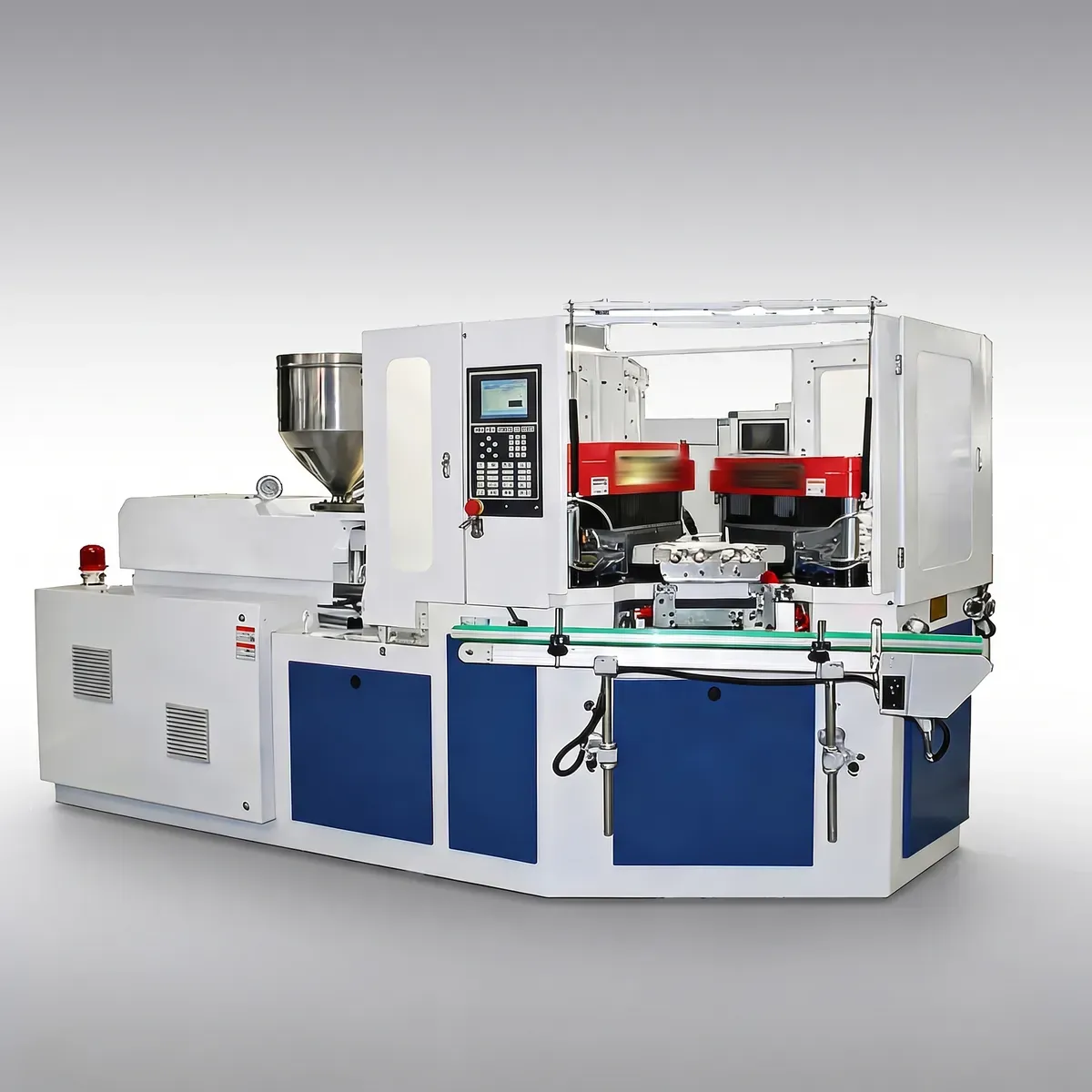
ZQ40 Injection Blow Molding Machine Replacement for Uniloy UIB70 Model
Our ZQ40 injection blow molding machine replacement for Jomar IBM40 integrates a full European-style structural design, laying a solid foundation for long-term stable operation. With damping force 20% to 30% higher than that of similar products, it ensures uniform wall thickness and a flawless finish of work pieces across every production run. The standard servo rotation system enables precise control and simple operation, reducing the learning curve for operators and shortening commissioning time.
Our ZQ40 injection blow molding machine replacement for Jomar IBM40 integrates a full European-style structural design, laying a solid foundation for long-term stable operation. With damping force 20% to 30% higher than that of similar products, it ensures uniform wall thickness and a flawless finish of work pieces across every production run. The standard servo rotation system enables precise control and simple operation, reducing the learning curve for operators and shortening commissioning time. Thanks to the unique pressurized clamping structure, the booster cylinder does not involve in mold opening or closing, which not only improves clamping stability but also reduces energy consumption by 10% to 20% compared to industry standards. As a leading plastic injection blow molding machine from Ever-Power, the ZQ40 is fully engineered to substitute Jomar IBM40 tooling and workflows with zero compromise.
The ZQ40 IBM machine is widely deployed in pharmaceutical packaging, cosmetic bottle production, food-grade container manufacturing, and personal care product lines. Its 400KN injection clamping force and max platen size of 480 x 340 mm make it the ideal one step injection blow molding machine for producing containers ranging from 10 ml to 1,000 ml with cavitation up to 9 cavities at 10 ml volume. Whether you are transitioning from a Jomar IBM40 or sourcing a brand-new PET injection blow molding machine, the ZQ40 delivers consistent output, reduced scrap, and exceptional ROI.
Mold Cavitation(For Reference)
| Approx Volume | 10ml | 30ml | 60ml | 100ml | 250ml | 500ml | 1000ml |
|---|---|---|---|---|---|---|---|
| Max.cavitation | 9 | 8 | 6 | 4 | 3 | 2 | 1 |
Main Technical Parameters
| Item | Unit | ZQ40 |
|---|---|---|
| Injection System | ||
| Screw Diameter | mm | 40/45 |
| Screw L/D | % | 22:1 |
| Injection weight! | g | 190/260 |
| Heating power | KW | 7.5 |
| Number of barrel zones | 3+N | |
| Injection stroke | mm | 120 |
| Clamping System | ||
| Clamping force of injection | KN | 400 |
| Opening stroke for injection | mm | 165 |
| Clamping force of blowing | KN | 60 |
| Opening stroke for blowing | mm | 140 |
| Lifing height of rotary table | mm | 70 |
| Mould | ||
| Max.Platen size(LxW) | mm | 480x340 |
| Mold thickness | mm | 180 |
| Dia. of bottle | mm | 120 |
| Botle height | mm | 220 |
| Suitable bottle height | mm | 1-1500 |
| Stripping stroke | mm | 220 |
| Hydraulic system | ||
| Hydraulic Pressure | Map | 14 |
| Motor power | KW | 11 |
| Dry cycle | S | 3.5 |
| Total Power | KW | 20 |
| Operating power | % | 52-70 |
| Others | ||
| Min. Air pressure of compressed air | MPa | 0.7- 1.2 |
| Compressed air capacity | M³/min | 0.7 |
| Water flowage | M³/h | 3.5 |
| Cooling water pressure | MPa | 0.3-0.4 |
| Dimensions (Lx W x H ) | M | 3.5x1.3x1.7 |
| Net weight | Ton | 3.8 |
Replaceable Brand and Model
| Ever-Power | Clamping Force | Jomar | SUMA | Uniloy | Bloma |
| ZQ40 | 40T | IBM40 | 40iB | UIB70 | IBM45 |
| ZQ60 | 60T | IBM65 | 65iB | UIB90 | IBM50 |
| ZQ80 | 80T | IBM85S | 85iB | UIB120 | IBM85 |
| ZQ110 | 110T | IBM135 | 135iB | UIB150 | IBM135 |
| ZQ135 | 135T | IBM175 | 175iB | UIB180 |
IBM Machine Screw Diameter
| Ever-Power | Screw Diameter | Jomar | SUMA | Bloma |
| ZQ40 | 40/45 | 35/40 | 40 | 45 |
| ZQ60 | 45/50 | 45 | 40/50 | 50 |
| ZQ80 | 55 | 55 | 50/60 | 50 |
| ZQ110 | 65 | 65 | 65/76 | 70 |
| ZQ135 | 70 | 70 | 65/76 |
IBM Machine Injection Weight
| Ever-Power | Injection Weight | Jomar | SUMA | Bloma |
| ZQ40 | 190/260 | 180 | 169 | 180 |
| ZQ60 | 260/383 | 205 | 169/264 | 240 |
| ZQ80 | 466 | 300 | 333/480 | 310/280 |
| ZQ110 | 540 | 450/550 | 580/770 | 560 |
| ZQ135 | 650 | 450/550 | 580/770 |
IBM Machine Injection Clamping Force
| Ever-Power | Injection Clamping Force | Jomar | SUMA | Bloma |
| ZQ40 | 400KN | 340KN | 386KN | 350KN |
| ZQ60 | 600KN | 460KN | 580KN | 500KN |
| ZQ80 | 800KN | 680KN | 720KN | 700KN |
| ZQ110 | 1100KN | 1210KN | 1200KN | 1250KN |
| ZQ135 | 1350KN | 1560KN | 1600KN |
IBM Machine Mold Size
| Ever-Power | Mold Size | Jomar | SUMA | Bloma |
| ZQ40 | 480 × 340 | 394 × 508 | 470 × 350 | 450 × 390 |
| ZQ60 | 600 × 390 | 432 × 660 | 620 × 400 | 620 × 430 |
| ZQ80 | 800 × 400 | 464 × 749 | 700 × 400 | 620 × 430 |
| ZQ110 | 1100 × 460 | 559 × 1118 | 1000 × 500 | 900 × 480 |
| ZQ135 | 1300 × 500 | 635 × 1372 | 1200 × 600 |
IBM Machine Size
| Ever-Power | Mold Size (M) | Jomar | SUMA | Bloma |
| ZQ40 | 3.8 × 1.3 × 1.7 | 2.72 × 1.9 × 2.75 | 3.8 × 1.5 × 2.3 | 4.05 × 1.52 × 2.55 |
| ZQ60 | 3.8 × 1.4 × 1.8 | 2.92 × 1.98 × 3.41 | 4 × 1.7 × 2.3 | 620 × 430 × 2.55 |
| ZQ80 | 4.5 × 1.6 × 2 | 3.33 × 1.94 × 3.41 | 4.5 × 2 × 2.6 | 620 × 430 × 2.55 |
| ZQ110 | 5 × 1.8 × 2.2 | 3.79 × 2.4 × 3.41 | 5 × 2.4 × 2.7 | 900 × 480 × 2.55 |
| ZQ135 | 5.5 × 2 × 2.4 | 4.22 × 2.67 × 3.58 | 6 × 2.6 × 2.7 |
Note: Brands are mentioned only to help customers choose products, not to sell those brands' products.
Features of the ZQ40 All Electric Injection Blow Molding Machine
1. Full European-Style Structure with Superior Clamping Force
The ZQ40 injection blow molding machine adopts a full European-style frame structure that delivers a clamping force 20% to 30% higher than comparable machines in the same class. This superior structural rigidity guarantees consistent mold alignment, minimizes flash formation, and extends mold service life significantly. The design is proven across high-output plastic injection blow molding machine lines in pharmaceutical, cosmetic, and food-grade environments worldwide.
2. High-Precision Servo Rotation System
The standard high-precision servo-driven angle divider achieves complete synchronization between mold opening and closing actions and turret lifting. This precision indexing mechanism eliminates positional error between stations, which is critical in a one step injection blow molding machine workflow where core rod alignment directly impacts preform quality, neck finish accuracy, and overall bottle dimensional consistency.
3. Unique Pressurized Clamping Structure with Dual Hydraulics
The proprietary pressurized clamping system keeps the booster cylinder entirely out of the mold opening and closing cycle. The standard dual hydraulic circuit handles clamping independently, reducing thermal load on the system and delivering energy consumption 20% to 30% below industry average. For factories seeking injection blow moulding machine efficiency without sacrificing clamping reliability, this is a clear competitive advantage.
4. Versatile Cavitation Range for Small to Large Volume Bottles
The ZQ40 IBM injection blow molding machine supports up to 9 cavities at 10 ml and efficiently scales down to single-cavity 1,000 ml production. This flexibility makes it equally suited to high-speed pharmaceutical vial lines and low-volume premium cosmetic bottle production, giving buyers and injection blow molding machine suppliers a single platform solution for multiple SKUs.
5. Optimized Hot Runner System for Minimal Gram Weight Deviation
The advanced hot runner system on this customized injection blow molding machine for sale ensures gram weight deviation and wall thickness deviation are minimized across every cycle. Combined with the mandrel's special core cooling channel design, fast molding cycles are maintained without compromising thermal uniformity, which is essential for PET injection blow molding machine applications where clarity and wall consistency are non-negotiable.
6. Zero-Burr, Zero-Flash, Zero-Waste Bottle Finish
Unlike conventional blow injection molding machine platforms, the ZQ40 produces bottles with no burrs or waste on the mouth or base. Thread dimensions are accurate to spec and provide 100% seal integrity from the first shot. This waste-free characteristic is particularly valued in sterile pharmaceutical packaging and high-transparency cosmetic container production where post-processing finishing cost would otherwise erode margins.
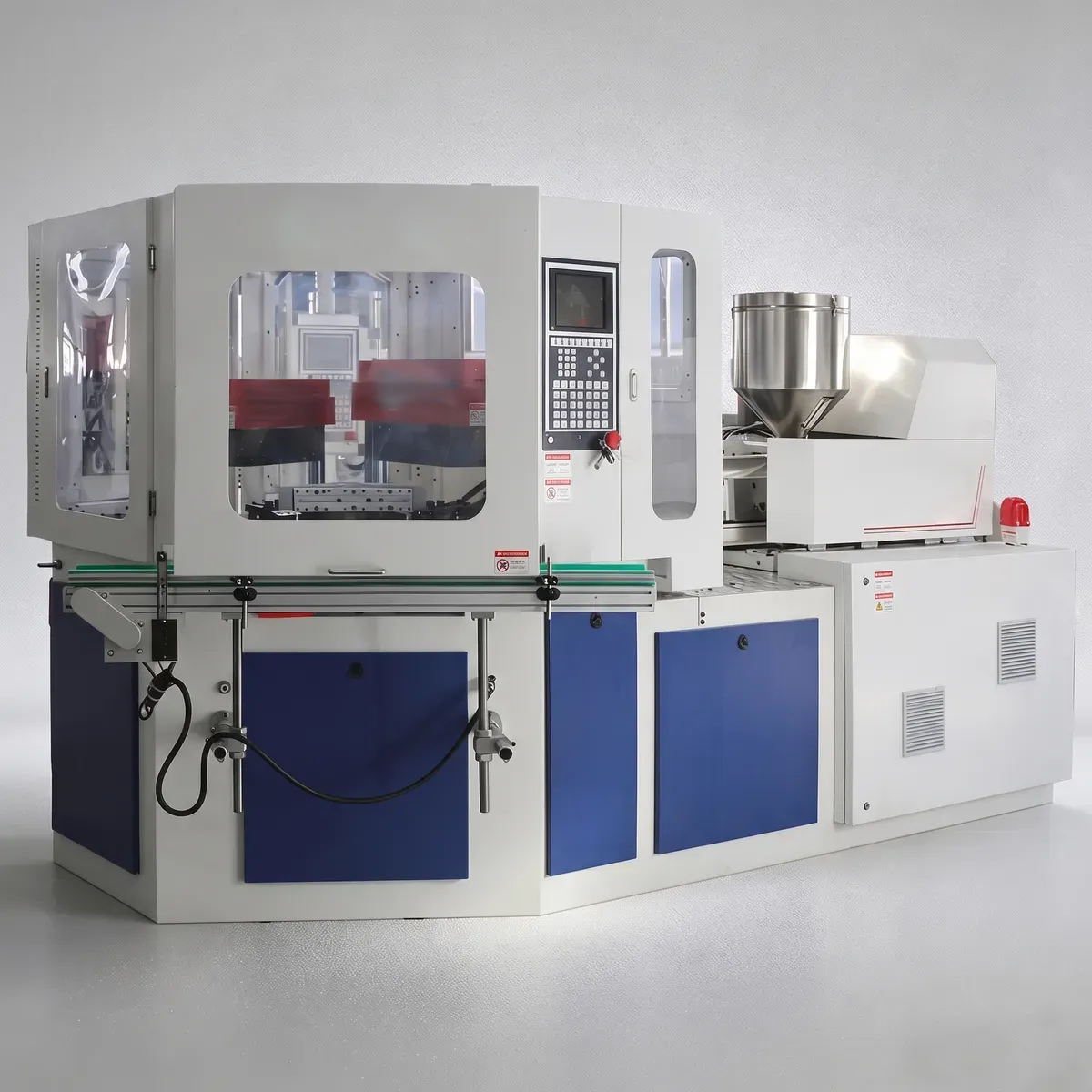
Working Principle of the IBM Machine
The ZQ40 ISBM machine operates on a synchronized three-station process where injection, blowing, and stripping occur simultaneously in a continuous cycle, maximizing throughput while eliminating waste material between stages.
In the injection station, polymer melt is injected precisely into the cavity around the core rod mandrel. The bottle neck geometry is formed with full dimensional accuracy at this stage. Temperature and pressure profiles are independently controllable across the 3+N barrel zones. Once the preform reaches the target temperature profile on the core rod, the mold opens and the mandrel with the shaped preform is indexed to the blow station. This precise thermal conditioning is what differentiates a true single stage injection stretch blow molding machine from a two-stage process.
At the blow station, compressed air is introduced through the core rod mandrel at a controlled pressure between 0.7 and 1.2 MPa. The air expands the preform outward until it conforms precisely to the cavity wall of the blow mold. The number of cavities determines the number of bottles produced per cycle. After the blow phase, the mold cavity cools the bottle to a stable ejection temperature. The mold then opens and the turret rotates to transfer the finished bottles to the stripping station, completing the blow molding phase of this IBM injection blow molding machine cycle.
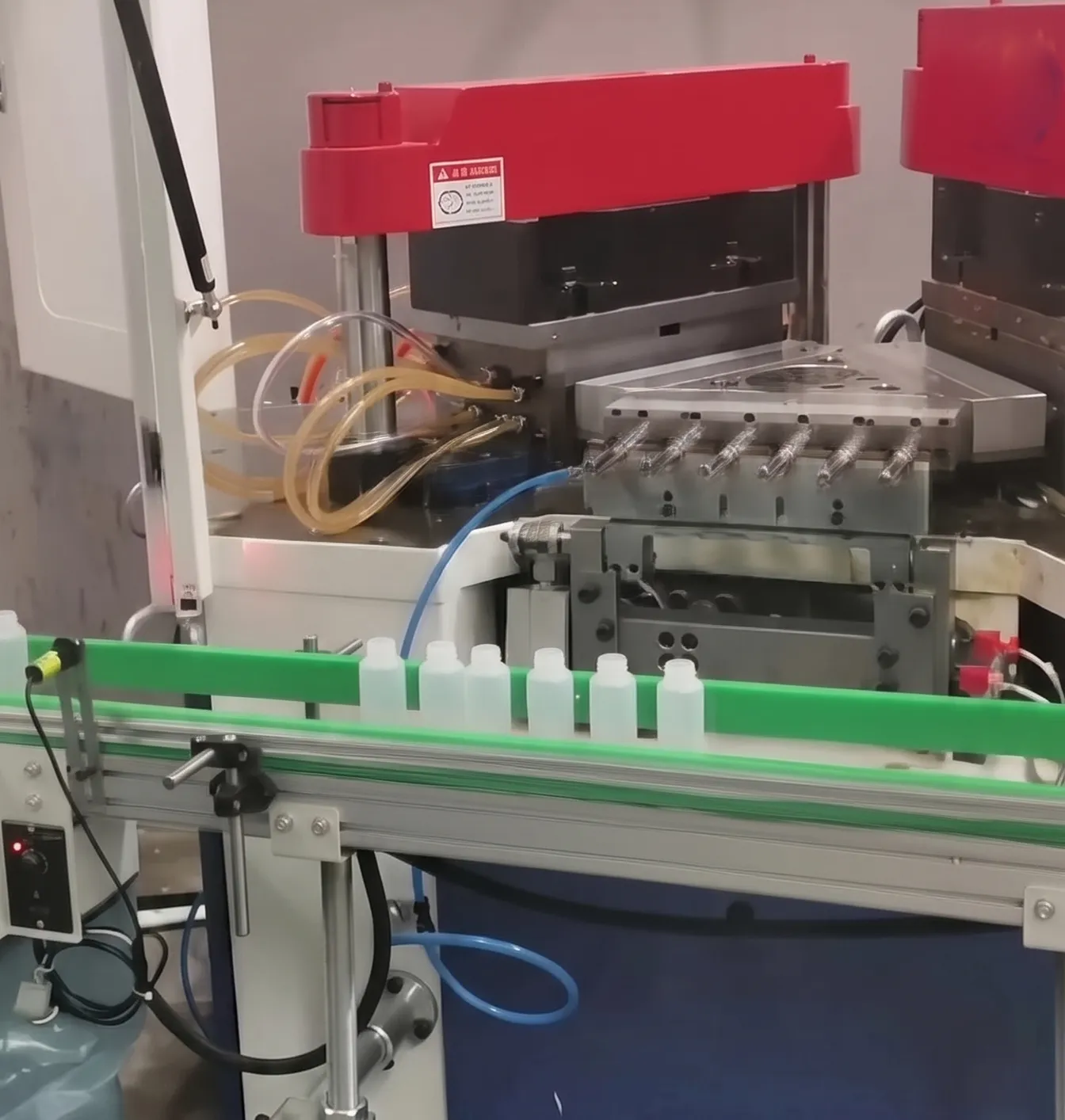
At the stripping station, the finished bottles are automatically ejected from the cooled core rods using the 220 mm stripping stroke mechanism. Bottles fall cleanly into a collection chute or conveyor for immediate packing, with no operator handling required. Critically, all three stations operate concurrently within each machine cycle, meaning injection, blowing, and stripping happen in parallel. This simultaneous three-station architecture is what gives this blow injection molding machine its exceptional output efficiency, minimal energy footprint, and near-zero scrap rate compared to two-stage alternatives.
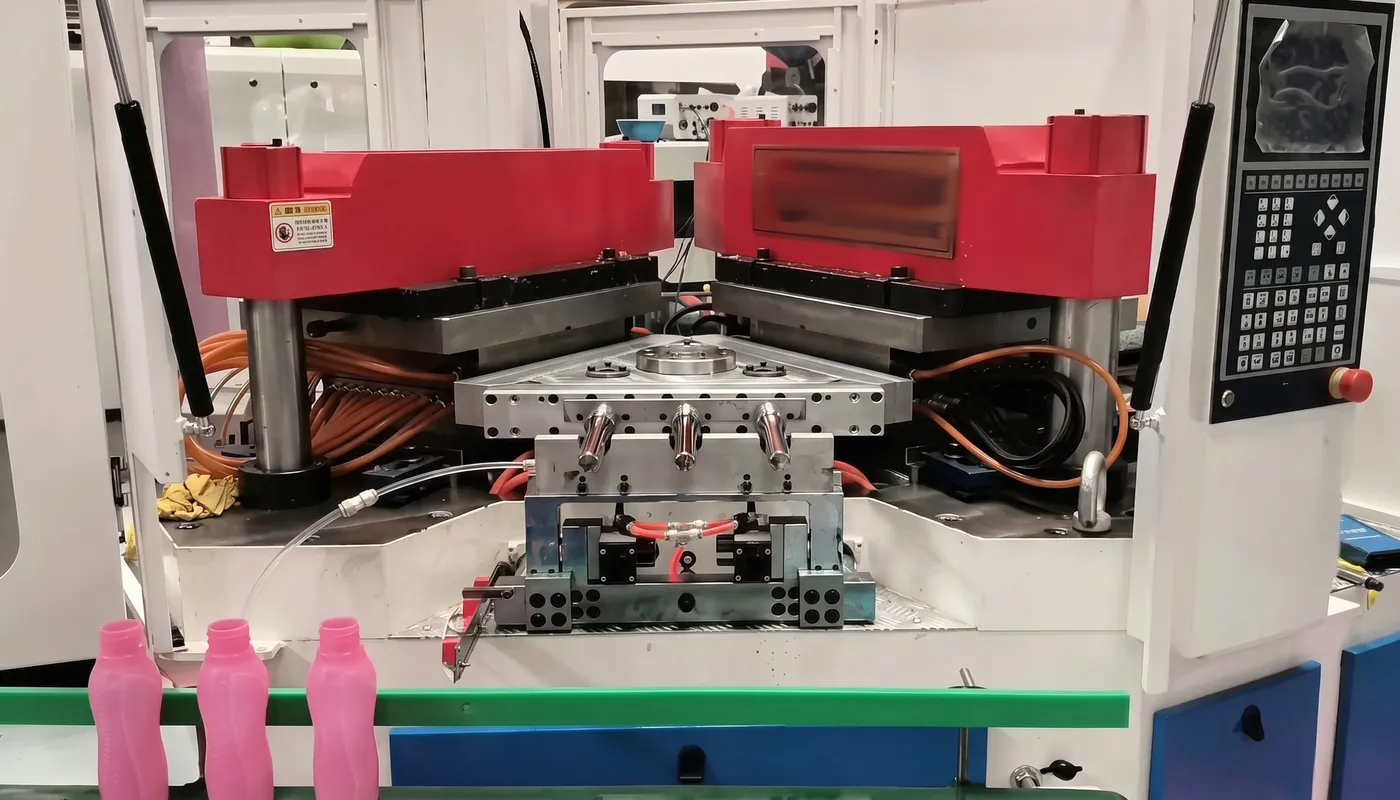
Applications of the Injection Blow Molding
As a versatile plastic injection blow molding machine, the ZQ40 serves demanding production environments across eight major packaging sectors. Its compatibility with HDPE, LDPE, PP, PS, ABS, PET, PCTG, and EVA resins gives formulators and packagers extraordinary flexibility.
1. Chemical Bottles
The ZQ40 IBM machine is widely used for producing HDPE chemical bottles ranging from 50 ml to 500 ml. Its superior clamping force and pressurized blow system ensure wall thickness uniformity critical for chemical containment integrity, including resistance to stress cracking under filled-compound or solvent conditions.
2. Cosmetic Bottles
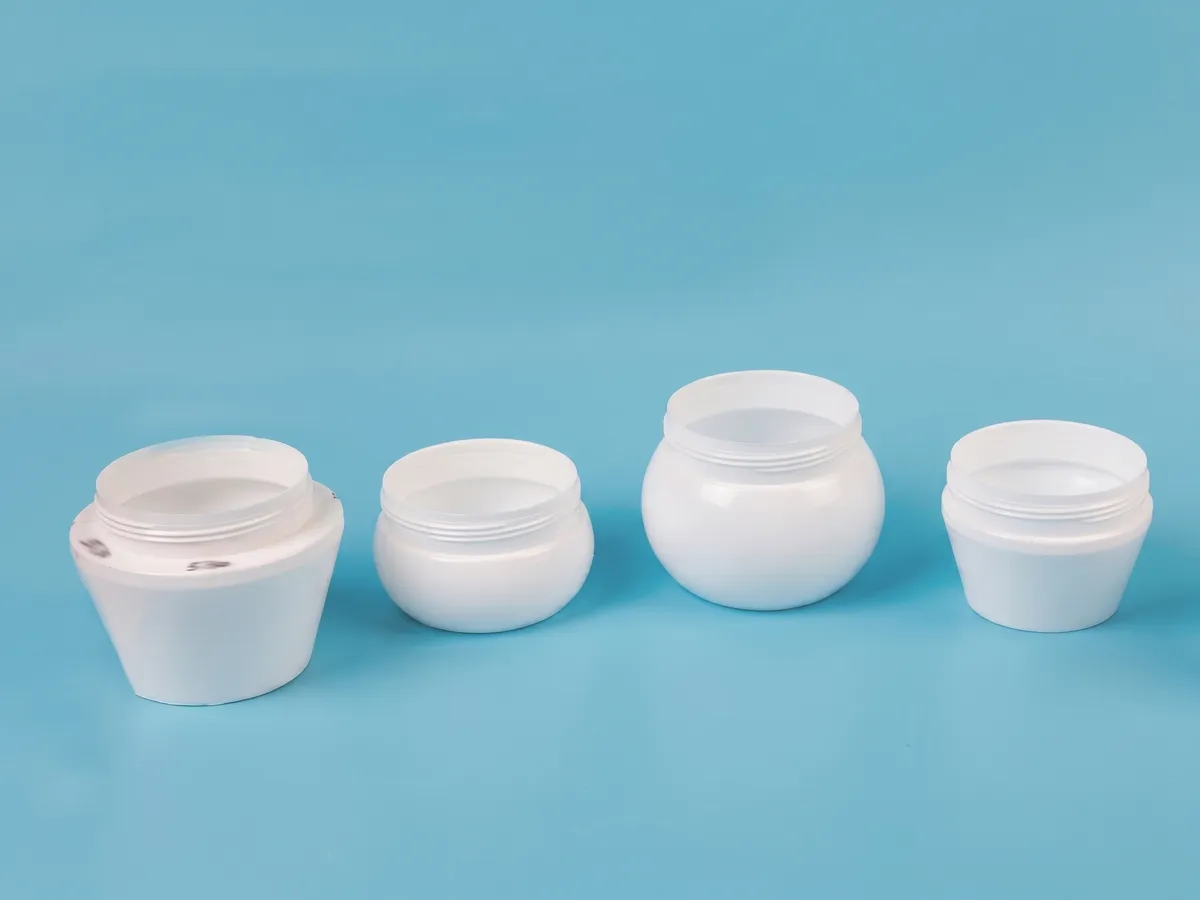
Premium cosmetic packaging demands visual clarity, dimensional accuracy, and an impeccable surface finish. The ZQ40 injection blow moulding machine delivers all three, producing high-transparency PP, PCTG, and ABS cosmetic bottles with flawless neck threads, consistent gloss levels, and burr-free bases that meet the aesthetic standards of global beauty brands.
3. Beverage Bottles
For beverage applications, particularly small single-serve and portion-control formats between 100 ml and 500 ml, the ZQ40 PET injection blow molding machine configuration produces lightweight containers with excellent gas barrier properties and crystal clarity, meeting food-contact material compliance requirements across multiple export markets.
4. Pharmaceutical Bottles
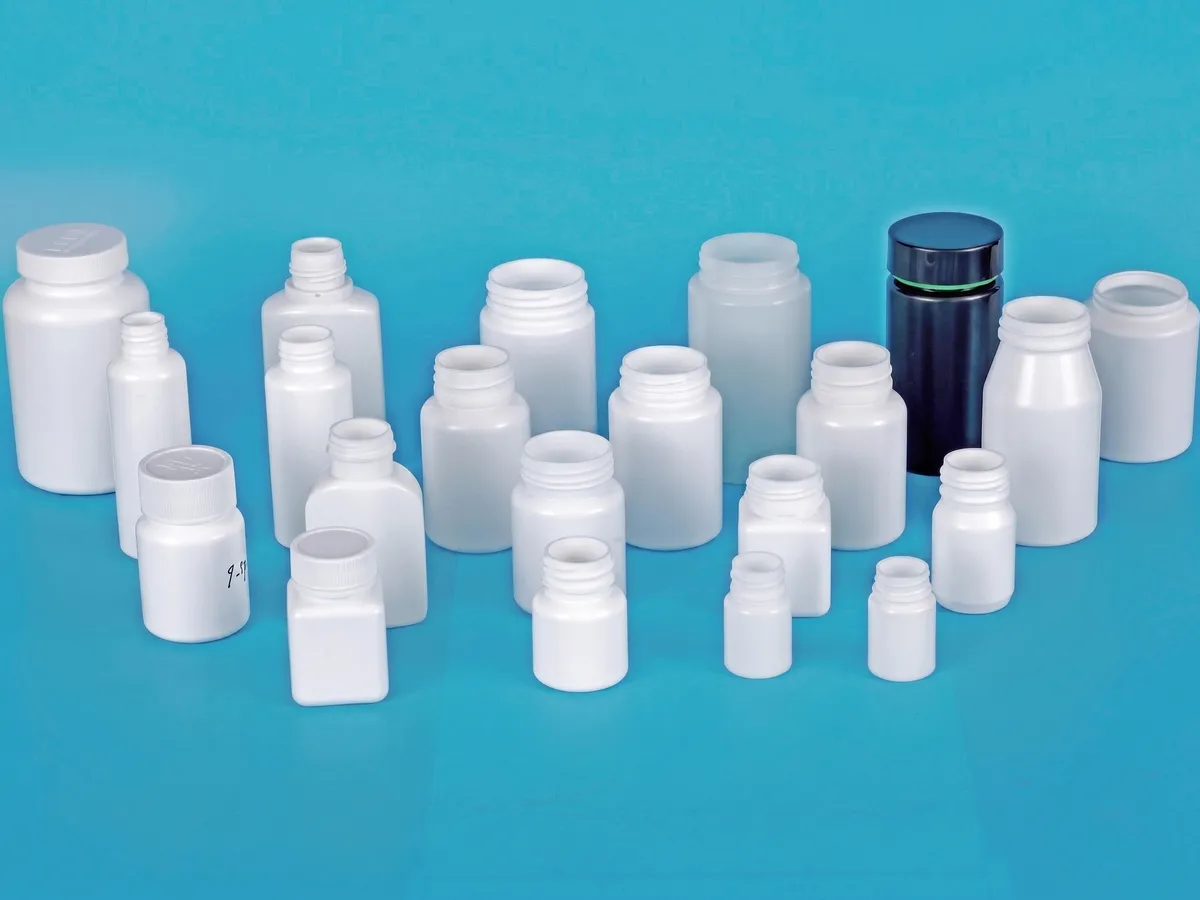
In pharmaceutical packaging, 100% seal integrity and dimensional precision of the bottle neck thread are regulatory requirements. The ZQ40 IBM injection blow molding machine produces pharmaceutical vials, syrup bottles, and tablet containers with exact thread pitch and closure compatibility, making it a trusted platform among pharmaceutical packaging line engineers and GMP-certified contract packagers.
5. Lotion Bottles
Lotion dispensers and pump-bottle containers require precise shoulder geometry and consistent inner volume for pump priming. The ZQ40 all electric injection blow molding machine variant ensures repeatability across high-cavitation runs, making it ideal for personal care contract manufacturers producing private-label lotion, serum, and body oil packaging at competitive injection blow molding machine prices.
6. Eyedropper Bottles
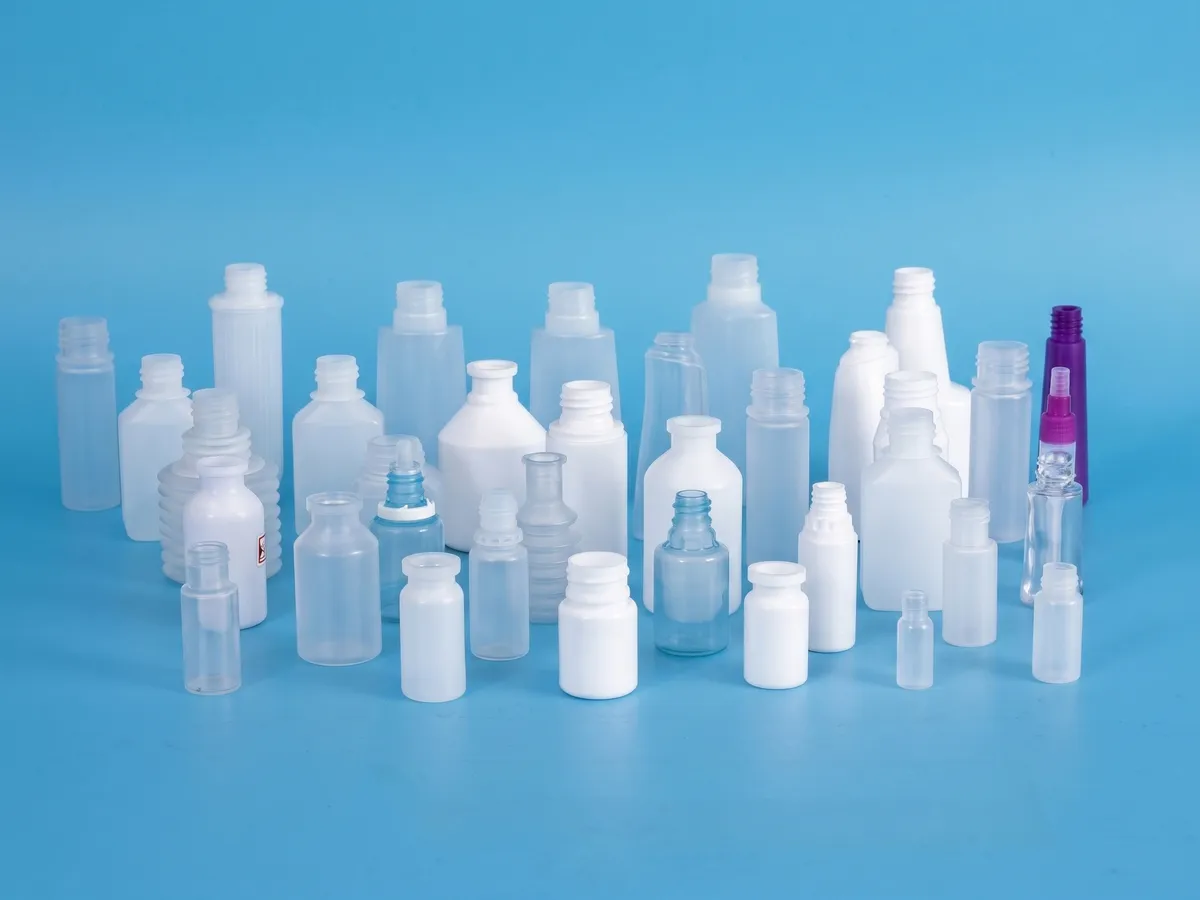
Eyedropper bottle production demands extremely tight tolerance control on the dropper neck inner diameter and tip geometry. The ZQ40 supports high-cavitation molds for small-volume eyedropper bottles from 1 ml to 30 ml, with process stability high enough to maintain fill-accuracy specifications required for ophthalmic and diagnostic drop products.
7. Soap Bottles
Liquid soap and hand sanitizer bottles in HDPE and PP are ideal candidates for the ZQ40 blow injection molding machine. The machine handles high melt-flow PP resins efficiently and produces soap bottles with smooth, label-friendly surfaces, properly formed pump-neck threads, and consistent wall distribution that prevents warping or paneling during hot-fill operations.
8. Food Bottles
From honey bottles to condiment containers and health supplement jars, the ZQ40 injection blow molding machines produce food-contact-compliant HDPE and PP bottles meeting FDA, EU, and equivalent regulatory standards. The one-step IBM process eliminates intermediate preform storage, reducing contamination risk and lowering total cost of ownership versus two-stage injection stretch blow molding machine alternatives.
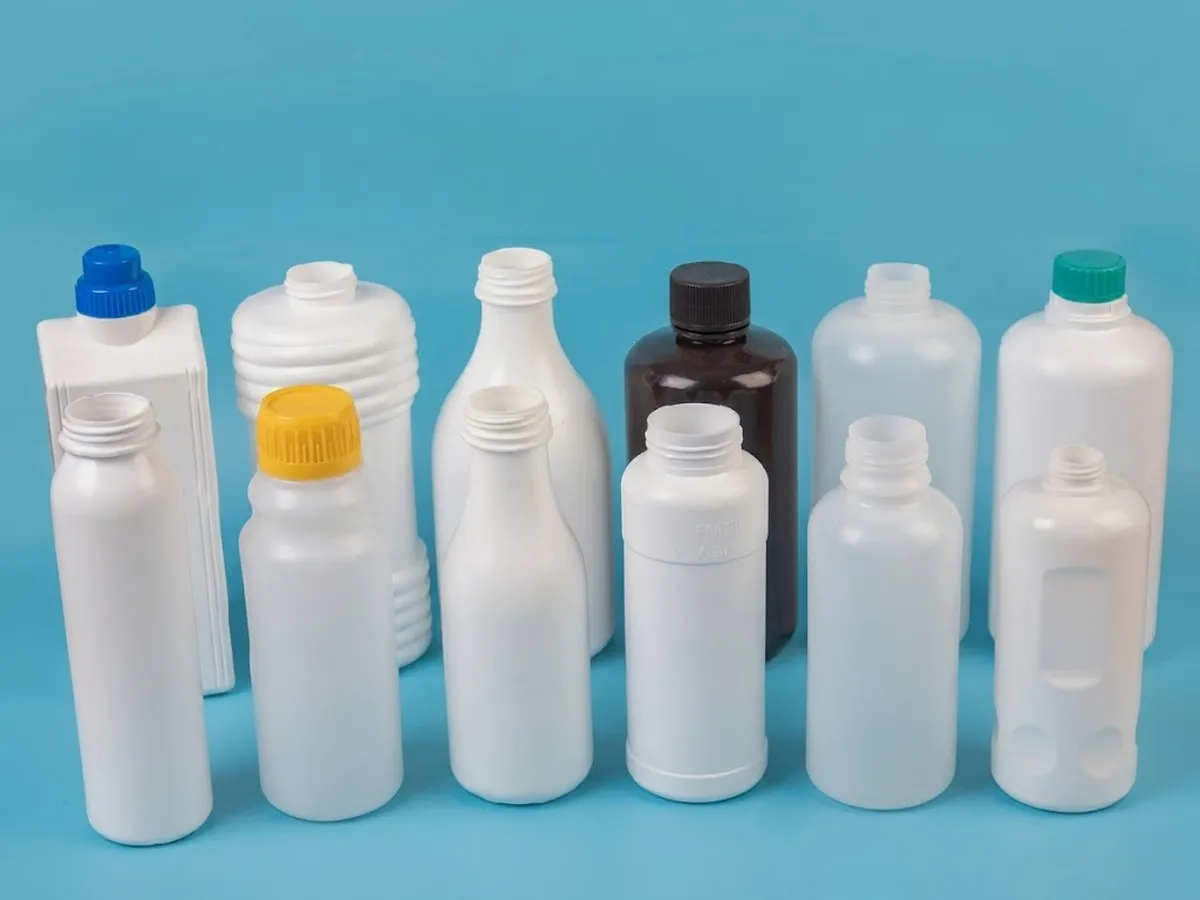 |
 |
| Food Bottles | Pharmaceutical Bottles |
 |
 |
| Cosmetic Bottles | Eyedropper Bottles |
ZQ40 Injection Blow Molding Machine Components
1. Stock Preparation / Injection Device
The injection unit houses the 40/45 mm diameter screw with 22:1 L/D ratio operating across 3+N independent barrel heating zones. It plasticizes polymer resin to a precise melt temperature, then injects a controlled shot weight of 190 g or 260 g into the injection mold at up to 14 MPa hydraulic pressure with a 120 mm stroke. This unit forms the foundation of every IBM injection blow molding machine cycle.
2. Hot Runner System
The optimized hot runner manifold maintains melt temperature uniformity from nozzle to gate, eliminating cold slugs and reducing start-up waste. Temperature is independently controlled per drop on multi-cavity tooling. This system minimizes gram weight deviation between cavities and is a key differentiator of this full electric injection blow molding machine platform compared to cold runner legacy equipment.
3. Core Rod (Mandrel)
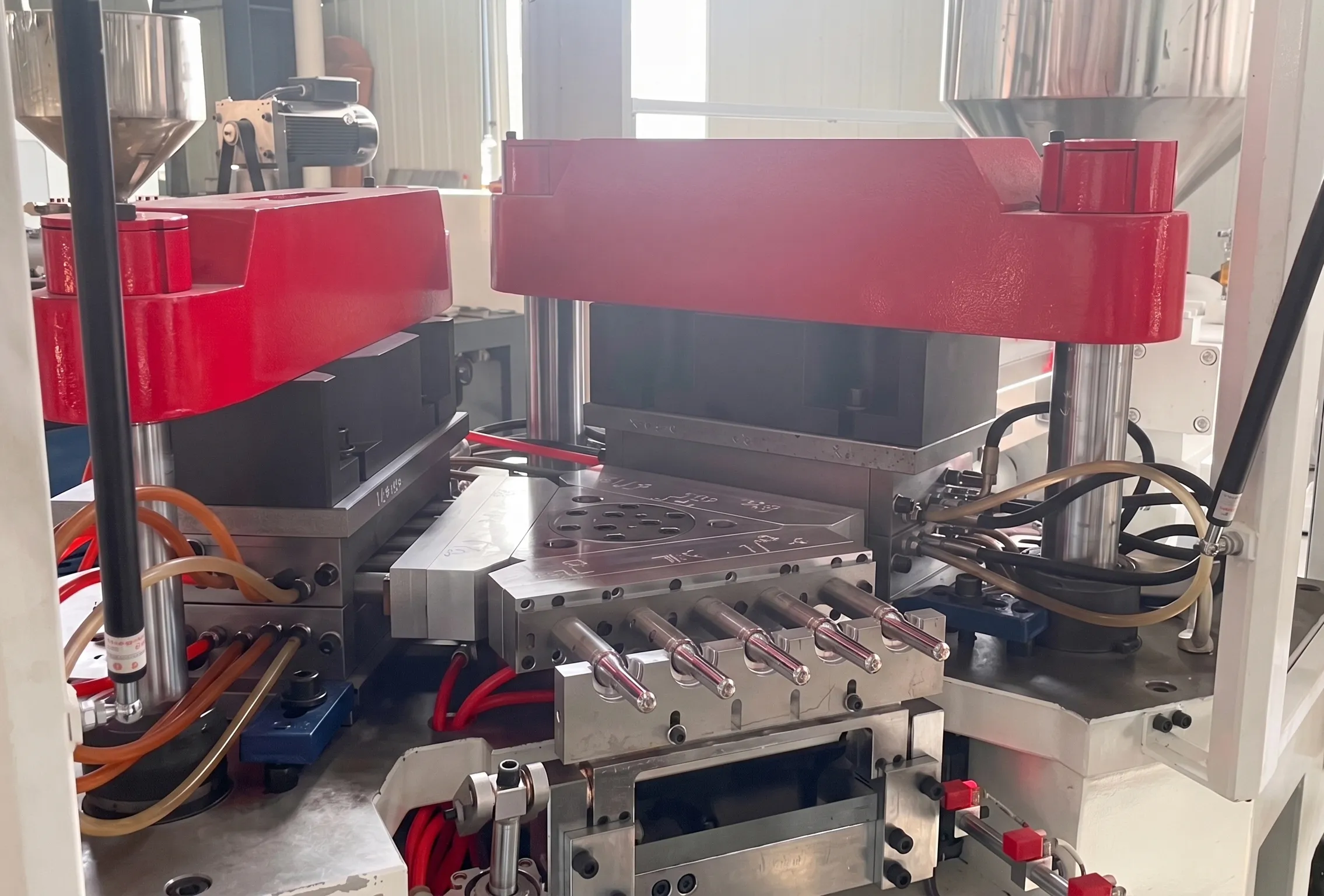
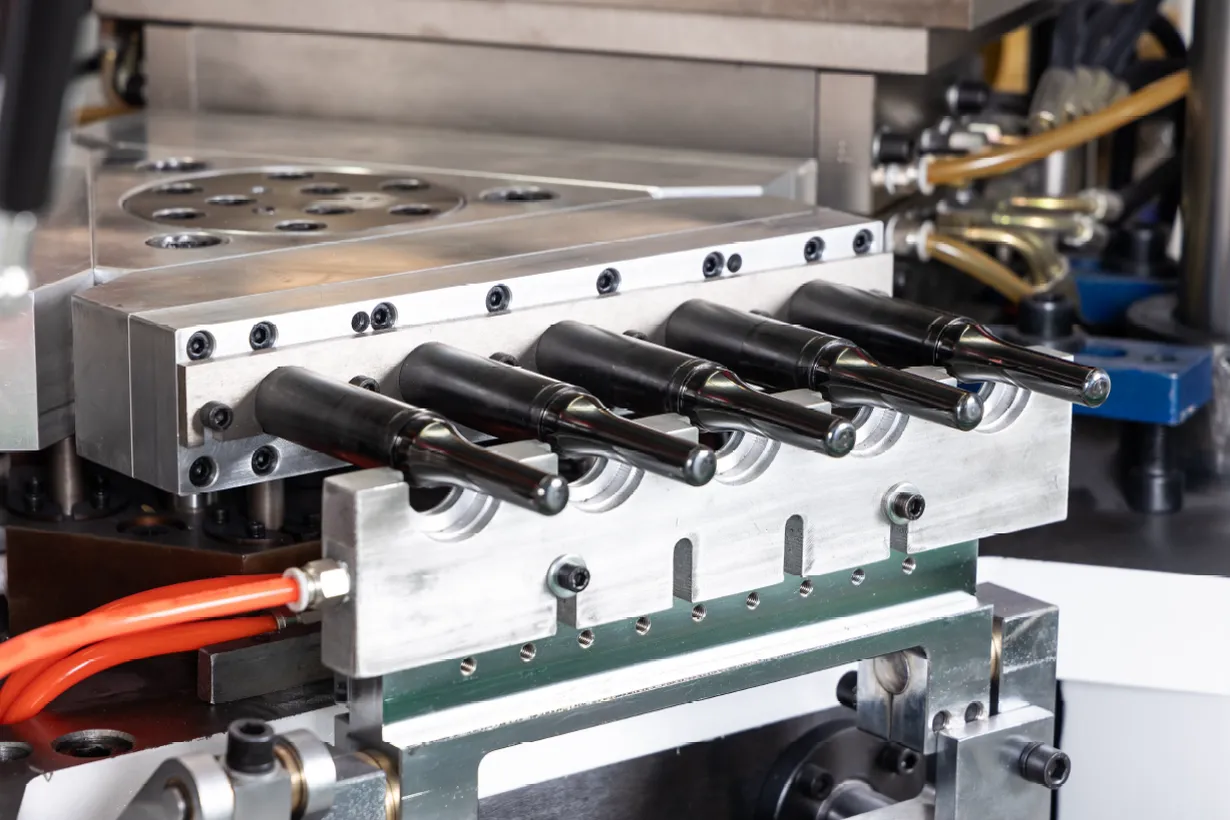
The core rod carries the preform from the injection station through blow and stripping. Its special internal cooling channel design ensures rapid, uniform thermal conditioning of the preform, which is the defining variable in a one step injection blow molding machine for achieving consistent wall thickness distribution. Core rods are CNC-machined to tight tolerances and surface-hardened for long service life.
4. Bottle Preform
In the ZQ40 single stage injection stretch blow molding machine process, the preform is not a separate purchased component but is formed in-machine at the injection station. The preform retains precise thermal energy from the injection phase, making it immediately blow-moldable without reheating. This eliminates reheating energy cost and the product quality risks associated with reheat non-uniformity in two-stage processes.
5. Injection Mold
The injection mold on this plastic injection blow molding machine is manufactured from imported S136 steel alloy or 4Cr13 stainless steel, delivering exceptional hardness, corrosion resistance, and polishability. The cavity and neck zone feature movable inserts for convenient size changeover. The special oil cooling channels maintain stable, precise mold temperature for repeatable preform geometry.
6. Injection Station
The injection station is the first process position on the ZQ40 ISBM machine's three-station turret. Here, 400 KN of injection clamping force seals the mold during the injection shot. The 165 mm injection opening stroke provides ample daylight for mold access during maintenance and changeover. Clamping force exceeds the Jomar IBM40 specification of 340 KN, providing greater mold protection and longer tool life.
7. Blow Station
At the blow station, the preform-loaded core rod is enclosed within the blow mold and compressed air at 0.7 to 1.2 MPa is introduced through the mandrel. The 60 KN blow clamping force holds the mold secure during inflation. The 140 mm blow opening stroke ensures full mold parting clearance for the blown bottle before indexing to the stripping station, maintaining uninterrupted high-speed cycle performance of this best injection blow molding machine.
8. Blow Mold
The blow mold on the ZQ40 scrap edge injection blow molding machine platform is engineered for rapid heat transfer through precisely drilled cooling channels that surround each cavity. Max platen size of 480 x 340 mm accommodates multi-cavity tooling for bottles up to 120 mm in diameter and 220 mm in height. S136 steel mold inserts provide the mirror-polish cavity finish required for crystal-clear transparent containers.
9. Stripping Station
The stripping station automatically ejects finished bottles from the cooled core rods via the 220 mm stripping stroke. Because stripping is fully automated, no operator intervention is needed between cycles. The ejected bottles fall onto a collection conveyor or into a chute ready for downstream packing or inspection. This zero-touch automation capability is a core reason production managers favour this injection blow molding machine manufacturer over manual or semi-automatic alternatives.
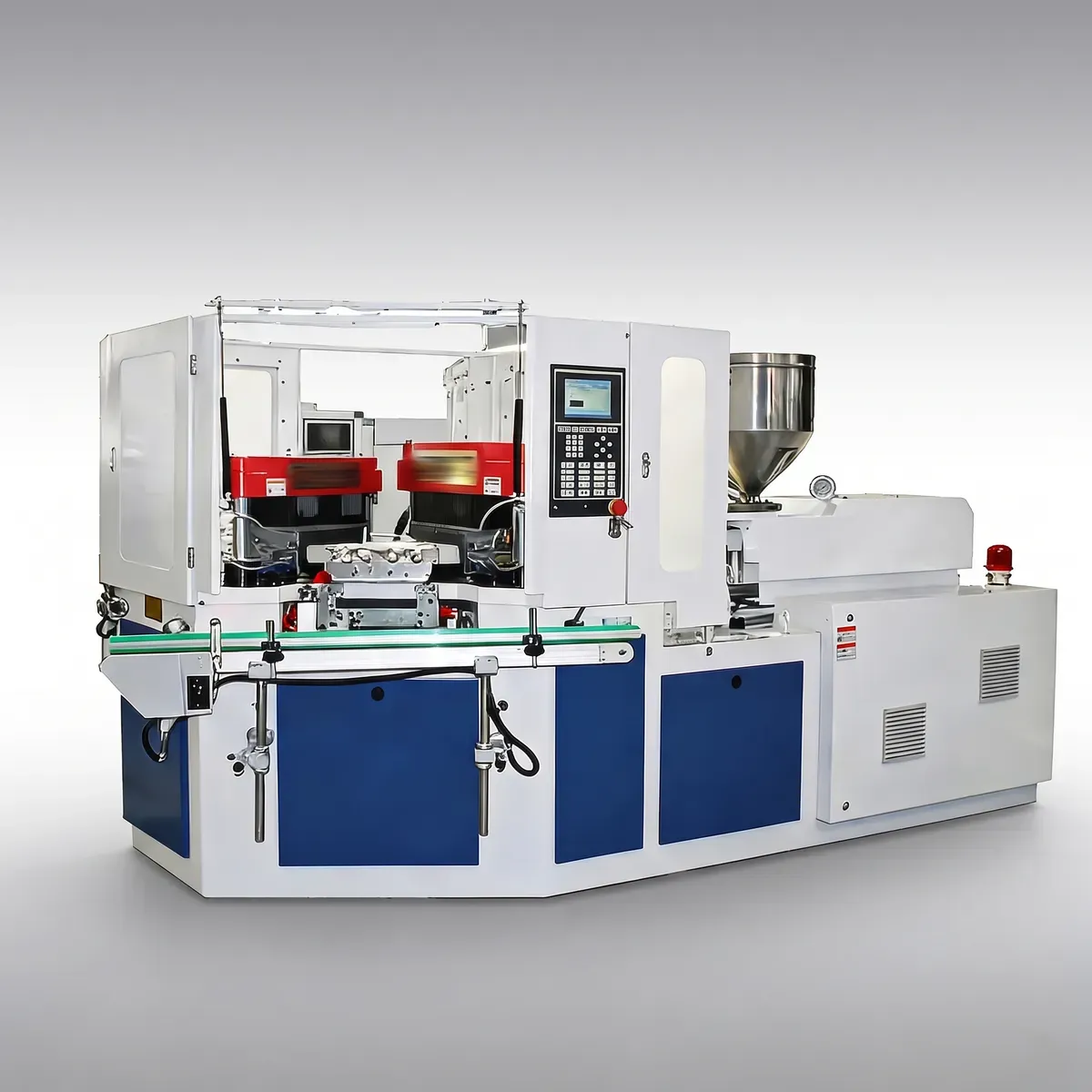
ZQ40 vs. Jomar IBM40: Why Choose Ever-Power?
When evaluating injection blow molding machine price against total cost of ownership, the ZQ40 consistently delivers stronger performance metrics and lower operating cost than the Jomar IBM40 it replaces.
1. Higher Injection Clamping Force
The ZQ40 delivers 400 KN injection clamping force versus the Jomar IBM40's 340 KN. This 17.6% improvement in clamping force means less flash, lower mold wear rates, and better containment of high-injection-pressure materials such as filled PP or reinforced engineering polymers, without any corresponding increase in machine footprint or power consumption.
2. 20% to 30% Lower Energy Consumption
The pressurized clamping architecture excludes the booster cylinder from the mold open and close cycle entirely. Combined with servo-driven motion control, the ZQ40 achieves a 20% to 30% reduction in per-cycle energy consumption compared to standard Jomar IBM40 hydraulic machines. For continuous three-shift production, the resulting electricity savings represent a measurable annual cost advantage.
3. Superior Screw Injection Weight
At 190 g to 260 g injection weight versus the Jomar IBM40's 180 g single weight, the ZQ40 gives process engineers additional headroom when tooling large-volume containers or increasing cavitation on lighter-weight bottles. This expanded processing window is an important consideration for injection blow molding machine manufacturers evaluating platform flexibility for future product lines.
4. Larger Mold Platen Footprint
The ZQ40 platen measures 480 x 340 mm compared to the Jomar IBM40's 394 x 508 mm format. While Jomar's platen is taller, the ZQ40's wider horizontal format is better suited to the multi-cavity bottle mold configurations common in pharmaceutical and personal care production lines, allowing more cavities per row without complex mold stacking arrangements.
5. Compact Machine Footprint
At 3.5 m x 1.3 m x 1.7 m, the ZQ40 occupies significantly less floor space than the Jomar IBM40 at 2.72 m x 1.9 m x 2.75 m, particularly in height. This compact profile makes it feasible to install in facilities with low ceiling clearance or to deploy multiple ZQ40 injection blow molding machines in parallel on a standard factory grid, improving overall throughput per square metre of production floor.
6. Full Turnkey Service with Local Support
Unlike purchasing a used PET injection blow molding machine or sourcing through intermediary injection blow molding machine suppliers, buying direct from Ever-Power provides access to the full original equipment manufacturer support chain: in-house mold design, machine commissioning, operator training, spare parts supply, and remote diagnostics. This turnkey model dramatically reduces post-purchase integration risk for first-time IBM machine buyers.
Compatible Raw Materials
The ZQ40 injection blow molding machines process a wide spectrum of thermoplastic resins. Compatibility with diverse materials gives manufacturers the flexibility to address multiple end markets with a single platform.
HDPE (High-Density Polyethylene)
HDPE is the most widely processed resin on IBM machines for chemical, pharmaceutical, and household product bottles. The ZQ40 processes HDPE at standard melt temperatures of 180 to 230 degrees Celsius. Its excellent chemical resistance and HDPE's semi-rigid properties make it ideal for closure-compatible pharmaceutical and industrial containers produced on this injection blowing molding machine platform.
PP (Polypropylene)
PP offers an excellent balance of rigidity, chemical resistance, and clarity in thin-wall applications. The ZQ40 injection stretch blow molding machine configuration processes both homopolymer and random copolymer PP grades for cosmetic, food, and personal care applications. PP's broad processing window and compatibility with hot-fill products make it a highly demanded resin in global packaging markets served by this machine.
LDPE (Low-Density Polyethylene)
LDPE produces soft, squeezable bottles with excellent flexibility, typically used for eyedropper bottles, nasal spray containers, and travel-size personal care packaging. The ZQ40's precise melt control and independent barrel zone heating allow LDPE processing with excellent dimensional stability and low residual stress in the finished bottle, preventing warping or shrinkage during cooling.
PS (Polystyrene) and High-Transparency PS
Standard and crystal-clear PS grades are widely used on this IBM machine for dairy and lactic acid bacteria product containers, including yogurt drink bottles and probiotic supplement containers. PS produces glass-like clarity and excellent stiffness in thin walls, making it a preferred material for premium single-serve nutrition and beverage product packaging produced at competitive injection blow molding machine price points.
PCTG (Polycyclohexylene Terephthalate Glycol)
PCTG is a premium copolyester delivering extraordinary optical clarity, impact resistance, and BPA-free status for cosmetic and high-value healthcare packaging. The ZQ40 processes PCTG effectively within its 3+N zone barrel, producing bottles with glass-like transparency that enhances product visual appeal on retail shelves. PCTG is one of the fastest-growing resins in cosmetic and nutraceutical packaging globally.
ABS and EVA
ABS resin is used for opaque, high-impact cosmetic and personal care containers where durability and excellent surface quality for printing and decoration are required. EVA provides exceptional flexibility and softness for squeezable product formats. Both materials are processable on the ZQ40 ISBM machine with appropriate screw geometry selection and barrel temperature profiling across the independently controlled heating zones.
 |
 |
Characteristics of ZQ Series Automatic Mould
1. Activity-Designed Cavity and Neck with Special Oil Channels
The injection mold cavity and neck insert use a movable design that allows rapid dimensional changeover without replacing the full mold body. Specially designed oil cooling channels run directly through the cavity walls, ensuring stable, consistent mold temperature across every shot. This thermal stability is fundamental to maintaining precise preform tube billet dimensions on this best injection blow molding machine for multi-SKU production environments.
2. Premium S136 and 4Cr13 Stainless Steel Construction
All ZQ series injection mold inserts are manufactured from imported S136 tool steel alloy or 4Cr13 stainless steel. These high-strength, high-hardness materials deliver mirror-quality cavity surface finishes achievable in excess of Ra 0.02 microns. The superior wear resistance of these alloys significantly extends mold service life, reducing long-term tooling cost per unit for high-volume plastic injection blow molding machine operations.
3. Optimized Hot Runner with Minimal Wall Thickness Deviation
The ZQ series hot runner system is designed in concert with the preform cavity geometry to produce embryo blanks with gram weight deviation minimized across all cavities simultaneously. The mandrel's special internal cooling channel geometry maintains consistent core rod temperature, enabling fast cycle times without sacrificing core cooling effectiveness. This balanced thermal design is what makes the ZQ40 one of the most reliable injection blow molding machines for high-cavitation pharmaceutical tooling.
4. Precise Mouth and Thread Geometry with 100% Seal
The neck finish and thread form are molded at the injection station where full clamping force is applied, giving the bottle neck dimensional accuracy that cannot be achieved in subsequent downstream operations. Thread pitch, major diameter, and minor diameter are all held to specification with 100% closure seal integrity verified in the mold design phase. This is especially critical for child-resistant closures and tamper-evident caps used in pharmaceutical injection blow moulding machine applications.
5. Zero Burr and Zero Waste on Bottle Mouth and Base
A defining characteristic of the IBM process on the ZQ40 injection blow molding machine is the complete absence of gate witness marks, parting line flash, or pinch-off waste on the bottle base. Unlike extrusion blow molding where a parison pinch-off leaves a weld line at the base, the IBM process produces a clean, fully enclosed base geometry in the blow mold. There is no trim operation required, eliminating downstream labour and scrap reprocessing cost.
6. Consistent Product Size, Weight, and Wall Thickness Across All Cavities
The ZQ series mold design ensures that product size, weight, mold parting line position, and wall thickness distribution are consistent across every cavity within a multi-cavity tool and from one production run to the next. This consistency is validated at each commissioning and is maintained through ongoing process monitoring via the PLC control interface. For injection blow molding machine suppliers serving global brand owners, this dimensional consistency is the foundation of specification compliance and product quality claims.
Maintenance Tips
1. Injection Unit Maintenance
The barrel, screw, nozzle, and check ring require periodic inspection to monitor wear-related performance degradation. Screw and barrel service life ranges from 3,000 to 10,000 operating hours depending on the abrasiveness of the resin processed. Abrasive filled materials shorten this interval to 3,000 to 5,000 hours. Inspect screw flight clearance and check ring seal integrity during planned shutdowns. Regular barrel purging at shutdown using appropriate purge compounds minimizes degraded material in the next startup and reduces colour changeover waste on this injection blow molding machine.
2. Clamping System Maintenance
The clamping system toggle mechanisms, guide columns, and bushings require regular lubrication and wear inspection. Lubricate toggle pins and bushings according to the machine manual schedule, typically every 200 to 500 operating hours. Verify injection clamping force monthly using the machine's internal force monitoring function. Inspect guide column surfaces for scoring or wear marks quarterly. Platen parallelism should be verified annually and after any mold change involving significantly different mold weights or footprints.
3. Temperature Control System Maintenance
Heater band resistance on each barrel zone should be checked monthly for continuity and resistance value against the nominal specification. Thermocouple accuracy should be verified quarterly using a calibrated reference device. Heater band failure causes temperature inconsistency that directly affects melt quality in this injection blowing molding machine. Plan for heater band replacement costs of USD 500 to USD 2,000 per zone depending on zone size and replace proactively rather than reactively to avoid unplanned production interruption.
4. Hydraulic System Maintenance
Hydraulic oil should be sampled quarterly for viscosity, water content, and particle count analysis. Replace hydraulic oil every 2,000 to 4,000 operating hours depending on operating conditions and oil analysis results. Hydraulic filter elements should be replaced every 500 to 1,000 hours at a cost of USD 50 to USD 200 per filter. Maintaining clean hydraulic oil is the single most effective way to extend pump and valve service life on any hydraulic injection blow molding machine platform.
5. Grease Lubrication Program
Grease lubrication of toggle mechanisms, guide pins, bushings, and slides reduces friction-induced wear on all high-cycle moving components. High-load components such as toggle pins require lubrication weekly to monthly depending on production intensity. Lighter-load components such as guide rail slides may be maintained on a 3 to 6 month interval. Use only manufacturer-specified grease grades to match load, temperature, and environmental conditions. Over-lubrication attracts contaminants and should be avoided by applying only the specified quantity per point per interval.
6. Cooling Water System Maintenance
The cooling water system supplying mold cooling and barrel cooling must be maintained at 0.3 to 0.4 MPa with a minimum flow rate of 3.5 M3/h. Coolant quality directly affects mold cooling efficiency, cycle time, and product quality on this one step injection blow molding machine. Inspect coolant condition monthly for pH drift, hardness, and biological contamination. Clean cooling channel interiors annually to remove scale and mineral deposits. Replace coolant additive packages according to supplier recommendations to prevent corrosion of mold steel and cooling circuit components.
Why Choose Ever-Power's Injection Blow Molding Machines?
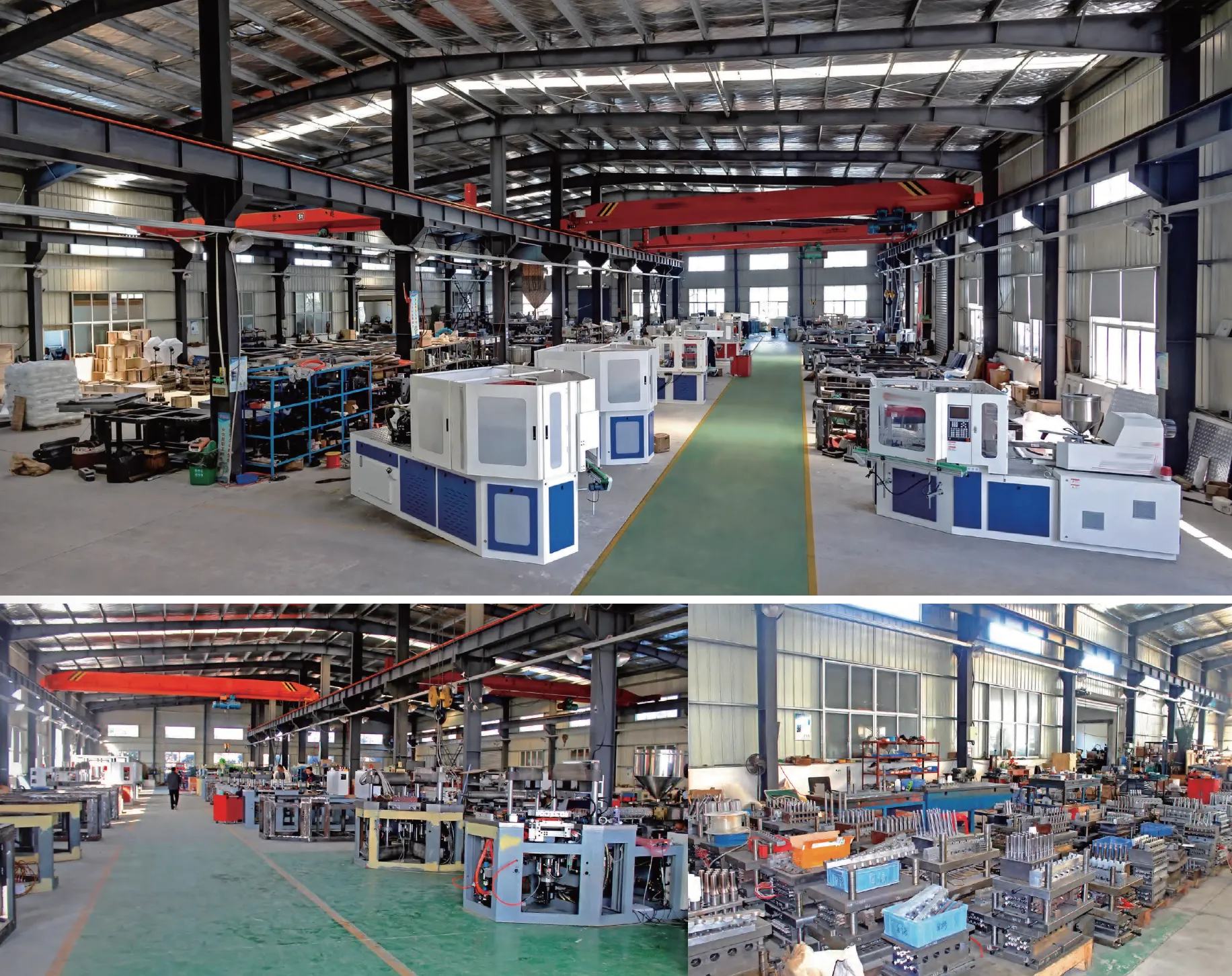
Mexico Ever-Power ISBM Machinery Co., Ltd. specializes exclusively in automatic one-step injection blow molding machines and supporting injection blow mold design and manufacture. Our product portfolio spans IBM machines, extrusion blow molding machines, injection stretch blow molding machines, and all associated auxiliary equipment. The company's advantageous location and excellent logistics infrastructure enable reliable global delivery to over nine major export markets.
Ever-Power brings together senior engineers and technical personnel with deep specialization in injection blow molding machine design, IBM mold engineering, and plastic process optimization. The team's combined theoretical knowledge and hands-on manufacturing experience enables us to deliver detailed and thorough pre-sale consultation, in-process engineering support, and reliable after-sales service to injection blow molding machine suppliers, contract packagers, and direct end users worldwide.
Ever-Power injection blow molding machines process HDPE, LDPE, PP, PS, high-transparency PS, ABS, EVA, PCTG, and environmental corn materials. Production volumes range from 1 ml to 1,000 ml across pharmaceutical packaging, food packaging, healthcare packaging, and cosmetic packaging applications. This breadth of material and application coverage makes Ever-Power the preferred injection blow molding machine manufacturer for producers serving diverse end markets from a single platform.
Ever-Power adheres to the enterprise development tenet of self-reliance, integrity, pragmatism, innovation, and responsibility. We build one-stop turnkey injection blow molding machine projects that deliver high-end IBM production output to customers demanding world-class quality at globally competitive injection blow molding machine prices. From the first enquiry through to years of post-installation support, every interaction with Ever-Power is backed by a team that is genuinely invested in your production success.
Frequently Asked Questions
Q: What makes the ZQ40 a true injection blow molding machine replacement for the Jomar IBM40?
A: The ZQ40 is designed to match and exceed the Jomar IBM40's process parameters while improving on clamping force (400 KN vs 340 KN), injection weight range (190 to 260 g vs 180 g), and energy consumption (20 to 30% lower). The three-station IBM process architecture is identical, meaning the transition from IBM40 tooling and process parameters to the ZQ40 is straightforward. Ever-Power's engineering team provides a full compatibility assessment of existing Jomar IBM40 molds before delivery to verify fit and process transferability.
Q: What is the injection blow molding machine price for the ZQ40 and what is included?
A: Injection blow molding machine price varies depending on screw diameter configuration, optional servo or hydraulic drive selection, and whether mold tooling is included in the package. The ZQ40 base machine price is available on request via the contact form. Ever-Power offers turnkey packages that include machine supply, custom IBM mold design and manufacture, on-site installation, operator training, and first-year spare parts kit. Contact us directly for a customized quotation based on your bottle specifications and production requirements.
Q: Can the ZQ40 process PET resin for PET injection blow molding machine applications?
A: The ZQ40 IBM machine processes a wide range of thermoplastics including HDPE, LDPE, PP, PS, ABS, PCTG, and EVA. For PET injection blow molding machine applications requiring biaxial orientation, the ZQ series injection stretch blow molding machine configuration with stretch rod is recommended. Please consult Ever-Power's application engineers to confirm the optimal machine model and screw configuration for your specific resin and bottle design requirements.
Q: What bottle sizes can the ZQ40 one step injection blow molding machine produce?
A: The ZQ40 produces bottles ranging from 1 ml to 1,000 ml in volume, with a maximum bottle diameter of 120 mm and maximum bottle height of 220 mm. The stripping stroke of 220 mm accommodates tall narrow-neck formats as well as wide-mouth containers. Cavitation scales from 9 cavities at 10 ml down to 1 cavity at 1,000 ml. The wide production range makes the ZQ40 one of the most flexible injection blow molding machines for small to mid-volume producers serving multiple packaging segments.
Q: How does the ZQ40 compare to a single stage injection stretch blow molding machine?
A: The ZQ40 is a true single stage injection blow molding machine where injection, blowing, and stripping occur in a single continuous cycle without reheating. A single stage injection stretch blow molding machine adds an axial stretch rod to achieve biaxial molecular orientation in PET. Both processes eliminate the preform storage and reheating step of two-stage systems. The ZQ40 IBM process is better suited to HDPE, PP, and PS applications where biaxial orientation is not required, while ISBM is preferred for PET barrier applications like carbonated beverage bottles.
Q: Does Ever-Power offer customized injection blow molding machine configurations for sale?
A: Yes. As a full-service injection blow molding machine manufacturer, Ever-Power offers customized ZQ40 configurations including non-standard screw diameters, extended barrel lengths for long-residence materials, special surface treatments for corrosive resins, and custom electrical panel layouts for specific voltage standards. Customized injection blow molding machine packages can also include co-developed mold designs to suit unique bottle geometries not covered by standard tooling. Contact our engineering team with your bottle drawing and production requirements to initiate a customized machine for sale quotation.
Q: What is the dry cycle time of the ZQ40 IBM injection blow molding machine?
A: The ZQ40 achieves a dry cycle time of 3.5 seconds, which is the machine's theoretical minimum cycle measured without material or cooling time. Actual production cycle times will be longer depending on material processing temperatures, cooling requirements, and bottle wall thickness. For most HDPE and PP applications in the 60 ml to 250 ml range, total production cycle times of 8 to 15 seconds are typical, translating to competitive output rates for multi-cavity pharmaceutical and cosmetic bottle production.
Q: Is the ZQ40 suitable as an LED bulb cover injection blow molding machine?
A: Yes, the ZQ40 is widely used as an LED bulb cover injection blow molding machine for producing high-transparency PS or PCTG diffuser covers. The machine's precise wall thickness control and superior cavity surface finish produce LED covers with consistent light diffusion characteristics and excellent dimensional accuracy for snap-fit assembly. The high-transparency PS processing capability and 9-cavity maximum at 10 ml volume make it well suited to high-volume LED bulb cover production runs. Contact our team for mold design specifications specific to LED cover applications.
Q: What after-sales support does Ever-Power provide for injection blow molding machine suppliers and end users?
A: Ever-Power provides comprehensive after-sales support including on-site installation and commissioning by factory-trained engineers, operator training programs covering machine operation, process optimization, and routine maintenance procedures, a structured spare parts program with recommended stocking lists, remote technical support via video call and PLC remote access, and a local agent network across our key export markets. Spare parts availability for all ZQ series injection blow molding machines is guaranteed for a minimum of ten years from the production date of each machine delivered.
Q: What is the minimum compressed air pressure required for the ZQ40 injection blow molding machine?
A: The ZQ40 requires a minimum compressed air supply pressure of 0.7 MPa, with an optimal operating range up to 1.2 MPa and a consumption rate of 0.7 M3/min. It is important that the compressed air supply is clean, dry, and oil-free to protect the blow air passages in the mandrel and to prevent contamination of the bottle interior, particularly for pharmaceutical and food-grade applications. A refrigerated air dryer and pre-filter unit is recommended upstream of the injection blow molding machine in all production environments where moisture or particulate contamination risk exists.
Customer Reviews
Priya Mehra, Pharmaceutical Packaging, India
"We have been running the ZQ40 on our 50 ml pharmaceutical syrup bottle line for just over a year now. It replaced an aging Jomar IBM40 we had been operating since 2016 and the difference is immediately obvious. The clamping force alone gives us far less flash to deal with between shifts. We run HDPE at 9 cavities and the gram weight deviation across all cavities is within 0.3 g consistently. I was skeptical about a Chinese injection blow molding machine at first but the Ever-Power team installed it cleanly, trained my operators in three days, and the machine has not had a single unplanned downtime event. Very impressed."
Kim Tae-won, Cosmetic Packaging, Korea
"We bought two ZQ40 machines for our cosmetic bottle production line in Seoul six months ago. We make PP lotion bottles at 250 ml with 3 cavities and the output quality has been excellent. Our previous machine required daily adjustment of the indexing mechanism but the servo rotation on the ZQ40 just holds position run after run. We evaluated machines from three different injection blow molding machine manufacturers before choosing Ever-Power and the price for injection blow molding machine capability at this level was simply unbeatable from China. Shipping and installation went smoothly."
David, Beverage Packaging, USA
"Honestly, I was worried about the after-sales support before ordering but Ever-Power have been really responsive. We had a thermocouple fault on barrel zone 2 about three months after commissioning and the technical team diagnosed it remotely and had us back running within four hours using a spare part from our on-site kit they told us to keep. Our ZQ40 runs 100 ml PS lactic acid bacteria bottles and the clarity of the output is as good as anything I have seen on European injection blow molding machines at three times the price. Solid machine."
Ahmet Yilmaz, Pharmaceutical Packaging, Turkey
"We produce 30 ml eyedropper bottles in LDPE for a pharmaceutical client here in Istanbul. The ZQ40 we purchased runs at 8 cavities without any issue at all. What I really like is the energy consumption - our electricity bill for this machine is noticeably lower than the old equipment it replaced, which matches what Ever-Power told us about the 20 to 30 percent savings. The mold quality they supplied with the machine is also very good - S136 steel, very clean thread form, zero flash on the neck. The machine arrived on schedule, which was important because we had a contract deadline to meet."
Nomvula Dlamini, Soap Packaging, South Africa
"We have been a Formosa client for several years and recently added a ZQ40 to our lineup for smaller bottle formats alongside our existing ZQ60. The ZQ40 handles our 60 ml and 100 ml soap bottle range perfectly in HDPE. The pressurized clamping system is noticeably different from anything we have had before - mold wear on the neck inserts is much slower than our previous machine. Customer support from Ever-Power is very professional and they always reply within 24 hours. We already plan to buy another one next year."
Carlos Ferreira, Cosmetic Packaging, Brazil
"We run PCTG cosmetic serum bottles at 4 cavities on our ZQ40 here in Sao Paulo. The surface finish of these bottles is outstanding - our brand client was specifically asking for glass-like clarity and we are achieving it consistently. The machine commissioning took about a week from arrival which was reasonable. My only small comment is that the manual could be more detailed on the hydraulic calibration procedure but the Ever-Power technician on-site walked us through it completely. Overall this is a very capable and competitively priced injection blow molding machine and I would recommend it without hesitation."
Dmitri Volkov, Food Packaging, Russia
"My concern before ordering was whether an Ever-Power IBM machine could truly replace our Jomar IBM40 without retooling our existing molds. The Ever-Power engineering team reviewed our existing tooling dimensions thoroughly and confirmed compatibility before we committed. The transition was very smooth - we were running production within two days of installation. We make food-grade HDPE supplement bottles at 100 ml with 4 cavities and output quality is at least as good as what we had before, with a shorter dry cycle time of 3.5 seconds. Very happy with the purchase."
Rodrigo Espinosa, Beverage Packaging, Mexico
"We manufacture beverage bottles here in Mexico City for a national sports drink brand and the ZQ40 has been running non-stop for eight months since installation. We produce 250 ml PP bottles at 3 cavities and the throughput is excellent. The servo rotation system is quiet and smooth compared to the pneumatic indexing on our old machine. What surprised me most was the low operating power consumption - we are in the 52 to 65 percent range consistently, which our energy consultant confirmed is significantly below typical injection blow molding machine benchmarks for this output level. A very good product."
Oleksandr Bondarenko, Personal Care Packaging, Turkey
"Excellent experience from start to finish. We enquired about the ZQ40 injection blow molding machine as a replacement for our Jomar IBM40 in December and placed the order in January after a detailed video call with the Ever-Power technical team who answered all our questions about material compatibility for ABS and PP. The machine arrived in Istanbul on time in March and the installation team was very professional. Running output from day three. We make cosmetic bottle caps and small personal care containers and the product quality has been consistently good. The after-sales support response time is fast and the spare parts pricing is very reasonable."
Additional information
| Edited by | Yjx |
|---|