
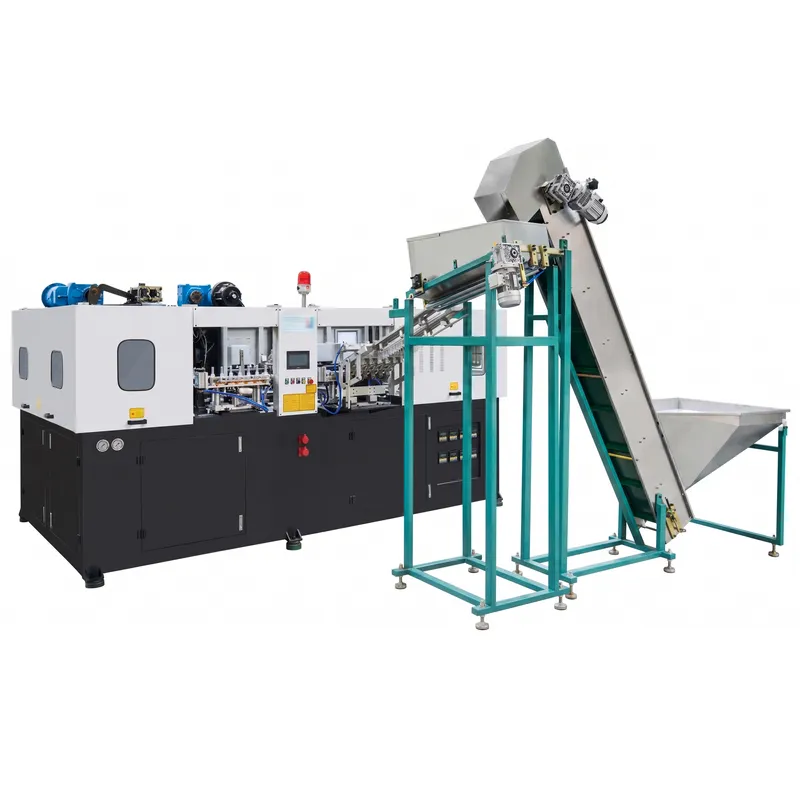
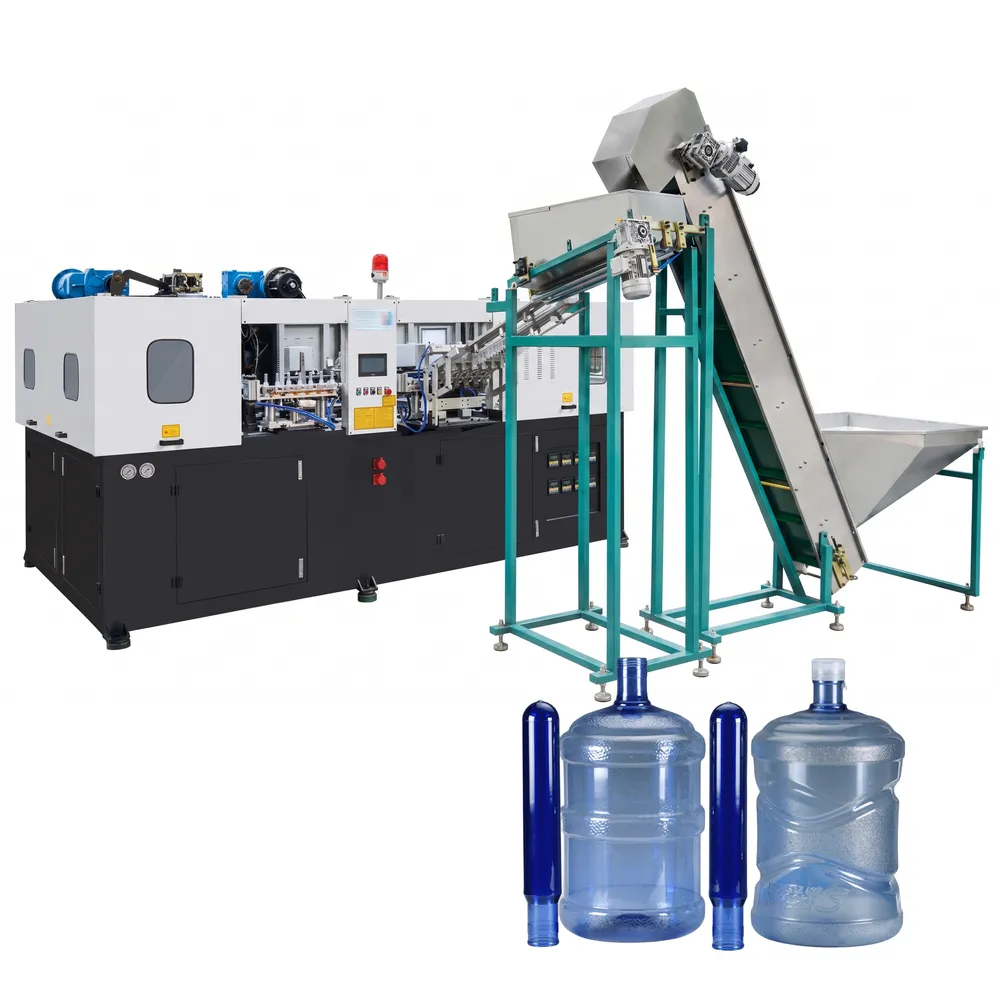
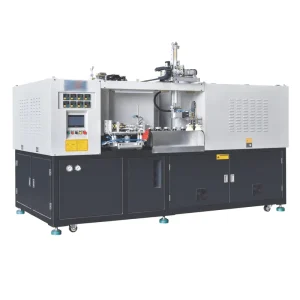
EPA.AS-2C114.3 Fully Automatic Blow Molding Machine for Water and Beverage Bottles
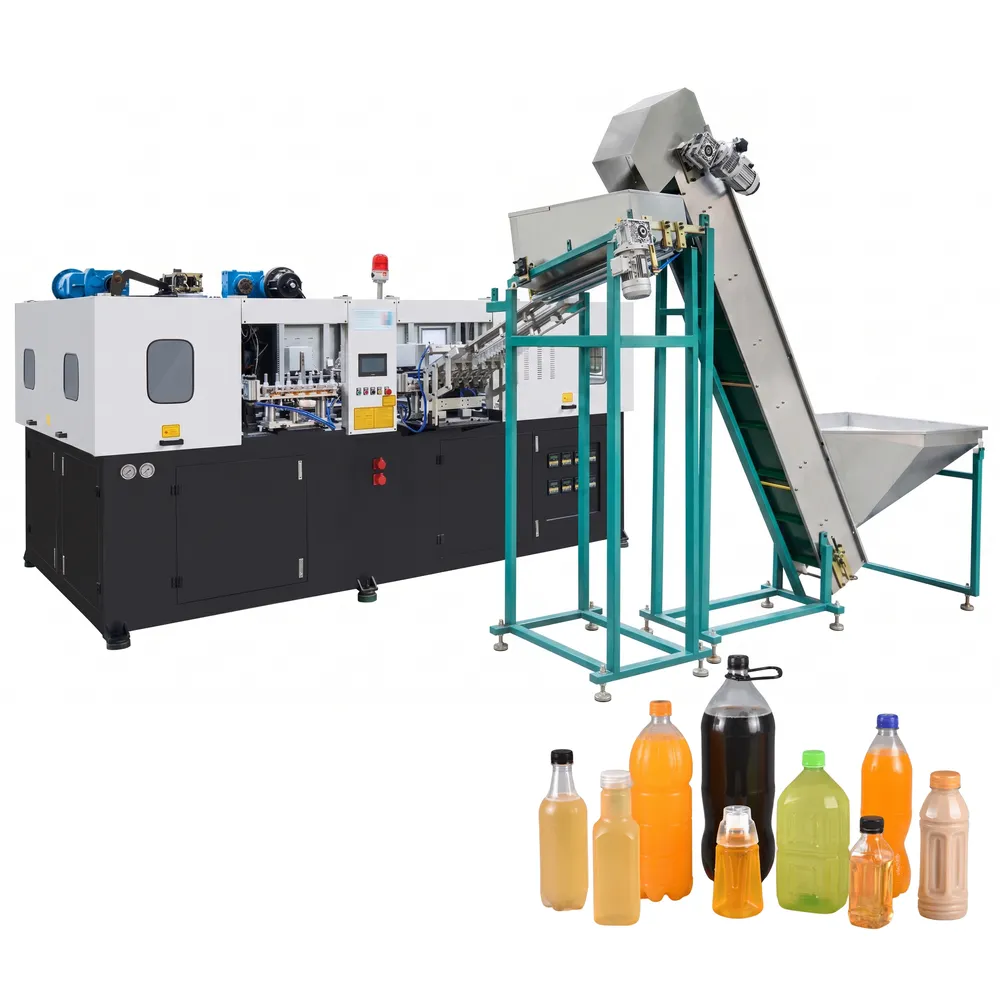
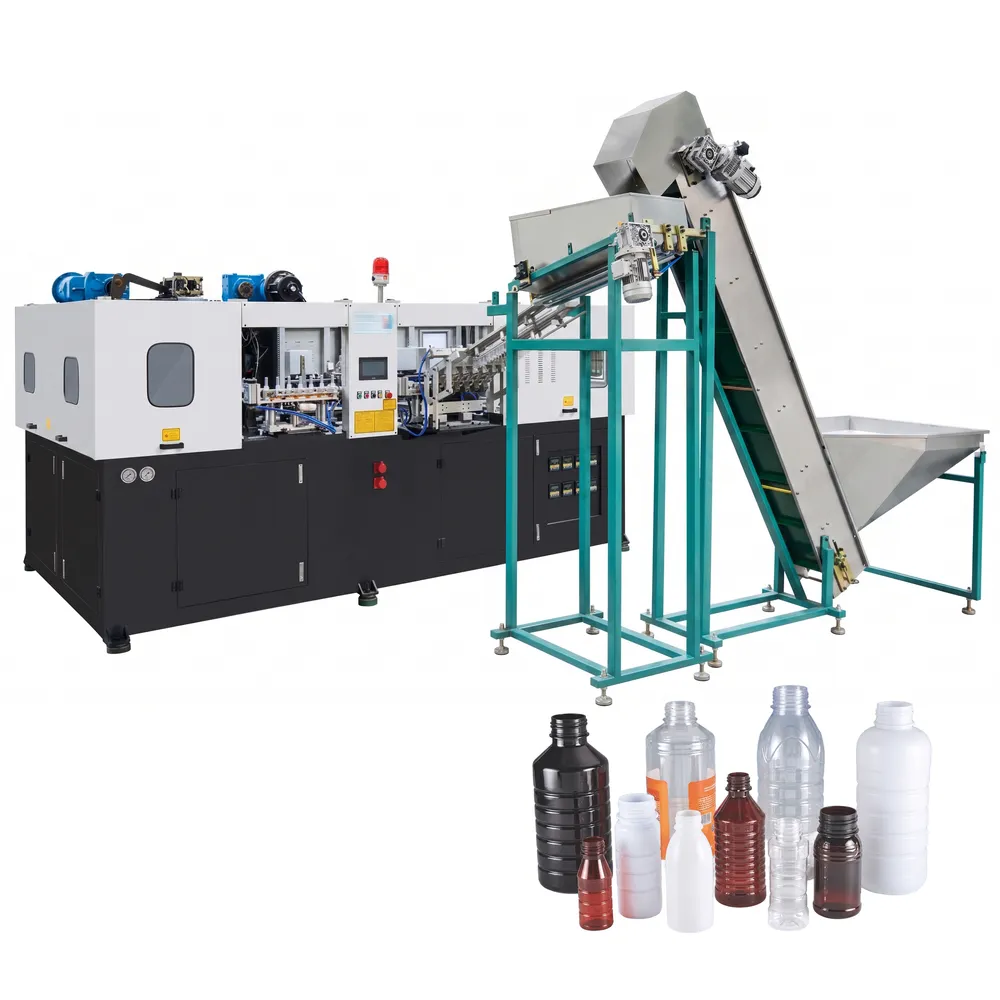
The EPA.AS-2C114.3 Fully Automatic Blow Molding Machine is an advanced two-stage PET blow molding machine engineered for high-throughput production of water and beverage bottles. Featuring a dual-cavity, multi-pitch mold configuration, this automatic blow molding machine delivers a theoretical output of 2,000 bottles per hour for the AS-2C114.3 model, with the broader EPA series reaching up to 9,200 bottles per hour on the 8-cavity variant. The machine accommodates containers from 500 ml to 22,000 ml, with a maximum body diameter of 300 mm, making it one of the most versatile plastic blow molding machines available for mid-to-large-scale beverage and industrial packaging lines.
The EPA.AS-2C114.3 Fully Automatic Blow Molding Machine is an advanced two-stage PET blow molding machine engineered for high-throughput production of water and beverage bottles. Featuring a dual-cavity, multi-pitch mold configuration, this automatic blow molding machine delivers a theoretical output of 2,000 bottles per hour for the AS-2C114.3 model, with the broader EPA series reaching up to 9,200 bottles per hour on the 8-cavity variant. The machine accommodates containers from 500 ml to 22,000 ml, with a maximum body diameter of 300 mm, making it one of the most versatile plastic blow molding machines available for mid-to-large-scale beverage and industrial packaging lines.
Equipped with a high-precision infrared preform heating system and a dual-zone air pressure management unit, the machine achieves a stable blowing pressure of 35 kg/cm2 with a low-pressure operating circuit at 7 kg/cm2. The integrated cooling water circuit maintains a precise temperature of 8-12 degrees C at a flow rate of 30 L/min, ensuring uniform wall thickness and excellent optical clarity in every bottle. Designed for real-world industrial applications, this fully automatic blow molding machine is ideal for producing mineral water bottles, carbonated beverage containers, juice bottles, agricultural chemical bottles, and industrial chemical packaging, delivering consistent quality with minimal operator intervention across three-shift continuous production.
Technical Parameter
| Water, Beverage Bottle Blow Molding Machine | |||
|---|---|---|---|
| Model | Unit | EPA.AS-2C114.3 | |
| Molding | Clamping stroke | mm | 122 |
| Mold-open distance | mm | 302 | |
| Mold-close distance | mm | 180 | |
| Stretching stroke | mm | 400 | |
| Mold-open distance | mm | 50 | |
| Mold-close distance | mm | 114.3 | |
| Preform Holder | 48 | ||
| Cavities | 2 | ||
| Container | Max.Container Volume | ml | 1000 |
| Neck Diameter Range | mm | 88 | |
| Max.Container Diameter | mm | 94 | |
| Max.Container Height | mm | 260 | |
| Theoretical Output | bph | 2000 | |
| Electrical System | Max.Heating Power | kw | 45 |
| Heating Power | kw | 20 | |
| Air System | Operating Pressure | kg/cm² | 7 |
| Low Pressure Air Consumption | ltr/min | 600 | |
| Blowing Pressure | kg/cm² | 35 | |
| High Pressure Air Consumption | ltr/min | 1600 | |
| Cooling Water | Operating Pressure | kg/cm² | 6 |
| Temperature | °C | 8-12 | |
| Flow rate | ltr/min | 30 | |
| Machine | Size (L*W*H) | mm | 2660*1660*2150 |
| Weight | kg | 2600 | |
Features of the EPA.AS-2C114.3 Beverage Bottle Blow Molding Machine
1. High-Efficiency Multi-Cavity Production
The EPA blow molding machine series spans 2 to 8 mold cavities. The EPA.ES-8C76 achieves up to 9,200 bottles per hour, while the EPA.ES-6C76 delivers 7,200 bph, making this among the fastest high speed blow molding machines in its class. The multi-pitch mold architecture handles container volumes from 500 ml to 22,000 ml and body diameters up to 300 mm (EPA.JS-2C366), covering water, beverage, pesticide, and chemical packaging in a single production platform. This broad flexibility makes it a compelling choice for plastic bottle blow molding machine buyers seeking high throughput without sacrificing product diversity.
2. Energy Efficiency and Precision Control
The machine's energy management system uses segmented infrared heating zones with a common operating power of just 20 kW, compared to a maximum rated capacity of 45 kW, delivering substantial savings during steady-state production. Blowing pressure is held precisely at 35 kg/cm2, and low- and high-pressure air volumes (600 ltr/min and 1,600 ltr/min respectively) can be tuned independently. Combined with the cooling water circuit (8-12 degrees C, 30 ltr/min), the system minimizes defect rates during extended three-shift runs, giving this automatic PET blow molding machine a real edge in total cost of ownership over competing platforms.
3. Wide Adaptability and High Reliability
The EPA series encompasses EPA.ES, EPA.AS, and EPA.JS model families, including the EPA.ES-2C100, EPA.ES-4C130, and EPA.JS-2C200. The maximum mold-open distance reaches 772 mm on the EPA.JS-2C366, enabling swift mold changeovers across different bottle geometries. All critical moving components are sourced from internationally recognized suppliers, delivering low maintenance cycles and predictable uptime for industrial blow molding machine operations. Backup parts availability and documented service intervals further support long-term production planning at scale.
4. Excellent Output Quality and Broad Application
Processing PET and PETG materials, the EPA series produces bottles with dimensional neck accuracy, high optical clarity, and uniform wall thickness, complying with food-grade and chemical packaging regulatory requirements. The machine is particularly suited for chemically resistant pesticide and industrial chemical bottles, while delivering exceptional consistency for mineral water and beverage containers. As a PET bottle blow molding machine, it matches the output quality expectations of major FMCG brands and contract packaging operations worldwide.
5. Fully Automatic Operation
Automated preform feeding, infrared heating, stretch-blow molding, and bottle ejection are fully integrated in a single continuous production loop. Operators are required only for setup, quality sampling, and routine maintenance, dramatically reducing labor costs on high-volume lines. The PLC-based control interface with touchscreen HMI simplifies parameter adjustment and batch logging. As a fully automatic blow molding machine, the EPA.AS-2C114.3 is ready for integration with downstream filling, capping, labeling, and palletizing equipment via standard conveyor interfaces.
6. Custom Configuration Available
As a leading custom blow molding machine supplier, Ever-Power offers project-specific configuration services covering mold design, cavity count, neck tooling, and production line integration. Whether you require a standard 2-cavity water bottle setup or a high-cavity bottle blow molding machine for large-volume carbonated drink production, the engineering team can tailor the EPA platform to your capacity targets, footprint constraints, and downstream equipment interfaces. Factory acceptance testing and overseas commissioning support are available on all orders.
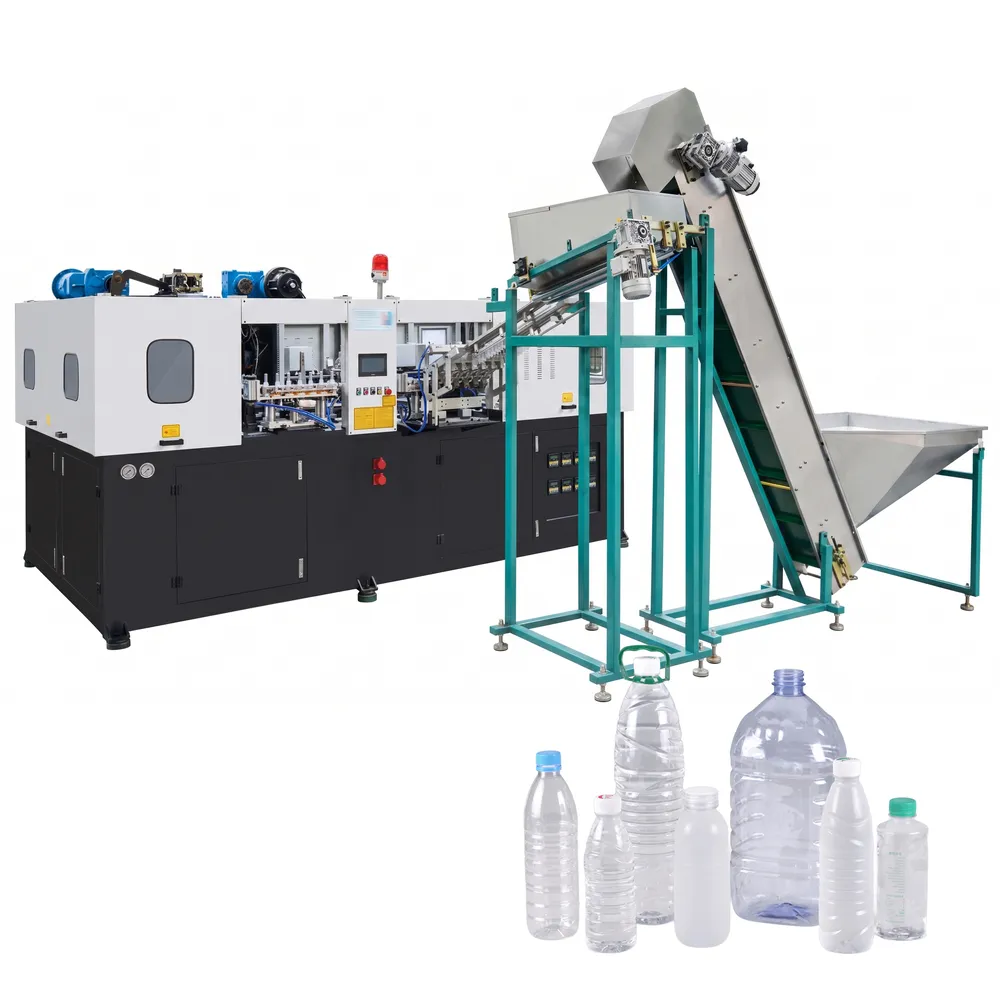
PET Blow Molding Machine Process: Step by Step
Step 1: Raw Material Preparation
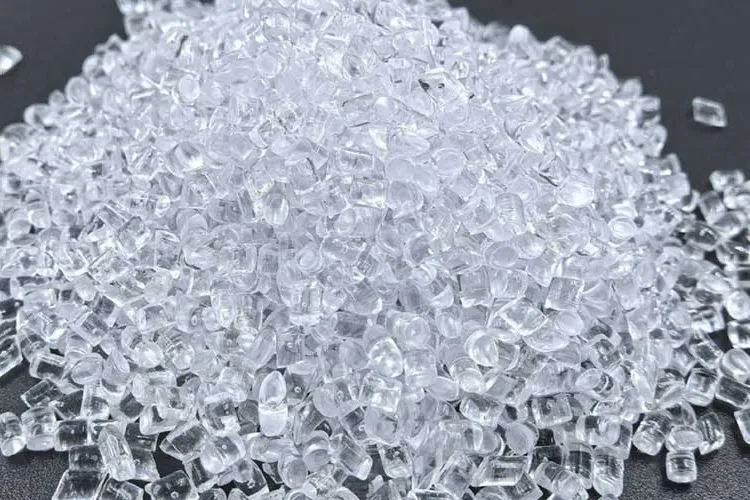
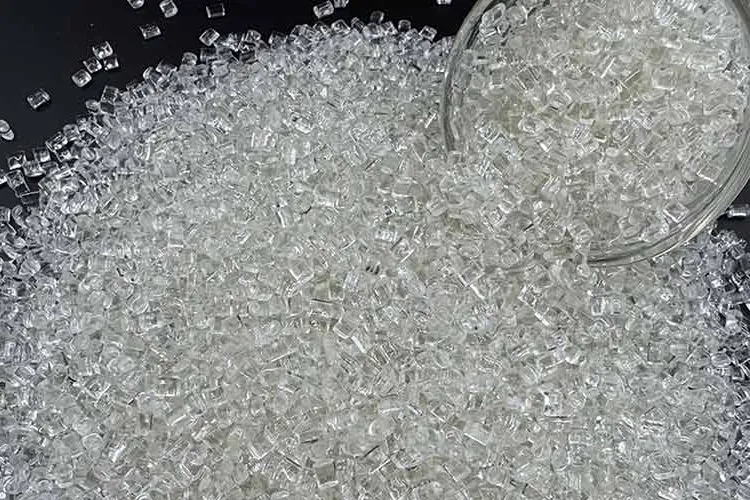
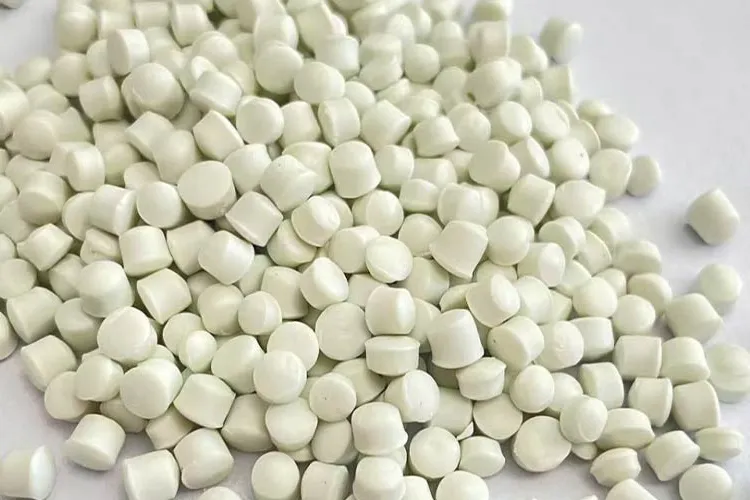
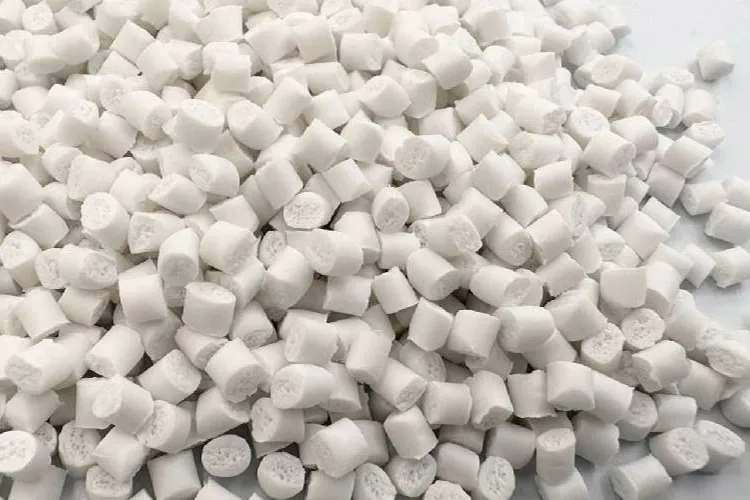
PET, PETG, PP, or PE resin pellets are screened, blended, and dried to strict moisture specifications. Drying is critical for PET because residual moisture above 50 ppm causes hydrolytic degradation during melt processing, resulting in hazy, weak bottles. Material feeders deliver pre-conditioned resin to the injection barrel with consistent bulk density and flow rate, forming the quality foundation for all downstream blow molding machine process steps.
Step 2: Injection Molding of Preforms
Dried resin is injected into a multi-cavity preform mold under tightly controlled barrel temperature, back pressure, and injection speed profiles. The resulting test-tube-shaped preforms have precision neck threads and gate geometry. In the two-stage process, preforms are cooled, inspected, and stored before transfer to the blow molding station, a separation that allows independent optimization of injection and blowing parameters for superior product quality.
Step 3: Preform Preheating
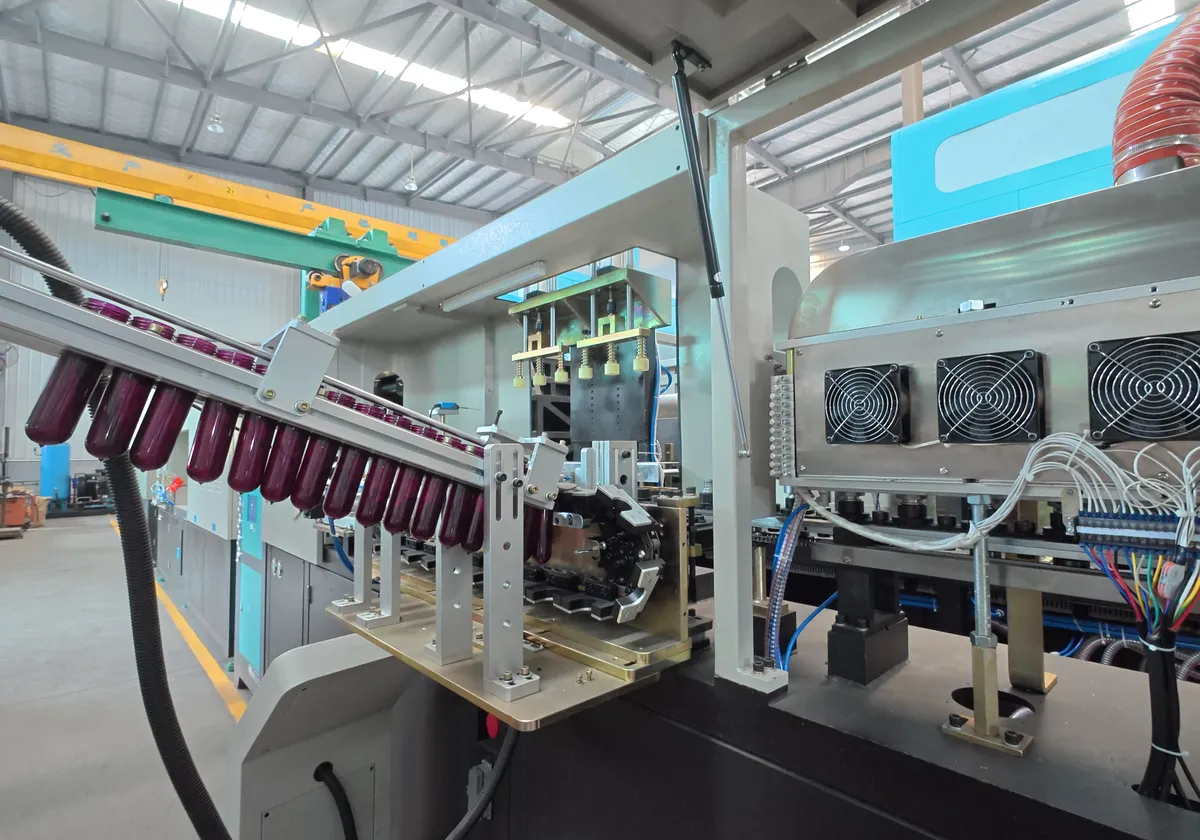
Stored preforms pass through a multi-zone infrared oven on a continuous mandrel conveyor. Each zone's lamp intensity and spacing are independently set to achieve the target temperature gradient: hotter at the body, cooler at the neck to protect thread integrity. The EPA machine uses 48 preform holders to buffer and evenly rotate preforms through heating zones, ensuring uniform temperature from outer surface to core before entering the blow station.
Step 4: Stretch-Blow Molding
Heated preforms are transferred to the blow mold where a stretch rod extends axially to a stroke of 400 mm while high-pressure air (up to 35 kg/cm2) simultaneously expands the preform radially into the mold cavity. This biaxial orientation dramatically improves the tensile strength, barrier properties, and clarity of the finished bottle. The two-stage injection stretch blow molding machine principle enables higher production speeds compared to inline single-stage systems, as the blow station operates independently of the preform injection cycle.
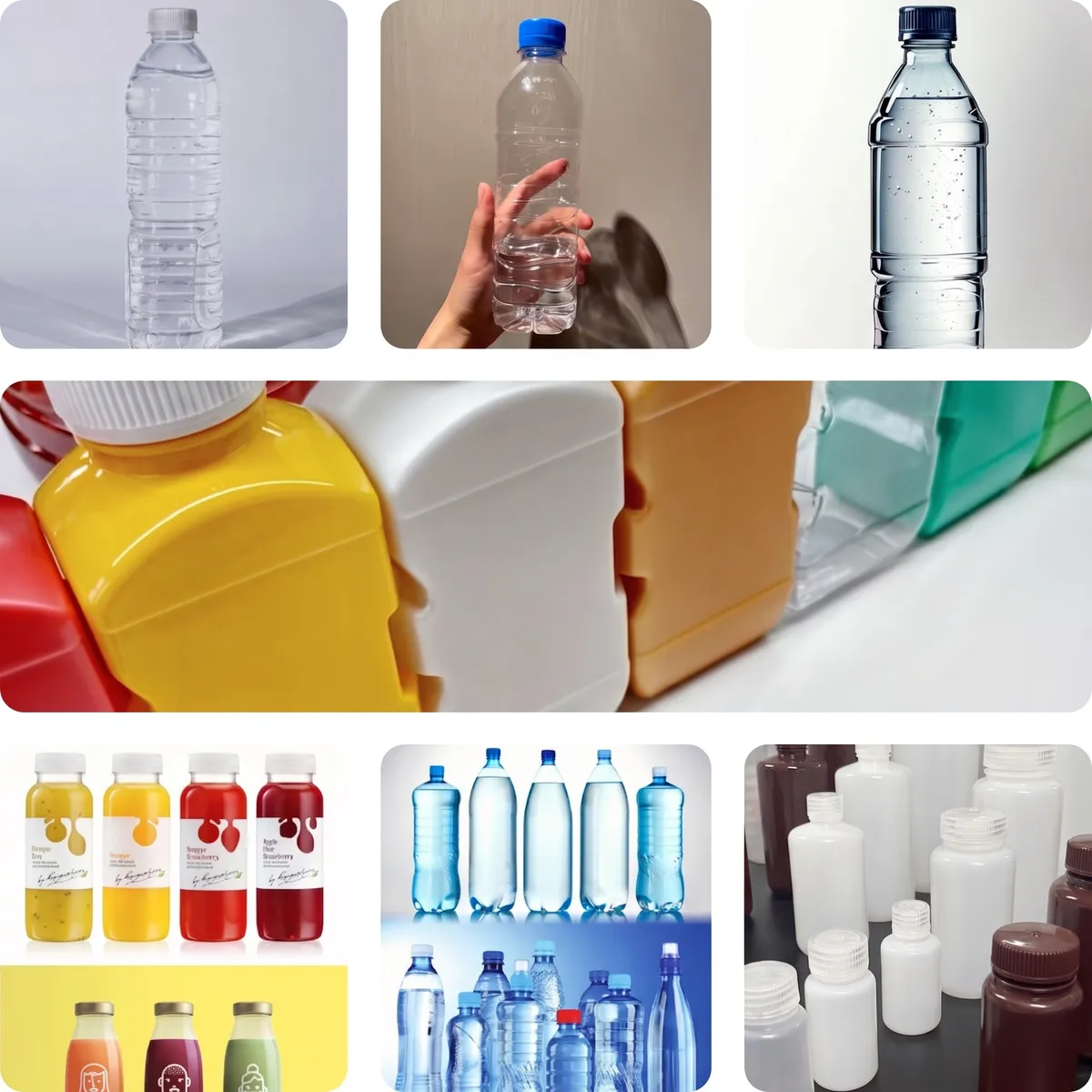
Applications of the Fully Automatic Blow Molding Machine
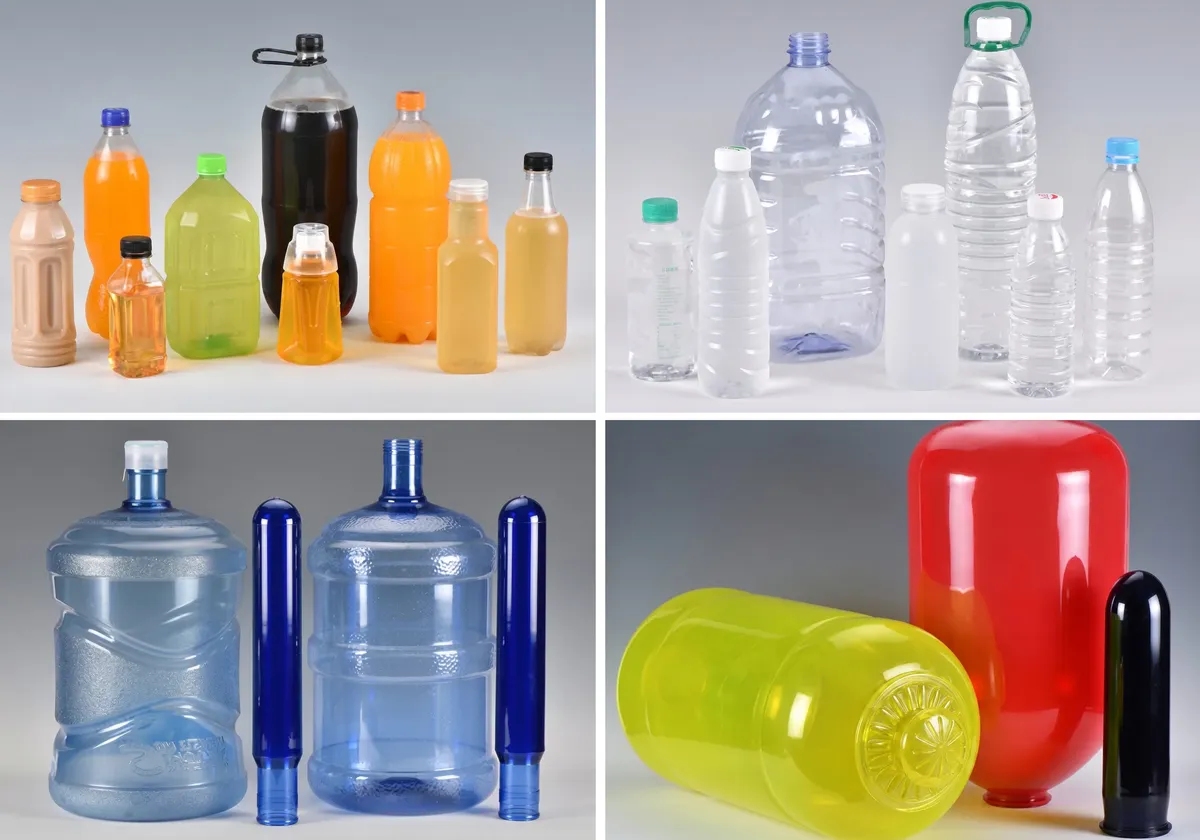
1. Mineral Water and Drinking Water Bottles
The EPA.AS-2C114.3 is optimized for 500 ml to 1,000 ml PET water bottle production with the 2-cavity configuration. Neck accuracy within tight tolerances ensures reliable capping on high-speed filling lines. FDA-compliant PET material processing maintains food-grade purity standards required by major mineral water brands and private-label bottling operations in regulated markets.
2. Carbonated Beverages and Juices
High blowing pressure (35 kg/cm2) combined with biaxial orientation produces PET bottles with the hoop strength needed for carbonated soft drink and sparkling water applications. The PET bottle blow molding machine achieves consistent wall thickness distribution that resists pressure creep during shelf storage, a critical performance factor for CSD and juice brands shipping in hot climates or altitude-variable supply chains.
3. Pesticide and Agricultural Chemical Bottles
PET and PETG blown on the EPA platform provide excellent chemical resistance to herbicides, fungicides, and insecticides. Neck diameter options up to 88 mm accommodate wide-mouth formats for products requiring easy pouring or dosing cup fitment. This plastic blow molding machine configuration meets UN-approved packaging requirements for hazardous agricultural formulations, supporting compliance with international shipping regulations.
4. Industrial Chemical and Lubricant Containers
Larger EPA series models including the EPA.JS-2C200 (5,000 ml) and EPA.JS-2C366 (22,000 ml) produce heavy-duty jerricans, drum liners, and industrial lubricant containers. The structural integrity of biaxially oriented PET handles aggressive solvents and oils, while high-clarity walls allow visual fluid level inspection without opening the container. These formats serve automotive, industrial maintenance, and chemical distribution sectors.
5. Food Condiment and Edible Oil Bottles
The EPA series handles edible oil, soy sauce, vinegar, and condiment bottle formats with the multi-pitch mold design accommodating oval, square, and round cross-section geometries in the same machine frame. Centralized heating and distance blowing technology reduces production cycle times for larger 5L edible oil formats, directly lowering the cost per bottle for food manufacturers and private-label packagers.
6. Pharmaceutical and Healthcare Packaging
With material compatibility extending to PETG and PP, the EPA blow molding platform supports pharmaceutical-grade bottles for liquid oral medications, vitamin supplements, and healthcare products. Uniform wall thickness ensures consistent torque performance on child-resistant closures and tamper-evident bands, a mandatory requirement for pharmaceutical packaging in regulated markets across the Americas, Europe, and Asia.
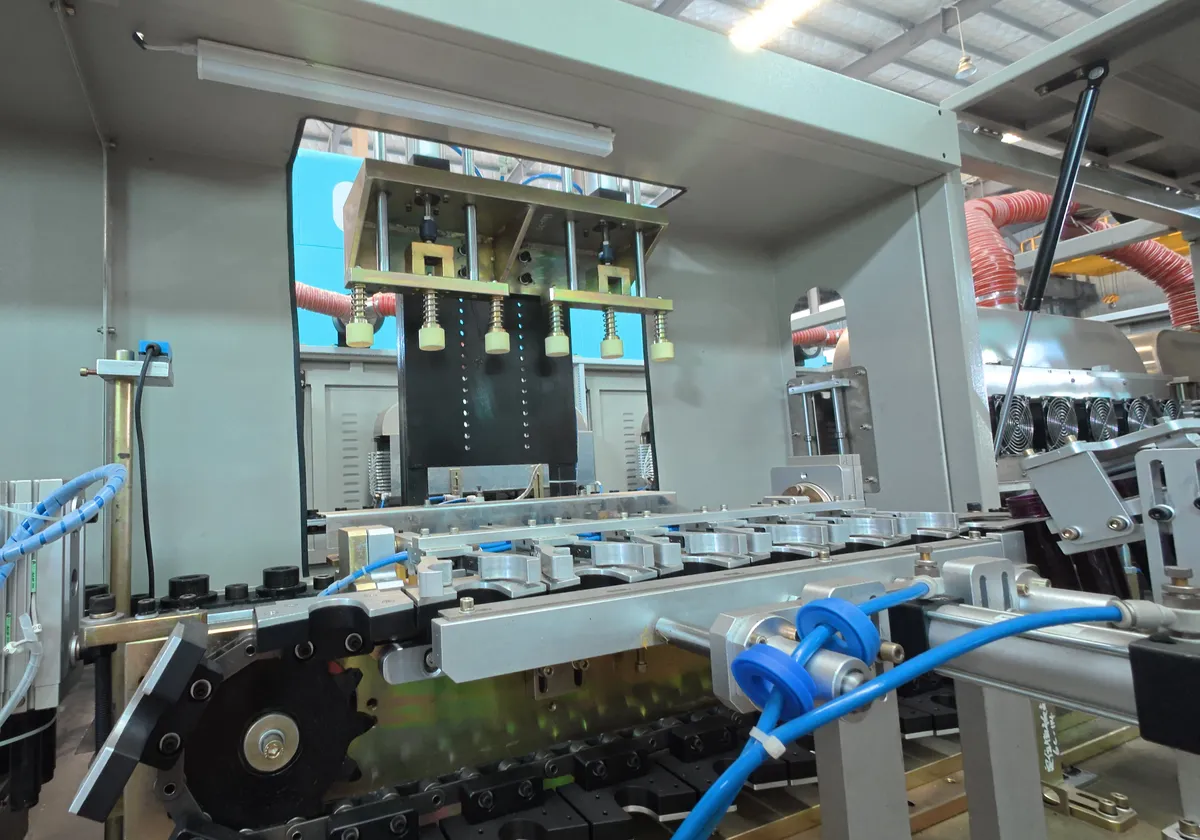
EPA.AS-2C114.3 Two-Stage Blow Molding Machine Parts
Injection Unit
The injection unit plasticizes and injects molten resin into the preform mold. It features a servo-driven screw-barrel assembly with temperature-zoned band heaters for precise melt uniformity, a non-return valve to prevent backflow during injection, and a closed-loop injection pressure sensor that maintains shot weight consistency within narrow tolerances across thousands of cycles per day.
Preform Heating Oven
The infrared oven houses multiple lamp zones with individually adjustable power outputs. The 48-position preform holder mandrel rotates preforms continuously through the heating tunnel, ensuring 360-degree temperature uniformity from neck to gate. Ceramic reflectors maximize energy transfer efficiency, and the oven's closed-loop temperature controller compensates for ambient variation in high-humidity or cold production environments.
Clamping Unit
The clamping unit generates and maintains the 122 mm clamping stroke required to hold the two-piece blow mold closed against the 35 kg/cm2 internal blowing pressure. A high-rigidity platen assembly minimizes mold deflection under load, protecting parting line geometry and extending mold service life. The 302 mm mold-open distance accommodates both bottle ejection and mold changeover without requiring crane assistance for standard mold sets.
Blowing Unit and High-Pressure Air Circuit
The blowing unit comprises the stretch rod actuator, blow pin assembly, and dual-stage air valve block. The 400 mm stretching stroke provides the axial draw ratio required for biaxial molecular orientation in PET. High-pressure air at 35 kg/cm2 (1,600 ltr/min) rapidly inflates the preform against the cooled mold surface in milliseconds, freezing the molecular orientation and producing the final bottle geometry with minimal cycle dead-time.
Mold Cooling Water System
The mold cooling circuit circulates chilled water at 8-12 degrees C and 30 ltr/min through milled channels within the blow mold cavity blocks. Rapid mold cooling solidifies the blown bottle within the target cycle time, prevents post-blow shrinkage distortion, and maintains dimensional stability at the bottle base and shoulder, the two areas most sensitive to wall thinning and deformation under heat.
PLC Control System
The machine is governed by a PLC-based control platform with a color touchscreen HMI for parameter entry, production statistics, and alarm management. Each process variable (oven zone temperature, blowing pressure, stretch rod speed, and clamping force) is monitored in real time with user-configurable alarm thresholds. Recipe storage allows rapid switchover between product SKUs without re-calibration, reducing line changeover time for multi-product beverage packaging operations.
Preform Transport and Feeding System
An automated preform hopper elevator feeds sorted preforms onto the mandrel chain at speeds matched to production throughput. Orientation sensors verify preform neck-up positioning before entry into the heating oven, rejecting misaligned preforms before they reach the blow station. This fully automated feeding subsystem eliminates manual preform handling labor and prevents foreign body contamination in food and pharmaceutical packaging environments.
Bottle Ejection and Conveyor Interface
After the blow-cooling phase, finished bottles are pneumatically ejected from the open mold and transferred to an outfeed air conveyor or mechanical slat conveyor interfacing with downstream filling or inspection equipment. The ejection mechanism is synchronized with the main machine PLC, ensuring smooth bottle transfer at full production speed without jams or bottle-on-bottle collisions that could create quality rejects or line stoppages on the filling side.
Advantages of Beverage Bottle Blow Molding Machine
1. Flexible Process Optimization
Two-stage architecture physically separates injection molding from blow molding, allowing operators to independently fine-tune temperature, pressure, speed, and cooling parameters for each stage. This means production engineers can optimize preform quality without impacting blowing throughput, or adjust blow parameters for a new bottle design without altering the proven preform specification, significantly reducing qualification time for new SKUs.
2. Superior Product Quality
Because preforms are fully conditioned to a stable temperature profile before entering the blow station, the resulting bottles exhibit more uniform wall thickness, higher clarity, and better mechanical strength than those produced on single-stage platforms. This quality advantage is particularly valuable for carbonated beverage bottles where wall consistency directly affects CO2 retention, and for pharmaceutical containers where dimensional consistency is a regulatory requirement.
3. High Production Throughput
The EPA blow molding machine series demonstrates the throughput advantage of two-stage systems clearly: the 8-cavity EPA.ES-8C76 achieves 9,200 bph and the 6-cavity EPA.ES-6C76 reaches 7,200 bph, rates that single-stage machines cannot match at equivalent equipment footprints. Large mineral water operations, beverage co-packers, and industrial chemical bottlers running three-shift operations require this level of throughput to remain cost-competitive in commodity packaging markets.
4. Energy Efficiency at Scale
Bulk reheating of preforms through a continuous infrared oven with reflective ceramic panels is inherently more energy-efficient than sequential single-preform heating on a single-stage machine. The EPA platform's 20 kW common operating power against a 45 kW maximum rating demonstrates real-world energy headroom during steady-state production, contributing to a lower cost per bottle at the volumes where two-stage automatic blow molding machine economics are most favorable.
5. Seamless Automation Integration
Two-stage machines integrate naturally into fully automated packaging lines. The EPA platform's outfeed conveyor interface connects directly to rotary fillers, linear cappers, sleeve labelers, and palletizers without intermediate buffer tables. The PLC control system supports line communication protocols for synchronized start-stop and speed matching with filling line controls, minimizing buffer zone requirements and reducing in-process inventory of unfilled bottles.
6. Lower Long-Term Operating Cost
Although the upfront capital investment for a two-stage blow molding machine is higher than for a comparable single-stage system, the per-bottle operating cost is consistently lower at volumes above approximately 2,000 bph. Reduced labor dependency, lower energy consumption per bottle, fewer scrap cycles due to stable preform conditioning, and longer mold service life due to controlled process parameters all contribute to a favorable total cost of ownership over a 5 to 10-year equipment lifecycle.
7. Preform Supply Chain Flexibility
Two-stage systems can source preforms from third-party injection molders, giving buyers the flexibility to compare preform suppliers on price and quality rather than being tied to in-house preform production capacity. This is particularly advantageous for contract packagers serving multiple brand customers where preform specifications may vary by brand, and for operations in regions with competitive preform supply markets that make external preform procurement more cost-effective than in-house injection molding.
Compatible Materials
PET (Polyethylene Terephthalate)
PET is the dominant material for this PET blow molding machine and accounts for the majority of global beverage bottle production. Its exceptional clarity, high tensile strength, excellent CO2 barrier properties, and suitability for FDA food contact make it the preferred choice for mineral water, carbonated soft drinks, juice, edible oil, and pharmaceutical liquid containers. PET's recyclability also meets sustainability mandates in regulated markets.
HDPE (High-Density Polyethylene)
HDPE is used for opaque bottles requiring robust chemical resistance and impact durability. It is widely used for laundry detergent, household cleaners, motor oil, agricultural pesticide, and industrial chemical containers. HDPE's resistance to a broad range of solvents and temperature extremes makes it suitable for products that would degrade or permeate PET, and its toughness reduces shipping damage in transit for heavy industrial packaging.
LDPE (Low-Density Polyethylene)
LDPE produces flexible, squeezable containers ideal for shampoo, conditioner, lotions, sauces, and other semi-liquid personal care and food products. Its natural translucency allows the customer to see remaining product levels, and its excellent moisture resistance protects liquid formulations during storage. LDPE bottles can be designed with controlled squeeze rates for precision dispensing applications in personal care and foodservice packaging.
PP (Polypropylene)
PP offers outstanding thermal resistance and chemical compatibility with acids, bases, and pharmaceutical excipients, making it the preferred material for hot-fill food packaging, pharmaceutical syrups, and healthcare product bottles. PP bottles can withstand sterilization temperatures required in GMP manufacturing environments, and their high purity specification meets USP and EP standards for primary pharmaceutical packaging compliance.
PC (Polycarbonate)
Polycarbonate is used for reusable bottles in sports, outdoor, and laboratory applications where high-impact resistance and optical clarity are prioritized. PC's ability to withstand repeated dishwasher cleaning and sterilization cycles makes it suitable for reusable water bottles, laboratory reagent containers, and industrial process sampling vessels where long service life justifies the higher material and processing cost compared to PET or HDPE alternatives.
PETG (PET Glycol-Modified)
PETG combines the clarity and chemical resistance of standard PET with improved impact strength and easier processability at lower mold temperatures. It is particularly suited for cosmetic bottles, pharmaceutical packaging, and specialty food containers where exceptional gloss and transparency are marketing priorities. PETG does not require drying as aggressively as PET, providing process flexibility for contract manufacturers running mixed-material blow molding schedules.
PEN (Polyethylene Naphthalate)
PEN provides superior gas barrier performance compared to standard PET, making it the preferred choice for premium carbonated beverages, beer, and juice products where extended shelf life is a priority. PEN's higher gas barrier reduces oxygen ingress and CO2 loss, extending carbonation retention by a factor of 2 to 4 times versus standard PET bottles of equivalent wall thickness. It is also UV-resistant, protecting light-sensitive beverages such as beer and fruit juices from photodegradation.
PVC (Polyvinyl Chloride)
PVC remains in use for specialty cosmetic and personal care bottles where its flexibility and chemical resistance offer formulation compatibility advantages over PET. It is valued for its ease of pigmentation, wide range of achievable surface finishes, and compatibility with a broad spectrum of cosmetic ingredients. PVC processing requires careful exhaust management and is subject to increasing regulatory restrictions in some markets, which should be evaluated as part of packaging material selection.
 |
 |
 |
 |
Single-Stage vs. Two-Stage Blow Molding Machine
Single-Stage Blow Molding Machine
In a single-stage system, preform injection and bottle blowing occur in the same machine without intermediate preform storage. Preforms pass directly from injection through temperature conditioning into the blow station while still retaining residual heat from molding. This approach reduces floor space and eliminates a preform handling step, making it attractive for operations producing specialty shapes, pharmaceutical containers, or short production runs where frequent mold changes are required.
Advantages: Compact footprint, lower capital investment, excellent for special shapes and high-clarity PETG, suitable for GMP pharmaceutical environments with no-touch-after-molding requirements.
Limitations: Lower output per hour than two-stage systems, less energy efficient per bottle at high volumes, less suitable for commodity beverage production where throughput is the primary KPI.
Two-Stage Blow Molding Machine
The two-stage process separates preform production from bottle blowing. Injection-molded preforms are cooled, stored, and later reheated in a dedicated infrared oven before entering the blow station. This decoupling allows the injection and blow stations to run at independently optimized speeds and temperatures, enabling much higher output rates. The EPA.ES-8C76 reaches 9,200 bph and delivers better energy efficiency through bulk preform heating versus sequential single-piece conditioning.
Advantages: High production capacity for large-scale operations, better energy efficiency at volume, consistent bottle uniformity through controlled preform conditioning, highly automatable for integration with filling lines, scalable from 2-cavity to 8-cavity configurations.
Best for: Large beverage manufacturers, mineral water brands, chemical packaging producers, edible oil bottlers, and any operation where throughput consistency and line integration are primary requirements.
| Feature | Single-Stage Machine | Two-Stage Machine (EPA) |
|---|---|---|
| Process Integration | Heating and blowing in one machine | Separate preform conditioning and blowing stages |
| Production Capacity | Moderate (small-medium runs) | High (up to 9,200 bph on EPA.ES-8C76) |
| Energy Efficiency | Lower per-bottle efficiency at volume | Higher (bulk preform reheating in optimized oven) |
| Automation Level | Semi-automatic or partial automation | Fully automatic, minimal operator dependency |
| Bottle Uniformity | Moderate | High (controlled preform conditioning) |
| Best Application | Specialty, pharma, small volume | Beverage, water, chemical, large-scale packaging |
Common Troubleshooting of Plastic Blow Molding Machine
Uneven Wall Thickness Distribution
Symptom: Bottles exhibit thin walls at the shoulder or base with excessive material accumulation at other zones. Root causes: Incorrect oven zone temperature profile producing non-uniform preform conditioning; stretch rod speed mismatched to material viscosity; preform not centered on blow pin. Resolution: Recalibrate oven zone lamp intensities starting from the base zone upward; verify stretch rod speed against material datasheet; inspect preform mandrel alignment and replace worn centering guides on the preform transport chain.
Bottle Haze or Cloudiness
Symptom: Finished PET bottles appear opaque or milky rather than crystal-clear. Root causes: PET resin moisture content above 50 ppm causing hydrolytic degradation during preform injection; preform reheating temperature too low leading to stress-whitening during stretch-blow; mold cooling temperature too high leaving amorphous zones in the bottle wall. Resolution: Verify hopper dryer dew point and residence time; increase oven heating power in upper heating zones; reduce cooling water setpoint temperature toward the 8 degrees C lower specification limit.
Bottle Base Deformation or Pearlescence
Symptom: Bottle bases show whitish rings (pearlescence) or exhibit push-up deformation under internal pressure. Root causes: Gate zone of preform overheated relative to body zone causing premature crystallization before molecular orientation is complete; insufficient blowing pressure preventing complete mold contact at the base geometry. Resolution: Reduce gate-area oven lamp power; increase high-pressure air supply to verify that the machine is reaching the full 35 kg/cm2 blowing pressure at the solenoid valve outlet; inspect blow pin seal for air leakage.
Neck Dimension Out of Tolerance
Symptom: Bottle neck finish dimensions (outer diameter, thread pitch, or tamper-evident ledge height) fall outside specification, causing capping failures on downstream filling lines. Root causes: Preform neck finish damaged during transport or hopper feeding; oven heating profile extending too high on the preform body causing neck deformation; blow mold neck insert worn beyond service tolerance. Resolution: Install preform neck protection guides in the hopper elevator; verify that the oven heating profile stops below the neck support plate; measure neck insert dimensions and replace if beyond the manufacturer tolerance limit.
Machine Stops During Production (Alarm Triggered)
Symptom: PLC alarm halts the machine mid-cycle, resulting in incomplete bottles and production downtime. Root causes: Air supply pressure drop below the 7 kg/cm2 operating threshold triggering a safety interlock; cooling water flow rate below the 30 ltr/min minimum; oven temperature runaway exceeding setpoint; preform jam in the feeding system triggering a sensor fault. Resolution: Check compressor output pressure and receiver tank; verify cooling water valve position and chiller setpoint; inspect oven zone thermocouple connections; clear the preform jam and reset the sensor fault through the HMI alarm management screen.
Reduced Throughput Below Rated Output
Symptom: Machine produces significantly fewer than the rated 2,000 bph, causing downstream filling line starvation. Root causes: Preform feed hopper running low or misorienting preforms; oven heating time extended due to degraded infrared lamp output requiring slower conveyor speed; mold cooling cycle extended due to chilled water temperature above the 12 degrees C upper limit. Resolution: Refill preform hopper and calibrate orientation sensor sensitivity; measure lamp output with an infrared meter and replace bulbs below 70% rated output; service the water chiller and verify cooling setpoint accuracy at the mold water inlet thermocouple.
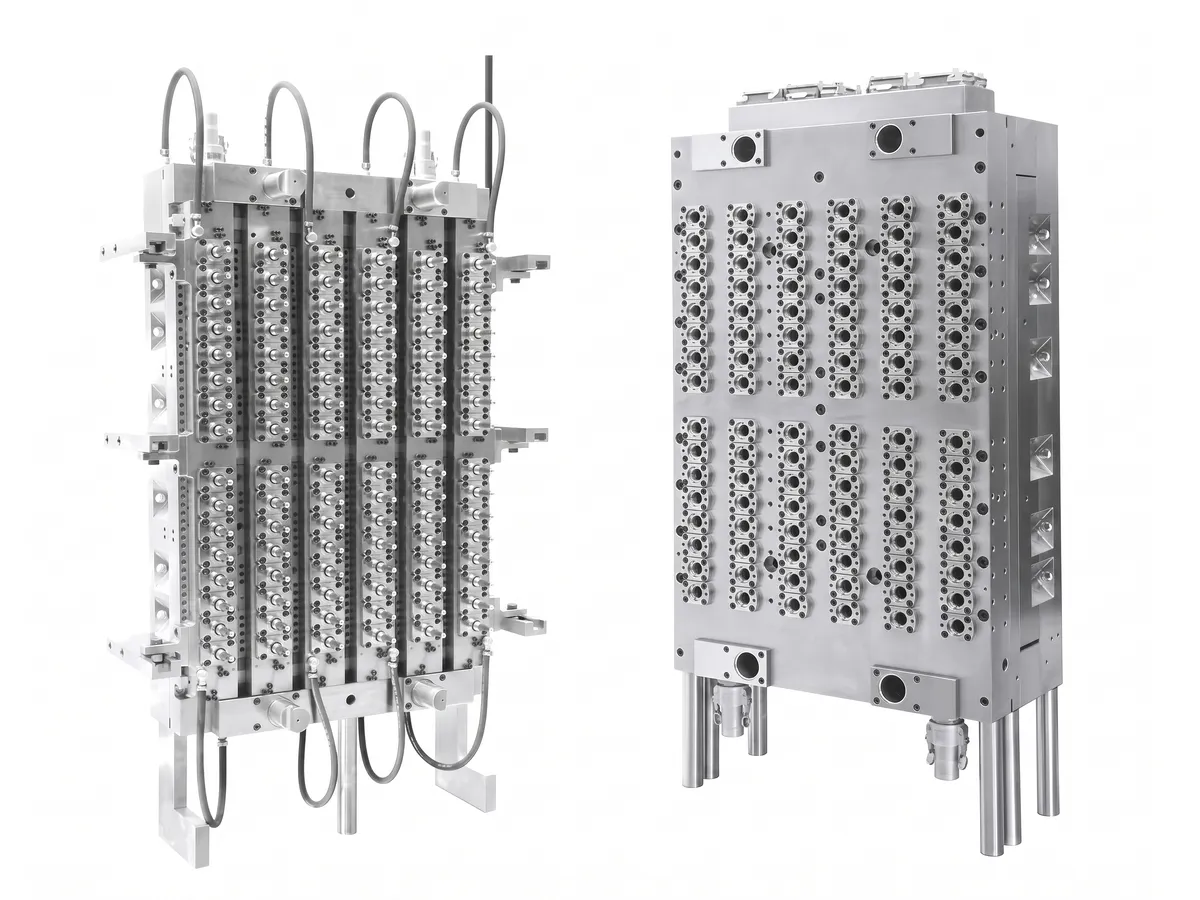
Water and Beverage Bottle Blow Molding Machine Mould
Ever-Power supplies both preform injection molds and blow molds engineered for the EPA platform, with material and design specifications that match the performance demands of high-volume beverage production.
Preform Injection Mold
- Coaxial die lip design: The two-part die lip assembly ensures that the preform gate and body remain on a common axis throughout injection, eliminating eccentricity that would cause uneven wall thickness in the blown bottle.
- Optimized cooling channel geometry: Conformal cooling channels machined into the cavity blocks maximize heat extraction rate, reducing preform cycle time while maintaining surface quality and dimensional stability of the finished preform.
- Imported 2316 die steel cavity components: The formation components use imported 2316 die steel that is rust-resistant and has undergone full hardening heat treatment, extending mold service life in high-humidity beverage manufacturing environments.
- 420 stainless steel structural components: Core plates, cavity plates, and structural elements are fabricated from 420 stainless steel to ensure corrosion resistance throughout the mold service life, reducing maintenance costs in facilities using aggressive cooling water treatments.
- Standard interchangeable die fittings: All die lip components use standardized interchangeable fittings, enabling rapid switch between preform designs without full mold disassembly, reducing tooling changeover time during product transitions.
- Multi-preform single-mold design: Advanced cavity layout allows a single mold to produce more than one preform geometry per production run, maximizing preform inventory flexibility and reducing tooling capital requirements for multi-SKU operations.
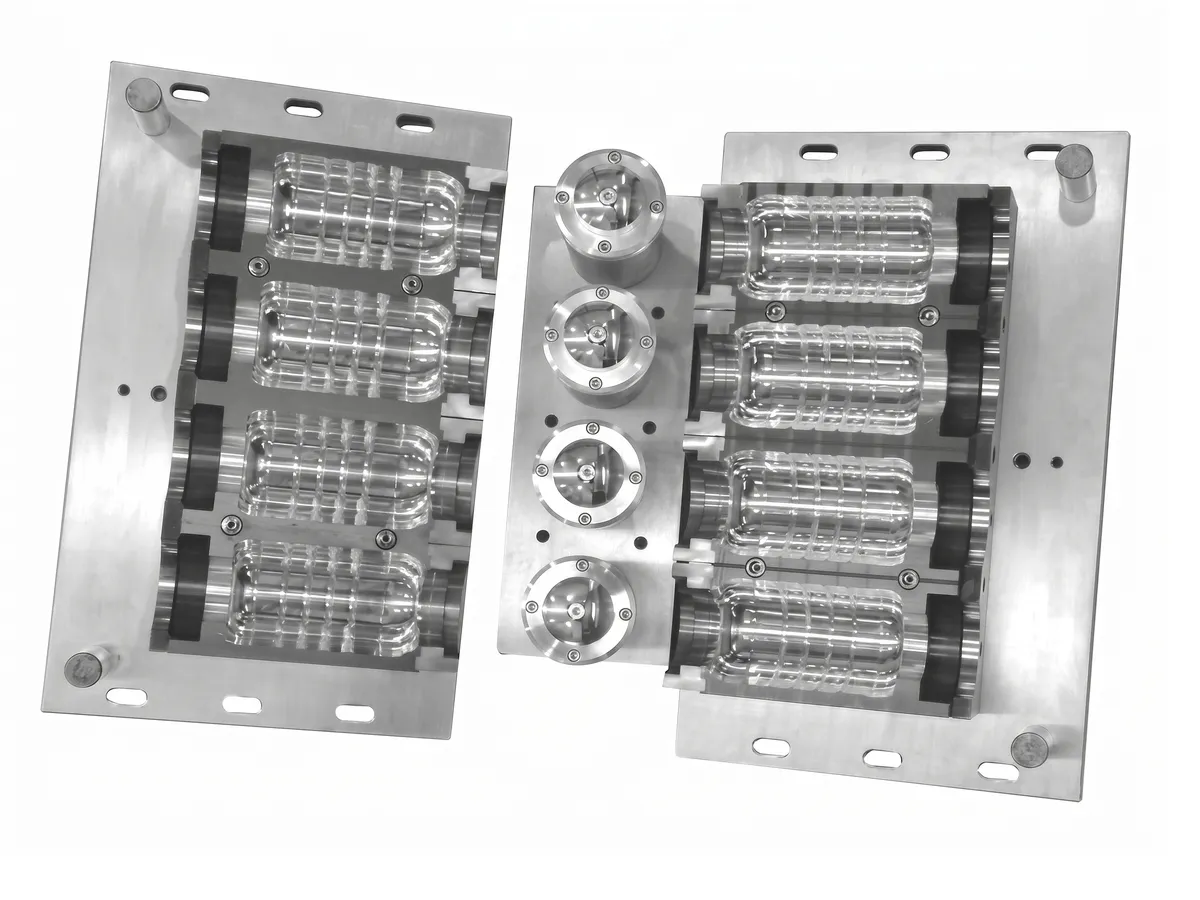
Blowing Mold
- High-quality alloy steel construction: Blow mold cavities are machined from premium alloy steel billets, providing the fatigue resistance required to withstand the repeated mechanical and pneumatic loading cycles of high-speed continuous bottle production.
- Advanced 3D CAD/CAM bottle design: Each blow mold is designed using international 3D CAD software that simulates material stretch behavior and wall thickness distribution before the mold is cut, reducing first-article qualification iterations and accelerating time to production for new bottle designs.
- Versatile bottle design portfolio: Ever-Power maintains a library of proven bottle designs across standard beverage, water, edible oil, and chemical packaging formats. Buyers can select from the existing portfolio or commission custom designs with full engineering support from the mold development team.
- Conformal water cooling channels: Milled cooling channels follow the contour of the bottle cavity to ensure uniform cooling across complex bottle geometries including oval bodies, recessed panels, and embossed brand logos, preventing hot spots that cause local wall thinning or deformation after demolding.
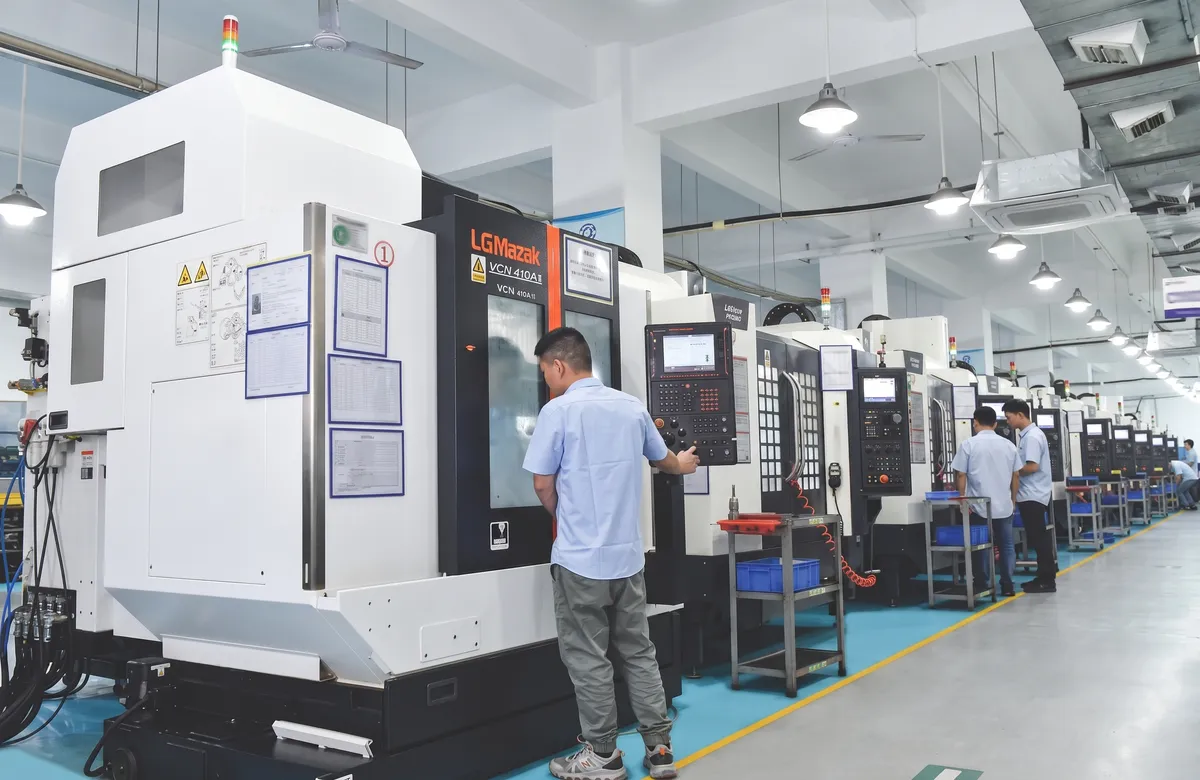
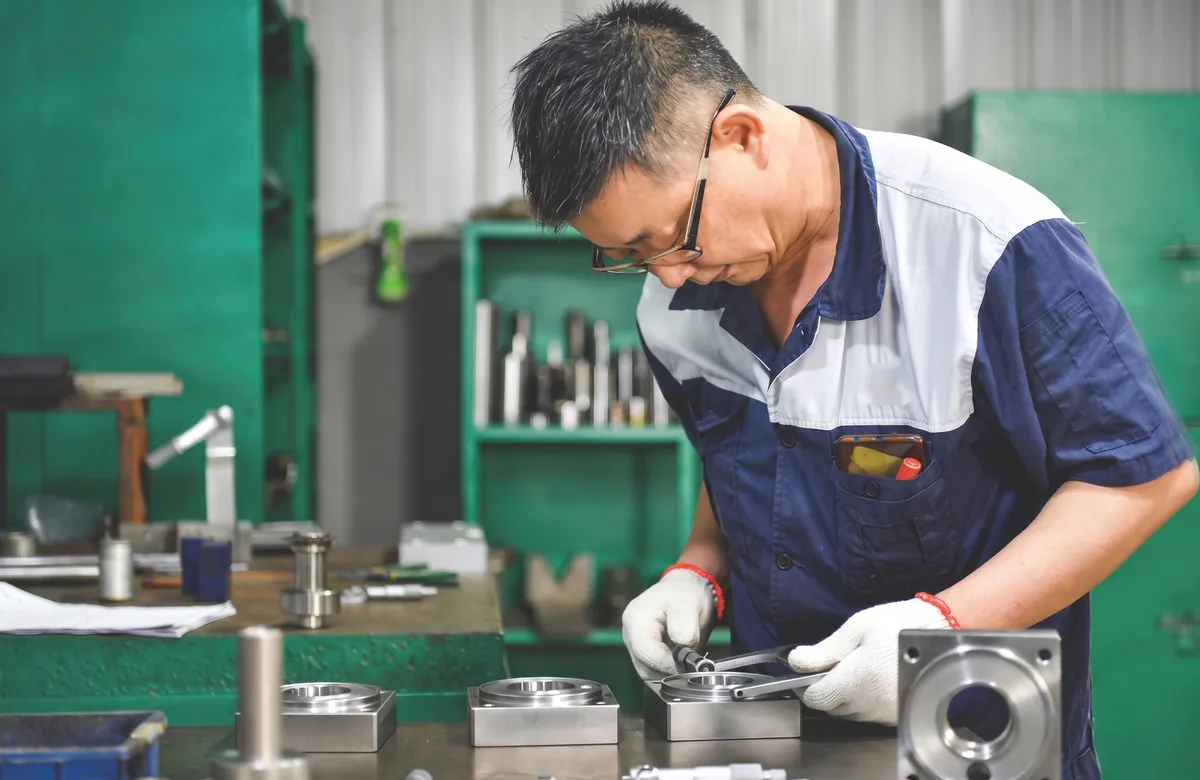
- Full CNC machining of all metal components: All mold metal parts are processed on CNC machining centers to achieve cavity dimension tolerances of plus or minus 0.02 mm, ensuring consistent bottle dimensions across the full cavity set and over the mold service life.
 |
 |
Why Choose Ever-Power's PET Blow Molding Machine?
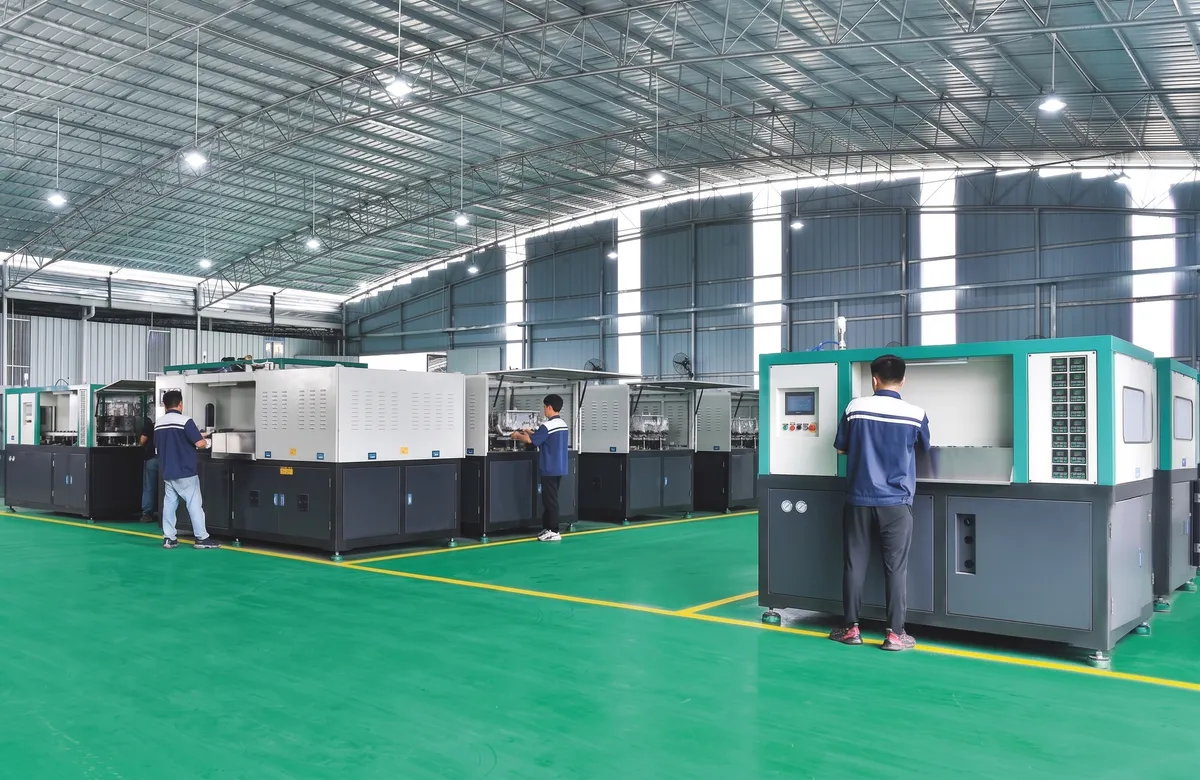
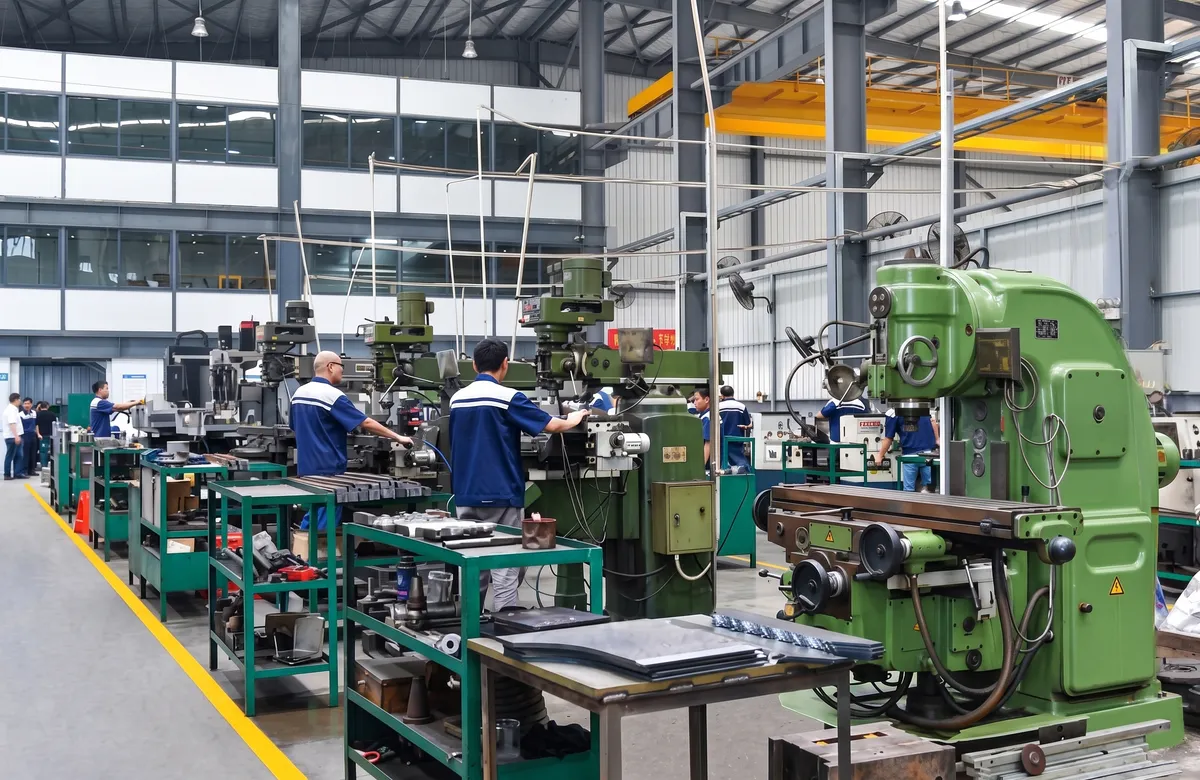
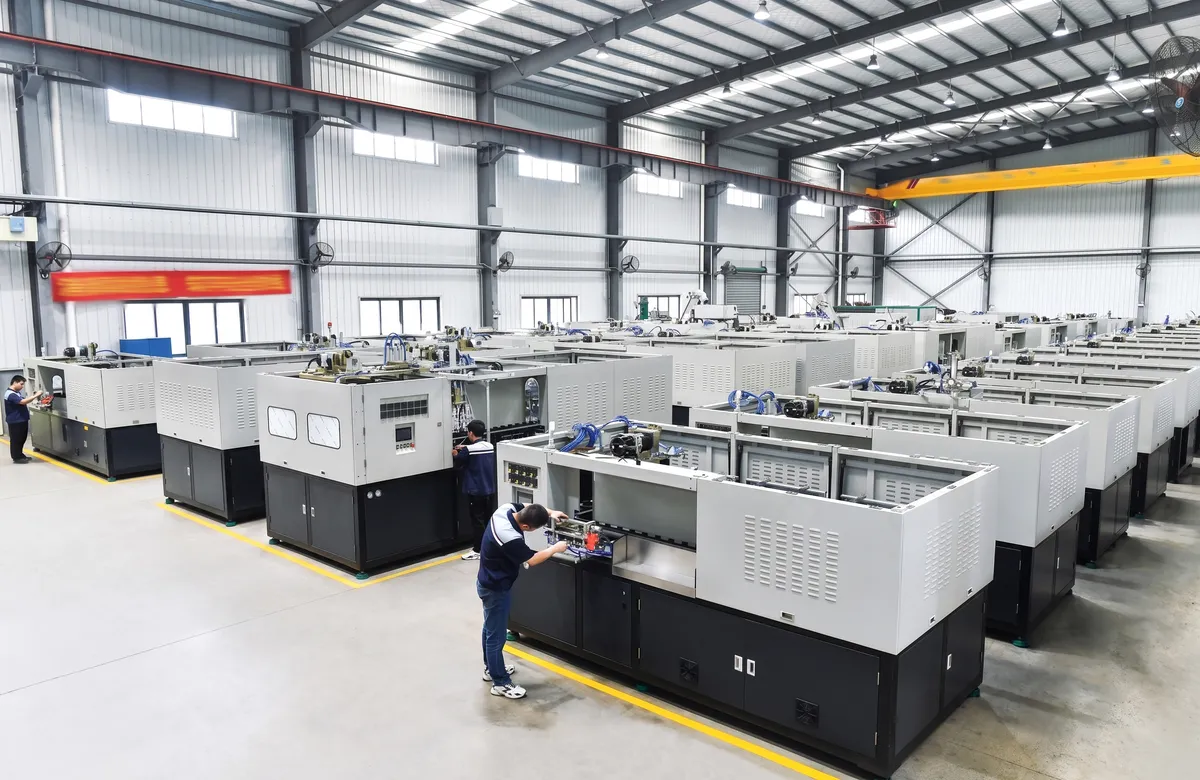
Mexico Ever-Power ISBM Machinery Co., Ltd is a specialized manufacturer and global supplier of automatic blow molding machines including injection blow molding, extrusion blow molding machine, and injection stretch blow molding machine systems, along with complete auxiliary machine packages. Strategically located with convenient access to major international shipping routes, Ever-Power serves beverage, pharmaceutical, food, cosmetic, agricultural, and industrial chemical packaging manufacturers across more than 30 countries.
The company brings together a dedicated R&D team with deep expertise in injection-blowing machinery and injection-blowing mold engineering. With substantial theoretical and hands-on experience accumulated over more than two decades of machine development, Ever-Power engineers can deliver detailed pre-sale feasibility assessments, customized equipment specifications, and comprehensive post-installation technical support tailored to each buyer's production environment and output targets.
Ever-Power's product applications span pharmaceutical packaging, food and beverage packaging, healthcare packaging, cosmetic packaging, agricultural chemical containers, and industrial chemical packaging. Compatible materials include HDPE, LDPE, PET, PETG, PP, PS, PPSU, PC, Tritan, ABS, PLA, EVA, PCTG, and bio-corn material, enabling buyers to transition between material platforms on the same equipment as their product portfolio evolves.
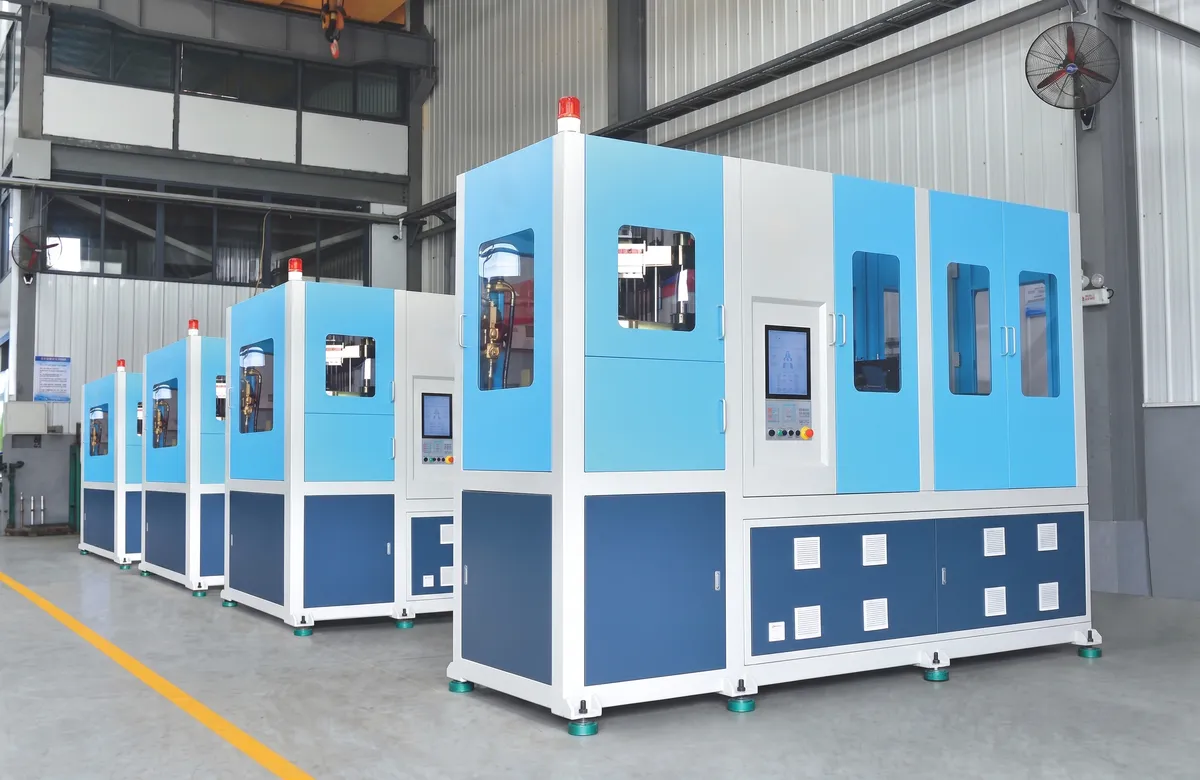
Ever-Power operates under the development philosophy of self-reliance, integrity, pragmatism, innovation, and responsibility. Every machine leaving our facility undergoes factory acceptance testing and quality verification before shipment. We build long-term partnerships with our customers, not single transactions, and our after-sales support structure reflects that commitment through lifetime technical assistance, rapid spare parts supply, and continuous product improvement programs. Ever-Power delivers complete turnkey high-end injection-blowing production lines covering machine supply, mold design and fabrication, preform specification, line integration engineering, commissioning supervision, operator training, and ongoing maintenance support. Whether you are setting up a greenfield bottle production facility or upgrading existing blow molding capacity, our project team manages the full scope from initial feasibility to first production run sign-off.
 |
 |
 |
 |
 |
 |
Frequently Asked Questions
Q: What bottle volumes can the EPA.AS-2C114.3 produce, and what is its maximum container height?
A: The EPA.AS-2C114.3 handles containers up to 1,000 ml with a maximum body diameter of 94 mm and a maximum container height of 260 mm. If you require larger volumes (up to 22,000 ml), the EPA.JS-2C366 model in the same series accommodates jerrican and large-container formats. For smaller high-speed formats such as 500 ml water bottles, the EPA.ES-2C100 with a 2,400 bph theoretical output may be a better fit depending on your production volume targets.
Q: What is the actual energy consumption of the EPA.AS-2C114.3 fully automatic blow molding machine during continuous operation?
A: The machine has a maximum installed heating power of 45 kW, but the common operating heating power during steady-state production is 20 kW. The difference represents the headroom used during warm-up and transient production events. Buyers should dimension their electrical supply connection to the 45 kW maximum but budget running energy costs based on the 20 kW operating figure for accurate production cost modelling. The low-pressure air circuit operates at 7 kg/cm2 consuming 600 ltr/min, and the high-pressure blowing circuit at 35 kg/cm2 consuming 1,600 ltr/min. These values are important for sizing your compressor installation.
Q: Can this PET blow molding machine process materials other than PET?
A: Yes. The EPA platform is compatible with PET, PETG, PP, HDPE, LDPE, PC, PEN, PVC, and PLA. Material changeovers require adjustment of oven temperature profiles and blowing pressure parameters, and in some cases preform tooling changes if neck or body geometry differs. Our applications engineering team can advise on the appropriate parameter settings for your target material and container specification. Note that PP and HDPE applications in the EPA two-stage platform require preform compatibility verification with your preform supplier.
Q: How do I choose between the EPA.AS-2C114.3 and a higher-cavity model for my production line?
A: The primary selection factor is your target output volume per shift. If your bottling line requires 1,500 to 2,000 bottles per hour on a single-shift basis, the 2-cavity EPA.AS-2C114.3 is appropriately sized and offers the lowest capital entry point in the series. For output requirements of 3,000 to 5,000 bph, consider the 4-cavity EPA.ES-4C76 or EPA.ES-4C114. For 7,000 to 9,200 bph, the 6 or 8-cavity models are required. When the container volume exceeds 1,000 ml, cavity count options are constrained by machine frame geometry and the EPA.JS series addresses larger-format requirements.
Q: What chilled water specification does the EPA.AS-2C114.3 require, and can I use tower water instead of a chiller?
A: The EPA.AS-2C114.3 requires cooling water at 8-12 degrees C, 6 kg/cm2 operating pressure, and 30 ltr/min flow rate. A dedicated refrigerant chiller is required to maintain the 8-12 degrees C specification consistently. Cooling tower water at ambient temperatures is not sufficient for stable mold cooling performance, particularly in tropical climates or summer operating conditions. We recommend a chiller with at least 30% capacity headroom above the mold flow requirement to maintain stable temperature during compressor heat load variations.
Q: Does Ever-Power supply the blow molds and preform molds together with the machine?
A: Yes. Ever-Power supplies complete turnkey packages including the blow molding machine, blow molds designed to your bottle specifications using 3D CAD simulation, and preform injection molds for the EPA injection station. Mold steel is selected based on production volume: 2316 imported die steel for cavity components and 420 stainless steel for structural parts. Both preform and blow mold designs can be customized to your brand bottle shape, neck finish standard, and label panel geometry. Factory mold trials and first-article sample approval are included before shipment.
Q: What is the difference between an extrusion blow molding machine and the EPA injection stretch blow molding machine?
A: An extrusion blow molding machine extrudes a molten plastic tube (parison) directly into the blow mold, producing bottles without molecular orientation. This process is suited for HDPE containers, complex handle bottles, and large industrial drums where shape complexity rather than wall uniformity is the priority. The EPA series uses injection stretch blow molding machine technology: preforms are injection-molded with precise geometry, reheated, then stretched biaxially before blowing. This biaxial orientation produces PET bottles with significantly higher strength-to-weight ratio, better clarity, and superior CO2 barrier performance.
Q: What is the machine footprint and weight, and what utilities must be installed before delivery?
A: The EPA.AS-2C114.3 occupies a floor area of 2,660 mm (L) by 1,660 mm (W) with a height of 2,150 mm, and weighs 2,600 kg. Prior to delivery, the following utilities must be installed: three-phase electrical supply sized for 45 kW maximum draw, high-pressure compressed air supply at 35 kg/cm2 with 1,600 ltr/min capacity, low-pressure air at 7 kg/cm2 with 600 ltr/min capacity, chilled water circuit at 6 kg/cm2 with 30 ltr/min flow capacity and 8-12 degrees C temperature setpoint, and a level reinforced floor with a 150 mm concrete foundation. Our engineering team provides a site preparation checklist with every order.
Q: What commissioning and after-sales support does Ever-Power provide for international buyers?
A: Ever-Power provides comprehensive pre-sale technical consultation, factory acceptance testing (FAT) before shipment, overseas commissioning support with an experienced engineer for machine installation and operator training, and ongoing after-sales support via dedicated WhatsApp, email, and video call channels. Spare parts are dispatched within 3 days for in-stock items. For buyers in regions where on-site support is time-critical, a local service partner network covers major markets in Southeast Asia, Latin America, the Middle East, and Africa. Multi-year maintenance contracts are available on request.
Q: Can the EPA blow molding machine integrate with an existing filling and packaging line?
A: Yes. The EPA platform is designed for downstream line integration. The outfeed conveyor interface uses standard air conveyor or slat conveyor connections compatible with rotary and linear filling equipment from major suppliers. The PLC control system supports line communication protocols for synchronized start-stop and speed matching with filling line controls. If your filling line operates at a fixed speed, our engineering team will specify the correct EPA model and cavity configuration to match bottle output to filler throughput, minimizing buffer zone requirements and reducing in-process inventory of unfilled bottles.
Customer Reviews
Carlos Mendoza, Beverage Bottle Packaging, Mexico
"We have been running our EPA.ES-4C76 for eight months now at our bottling plant in Monterrey and the throughput has been very consistent. We are hitting around 4,600 to 4,700 bottles per hour on 600 ml mineral water, basically what the spec said. The machine heats up fast and the oven is easy to adjust. Ever-Power sent a technician for commissioning and he stayed four days until we were comfortable with everything. Our operators picked it up quickly. Very good investment for the price compared to European brands we were looking at."
Rahul Sharma, Pesticide Bottle Packaging, India
"We ordered the EPA.AS-2C114.3 specifically for a pesticide bottle contract we had: 88 mm neck, 1L bottles, chemical-grade PET. The machine handled the job without any issues and the neck dimensions have been within tolerance every check we have done. We run three shifts and have had no major downtime in 14 months. Parts are available quickly. The cooling system keeps the mold temperature very stable and that really matters for the wall uniformity our client requires. I would recommend Ever-Power to other manufacturers who need a reliable plastic blow molding machine for industrial applications."
Ibrahim Al-Hassan, Water Bottle Packaging, Nigeria
"The EPA.ES-6C76 has changed our production completely. Before we were using a much older machine and output was maybe 3,500 an hour if everything was working well. Now we are at 7,000 consistently on the 500 ml water bottle. The power consumption surprised me. It really does run closer to 26 kW in normal operation, not the 68 kW max rating, so our electricity bill went down even with more output. Delivery was faster than I expected and the customs documentation was all handled by Ever-Power without any problems on our end."
Maria Santos, Edible Oil Bottle Packaging, Brazil
"We produce 5-liter edible oil bottles and were looking for a machine that could handle the large format reliably. The EPA.JS-2C200 does exactly what we needed. The centralized heating design for large bottles works well and our cycle times are better than the previous supplier we used. I was worried about after-sales support being so far from Mexico but the team responds within 24 hours on WhatsApp and they have solved every issue remotely so far with video calls. Very professional. Will be ordering a second machine later this year for a new contract we just won."
Tran Van Duc, Drink Bottle Packaging, Vietnam
"Bought the EPA.ES-4C114 for carbonated drink bottles in late 2024 and it has been running without any serious issues for almost 19 months. The 4-cavity configuration gives us around 3,200 bottles per hour on 1.3L bottles which fits our filling line perfectly. We did have an oven lamp replaced at month 12 which was straightforward. Ever-Power sent the replacement parts by express and included a step-by-step video from the engineer. Machine quality is much better than some local brands we tried before and the price difference is worth it for the reliability."
Ahmed Bouazizi, Water Bottle Packaging, Egypt
"We are using the EPA.ES-2C130 for 1.5L water bottles in our facility near Cairo. Summer ambient temperatures here go above 40 degrees C and I was concerned about the oven overheating but the cooling system handles it without problems. Output is stable at about 1,750 bottles per hour which is slightly below the 1,800 rated because we run a slower oven speed for safety margin in our conditions. The bottle clarity is excellent and our customers notice the quality improvement. Would have given 5 stars if the machine manual had been available in Arabic from the start."
Nguyen Thi Lan, Water Bottle Packaging, Indonesia
"We invested in the EPA.ES-8C76 for a high-volume water bottle contract and the 9,200 bph output is real. We verified it with a counter on the outfeed conveyor in the first week. The 8-cavity configuration was the right choice for our volume and the machine footprint is manageable in our existing factory layout. Ever-Power's team did the factory acceptance test with us over video call before shipping and that gave us a lot of confidence. First spare parts order was shipped within 3 days. The machine has paid back a large portion of the investment already in the first 7 months."
Kwame Asante, Juice Bottle Packaging, Ghana
"We chose the EPA.AS-2C114.3 for our juice and water packaging line after comparing several blow molding machine manufacturers. Ever-Power's price was competitive but what decided it was their technical response time. They answered every question quickly and sent detailed engineering drawings before we committed. The machine arrived in good condition, installation went smoothly, and we have been producing consistently at 1,900 to 2,000 bottles per hour since startup. The cooling water system is very stable and we have not had a quality rejection batch in ten months of operation. Highly recommended."
Andrei Popescu, Beverage Bottle Packaging, Romania
"As a technical buyer I looked carefully at the EPA.ES-4C100 specs before purchasing and the machine performs exactly as documented. Blowing pressure holds steady at 35 kg/cm2 and the oven zone control is precise to within about 1.5 degrees C on our infrared checks. We produce 800 ml beverage bottles and the wall distribution is very even, better than 0.15 mm variation across the bottle body. The PLC interface is intuitive and our engineers were comfortable with it after one training day. Spare parts pricing is reasonable and lead time for non-stock items has been 7 to 10 days. Overall a solid, well-built automatic PET blow molding machine."
Additional information
| Edited by | Yjx |
|---|
Related products
-
EPA.AS-2C114.3 Fully Automatic Blow Molding Machine for Daily Chemicals & Cosmetic Bottles
-
EPA.ES-2C150 Fully Automatic Blow Molding Machine for Edible Oil and Handle Bottles
-
EPA.ES-3C114 Fully Automatic Blow Molding Machine for Daily Chemicals & Cosmetic Bottles
-
EPA.ES-2C130 Fully Automatic Blow Molding Machine for Food Wide-Mouth Jars and Cans