
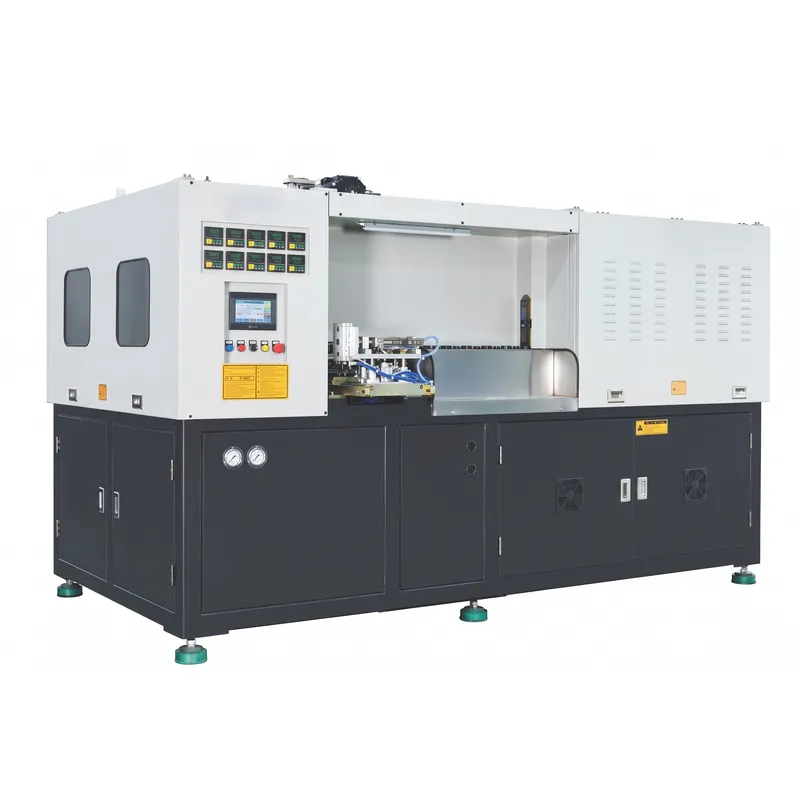
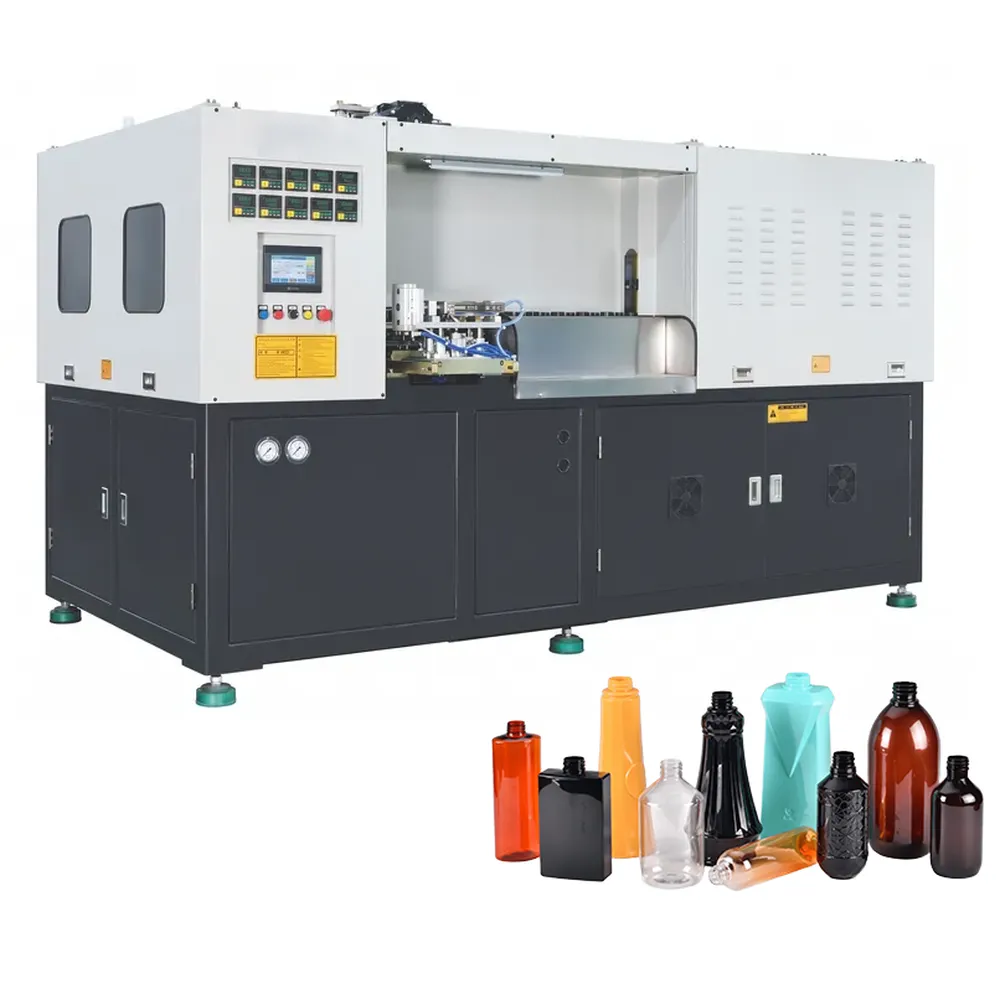
EPA.AS-4C76.2 Fully Automatic Blow Molding Machine for Daily Chemicals & Cosmetic Bottles
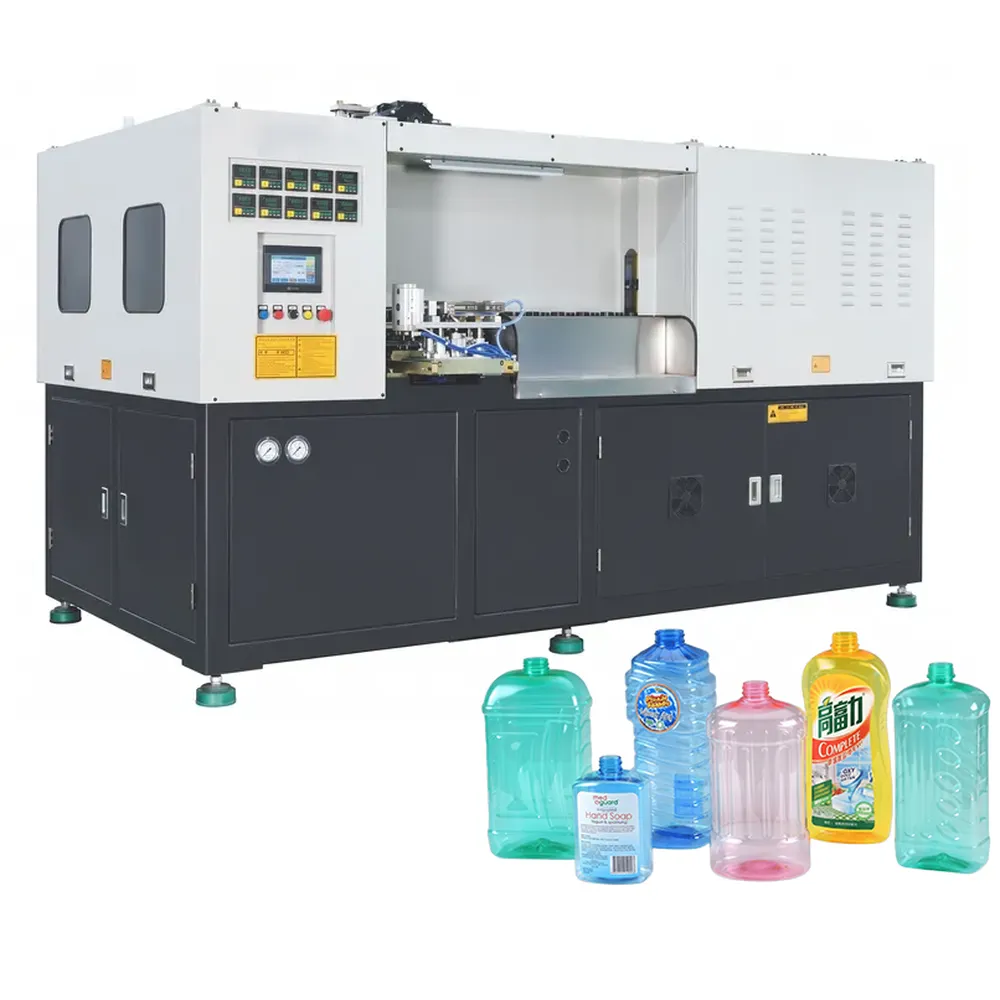
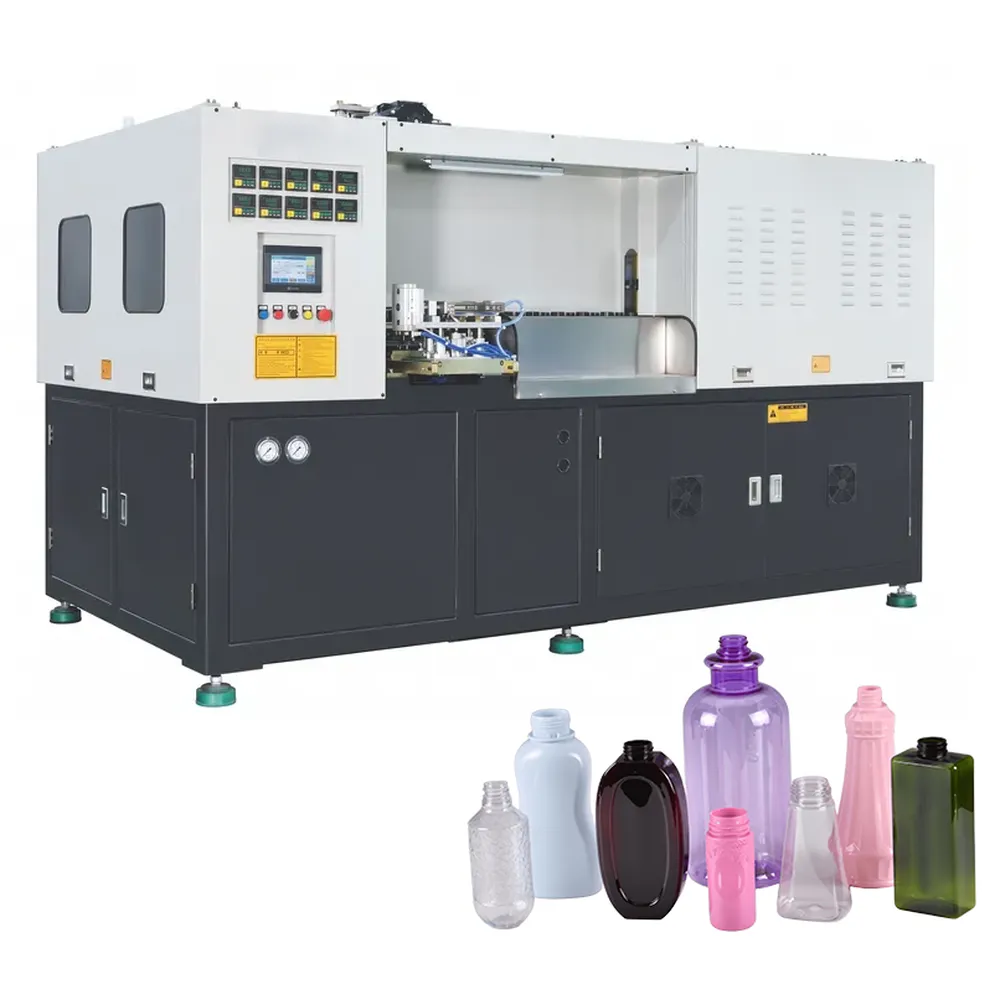
The EPA.AS-4C76.2 fully automatic blow molding machine is engineered for manufacturers requiring precision, speed, and reliability in the production of PET and PETG cosmetic and daily chemical containers. Adopting internationally renowned servo motors, precision reducers, world-class electrical components, and an advanced PLC control system, this two-stage blow molding machine delivers stable, efficient, and energy-saving performance across every production cycle.
The EPA.AS-4C76.2 fully automatic blow molding machine is engineered for manufacturers requiring precision, speed, and reliability in the production of PET and PETG cosmetic and daily chemical containers. Adopting internationally renowned servo motors, precision reducers, world-class electrical components, and an advanced PLC control system, this two-stage blow molding machine delivers stable, efficient, and energy-saving performance across every production cycle. Its robust mechanical construction makes it equally capable of handling standard round bottles and highly complex special-shaped cosmetic bottle designs that demand exceptional dimensional accuracy.
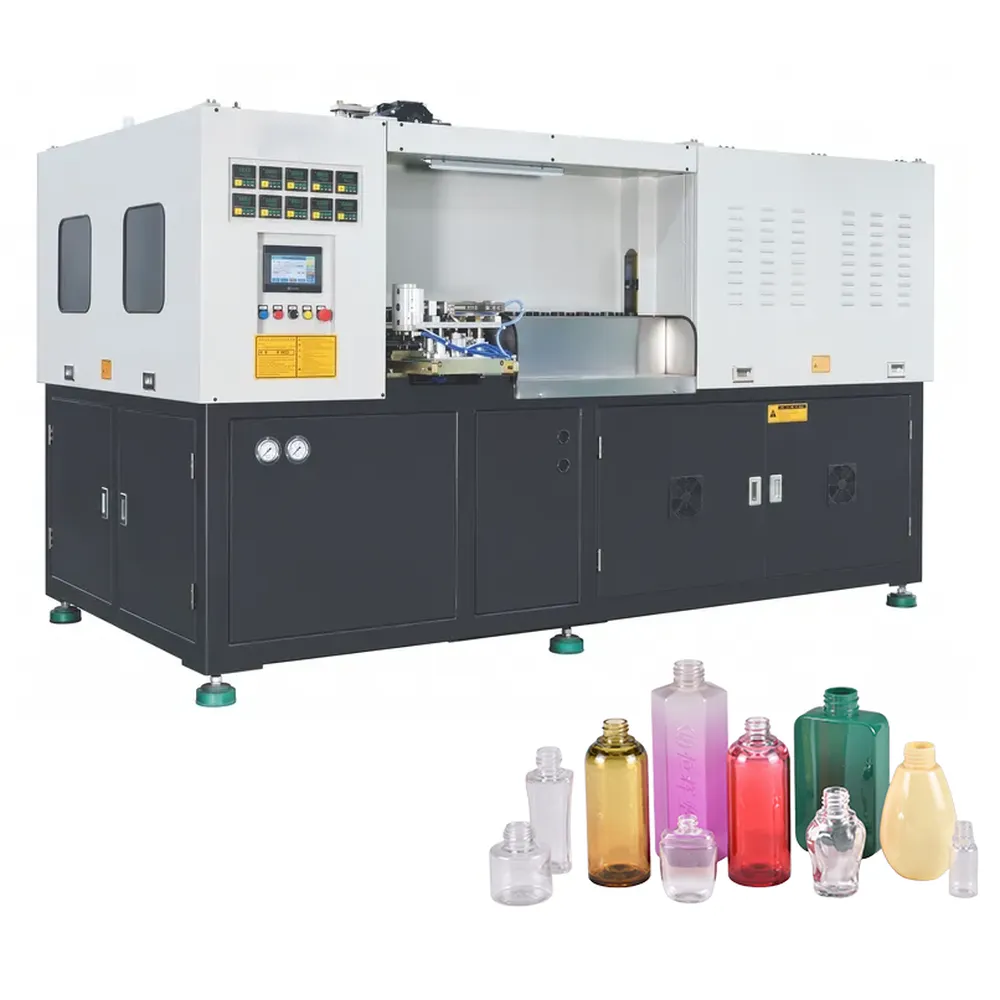
With a theoretical output of 4,000 bottles per hour through its 4-cavity mold configuration, the EPA.AS-4C76.2 is purpose-built for large-scale cosmetic and personal care packaging lines. It excels in blowing shampoo bottles, conditioner containers, body lotion bottles, facial cleanser bottles, hand wash bottles, and a wide spectrum of daily chemical packaging with neck diameters up to 48mm and container volumes up to 500ml. As a leading plastic blow molding machine in its class, it combines high-speed output with fine surface finish and tight dimensional tolerances, making it the preferred choice for cosmetic brands and OEM packaging manufacturers worldwide.
Technical Parameter
| Model | Unit | EPA.AS-4C76.2 | |
|---|---|---|---|
| Molding | Clamping stroke | mm | 100 |
| Mold-open distance | mm | 280 | |
| Mold-close distance | mm | 180 | |
| Stretching stroke | mm | 350 | |
| Mold-open distance | mm | 50 | |
| Mold-close distance | mm | 76.2 | |
| Preform Holder | 96 | ||
| Cavities | 4 | ||
| Container | Max.Container Volume | ml | 500 |
| Neck Diameter Range | mm | 48 | |
| Max.Container Diameter | mm | 65 | |
| Max.Container Height | mm | 250 | |
| Theoretical Output | bph | 4000 | |
| Electrical System | Max.Heating Power | kw | 33 |
| Heating Power | kw | 17 | |
| Air System | Operating Pressure | kg/cm² | 7 |
| Low Pressure Air Consumption | ltr/min | 600 | |
| Blowing Pressure | kg/cm² | 35 | |
| High-pressure air consumption | ltr/min | 4000 | |
| Cooling water | Operating Pressure | kg/cm² | 5-6 |
| Temperature | ℃ | 8-10 | |
| Flow rate | ltr/min | 40 | |
| Machine | Size (L*W*H) | mm | 3370*1850*2100 |
| Weight | kg | 4000 | |
Features of the EPA.AS-4C76.2 Cosmetic Bottle Blow Molding Machine
1. High-Speed Production
The EPA.AS-4C76.2 achieves a theoretical output of 4,000 bottles per hour via its 4-cavity mold system and 96-position preform holder, making it a true high speed blow molding machine for large-volume cosmetic and daily chemical packaging lines. Whether you run single shifts or 24-hour continuous operations, the servo-driven cycle optimization ensures consistent throughput with minimal downtime, translating directly into lower cost-per-unit and faster return on investment for your production facility.
2. Precise PLC Control
The machine features an advanced PLC-based control system that gives operators full authority over every production variable including heating zone temperatures, blowing pressure (up to 35 kg/cm²), stretching stroke, and mold clamping timing. This precision dramatically reduces the risk of defective output, ensures bottle-to-bottle dimensional consistency, and simplifies the process of blow molding machine troubleshooting through real-time diagnostic feedback on the operator panel. Intuitive human-machine interface reduces the learning curve for new operators.
3. Energy-Saving Servo Drive
Fitted with internationally branded servo motors across all major axes, the EPA.AS-4C76.2 consumes substantially less energy than conventional hydraulic blow molding machines. Normal heating power runs at just 17 kW despite the machine capacity, enabling significant electricity cost savings over the equipment lifetime. The servo system also delivers faster response times, smoother motion profiles, and reduced mechanical wear, all of which contribute to lower long-term blow molding machine maintenance costs and extended service life for critical components.
4. Special-Shaped Bottle Capability
As a dedicated cosmetic blow molding machine and daily chemical blow molding machine, the EPA.AS-4C76.2 is engineered to handle the complex contours, asymmetric profiles, and premium surface finish standards that cosmetic brands demand. Its generous mold-open distance of 280mm and stretching stroke of 350mm accommodate a wide variety of bottle shapes, from standard cylindrical shampoo bottles to irregular oval, square, or multi-faceted luxury perfume and skincare containers, making it an ideal custom blow molding machine solution.
5. Fully Automated Operation
From preform loading through bottle ejection, every stage of the production cycle runs automatically without manual intervention. The 96-position preform conveying system, automated heating tunnel, synchronized blow station, and bottle discharge conveyor work in unison to eliminate operator touchpoints that can introduce quality variation or contamination. This full automation not only improves output consistency but also allows a single operator to oversee multiple machines simultaneously, reducing labor costs and enhancing overall production line efficiency.
6. Proven Industrial Durability
The machine frame and all contact surfaces are built to industrial-grade mechanical tolerances using premium structural steel and precision-machined components. The cooling water circuit operates at 5 to 6 kg/cm² with a controlled temperature range of 8 to 10°C, ensuring molds are consistently cooled to optimal temperature for each cycle. Combined with world-class branded components throughout, the EPA.AS-4C76.2 is designed for continuous multi-shift operation over many years, with straightforward planned blow molding machine maintenance schedules to preserve peak performance.
Blow Molding Machine Working Principle
1. Raw Material Preparation
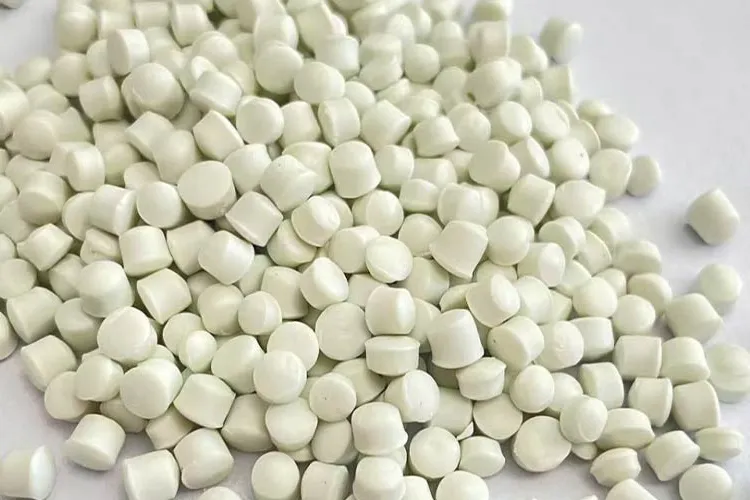
PET, PETG, or other approved resins are screened, blended, and metered before entering the injection molding stage. Rigorous drying and crystallization treatment removes moisture to below 50 ppm, preventing hydrolytic degradation and ensuring the mechanical and optical properties of every preform meet specification. Proper raw material preparation is the foundation of consistent downstream blow molding quality.
2. Injection Molding of Preform
The prepared resin is fed into an injection molding machine, heated and plasticized, then injected under controlled pressure into the preform mold cavity. Temperature, injection speed, hold pressure, and cooling time are precisely controlled to produce preforms with uniform wall thickness and molecular orientation. The finished preforms are cooled, ejected, and can be stored or transported before the blow molding stage, offering the scheduling flexibility that defines the two-stage approach.
3. Infrared Preheating
Preforms loaded onto the 96-position conveying system pass through a zoned infrared heating tunnel. Multiple independently controlled heating lamps create a precise thermal profile along the preform body, ensuring that the wall thickness area reaches the correct stretch temperature while the neck finish remains cool and dimensionally stable. Uniform preheating is critical to achieving even wall thickness distribution in the final bottle, and the 33 kW maximum heating system provides ample capacity for demanding production rates.
4. Stretch Blow Molding
The heated preforms are transferred into the 4-cavity blow mold where a stretch rod extends axially to orient the polymer chains longitudinally, immediately followed by high-pressure air at 35 kg/cm² inflating the preform radially to fill the mold cavity. This biaxial orientation dramatically improves the clarity, strength, barrier properties, and drop impact resistance of the finished bottle. The blow molding machine working principle at this stage requires precise synchronization of stretching speed and air pressure timing, managed automatically by the PLC system.
Applications of Fully Automatic Blow Molding Machine
Cosmetic Bottles
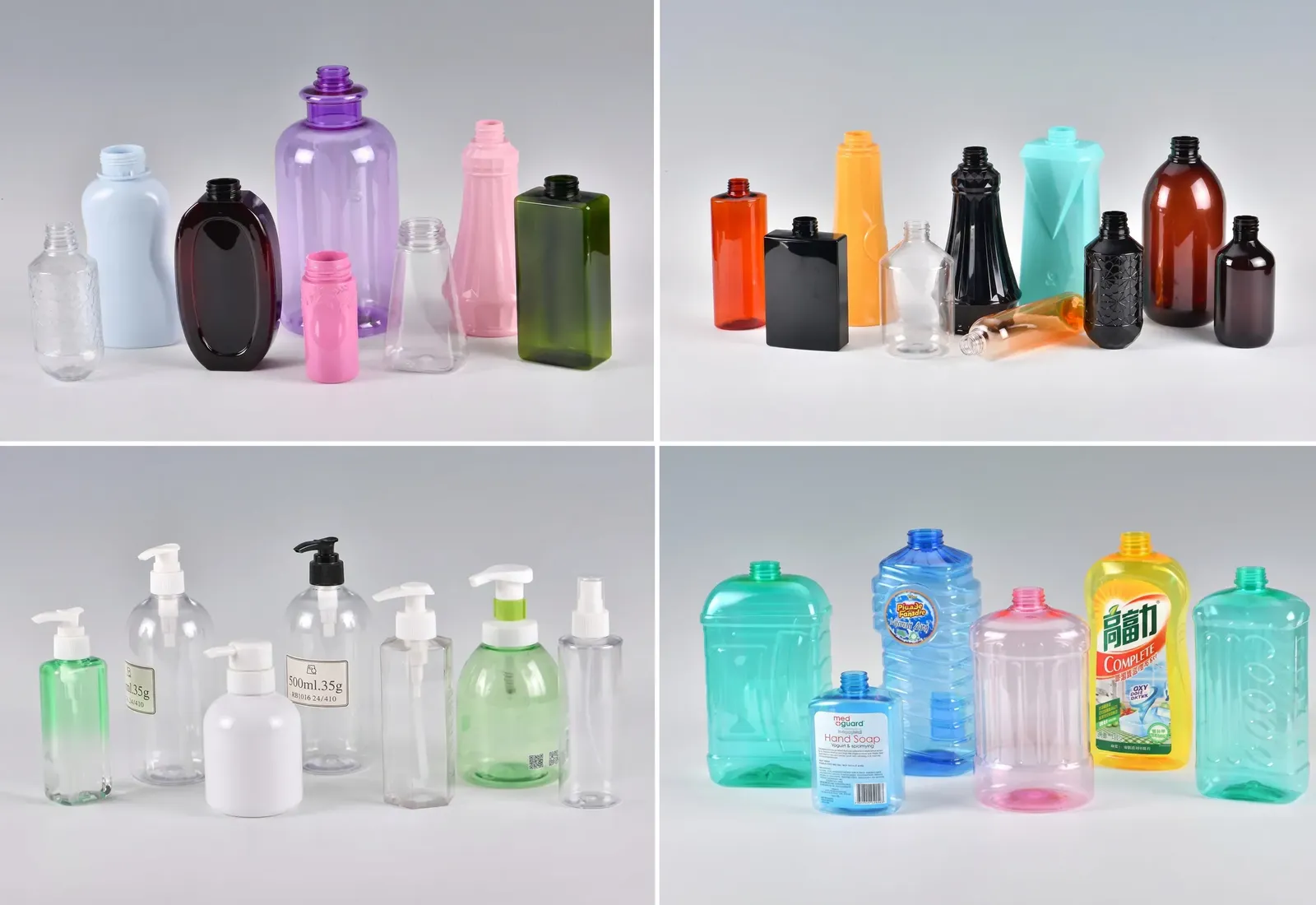
The machine is optimally designed as a cosmetic bottle blow molding machine, capable of producing lotion bottles, serum containers, facial cleanser bottles, toner bottles, and luxury skincare packaging with complex contours, premium surface clarity, and the tight neck tolerances that high-end cosmetic brands require.
Shampoo Bottles
Purpose-built as a shampoo bottle blow molding machine, the EPA.AS-4C76.2 handles the mid-to-large volume containers typical in personal hair care, supporting bottle sizes from small travel sizes up to 500ml family-size shampoo, conditioner, and hair treatment formats with consistent wall distribution and excellent label-panel flatness.
Dish Soap & Hand Wash
For daily chemical producers, the machine efficiently blows dish soap bottles, hand wash bottles, and kitchen cleaning product containers. Its 4-cavity output system ensures the high volumes needed to supply supermarket chains and household product brands, while the servo drive allows rapid changeover between bottle shapes as production schedules require.
Chemical Bottles
The robust PET blow molding capability supports industrial and household chemical packaging, including cleaning agents, disinfectants, and agricultural chemical bottles. PET material provides excellent chemical resistance and structural integrity while maintaining high optical clarity for product visibility on retail shelves, meeting both the functional and marketing requirements of chemical manufacturers.
Pharmaceutical Bottles
The machine can produce pharmaceutical-grade PET bottles for vitamin supplements, liquid medications, and nutraceutical products where product purity, barrier performance, and dimensional consistency are critical. The fully automated production cycle minimizes human contact with bottle surfaces, supporting clean-room compatible production environments and regulatory compliance requirements for pharmaceutical packaging.
Food & Beverage Bottles
As a versatile PET blow molding machine, the EPA.AS-4C76.2 is equally suited for food-grade packaging including edible oil bottles, juice bottles, condiment containers, and specialty food packaging. PET material is FDA-approved and globally recognized for food contact safety, and the biaxial orientation achieved during blow molding delivers the gas barrier properties essential for preserving product freshness and shelf life.
PET Jar Containers
As a capable PET jar blow molding machine, the EPA.AS-4C76.2 handles wide-mouth jar formats for cream cosmetics, hair masks, body butters, and solid personal care products. The wide neck diameter capability of up to 48mm accommodates jar necks that allow easy product dispensing, and the precise blow molding process ensures rim flatness critical for achieving effective sealing with induction-lined closures.
Key Components of the EPA.AS-4C76.2 Blow Molding Machine
1. Preform Conveying System
The 96-position preform holder carousel transports preforms continuously through the infrared heating zone and into the blow station at a controlled speed matched to production output requirements. The holders are engineered to grip preform neck rings securely while allowing the bodies to rotate freely for uniform 360-degree heating, eliminating cold spots that would cause uneven wall distribution in the finished bottle.
2. Infrared Heating Tunnel
Multiple independently controlled infrared heating zones generate a precisely calibrated thermal gradient along the preform body. Operators can tune each zone individually via the PLC interface to match the specific heating requirements of different preform weights, wall thicknesses, and resin types. The 33 kW maximum heating capacity with 17 kW normal operating power ensures efficient energy use while maintaining the throughput rate of 4,000 bottles per hour.
3. 4-Cavity Blow Mold Station
The heart of the EPA.AS-4C76.2 is its 4-cavity blow mold station, which simultaneously processes four preforms per cycle to achieve the rated output of 4,000 bph. Each cavity is individually cooled through precision-machined water channels with a 40 ltr/min flow rate at 8 to 10°C, ensuring rapid and uniform mold temperature control that is essential for cycle time optimization and consistent bottle quality across all four cavities.
4. Stretch Rod Assembly
The servo-driven stretch rod assembly extends a precisely controlled distance of up to 350mm during each blow cycle to perform axial orientation of the heated preform before air pressure radially expands it. Stretching speed, depth, and timing are fully programmable and synchronized with the blowing air valve sequence by the PLC control system. Correct stretch rod setup is the primary lever for achieving optimal biaxial orientation and target material distribution in the bottle sidewall.
5. High-Pressure Air System
The machine operates a dual air pressure system: low pressure at 7 kg/cm² for pneumatic actuator functions (600 ltr/min consumption) and high blowing pressure at 35 kg/cm² for the bottle formation step (4,000 ltr/min consumption). High-pressure air is typically supplied by a dedicated oil-free compressor to prevent contamination of the bottle interior. The fast valve response time of the high-pressure circuit is critical to achieving sharp bottle shoulder definition and full replication of complex mold surface details.
6. Servo Motor Drive System
World-class servo motors from internationally recognized brands drive all major machine axes including mold clamping, stretch rod actuation, and preform conveying. The servo system provides precise position and speed control with millisecond-level response, enabling smooth motion profiles that reduce mechanical shock on molds and tooling, extending their service life. Servo drives also enable precise energy recovery during deceleration phases, contributing to the machine overall energy efficiency rating.
7. PLC Control System
The industrial-grade PLC (Programmable Logic Controller) from a globally recognized brand manages all process parameters, safety interlocks, alarm monitoring, and production data logging. A color touchscreen HMI interface allows operators to access production recipes, adjust parameters in real time, view live production counters and efficiency reports, and respond to fault alarms during blow molding machine troubleshooting. Recipe storage functionality enables fast changeover when switching between different bottle designs on the same machine.
8. Cooling Water Circuit
The dedicated mold cooling circuit circulates chilled water at 5 to 6 kg/cm² operating pressure and 8 to 10°C temperature through precision-drilled channels in the blow mold halves. At a flow rate of 40 ltr/min, the system extracts heat rapidly from the formed bottle, enabling the shortest possible mold cooling time within each cycle. Consistent mold temperature is a key factor in achieving uniform bottle shrinkage, dimensional accuracy, and surface gloss in cosmetic and personal care container applications.
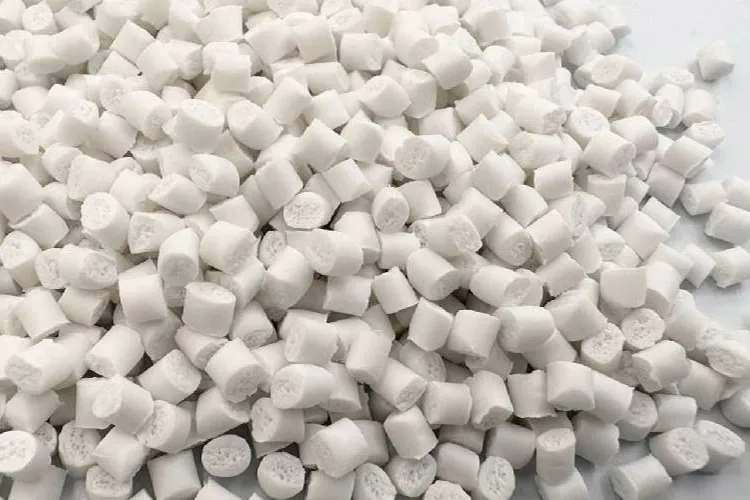
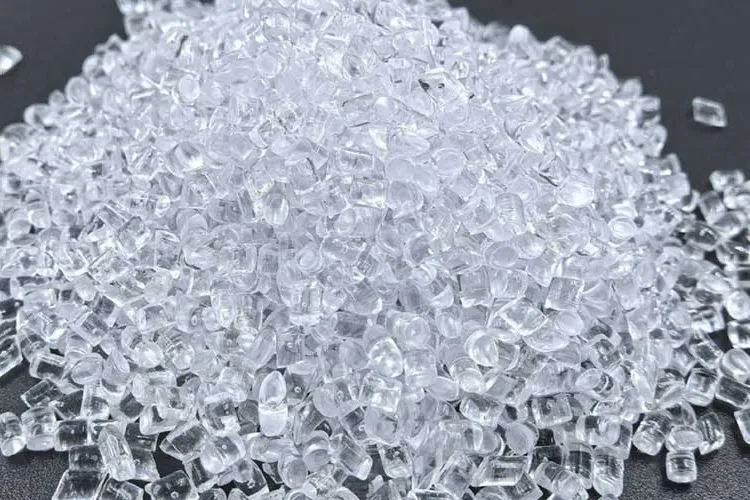
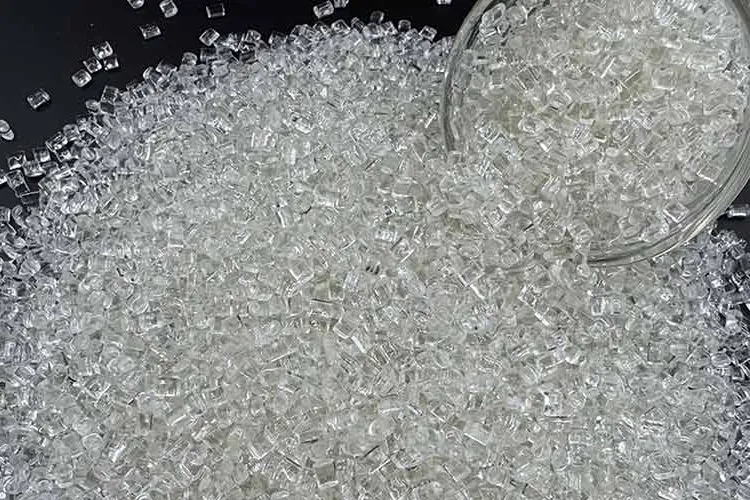
Raw Materials for Two-Stage Blow Molding Machine
PET (Polyethylene Terephthalate)
PET is the most widely used preform material for two-stage blow molding and the primary resin for the EPA.AS-4C76.2. Its outstanding combination of optical clarity, mechanical strength, chemical resistance, and food safety approval makes it the material of choice for cosmetic bottles, beverage containers, and pharmaceutical packaging. PET offers excellent recyclability, supports the circular economy goals of major cosmetic and FMCG brands, and achieves superior surface gloss and label adhesion in final container form.
PETG (Polyethylene Terephthalate Glycol)
PETG is the co-polyester variant optimized for the demanding requirements of premium cosmetic and personal care packaging. Compared to standard PET, PETG offers higher impact resistance, greater flexibility, and excellent compatibility with a wider range of cosmetic formulations including those containing fragrance oils and essential oil ingredients that can stress standard PET. PETG is particularly valued for luxurious surface finishes, complex embossed designs, and the deep scratch-free clarity expected in premium skincare and perfume packaging.
PP (Polypropylene)
Polypropylene preforms can be processed on two-stage blow molding equipment for applications where elevated temperature resistance is required, such as hot-fill packaging for foods and beverages processed at temperatures up to 90°C. PP is also widely used in pharmaceutical and food packaging where high chemical resistance, regulatory compliance, and microwave safety are important. Its lower density compared to PET results in lighter containers that reduce raw material cost and shipping weight across large production volumes.
PC (Polycarbonate)
Polycarbonate is selected for applications demanding exceptional impact resistance combined with high optical clarity and excellent temperature stability. PC bottles are used in reusable containers, water bottles, and packaging applications where the end-use environment involves mechanical stress or elevated temperature exposure that would cause standard PET to deform or fail. The high strength-to-weight ratio of PC and its ability to be sterilized by multiple methods make it valuable in laboratory, medical device, and premium reusable consumer container markets.
PE (Polyethylene)
Polyethylene, both HDPE and LDPE variants, offers excellent chemical resistance, flexibility, and impact strength at low cost, making it the dominant material for household chemical bottles, detergent containers, and personal care packaging where a degree of container squeeze ability is required for product dispensing. PE is particularly valued for its compatibility with a broad range of chemical formulations, its low moisture vapor transmission rate, and its established recyclability infrastructure across global markets.
Specialty & Blended Resins
Beyond the standard resin families, the two-stage blow molding process supports specialty materials including PLA (polylactic acid) from corn starch for sustainable packaging, Tritan copolyester for BPA-free reusable containers, and various barrier-enhanced PET blends with MXD6 or nano-clay additives for extended shelf-life beverage and food packaging. Ever-Power can advise on material compatibility with specific equipment configurations and provide technical support for developing new container designs using emerging sustainable materials.
 |
 |
 |
 |
Cosmetic Bottle Blow Molding Mold Features
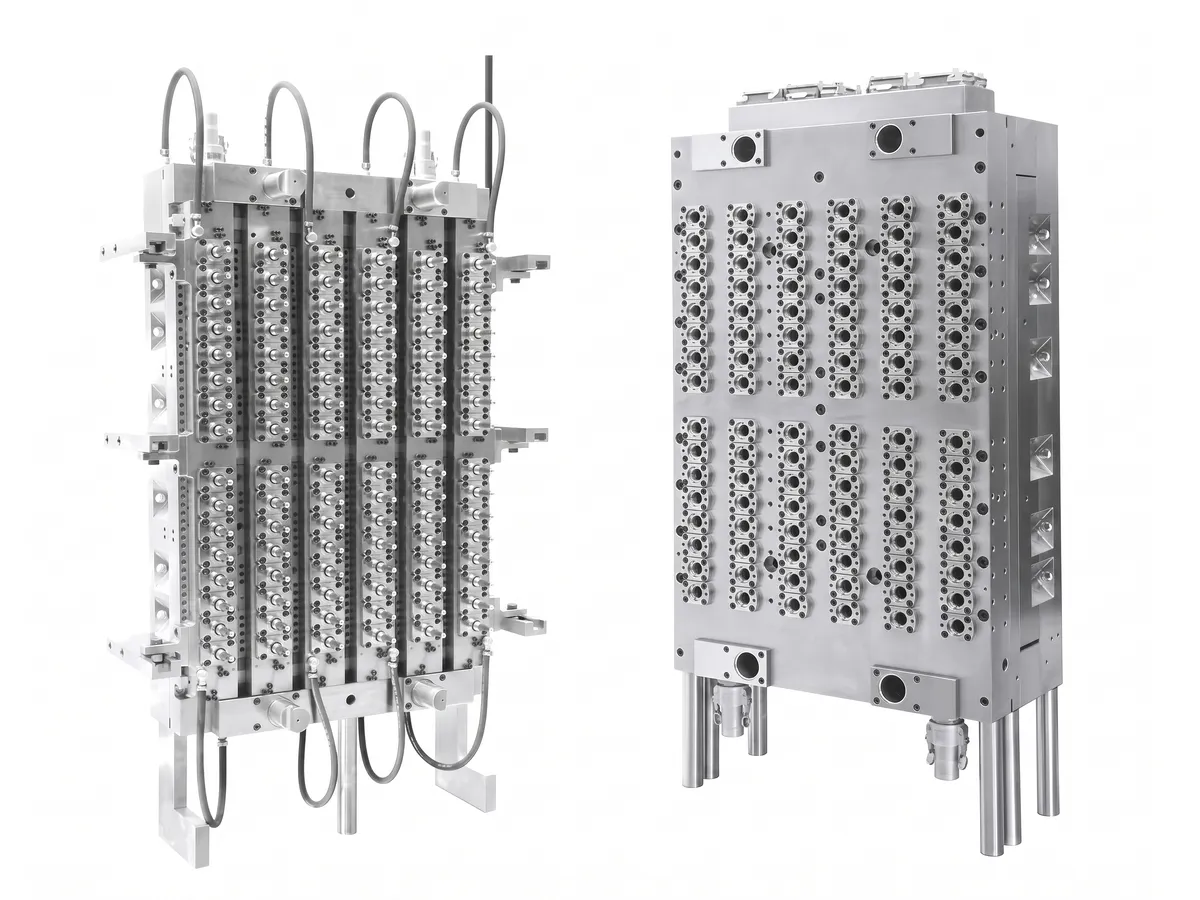
Preform Injection Mold
Dual-Part Die Lip Design
The injection mold die lip is composed of two independently precision-machined parts that together guarantee perfect coaxiality between the gate and cavity during preform formation. This design eliminates the asymmetric wall thickness variations that single-piece die lip designs can introduce, ensuring that every preform enters the blow station with uniform material distribution for consistent bottle quality.
Optimized Cooling Water Channels
The mold cooling circuit is engineered with CNC-drilled conformal channels that follow the preform body contour closely, delivering highly uniform heat extraction across the full surface area of each cavity. Faster and more uniform preform cooling enables shorter cycle times, improved preform crystallinity control, and better dimensional stability, directly reducing per-unit production costs and supporting high-speed blow molding machine operation.
Premium Mold Steel: 2316 and 420
All cavity formation components are manufactured from imported die steel grade 2316, which provides excellent corrosion resistance, high polishability for optical-quality preform surfaces, and the toughness required for multi-million-cycle production environments. Core plates, cavity plates, and structural components are manufactured from 420 stainless steel to ensure chemical resistance against aggressive release agents and cleaning compounds used in cosmetic packaging production facilities.
Advanced Multi-Type Design
The preform mold system supports advanced tooling configurations where a single mold base can accommodate different cavity inserts to produce multiple preform designs, reducing the total tooling investment for manufacturers with diverse bottle portfolios. Standard interchangeable fittings and modular design principles ensure that cavity inserts can be changed rapidly, and the mold is engineered for straightforward maintenance access without specialized tools or extended machine downtime.
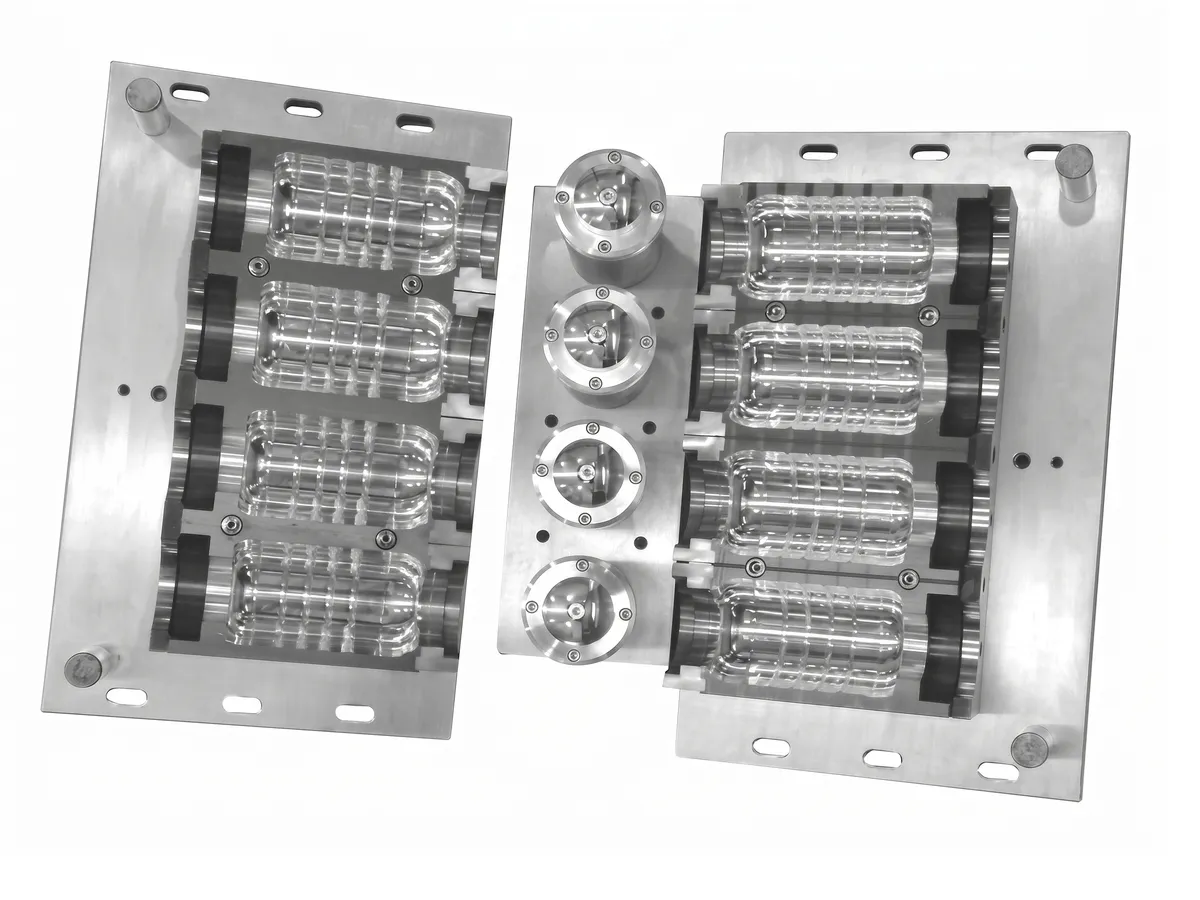
Blow Mold
High-Quality Steel Construction
Blow molds are machined from premium high-grade steel selected for its hardness, thermal conductivity, corrosion resistance, and machinability. The correct steel grade for the blow mold is determined by the anticipated production volume, the aggressiveness of the cooling medium, and the surface finish requirements of the specific cosmetic or daily chemical bottle being produced, with harder steel grades used for the highest-volume applications to maximize service life between refurbishment cycles.
3D Software-Driven Bottle Design
Every blow mold produced by our tooling division is designed using internationally recognized professional 3D CAD/CAM software, enabling precise modeling of complex cosmetic bottle geometries, virtual simulation of the blow molding process for wall thickness prediction, and direct CNC machine programming from the digital model. This digital workflow eliminates manual interpretation errors, reduces design-to-mold lead times, and ensures that the first article from a new mold matches the approved bottle design specification with minimal adjustment cycles.
Versatile Bottle Design Portfolio
Our mold design team offers a comprehensive library of standard cosmetic and daily chemical bottle designs available for immediate tooling production, as well as full custom bottle development service for brands requiring proprietary packaging. Standard designs cover round, oval, rectangular, and multi-faceted profiles in the 30ml to 500ml range, while custom designs can incorporate embossed logos, textured surfaces, integral grips, and other brand-differentiation features that create distinctive shelf presence for cosmetic and personal care products.
CNC-Machined Precision Components
All mold metal components are processed on advanced CNC machining centers to tolerances that ensure proper mold closure, parting line quality, and dimensional accuracy of the finished bottle. CNC machining eliminates the dimensional variation inherent in conventional machining approaches, and combined with the conformal cooling channel design and premium steel selection, produces blow molds that maintain consistent bottle quality across multi-million-cycle production runs characteristic of high-volume cosmetic packaging operations.
 |
 |
Full Electric Blow Molding Machine Troubleshooting
1. Uneven Wall Thickness
Uneven wall distribution in finished bottles is typically caused by non-uniform preform heating profiles in the infrared oven. Check that all heating lamp zones are functioning correctly and that the heating profile is properly calibrated to the specific preform geometry and resin type in use. Also inspect preform rotation for consistency, as sticking or irregular rotation creates cold spots. Confirm that the stretch rod is centered and moving at the correct programmed speed before adjusting heating parameters.
2. Bottle Haze or Cloudiness
Optical haze in PET or PETG bottles during a blow molding machine troubleshooting investigation is most often linked to crystallization caused by incorrect preform temperature during blowing. If the preform is too cold in any zone, the PET crystallizes during stretching rather than orienting amorphously, producing milky whitish areas. Verify infrared oven temperature profiles and thermocouple calibration. Also check preform moisture content, as inadequately dried PET resin produces hydrolytic degradation during injection molding that manifests as persistent haze in the blow-molded bottle.
3. Neck Deformation
Cosmetic bottle neck deformation during blow molding indicates that the preform neck finish is being overheated, causing it to lose dimensional integrity before reaching the blow mold. The infrared oven shielding system that protects the preform neck from heat exposure must be correctly positioned and in good condition. Inspect neck shields for damage or misalignment. Additionally, confirm that the overall oven temperature setting is not elevated beyond what is needed for the body zone, as excessive radiant heat can affect the neck even with shielding in place.
4. Incomplete Bottle Formation
When bottles fail to fully form to the mold cavity shape, particularly in base corners and shoulder areas, the primary suspect is insufficient blowing pressure or inadequate high-pressure air supply volume. Verify that the high-pressure compressor is delivering the specified 35 kg/cm² at the machine and that flow capacity meets the 4,000 ltr/min maximum demand. Also inspect high-pressure air valves for wear or sticking, and check that blow pin alignment is correct for full air delivery to the preform interior during the blow cycle.
5. Flash at Parting Line
Excessive flash at the blow mold parting line indicates either worn mold sealing faces, insufficient mold clamping force, or mold contamination preventing proper closure. Clean parting line surfaces thoroughly and inspect for wear or damage. Verify that the mold clamping stroke and force parameters in the PLC are correctly set for the installed mold. For persistent flash issues, inspect the mold clamping mechanism components for wear and arrange for mold regrinding of parting line faces if surface damage is confirmed during inspection.
6. Low Output Rate
When the machine is not achieving its rated 4,000 bph output despite correct parameter settings, the investigation should focus on cycle time analysis using the PLC data logging function. Identify which machine movement or wait state is extending each cycle beyond the design time. Common causes include extended mold cooling time due to insufficient chilled water flow or elevated coolant temperature, slow preform conveying due to mechanical wear, or extended blow cycle time due to high-pressure air system inadequacy. Systematic cycle time analysis is the most efficient approach to output rate restoration.
Why Choose Ever-Power's Blow Molding Machine?
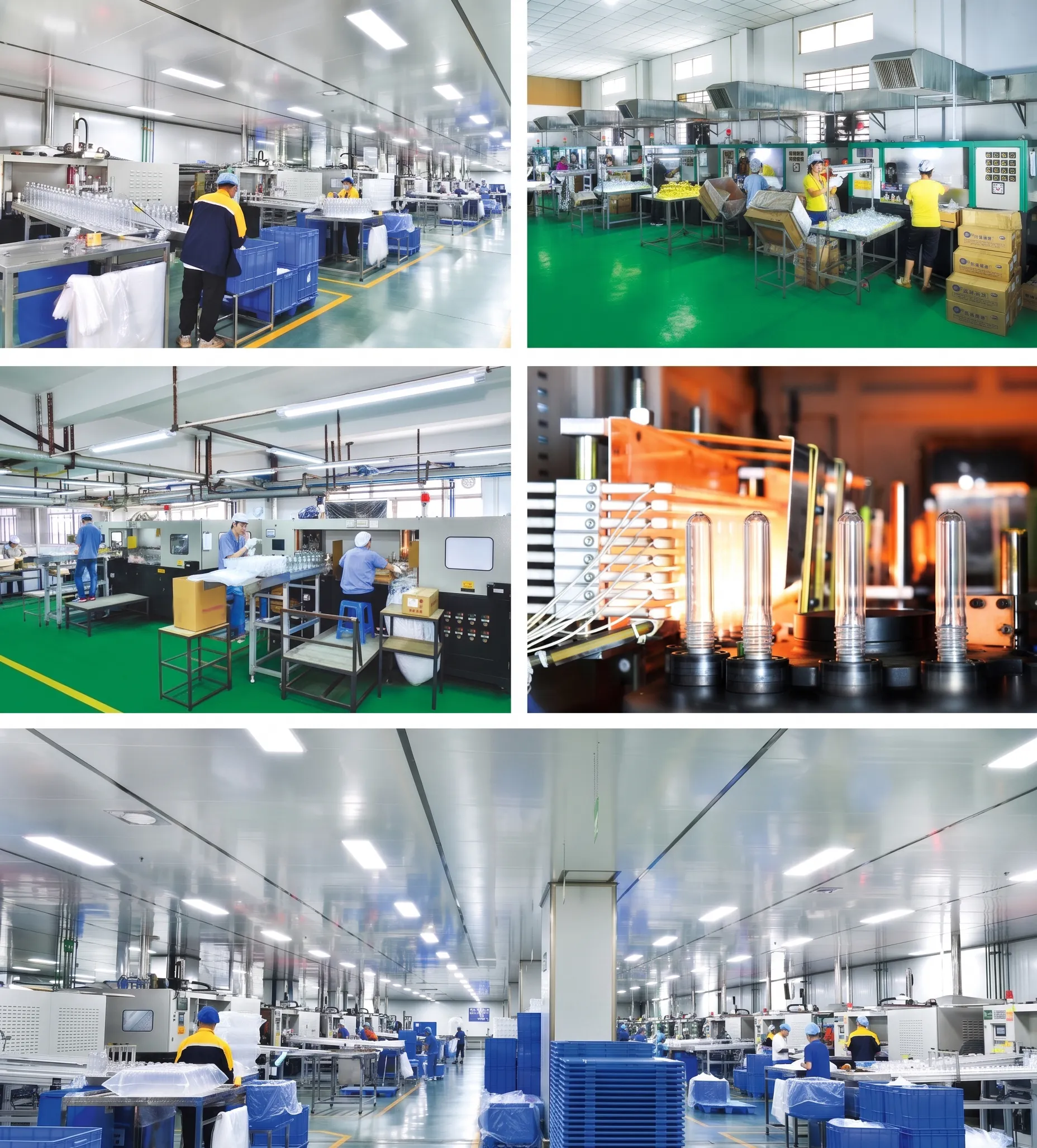
Mexico Ever-Power ISBM Machinery Co., Ltd is primarily engaged in the research and development, production, sales, and trade of automatic injection blow molding machines and injection stretch blow molding machines. Our product types encompass injection blow molding machines, extrusion blow molding machines, injection stretch blow molding machines, and auxiliary equipment, serving the complete spectrum of plastic packaging production requirements. Our expert engineering team brings together specialists with deep combined experience in injection-blow machinery engineering and injection-blow mold design. Rich theoretical knowledge combined with extensive practical project experience enables us to provide customers with comprehensive pre-sale consultation, professional sales support, and responsive after-sale technical services throughout the entire equipment lifecycle.
Our product applications cover pharmaceutical packaging, food packaging, health care packaging, cosmetic packaging, and industrial plastic packaging. Ever-Power adheres to the enterprise development tenet of self-reliance, integrity, pragmatism, innovation, and responsibility, building a one-stop turnkey project approach to deliver high-quality injection-blow products that satisfy user expectations for performance, reliability, and long-term value.
- 20+ Years of Innovation
Since 2003, Henggang Machinery has dedicated over two decades to the research, development, and refinement of blow molding technology. This sustained focus has generated a portfolio of national patents and earned the company leadership positions in high-end cosmetic, food, and pharmaceutical packaging equipment, with proven installations across more than 30 countries worldwide. - 20,000+ m² Production Base
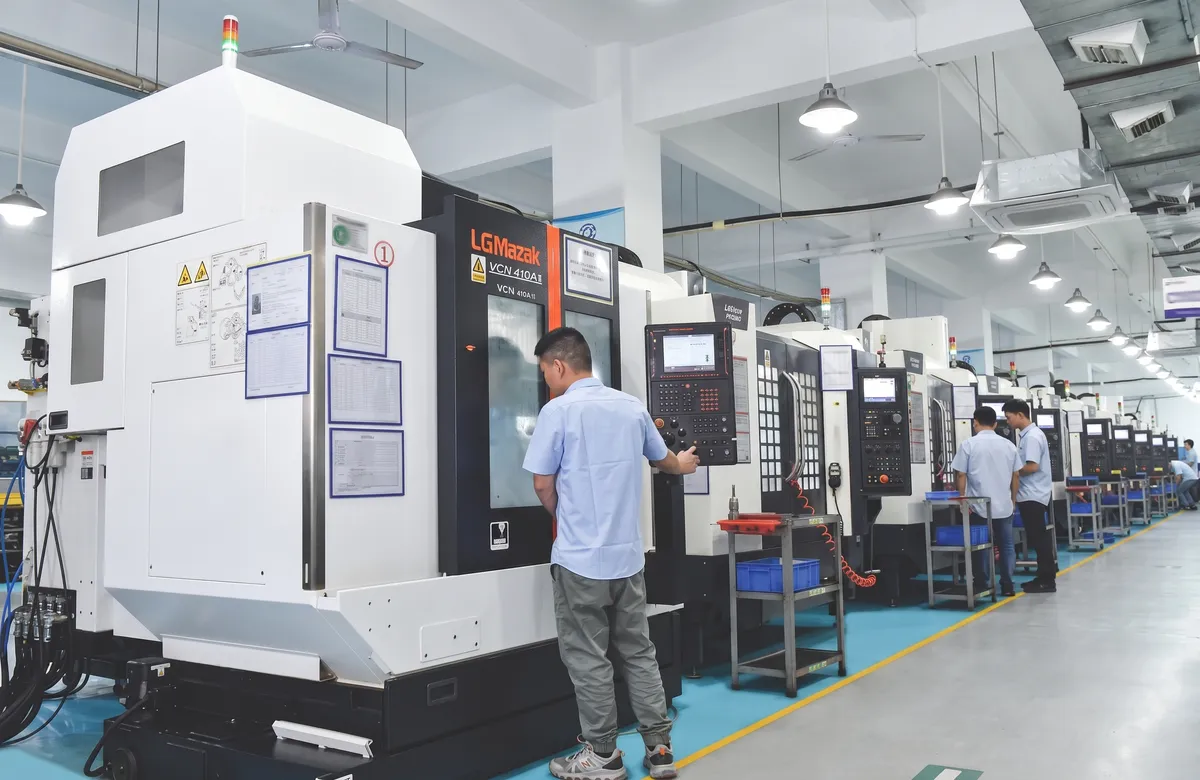
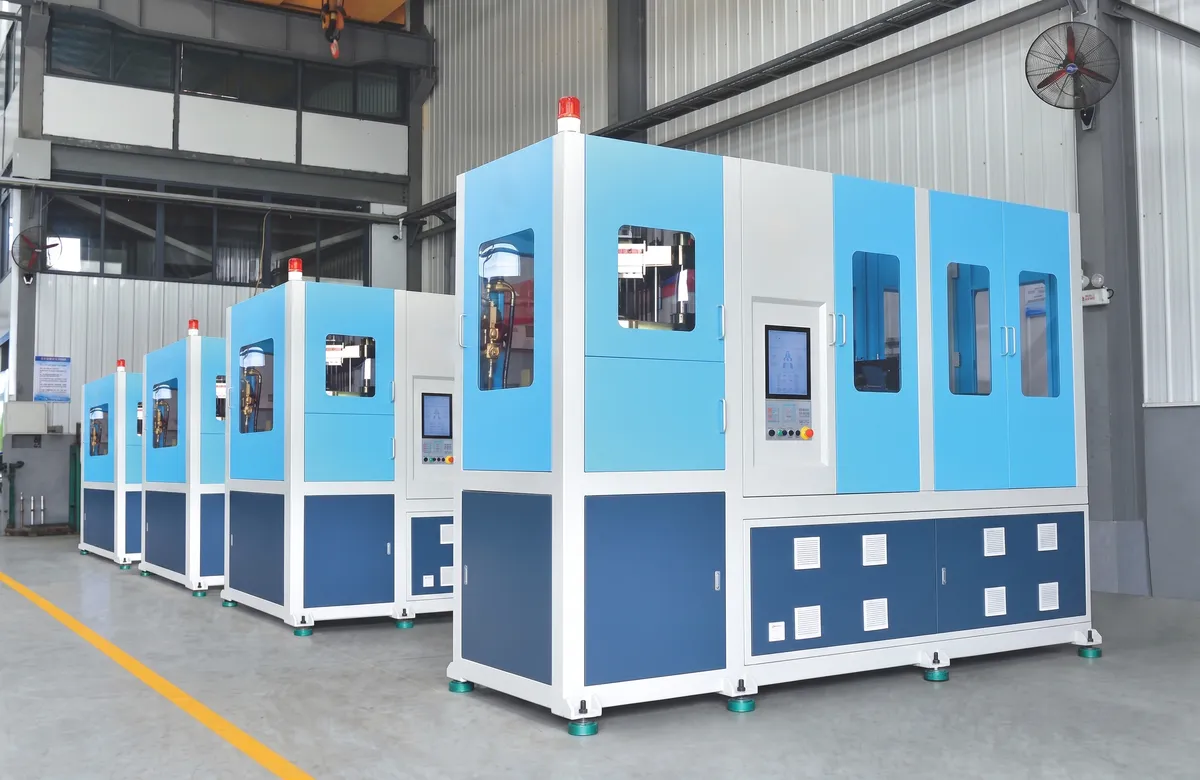
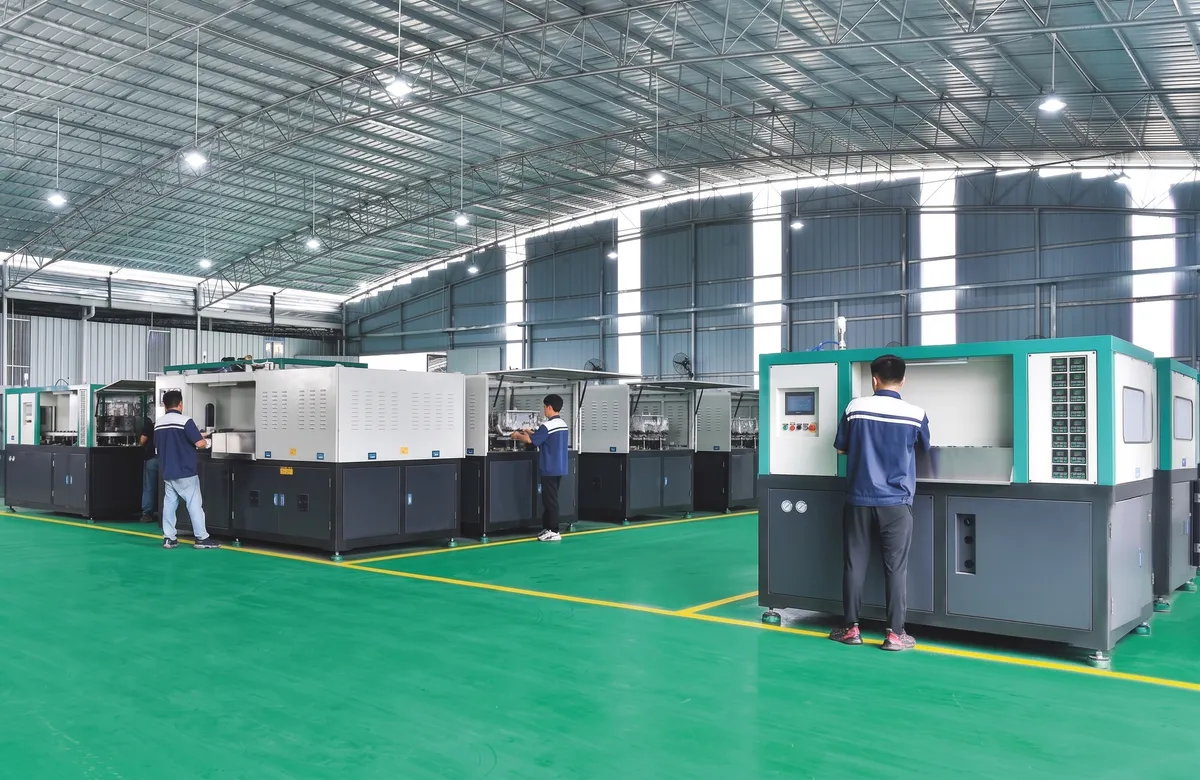
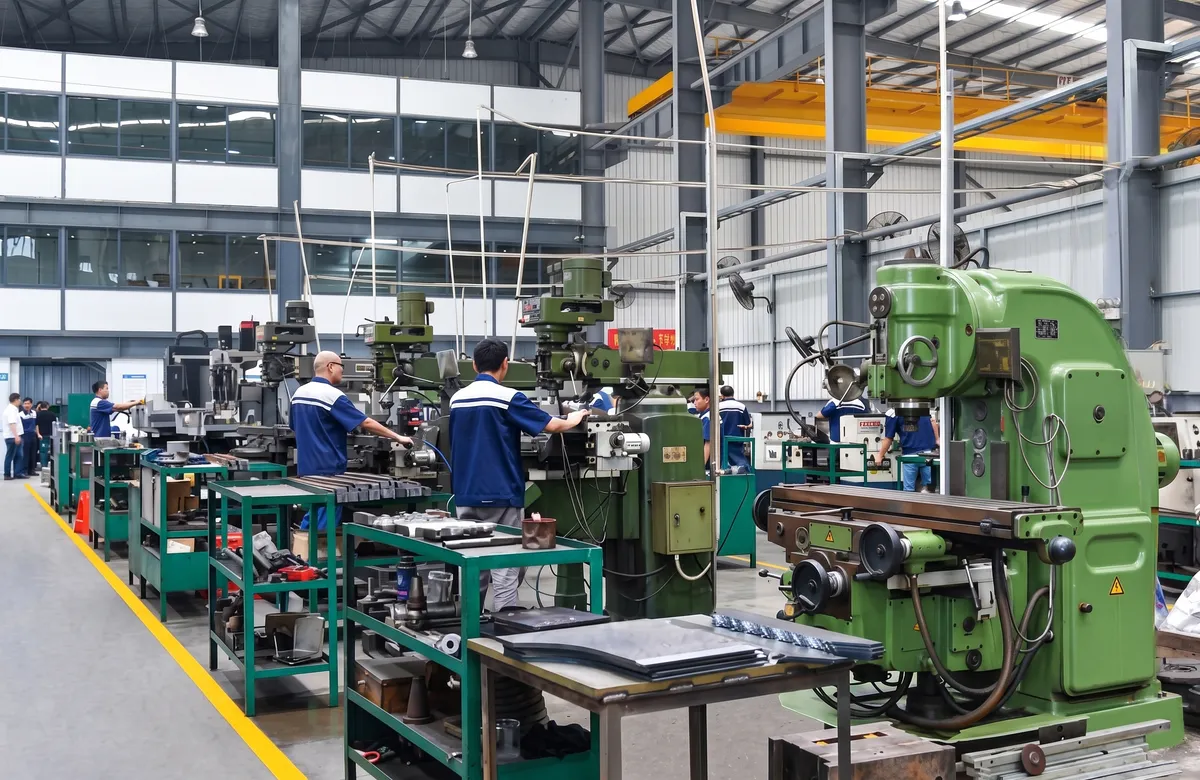
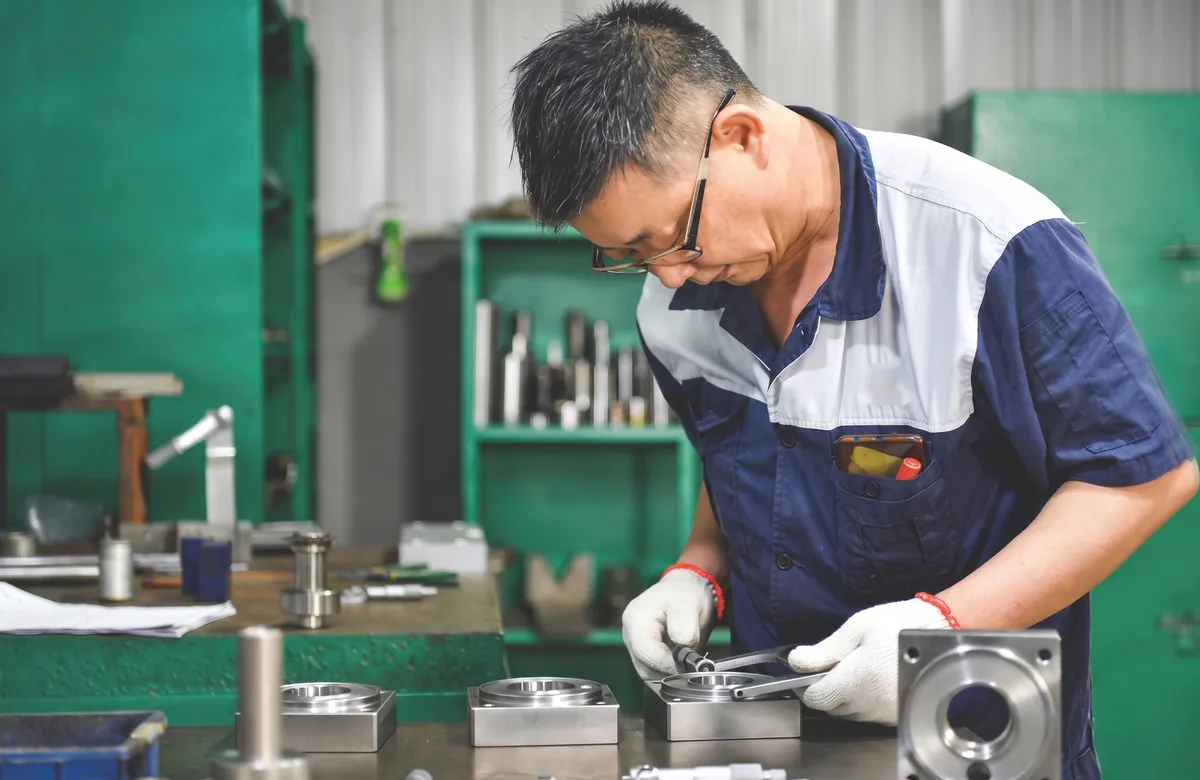
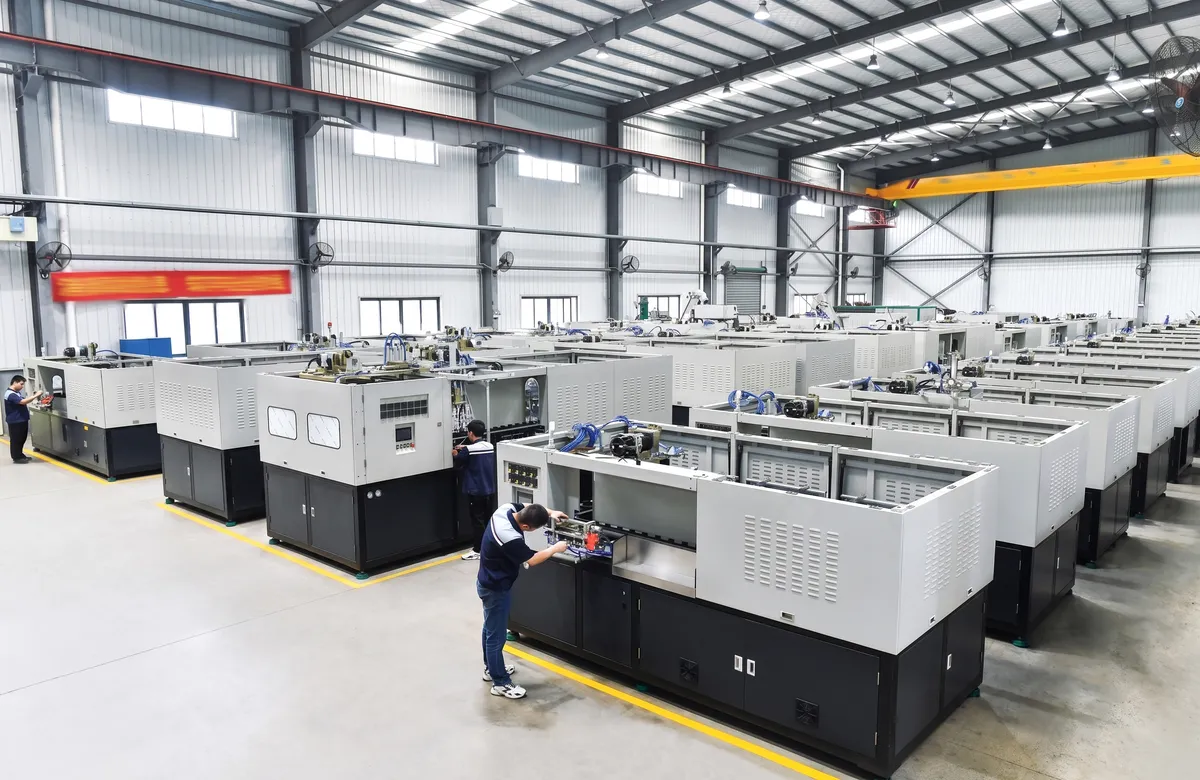
Our manufacturing facility spans over 20,000 square meters in Yingfu Industrial Zone, equipped with advanced CNC machining centers, precision assembly areas, and comprehensive testing infrastructure. This scale enables us to maintain quality control at every production stage and meet delivery schedules for multiple simultaneous orders from customers across global markets. - Global Brand Partners
Our blow molding machines have been chosen by globally recognized brands including Walmart, Walch, Blue Moon, Liby, PROYA, and Estee Lauder as part of their packaging supply chain. These partnerships with demanding multinational brands demonstrate the quality, reliability, and production consistency that Ever-Power machines deliver at the scale required by major consumer goods companies. - Comprehensive Material Range
Mexico Ever-Power ISBM Machinery Co., Ltd offers machinery solutions covering the full spectrum of plastic packaging materials including HDPE, LDPE, PET, PETG, PP, PS, PPSU, PC, Tritan, ABS, PLA, EVA, PCTG, and bio-based materials, enabling customers to select the optimal resin for their specific fill product, regulatory environment, and sustainability commitments without changing equipment suppliers.
 |
 |
 |
 |
 |
 |
Frequently Asked Questions
Q: What is the actual output of the EPA.AS-4C76.2 fully automatic blow molding machine in production?
A: The theoretical output is 4,000 bottles per hour using 4 cavities simultaneously. In actual production environments, effective output typically ranges from 3,600 to 3,900 bph depending on bottle complexity, operator efficiency, and brief scheduled pauses for quality checks. The servo-driven system maintains consistent cycle times once steady-state production is established, minimizing variation between shifts and helping operators achieve output rates close to the machine rated capacity.
Q: What bottle sizes and shapes can this cosmetic blow molding machine produce?
A: The EPA.AS-4C76.2 can produce containers from very small volumes up to 500ml maximum. The maximum container body diameter is 65mm and maximum height is 250mm with a neck diameter range of up to 48mm. The machine handles round, oval, rectangular, and special-shaped bottles including complex asymmetric cosmetic forms. For bottles near the maximum size envelope, please share your bottle drawing with our technical team to confirm compatibility and discuss the appropriate mold design approach before tooling is commissioned.
Q: How does a two-stage blow molding machine work differently from a one-step system?
A: In the two-stage blow molding machine process, preform injection molding and bottle blowing are performed as two separate steps on two independent machines. Preforms are produced, cooled to ambient temperature, and stored before being fed into the blow molding machine where they are reheated and blown. This separation allows each machine to operate at its optimum speed independently. In contrast, a one-step system performs injection, conditioning, and blowing in a single machine in one continuous cycle without the preform cooling down. The two-stage approach offers higher output rates and preform supply flexibility, while the single-stage approach suits specialty and pharmaceutical packaging with no-touch production requirements.
Q: What are the compressed air requirements for this plastic blow molding machine?
A: The EPA.AS-4C76.2 requires two separate compressed air supplies. Low pressure air at 7 kg/cm² with consumption up to 600 ltr/min is used for all pneumatic actuator functions. High pressure blowing air at 35 kg/cm² with consumption up to 4,000 ltr/min is required for the bottle formation step. The high-pressure air supply should ideally be provided by an oil-free compressor to prevent any oil contamination of bottle interiors. We strongly recommend consulting with an air compressor specialist to size your compressor and air receiver correctly for continuous operation at full machine output before installation.
Q: What is involved in regular blow molding machine maintenance for this model?
A: Routine blow molding machine maintenance involves daily checks of lubrication points, cooling water temperature and flow rate verification, inspection of blow pins and sealing rings for wear, and PLC alarm log review. Weekly tasks include infrared lamp inspection and replacement of any underperforming lamps, cleaning of preform holders, and checking servo drive status. Monthly maintenance covers cleaning of cooling water strainers, checking mold alignment and clamping force, and inspecting high-pressure air fittings for leaks. Ever-Power provides a detailed maintenance schedule and spare parts recommendations with every machine, and our technical team can assist remotely with blow molding machine troubleshooting via video call.
Q: Can this machine process PETG material for premium cosmetic bottles?
A: Yes, the EPA.AS-4C76.2 is compatible with PETG material and was specifically developed as a cosmetic bottle blow molding machine capable of processing both standard PET and PETG. PETG processing requires slightly different oven temperature settings and blow timing compared to PET due to PETG lower crystallization tendency and different stretch behavior. Our engineering team will provide PETG-specific start-up parameters as part of the machine commissioning process, and can provide reference settings from existing PETG production installations to help you achieve optimal results with your specific bottle design and PETG resin grade.
Q: How long does the mold changeover take on this blow molding machine for plastic bottles?
A: With experienced operators and proper tooling preparation, complete mold changeover on the EPA.AS-4C76.2 including removal of the existing mold set, installation of the new mold, water connection, and initial parameter loading from a saved recipe typically takes 40 to 60 minutes. First article inspection and minor parameter fine-tuning may add another 20 to 30 minutes before full production speed is achieved. Changeover time decreases significantly as operators gain experience with the machine. PLC recipe storage ensures that previously optimized settings for each bottle design are immediately accessible for rapid process restart after mold change.
Q: Does Ever-Power provide the preform injection mold along with the blow molding machine?
A: Yes. Ever-Power offers a complete tooling package including preform injection molds and blow molds as part of a turnkey project supply. Our in-house mold design team works from your approved bottle design and sample to engineer both the preform and blow mold as a matched system, ensuring that preform wall distribution, stretch ratio, and blow mold cavity geometry are optimized together for the best possible bottle quality and process stability. This integrated approach eliminates the compatibility risks that sometimes arise when preform and blow molds are sourced from different suppliers.
Q: What training and installation support does Ever-Power provide?
A: Every EPA.AS-4C76.2 purchase includes on-site installation and commissioning support by our technical engineers, who will supervise machine installation, complete all electrical and utility connections, perform initial machine qualification runs, and certify that the machine meets its rated output and quality specifications before handover. Operator training covering daily operation, parameter adjustment, mold changeover procedure, and basic blow molding machine troubleshooting is provided on-site during commissioning. Remote technical support via video call is available indefinitely after installation for process questions and diagnostic assistance from our engineering team.
Q: What quality certifications does the EPA.AS-4C76.2 high speed blow molding machine carry?
A: The EPA.AS-4C76.2 and the broader Henggang Machinery product range are manufactured under a rigorous quality management system and carry internationally recognized certifications including CE certification for European market compliance and ECM verification of compliance. All electrical components, safety interlocks, and machine guarding are designed to meet the safety standards required for industrial machinery sold into regulated markets. Certification documentation is provided with each machine delivery, and Ever-Power can assist with any additional technical documentation required for import clearance or local regulatory approval in your country.
Customer Reviews
Priya Mehta, Personal Care Packaging, India
"We have been operating the EPA.AS-4C76.2 for about eight months now at our shampoo bottle production facility and honestly the output consistency has been really impressive. We are running three shifts and getting very close to the rated 4,000 bph on our standard 400ml shampoo bottle. The biggest surprise was how stable the heating profile remained even after changing preform suppliers. The Ever-Power team helped us recalibrate the oven zones when we switched and we were back up to full speed within one shift. Excellent machine."
Carlos Fernandes, Cosmetic Packaging, Brazil
"We produce private-label cosmetic bottles for several brands here in Brazil and the bottle quality coming off this machine is noticeably better than what we were getting from our old equipment. The PETG processing in particular is very stable. We produce oval lotion bottles in 200ml and 350ml sizes and the dimensional consistency between cavities is very tight. Our brand customers have commented on the surface clarity improvement. Delivery took about 11 weeks and the installation team was professional."
Ahmet Yilmaz, Daily Chemical Manufacturer, Turkey
"What sold me on this machine was the energy efficiency. We compared three suppliers and the Ever-Power servo drive system drew significantly less power during normal operation than the comparable hydraulic machines we trialed. With electricity costs where they are in Turkey right now that matters a lot. We have been running for five months producing 250ml hand wash bottles and the power bill is noticeably lower than our old line. The PLC interface is also easier to navigate than I expected."
Nguyen Thanh Liem, Cosmetic Bottle Producer, Vietnam
"I was skeptical because we had a bad experience with another Chinese machine supplier about four years ago. But Ever-Power has been completely different. The pre-sale technical support was thorough and they answered every question we had about the mold specifications for our irregular shaped bottle. Installation took two weeks and the technicians were very knowledgeable. We have been running six months with almost no downtime. The after-sales response is fast too. One sensor failed at week three and a replacement arrived in four days."
Kim Soo-Yeon, Cosmetics Industry, South Korea
"We specifically needed the machine to handle a complex asymmetric bottle shape for our facial cleanser product line. Most suppliers told us there would be problems but Ever-Power actually ran a sample trial with our preform design before we signed the contract. That gave us confidence. The machine handled the special-shaped bottle without any issues and wall thickness distribution on the complex areas is actually better than we expected. The output is around 3,800 bph on this shape which is fine for our volume requirement."
Mohammed Al-Rashidi, Household Products, Saudi Arabia
"Good machine, good price, good service. I have purchased three blow molding machines from different suppliers over the years and this has been the smoothest experience. Crating and shipping were well organised, no damage on arrival. Commissioning was done by two experienced engineers who stayed on site for a week. We produce 300ml dish soap bottles and have been running at full capacity for four months. My operators like the touchscreen interface. Would buy again."
Fatima Ouahbi, Packaging Manufacturer, Morocco
"The logistics coordination from Ever-Power was excellent. We import from Mexico regularly and the shipping documentation, customs support, and communication through the whole process was much better than what we typically experience. The machine arrived on schedule and in perfect condition. We have been producing PET cosmetic jars for about seven months now. Our quality team is happy with the dimensional consistency and we have reduced our line rejection rate compared to our previous machine. Overall a very positive experience."
Andrzej Kowalski, Personal Care Production, Poland
"We operate a high-speed filling line for conditioner products and needed a blow molding machine that could keep pace without becoming a production bottleneck. The 4,000 bph output on our 480ml conditioner bottle is more than sufficient to maintain buffer stock for our filling line. The mold changeover time is also reasonable at about 45 minutes which lets us switch between our 200ml and 480ml designs within a single shift. The servo system makes changeover smoother than we expected."
Isabella Romano, Premium Skincare Brand, Italy
"I want to mention the mold design service specifically. We had a new bottle design for our premium skincare line that required a textured surface pattern and an unusual neck shape. The Ever-Power mold team worked with us through multiple design iterations via video call and sent us 3D renderings at each stage. The final mold produced bottles that matched our approved sample on the very first run. That almost never happens with custom tooling in my experience. We will definitely order the next mold from them as well."
Additional information
| Edited by | Yjx |
|---|
Related products
-
EPA.ES-4C76 Fully Automatic Blow Molding Machine for Pesticide and Chemical Bottles
-
EPA.ES-2C130 Fully Automatic Blow Molding Machine for Daily Chemicals & Cosmetic Bottles
-
EPA.AS-4C76.2 Fully Automatic Blow Molding Machine for Medicine Bottles
-
EPA.ES-2C100 Fully Automatic Blow Molding Machine for Daily Chemicals & Cosmetic Bottles