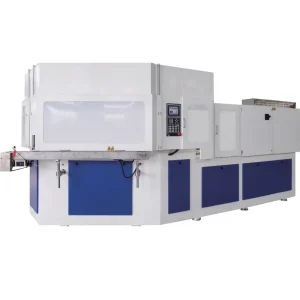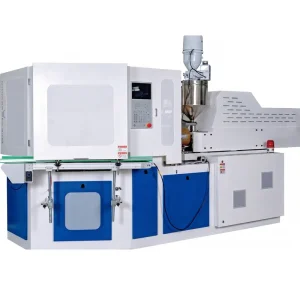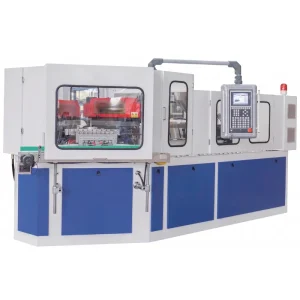
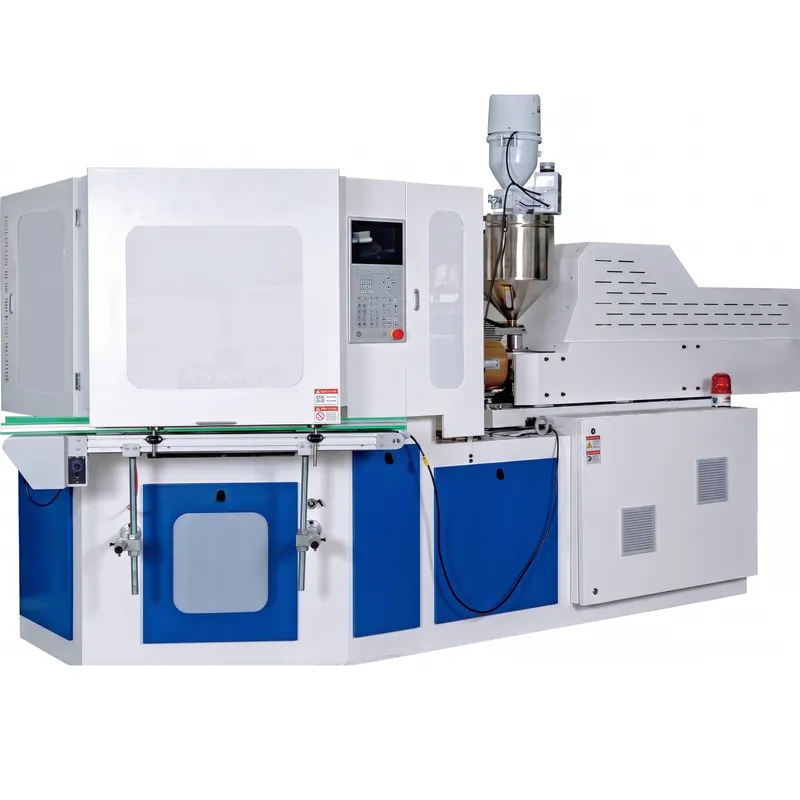
Ersatz für die Spritzblasformmaschine ZQ40 für das Modell SUMA 40iB
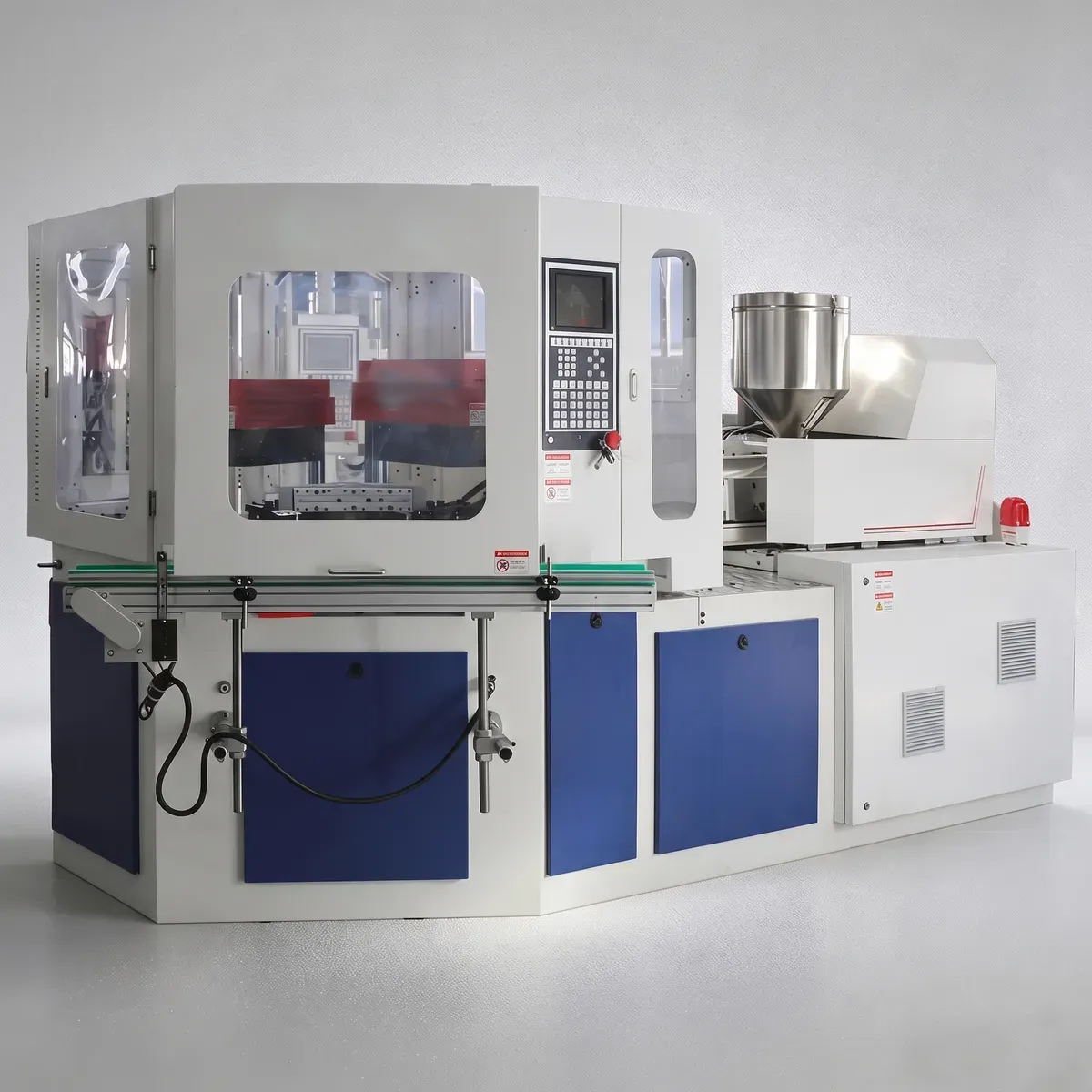
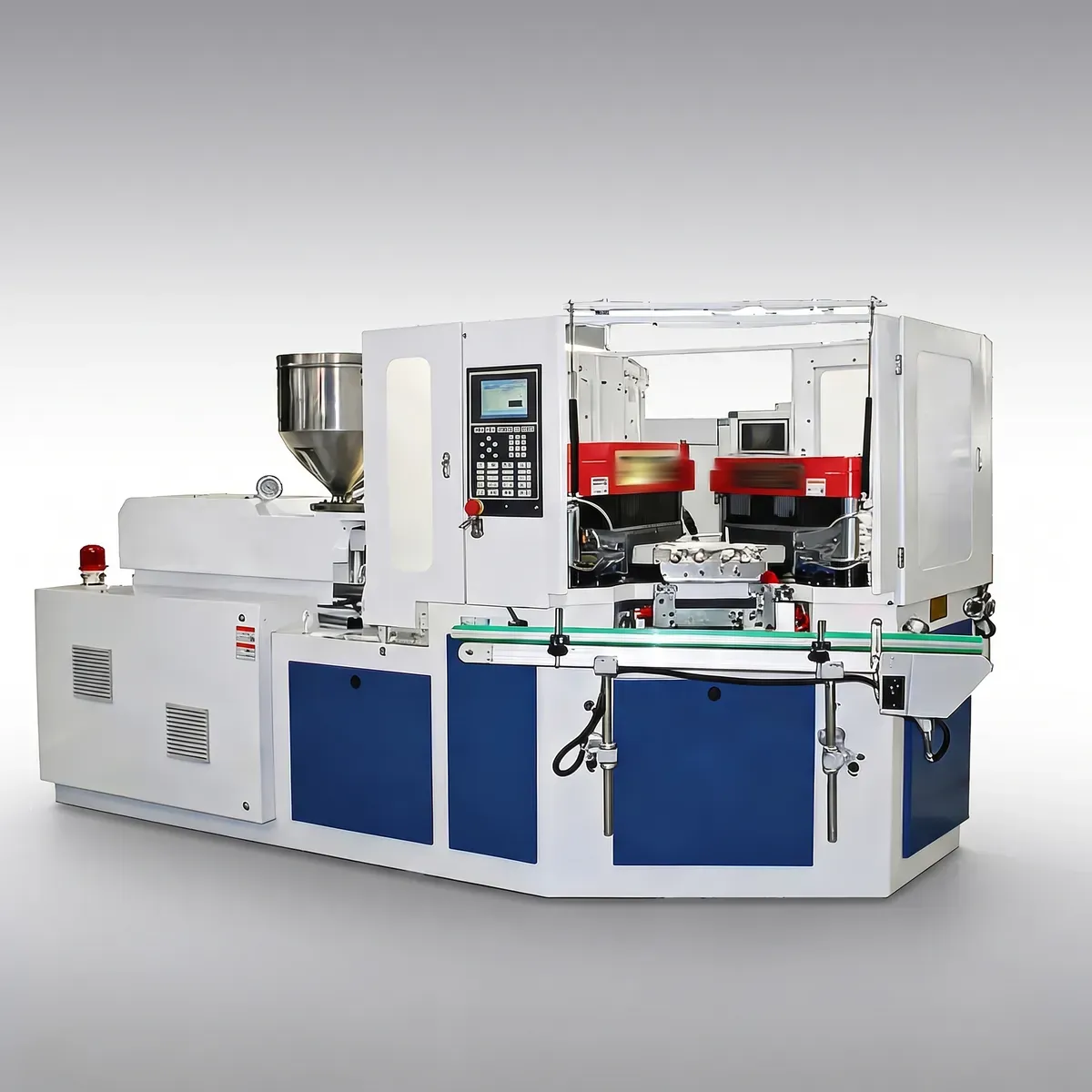
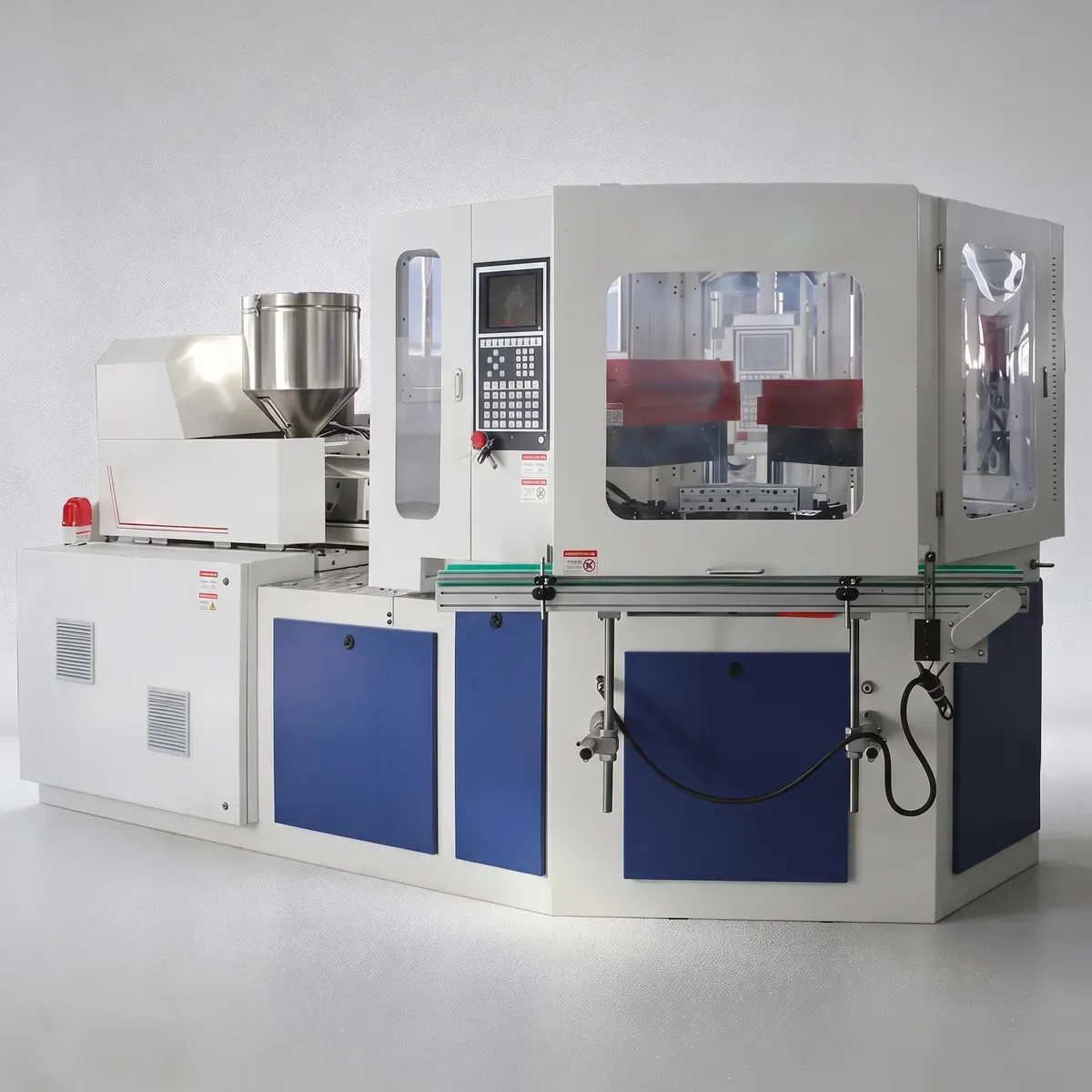
Die Spritzblasformmaschine ZQ40 ist eine präzisionsgefertigte, vollelektrische IBM-Maschine, die als direkter Ersatz für das Modell SUMA 40iB konzipiert wurde. Durch den vollständigen Verzicht auf Hydrauliköl in allen Bewegungsachsen erreicht diese vollelektrische Spritzblasformmaschine eine um 201 TP³ T kürzere Zykluszeit im Vergleich zu herkömmlichen Hydraulikmodellen. Bei der Produktion von 30-ml-Flaschen beträgt die Zykluszeit nur 8,2 Sekunden, was einer kontinuierlichen Tagesleistung von 105.000 Flaschen und einer Spitzenkapazität von 115.000 Flaschen pro Tag entspricht. Der Energieverbrauch wird um ca. 301 TP³ T gesenkt; der Stromverbrauch im Betrieb liegt bei 30-ml-Produktionsläufen bei lediglich 12 kWh pro Stunde.
The ZQ40 Injection Blow Molding Machine is a precision-engineered, full-servo IBM machine designed as a direct drop-in replacement for the SUMA 40iB model. Abandoning hydraulic oil entirely across all motion axes, this all electric injection blow molding machine achieves a 20% shorter cycle time compared to traditional hydraulic models. For 30ml bottle production, the cycle is as low as 8.2 seconds, translating to a sustained daily output of 105,000 bottles and a peak capacity of 115,000 bottles per day. Energy consumption is slashed by approximately 30%, with operating power recorded at just 12 kWh per hour during 30ml production runs. Absolute encoders integrated throughout the servo system deliver exceptional repeatability and dimensional accuracy across every production batch, making this one of the best injection blow molding machine options available for high-volume precision packaging.
The ZQ40 plastic injection blow molding machine features a bottom-up design that keeps the mold area completely free of lubricating oil, satisfying strict hygiene requirements for pharmaceutical packaging, nutraceutical bottles, cosmetic containers, and food-grade plastic bottles. Its electric cylinder-driven injection unit ensures stable, consistent shot weights with lower long-term maintenance costs compared to hydraulic alternatives. The conveyor rear is natively compatible with downstream automation including visual inspection systems, leak testers, labeling machines, and automatic packaging equipment, enabling fully unattended lights-out production. With a clamping force adjustable between 40 and 80 tons via a patented clamping structure, and mold cavitations ranging from 1 cavity for 1000ml containers up to 9 cavities for 10ml bottles, the ZQ40 is a versatile customized injection blow molding machine for sale that adapts to a wide spectrum of industrial and consumer packaging applications.
Formkavitation (zur Information)
| Ungefähres Volumen | 10 ml | 30 ml | 60 ml | 100 ml | 250 ml | 500 ml | 1000 ml |
|---|---|---|---|---|---|---|---|
| Max. Kavitation | 9 | 8 | 6 | 4 | 3 | 2 | 1 |
Wichtigste technische Parameter
| Artikel | Einheit | ZQ40 |
|---|---|---|
| Einspritzsystem | ||
| Schraubendurchmesser | mm | 40/45 |
| Schraube L/D | % | 22:1 |
| Einspritzgewicht! | G | 190/260 |
| Heizleistung | KW | 7.5 |
| Anzahl der Laufzonen | 3+N | |
| Injektionsschlag | mm | 120 |
| Spannsystem | ||
| Schließkraft der Einspritzung | KN | 400 |
| Öffnungshub für die Injektion | mm | 165 |
| Klemmkraft des Blas | KN | 60 |
| Eröffnungsschlag zum Blasen | mm | 140 |
| Hubhöhe des Drehtisches | mm | 70 |
| Schimmel | ||
| Maximale Plattengröße (L x B) | mm | 480x340 |
| Formdicke | mm | 180 |
| Durchmesser der Flasche | mm | 120 |
| Flaschenhöhe | mm | 220 |
| Geeignete Flaschenhöhe | mm | 1-1500 |
| Streifenstrich | mm | 220 |
| Hydrauliksystem | ||
| Hydraulischer Druck | Karte | 14 |
| Motorleistung | KW | 11 |
| Trockengang | S | 3.5 |
| Gesamtleistung | KW | 20 |
| Betriebsleistung | % | 52-70 |
| Andere | ||
| Mindestdruck der Druckluft | MPa | 0.7- 1.2 |
| Druckluftkapazität | m³/min | 0.7 |
| Wasserdurchfluss | M³/h | 3.5 |
| Kühlwasserdruck | MPa | 0.3-0.4 |
| Abmessungen (L x B x H) | M | 3,5 x 1,3 x 1,7 |
| Nettogewicht | Tonne | 3.8 |
Austauschbare Marke und Modell
| Ever-Power | Klemmkraft | Jomar | SUMA | Uniloy | Bloma |
| ZQ40 | 40T | IBM40 | 40iB | UIB70 | IBM45 |
| ZQ60 | 60T | IBM65 | 65iB | UIB90 | IBM50 |
| ZQ80 | 80T | IBM85S | 85iB | UIB120 | IBM85 |
| ZQ110 | 110T | IBM135 | 135iB | UIB150 | IBM135 |
| ZQ135 | 135T | IBM175 | 175iB | UIB180 |
IBM Maschinenschraubendurchmesser
| Ever-Power | Schraubendurchmesser | Jomar | SUMA | Bloma |
| ZQ40 | 40/45 | 35/40 | 40 | 45 |
| ZQ60 | 45/50 | 45 | 40/50 | 50 |
| ZQ80 | 55 | 55 | 50/60 | 50 |
| ZQ110 | 65 | 65 | 65/76 | 70 |
| ZQ135 | 70 | 70 | 65/76 |
IBM Maschineneinspritzgewicht
| Ever-Power | Einspritzgewicht | Jomar | SUMA | Bloma |
| ZQ40 | 190/260 | 180 | 169 | 180 |
| ZQ60 | 260/383 | 205 | 169/264 | 240 |
| ZQ80 | 466 | 300 | 333/480 | 310/280 |
| ZQ110 | 540 | 450/550 | 580/770 | 560 |
| ZQ135 | 650 | 450/550 | 580/770 |
IBM Maschinen-Spritzgieß-Schließkraft
| Ever-Power | Einspritzklemmkraft | Jomar | SUMA | Bloma |
| ZQ40 | 400 kN | 340 kN | 386 kN | 350 kN |
| ZQ60 | 600 kN | 460 kN | 580 kN | 500 kN |
| ZQ80 | 800 kN | 680 kN | 720 kN | 700 kN |
| ZQ110 | 1100 kN | 1210 kN | 1200 kN | 1250 kN |
| ZQ135 | 1350 kN | 1560 kN | 1600 kN |
IBM-Maschinenformgröße
| Ever-Power | Formgröße | Jomar | SUMA | Bloma |
| ZQ40 | 480 × 340 | 394 × 508 | 470 × 350 | 450 × 390 |
| ZQ60 | 600 × 390 | 432 × 660 | 620 × 400 | 620 × 430 |
| ZQ80 | 800 × 400 | 464 × 749 | 700 × 400 | 620 × 430 |
| ZQ110 | 1100 × 460 | 559 × 1118 | 1000 × 500 | 900 × 480 |
| ZQ135 | 1300 × 500 | 635 × 1372 | 1200 × 600 |
IBM Maschinengröße
| Ever-Power | Formgröße (M) | Jomar | SUMA | Bloma |
| ZQ40 | 3,8 × 1,3 × 1,7 | 2,72 × 1,9 × 2,75 | 3,8 × 1,5 × 2,3 | 4,05 × 1,52 × 2,55 |
| ZQ60 | 3,8 × 1,4 × 1,8 | 2,92 × 1,98 × 3,41 | 4 × 1,7 × 2,3 | 620 × 430 × 2,55 |
| ZQ80 | 4,5 × 1,6 × 2 | 3,33 × 1,94 × 3,41 | 4,5 × 2 × 2,6 | 620 × 430 × 2,55 |
| ZQ110 | 5 × 1,8 × 2,2 | 3,79 × 2,4 × 3,41 | 5 × 2,4 × 2,7 | 900 × 480 × 2,55 |
| ZQ135 | 5,5 × 2 × 2,4 | 4,22 × 2,67 × 3,58 | 6 × 2,6 × 2,7 |
Hinweis: Marken werden nur genannt, um Kunden bei der Produktauswahl zu helfen, nicht um die Produkte dieser Marken zu verkaufen.
Features of the ZQ40 IBM Injection Blow Molding Machine
1. Hohe Produktionskapazität
The ZQ40 injection blow molding machine delivers a sustained output of 105,000 bottles per day with peak capacity reaching 115,000 units per day for 30ml containers. With an 8.2-second production cycle, the machine operates continuously without frequent manual intervention, meeting large-volume orders quickly. As a high-output injection blow molding machine manufacturer's solution, this capacity gives your operation a direct competitive edge in fast-turnaround packaging markets including pharmaceutical, cosmetic, and FMCG sectors. Multi-cavity tooling up to 9 cavities further multiplies throughput for smaller bottle sizes.
2. Anpassbare Formgebungsoptionen
As a fully customized injection blow molding machine for sale, the ZQ40 accommodates a broad range of bottle shapes, volumes (1ml to 1,500ml), and neck geometries. The 40 to 80-ton adjustable clamping force and modular mold system allow rapid changeover between product lines. Whether you are producing narrow-neck pharmaceutical vials, wide-mouth cosmetic jars, or round consumer bottles, the machine's flexible mold platen (480 x 340mm) and screw diameter options (40mm or 45mm) ensure seamless adaptation to your specific SKU requirements without the need for additional base equipment.
3. Exceptional Energy Efficiency
This full electric Spritzblasformmaschine reduces energy consumption by approximately 30% versus hydraulic-driven equivalents. Operating power during 30ml bottle production is just 12 kWh per hour, with total installed power of only 20 kW and a utilization rate of 52 to 70%. The all-electric servo architecture eliminates hydraulic oil heating losses and idle pump energy draw entirely. For injection blow molding machine suppliers evaluating total cost of ownership, this energy profile translates to significant utility savings over the machine's operational lifetime, directly improving your profit margin per bottle produced.
4. Einfache Bedienung und geringer Wartungsaufwand
The ZQ40 is engineered for user-friendly operation with an intuitive HMI interface that guides operators through setup, parameter adjustment, and real-time monitoring. Absolute encoders in the servo system provide precise, repeatable positioning without manual recalibration between shifts. Because the machine eliminates hydraulic oil circuits entirely, routine maintenance tasks such as oil filter replacement, seal inspection, and hydraulic fluid management are completely removed from the maintenance schedule. Electric cylinder-driven injection units further simplify upkeep, reducing both planned and unplanned downtime across your production operations.
5. Qualitätskontrolle und Konsistenz
Absolute encoder servo positioning delivers dimensional repeatability that is simply not achievable with conventional hydraulic injection blow molding machines. Shot weight deviation, wall thickness uniformity, and neck thread accuracy are maintained within tight tolerances across every production run. The machine's precision control system continuously monitors injection pressure, barrel temperatures, clamp force, and cycle timing, automatically compensating for ambient variation. For regulated industries such as pharmaceutical and medical packaging, this level of dimensional control and batch-to-batch consistency is not optional, it is essential for GMP compliance and regulatory submission.
6. Hygienic Design for Regulated Industries
The ZQ40's bottom-up mechanical design ensures the mold area remains completely free of lubricating oil at all times. This is a critical hygiene compliance feature for pharmaceutical packaging, nutraceutical bottles, food-grade containers, and any application where contamination risk must be minimized. The architecture meets the clean-room-adjacent production standards required by major pharmaceutical and cosmetic brand owners globally, making the ZQ40 a strong candidate for facilities seeking GMP-aligned one step injection blow molding machine solutions without incurring the cost of dedicated cleanroom blow molding equipment.
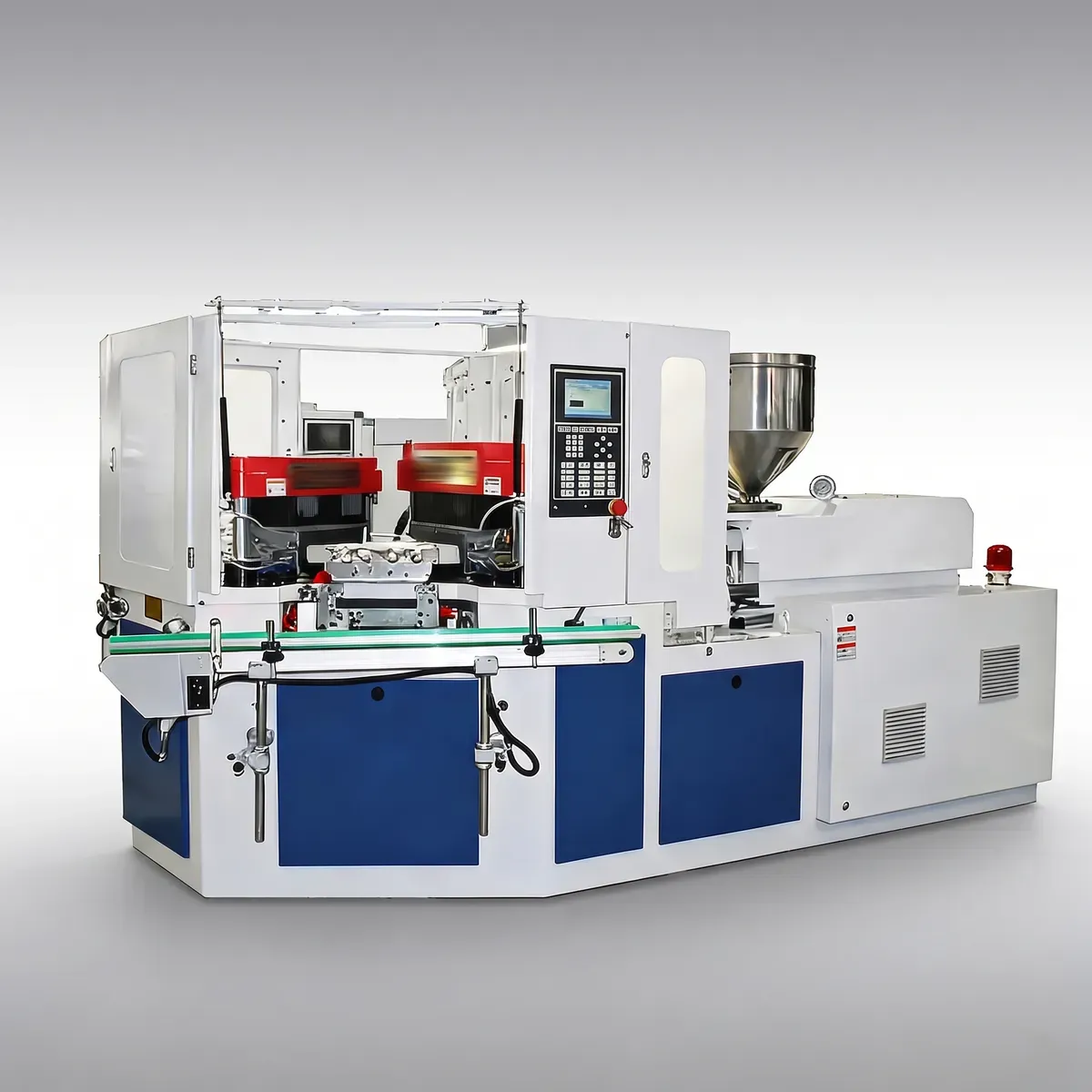
Funktionsprinzip
1. Vorformlingsinjektion
Molten plastic resin is precisely injected around the core rod into the injection cavity. The bottle neck geometry, thread profile, and finish dimensions are formed with high accuracy at this station because the neck is injection-molded rather than blow-formed. After sufficient cooling and dwell time under controlled injection pressure, the mold opens and the core rod, carrying the accurately formed parison, rotates on the indexing table to the blow molding station. This injection step is the foundation of the superior neck accuracy that distinguishes IBM injection blow molding machine technology from extrusion-based alternatives.
2. Blasformen
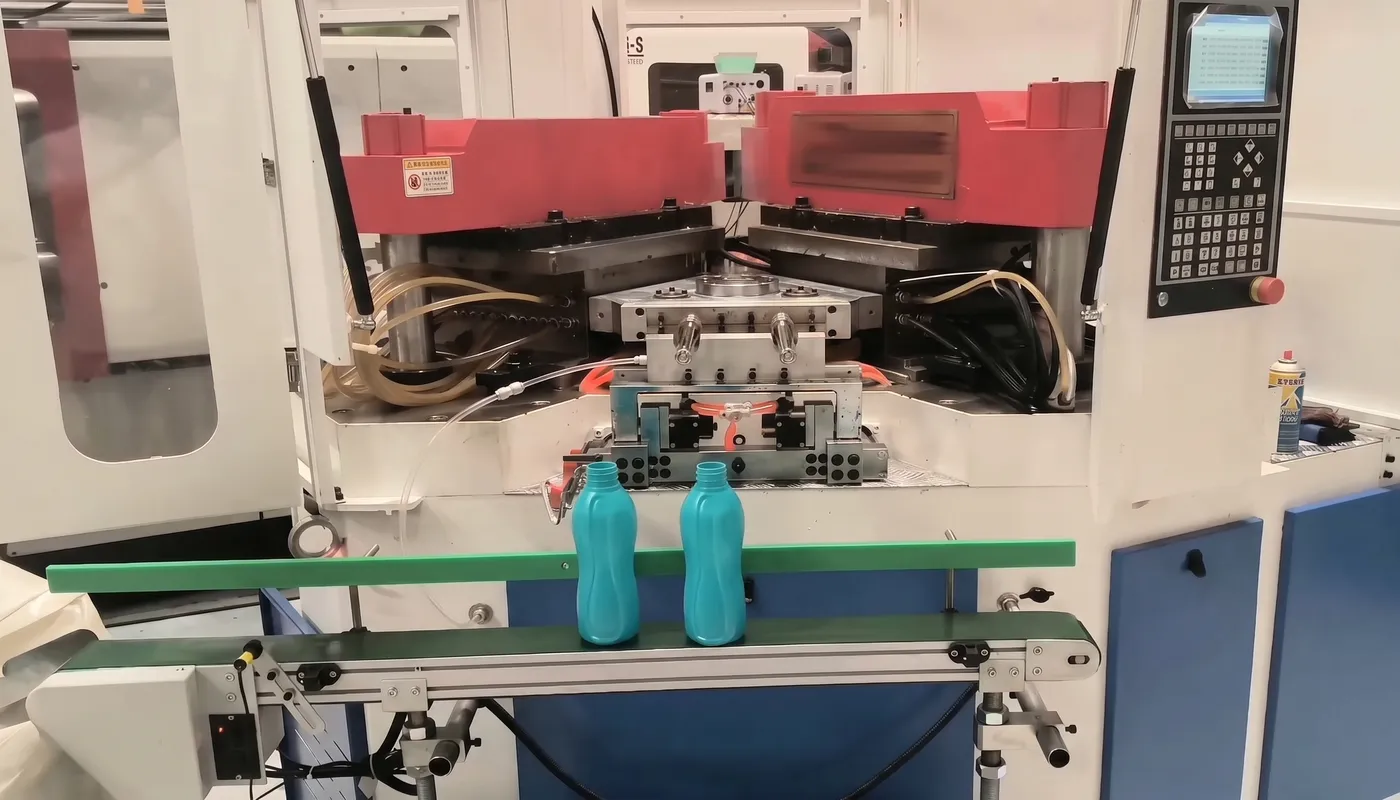
The preform-laden core rod indexes into the blow mold, which closes around it with a clamping force of 60 kN. Compressed air at 0.7 to 1.2 MPa is introduced through the mandrel, expanding the heated preform outward until the plastic conforms precisely to the interior surface of the bottle mold. Cooling channels within the blow mold rapidly solidify the bottle body, locking in the final wall thickness distribution and bottle geometry. The number of cavities at this station matches the injection station configuration. After cooling, the mold opens and the core rods rotate to the stripping station, carrying finished, fully formed bottles with no flash or trim waste.
3. Stripping and Ejection
At the stripping station, finished bottles are automatically ejected from the cooled core rods with a stripping stroke of 220mm. Bottles are cleanly released onto the outfeed conveyor system without requiring manual assistance or secondary trimming operations, because the IBM process produces no parison flash. The three stations, injection, blowing, and stripping, operate simultaneously in parallel on every index cycle, meaning the machine produces a complete set of finished bottles with each 8.2-second rotation. This simultaneous three-station architecture is the key to the ZQ40's exceptional output rate and material efficiency, with near-zero process waste in normal production.
Anwendungsgebiete
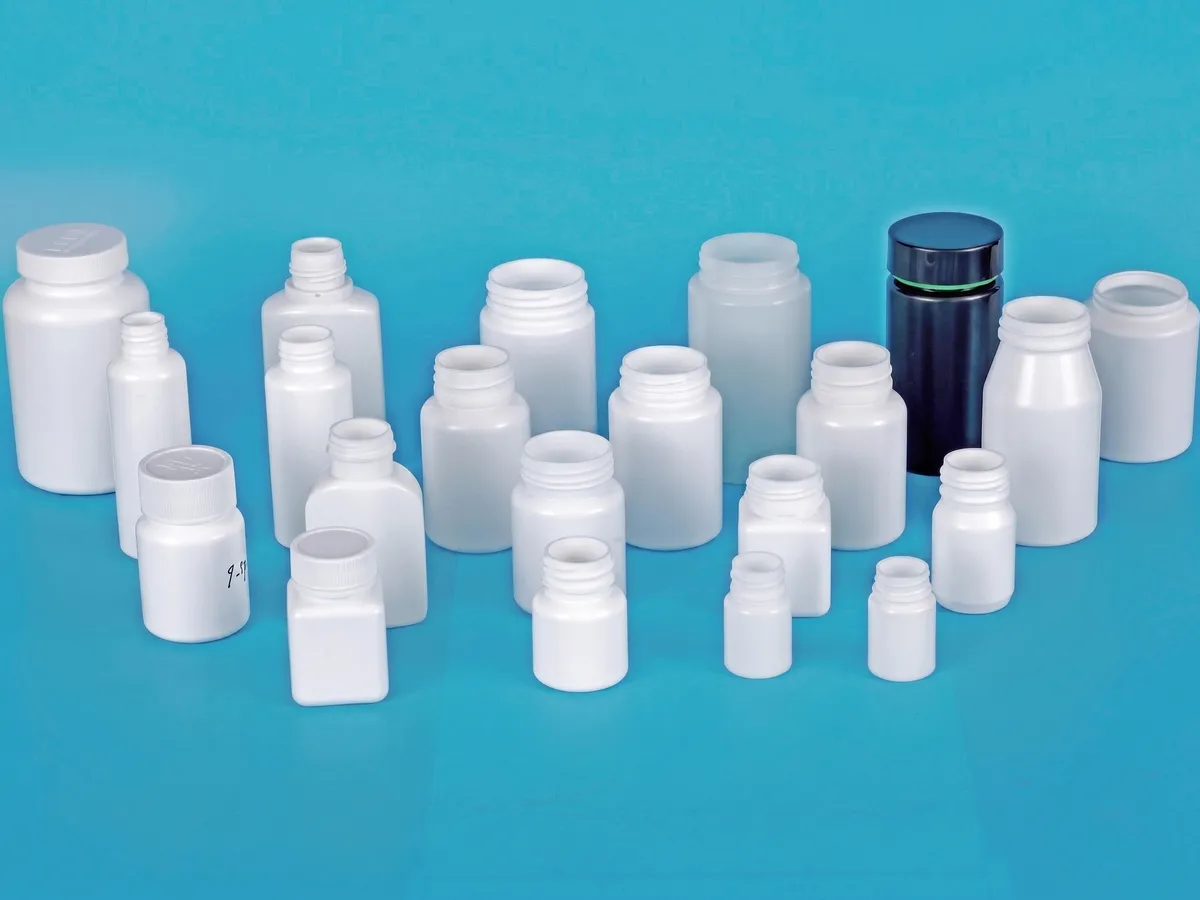
Chemikalienflaschen
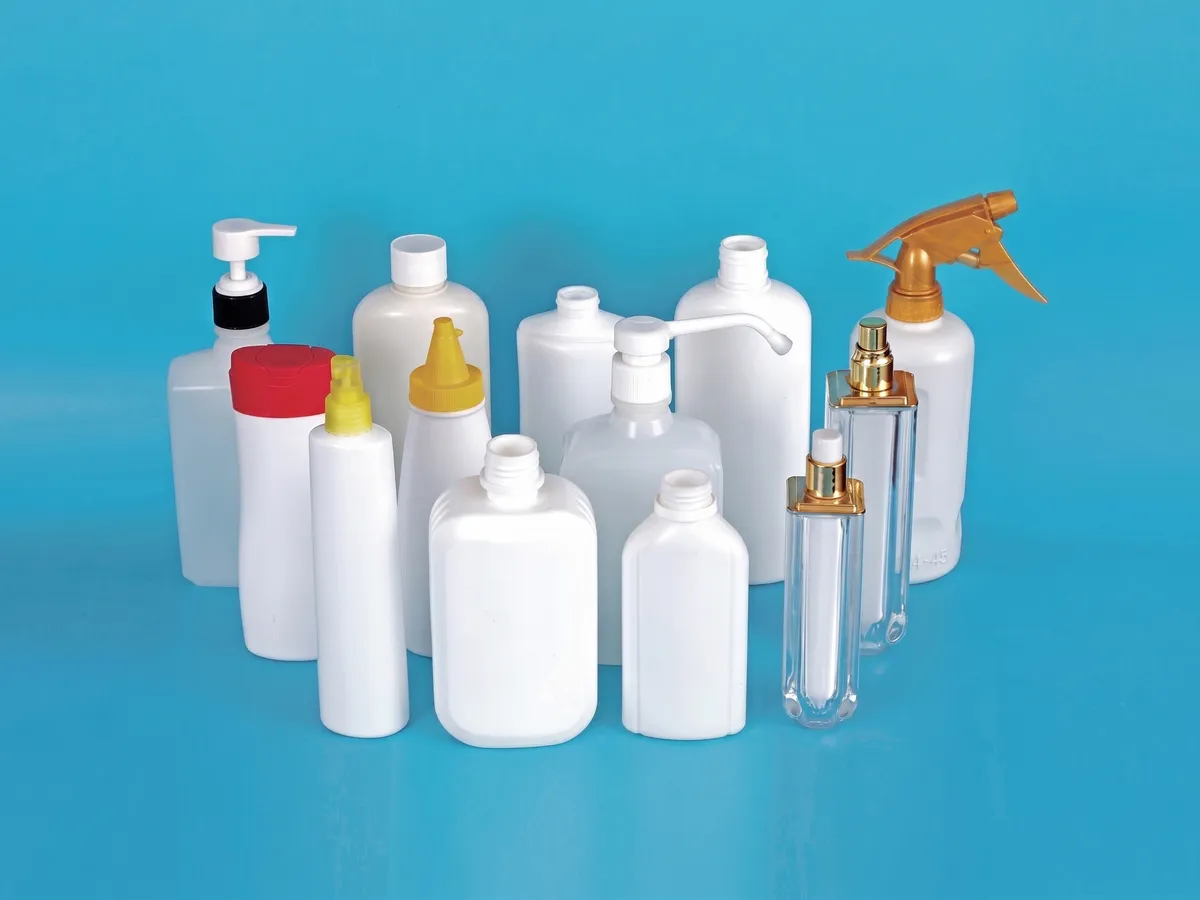
Industrial cleaning agents, laboratory reagents, and specialty chemical products demand bottles with precise neck sealing and excellent chemical resistance. The ZQ40 produces HDPE and PP chemical bottles with consistent wall thickness and accurate thread profiles that ensure airtight closure performance, preventing contamination and leakage during storage and transport in demanding industrial environments.
Kosmetikflaschen
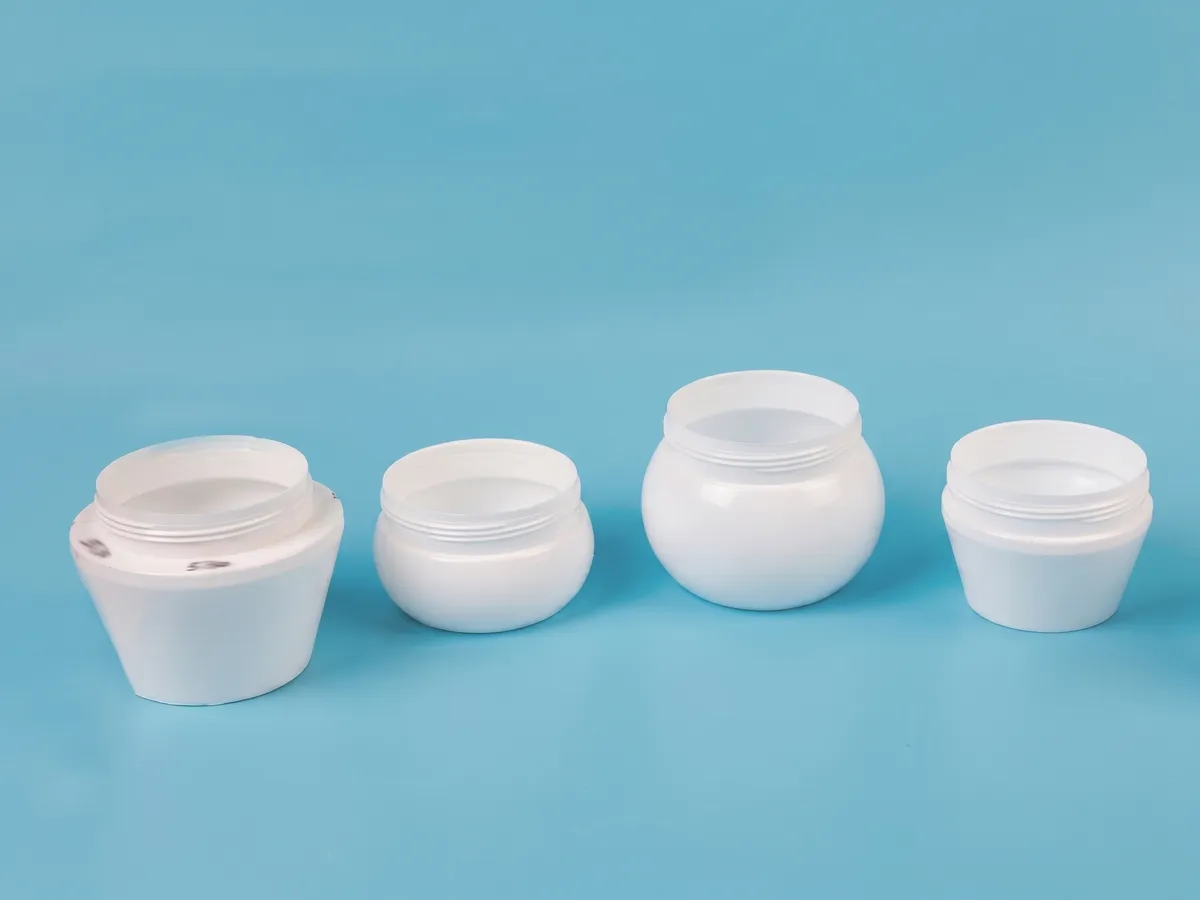
Lotions, serums, toners, and high-end skincare products require bottles with superior surface finish, dimensional uniformity, and visual clarity. The ZQ40's precise injection molding of the preform delivers cosmetic containers with smooth parting lines and consistent wall distribution that premium cosmetic brand owners demand. Processing materials including PCTG, PS, and ABS enables high-gloss transparent or translucent packaging.
Getränkeflaschen
Small-format beverage packaging such as juice shots, functional drinks, and single-serve dairy products benefit from the ZQ40's high-cavitation production capability. Up to 8 cavities for 30ml bottles and up to 4 cavities for 100ml bottles allow beverage producers to run high-volume production at competitive cost per unit, with food-safe HDPE, PP, and compatible PET-series materials processed cleanly in the oil-free mold zone.
Pharmaflaschen
This is the primary design application for the ZQ40. Pill bottles, tablet containers, liquid medicine bottles, and multi-dose packaging for the pharmaceutical industry require GMP-compatible production environments, precise neck thread geometry for child-resistant closures, and verifiable dimensional consistency across batches. The zero-oil mold zone and absolute encoder repeatability make the ZQ40 one of the most suitable injection blow moulding machine options for pharmaceutical packaging facilities worldwide.
Handwaschflaschen
Antibacterial hand wash, hand sanitizer, and foaming soap products require bottles with pump-compatible neck finishes and consistent shoulder geometry for automated filling lines. The ZQ40 produces HDPE and PP hand wash bottles with accurate thread profiles that interface reliably with standard pump dispensers, enabling high-speed automated filling and capping without rework or rejection rates that erode profitability in household and healthcare product manufacturing.
Spülmittelflaschen
Dish soap and kitchen cleaning product bottles must withstand repeated squeezing without fatigue cracking while maintaining an attractive shelf appearance. The ZQ40 enables production of LDPE and HDPE dish soap containers with controlled wall thickness distribution that balances squeeze flexibility and structural integrity. The machine's consistent cavity-to-cavity uniformity ensures every bottle in a batch fills to the same level on high-speed filling lines without adjustment.
Pipettenflaschen
Ophthalmic solutions, nasal sprays, and laboratory dropper bottles represent some of the most demanding applications for dimensional precision in the packaging world. Eyedropper bottles produced on the ZQ40 benefit from injection-formed neck geometry that ensures dropper tip and cap fitment accuracy within micron-level tolerances. The machine's clean, oil-free mold environment also supports the contamination control requirements for ophthalmic and sterile pharmaceutical dropper packaging applications globally.
Feeding Bottles
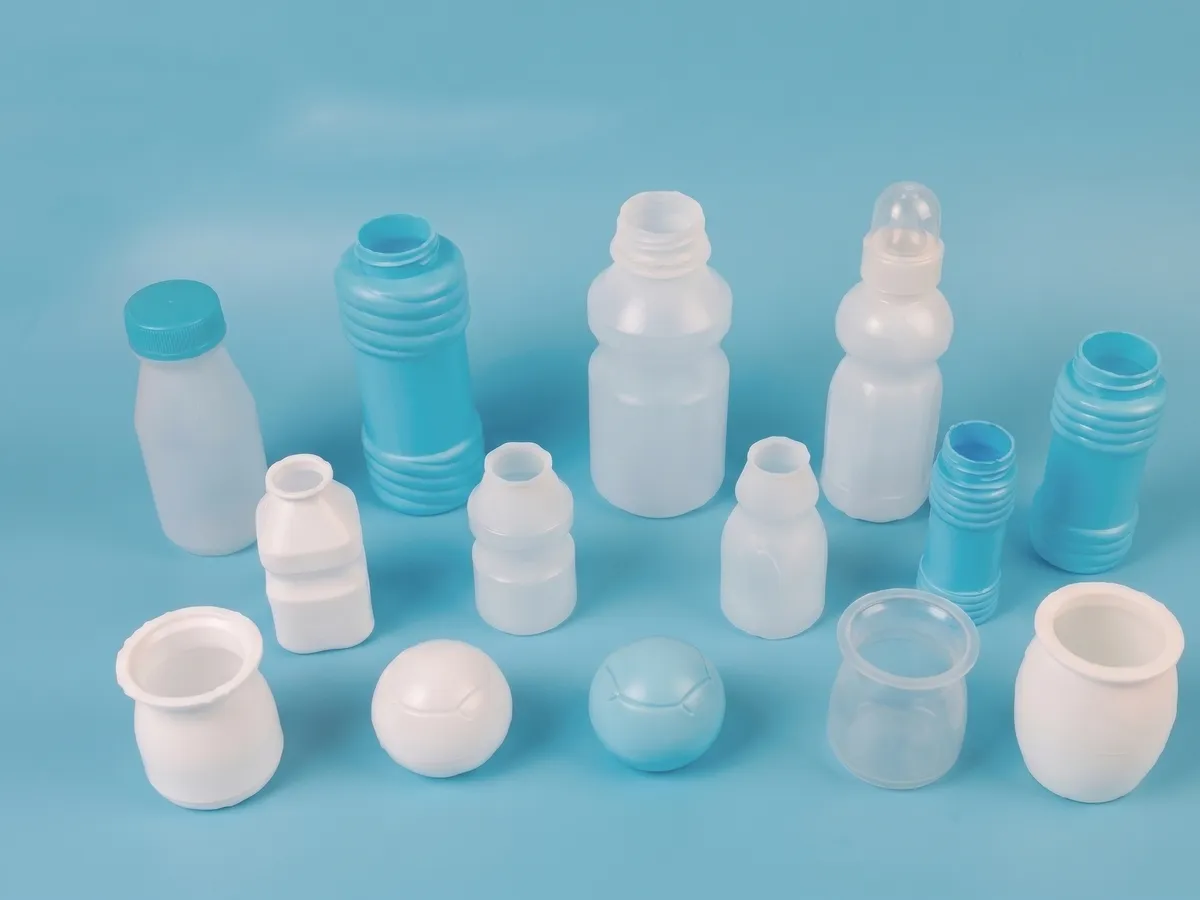
Baby feeding bottles and infant formula containers require food-safe, BPA-free materials processed in contamination-free environments. The ZQ40's zero-oil mold zone is directly aligned with the hygiene requirements for infant product packaging. PP and food-grade HDPE feeding bottles produced on this machine feature uniform wall thickness, accurate measurement markings alignment zones, and reliable teat-ring thread dimensions for the child-resistant tamper-evident closures demanded by infant product regulatory standards worldwide.
 |
 |
| Pharmaflaschen | Chemikalienflaschen |
 |
 |
| Kosmetikflaschen | Feeding Bottles |
ZQ40 IBM Maschinenkomponenten
1. Injektionsgerät
The injection device comprises a 40mm or 45mm diameter screw with a 22:1 L/D ratio, three heated barrel zones plus an additional zone (3+N), and an electric cylinder drive that delivers precise, repeatable shot weights of 190g or 260g. This component is responsible for melting and homogenizing the raw polymer resin before injection into the cavity, with 7.5 kW of barrel heating power maintaining optimal melt temperature for consistent material flow behavior.
2. Heißkanalsystem
The optimized hot runner system distributes molten plastic from the injection barrel to each cavity through temperature-controlled manifolds and heated gate nozzles. This component eliminates cold runner waste and ensures balanced, simultaneous filling of all cavities in multi-cavity configurations. Precise temperature control across the hot runner manifold minimizes gram weight deviation between cavities, maintaining consistent preform quality that directly influences bottle wall thickness uniformity in the subsequent blow stage.
3. Injection Station
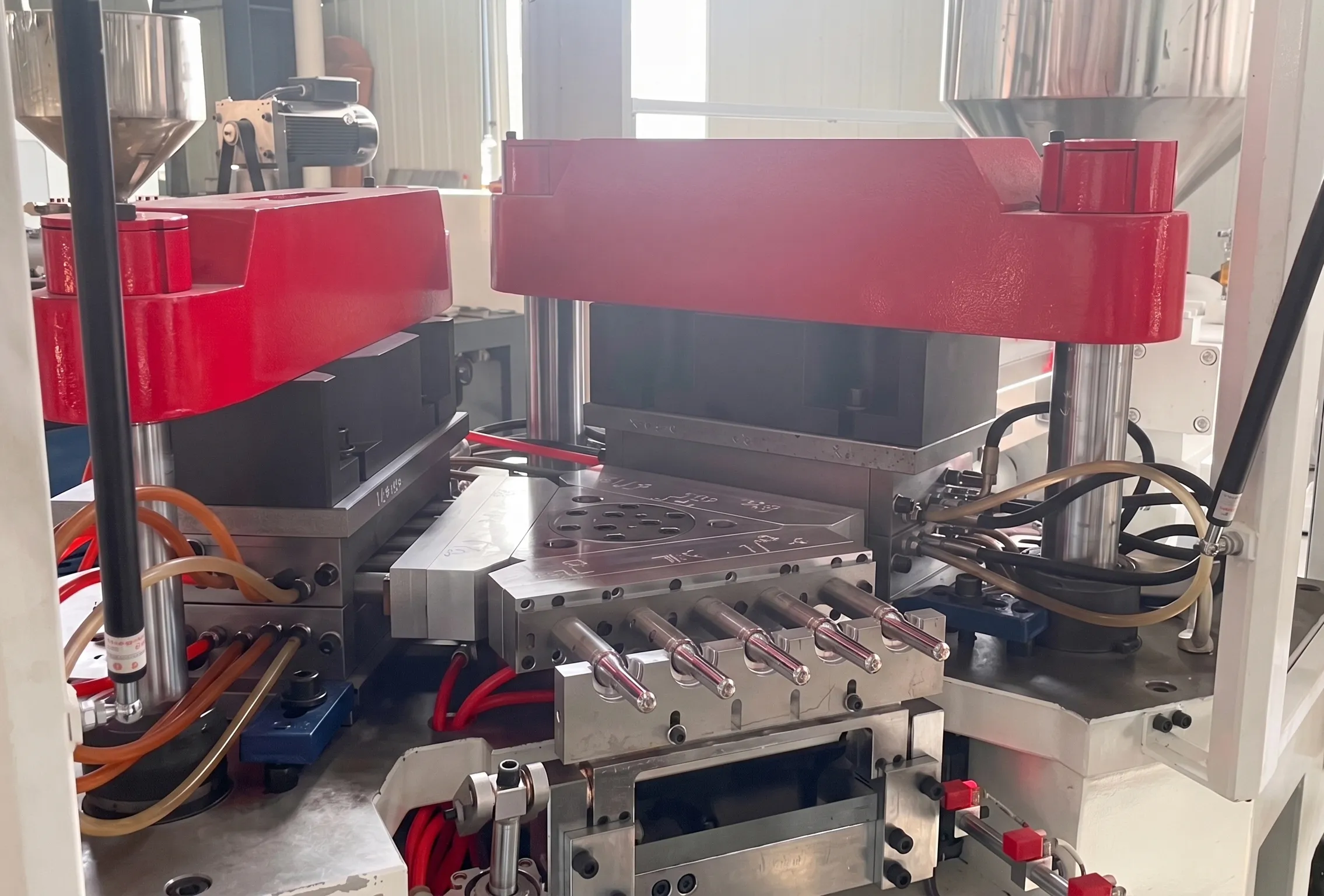
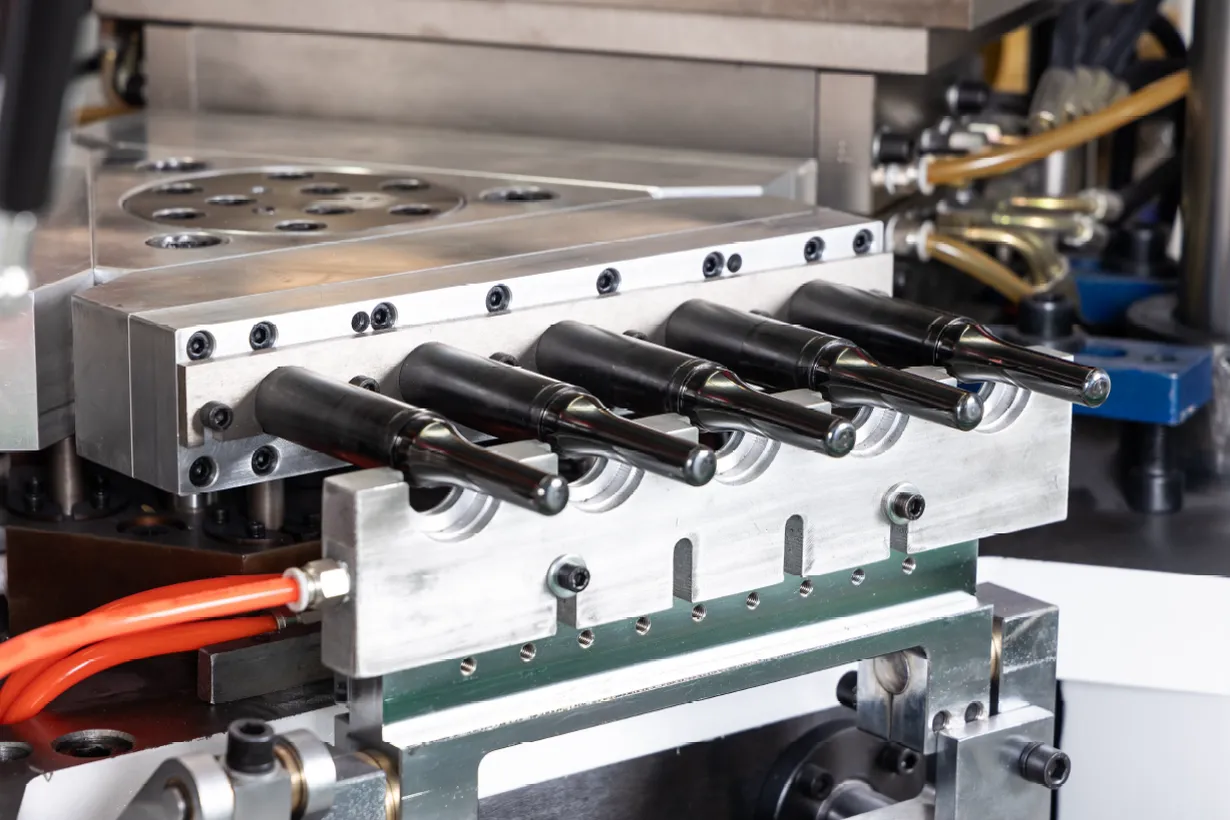
The injection station is the first of the three operating positions on the ZQ40's rotating table, where the injection clamping force of 400 kN closes the injection mold around the core rods with an opening stroke of 165mm. This station controls the injection cycle parameters including melt temperature, injection speed, packing pressure, and cooling time. The rotary table lifts 70mm to clear the molds during indexing, then precisely lowers and aligns for the next injection cycle, with the absolute encoder servo system ensuring repeatable positioning on every rotation.
4. Blow Station
The blow station houses the blow mold and associated clamping, air supply, and cooling systems. A clamping force of 60 kN holds the blow mold closed against the expanding air pressure during inflation, with an opening stroke of 140mm providing sufficient clearance for the indexed core rods and preforms. Compressed air supplied at 0.7 to 1.2 MPa enters the preform through the mandrel's air passage, inflating the preform to conform to the blow mold cavity while cooling water channels in the mold rapidly solidify the finished bottle body before the mold opens.
5. Blow Mold
The blow mold defines the external geometry of the finished bottle, including body shape, base configuration, surface texture, and any embossed branding features. Constructed with integrated cooling channels for rapid and uniform heat extraction, the blow mold is designed to minimize cycle time while achieving complete surface contact between the expanded plastic and the mold cavity walls. Because no parison pinch-off occurs in the IBM process, blow molds for injection blow molding machines have no flash trimming parting line across the bottle bottom, resulting in cleaner base aesthetics and no post-processing waste.
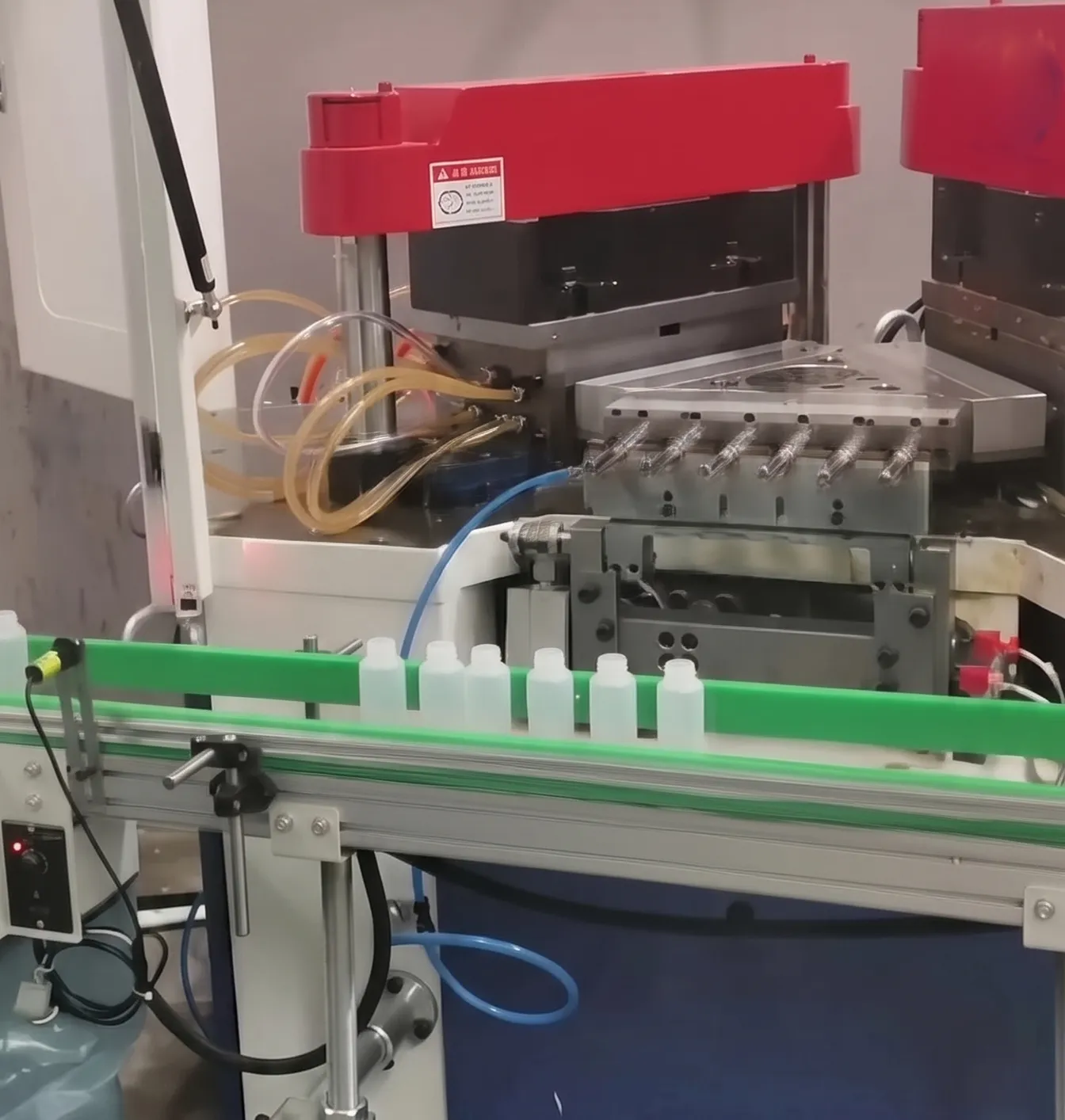
6. Stripping Station
At the stripping station, finished bottles are automatically ejected from the cooled core rods with a 220mm stripping stroke. The stripping mechanism removes bottles from the mandrel without requiring manual intervention or secondary trimming, since the IBM process produces no flash. Ejected bottles fall directly onto the outfeed conveyor system, where they are transported to downstream equipment such as visual inspection systems, leak testers, labeling machines, or automatic packaging equipment for fully automated, unattended production operation.
7. Core Rod (Mandrel)
The core rod, also called the mandrel, serves as the internal support around which the plastic preform is formed during injection and subsequently inflated during blowing. Engineered with internal cooling channels, the mandrel facilitates rapid heat removal from the preform inner surface, maintaining precise temperature conditions for consistent blowing performance. The special core rod structure on the ZQ40 achieves fast cycle times while providing excellent core cooling, directly supporting the 8.2-second production cycle for 30ml bottle production.
8. Bottle Preform
The preform is the intermediate product formed at the injection station, consisting of the fully formed bottle neck and thread profile with a thick-walled cylindrical body. Unlike extrusion blow molding where the parison neck is formed by the mold closing action, the IBM preform neck is injection-molded to its final dimensions, ensuring 100% accurate thread geometry and a leak-free sealing surface before the body is expanded by blowing. This is the foundational advantage of injection blow molding machines over other blow molding processes for precision packaging.
9. Injection Mold
The injection mold cavity and neck sections are manufactured from imported S136 steel alloy or 4Cr13 stainless steel, providing high hardness, corrosion resistance, and extended service life. The mold incorporates actively temperature-controlled zones with a special oil circuit design that enables precise cavity temperature uniformity, ensuring stable preform dimensions and reproducible tube blank quality across all production runs. The mold architecture supports the ZQ40's maximum platen size of 480 x 340mm with a mold thickness of 180mm.
ZQ40 vs. SUMA 40iB: Why Choose Ever-Power IBM Machine
1. Superior Clamping Force Range
The ZQ40 offers a 400 kN injection clamping force versus the SUMA 40iB's 386 kN, representing approximately a 4% increase in injection clamping capacity. More significantly, the ZQ40's special pressurized clamping structure provides an adjustable clamping range of 40 to 80 tons, giving operators greater flexibility to tune clamping conditions for different mold designs and material combinations without changing machine components, directly reducing tooling investment for multi-SKU production operations.
2. Full All-Electric Drive Architecture
The SUMA 40iB retains a hybrid or hydraulic-assisted drive for certain motion axes. The ZQ40 eliminates hydraulic oil entirely from all machine movements, delivering a true full electric injection blow molding machine architecture. This eliminates hydraulic oil maintenance, seal wear, thermal oil management, and associated contamination risks in the production environment, reducing total maintenance labor hours by a significant margin over a five-year production lifetime compared to operating a SUMA model.
3. Faster Cycle Time
The ZQ40 achieves a 20% shorter cycle time compared to traditional hydraulic models including the SUMA 40iB for 30ml bottle production. At 8.2 seconds per cycle versus approximately 10 seconds for comparable hydraulic machines, this translates to approximately 105,000 to 115,000 bottles per day. Over a 300-day production year, this faster cycle time generates millions of additional units annually from the same machine footprint, directly improving your return on investment compared to operating a SUMA model of equivalent clamping tonnage.
4. 30% Lower Energy Cost
Energy consumption during 30ml bottle production on the ZQ40 is recorded at just 12 kWh per hour, approximately 30% below the energy draw of equivalent hydraulic IBM machines. For a facility operating two shifts per day, 300 days per year, this difference amounts to thousands of kilowatt-hours in annual savings per machine. Across a fleet of injection blow molding machines, the cumulative energy savings represent a substantial operating cost reduction that makes the ZQ40 a more economical long-term choice than continuing to operate or replace aging SUMA models.
5. Larger Mold Platen
The ZQ40 features a maximum platen size of 480 x 340mm compared to the SUMA 40iB's 470 x 350mm footprint. This dimensional difference, combined with a 180mm mold thickness and 120mm maximum bottle diameter, provides slightly greater flexibility in mold design and cavity layout. Existing SUMA 40iB molds can be evaluated for compatibility or adapted for use on the ZQ40 with appropriate bolster plates, potentially reducing the tooling investment required for customers migrating from a SUMA platform to the ZQ40.
6. Automation Integration Ready
The ZQ40's conveyor rear is natively designed to interface with downstream automation equipment including visual inspection systems, leak testers, labeling machines, and automatic packaging lines. SUMA 40iB installations often require third-party integration engineering to achieve equivalent downstream automation connectivity. The ZQ40's out-of-the-box automation compatibility reduces the total capital investment and integration time required to achieve fully unattended, lights-out production in pharmaceutical, cosmetic, and consumer goods packaging facilities.
Raw Materials Compatible with the ZQ40 IBM Machine
The ZQ40 injection blow molding machine processes a wide range of thermoplastic resins for diverse packaging applications.
HDPE (Polyethylen hoher Dichte)
HDPE is the most widely used resin on injection blow molding machines for pharmaceutical, chemical, and household product bottles. It offers excellent chemical resistance, moisture barrier properties, FDA food-contact compliance, and processing stability across the ZQ40's barrel temperature range. HDPE bottles produced on the ZQ40 are used extensively for pharmaceutical pill containers, cleaning product bottles, and food packaging requiring reliable closure sealing and impact resistance during distribution.
PP (Polypropylen)
Polypropylene is a preferred material for pharmaceutical, cosmetic, and infant product packaging due to its excellent heat resistance, chemical inertness, and compatibility with steam sterilization processes. The ZQ40 processes PP efficiently across its heated barrel zones, delivering dimensionally stable PP bottles with excellent hinge flex properties for closure applications. PP's high clarity in its copolymer form also enables near-transparent packaging options for products where content visibility is a consumer selling point.
LDPE (Polyethylen niedriger Dichte)
LDPE's inherent flexibility and soft hand feel make it the material of choice for squeeze bottles, eye dropper containers, and dispensing packaging where controlled, gentle pressure is required to dispense product. The ZQ40 processes LDPE within its barrel temperature window to produce flexible-walled bottles with accurate neck geometry for dropper tip and dispensing closure compatibility. LDPE's low melting point and narrow processing window are managed effectively by the ZQ40's multi-zone barrel heating and precise screw speed control.
PS (Polystyrol) und hochtransparentes PS
Standard and high-transparency polystyrene grades are processed on the ZQ40 for cosmetic containers, single-serving dairy packaging such as lactic acid bacteria drink bottles, and transparent display packaging where glass-like clarity is desired without the weight or fragility of actual glass. High-transparency PS enables very low haze values in thin-walled blown bottles, supporting premium positioning for cosmetic and health supplement packaging in markets where packaging aesthetics directly influence purchase decisions.
ABS (Acrylnitril-Butadien-Styrol)
ABS is selected for packaging applications requiring elevated impact resistance, dimensional stability across temperature variations, and receptiveness to surface decoration techniques including metallization and lacquering. The ZQ40 processes ABS to produce cosmetic packaging, specialty personal care containers, and premium consumer goods bottles where a high-gloss surface finish and robust wall structure are required to project product quality. ABS's good melt flow behavior supports multi-cavity production with consistent cavity fill across the hot runner system.
PCTG and EVA Specialty Materials
PCTG (polycyclohexylene dimethylene terephthalate glycol) delivers exceptional optical clarity, excellent chemical resistance, and BPA-free food safety for premium cosmetic and pharmaceutical packaging. EVA (ethylene-vinyl acetate) and environmental-grade corn bioplastic materials are also processable on the ZQ40 for manufacturers targeting sustainable packaging solutions and reduced carbon footprint labeling. The ZQ40's configurable barrel temperatures and screw geometry options ensure optimal processing conditions across this broad spectrum of engineering and specialty thermoplastic materials.

Characteristics of ZQ Series Automatic Mould
1. Active Temperature Control with Exchangeable Cavities
The injection mold features an activity-designed cavity and neck configuration with a specially engineered oil circuit layout that enables convenient cavity replacement without complete mold disassembly. This design ensures stable, uniform tube blank dimensions across the mold's operational life by maintaining precise and consistent cavity temperature distribution. The interchangeable cavity architecture reduces changeover time between product sizes and extends overall mold service life by allowing worn cavity inserts to be replaced independently rather than scrapping the entire mold assembly.
2. Hochwertige Stahllegierungskonstruktion
Injection mold cavities and cores are manufactured from imported S136 steel alloy or 4Cr13 stainless steel. S136 is a premium tool steel offering excellent polishability for high-clarity cosmetic and pharmaceutical bottle surfaces, combined with superior corrosion resistance and hardness after heat treatment. 4Cr13 stainless steel provides outstanding resistance to acidic and alkaline material degradation, extending mold service life significantly versus standard P20 or H13 steel used in many lower-cost competing mold designs. Both materials are hardened and surface-treated for extended production cycles.
3. Optimierte Heißkanal- und Dornkonstruktion
The hot runner system and bottle preform geometry are co-designed to minimize gram weight deviation between cavities and reduce wall thickness variation in the finished bottle. Gram weight consistency across all cavities of a multi-cavity mold is critical for achieving uniform bottle quality and accurate fill volumes downstream. The special mandrel structure is engineered to maintain fast molding cycles while delivering excellent core cooling efficiency, ensuring the preform is at the optimal temperature for blow expansion when it reaches the blow station without requiring extended cooling dwell time.
4. Precise Thread Dimensions and 100% Sealed Mouth
The injection-formed bottle mouth and thread profile are dimensionally accurate to design specifications across every bottle produced, because the neck geometry is formed entirely by the injection mold rather than by blow mold closing. This injection-formed neck accuracy translates directly to 100% sealed closure performance when the bottle is fitted with its closure system, eliminating leak failures in pharmaceutical and food products that result from neck thread dimensional variation. Thread pitch, root diameter, and thread lead are all controlled by the injection cavity geometry with no secondary trimming or calibration required.
5. Zero Flash on Mouth and Base
Because the IBM process forms the bottle body by inflation rather than by pinching a parison between mold halves, there is no flash generated at the bottle base or mouth during normal production. Bottles produced on the ZQ40 require no secondary trimming, deflashing, or finishing operations before proceeding to filling and capping lines. This elimination of trimming labor and scrap material is a major economic advantage of injection blow molding machines over extrusion blow molding alternatives, particularly for high-volume production of pharmaceutical and cosmetic bottles where every unit of trimming waste represents a direct material cost.
6. Gleichbleibende Abmessungen, Gewicht und Wandstärke
Product dimensions, fill weight, parting line position, and bottle wall thickness are consistent from bottle to bottle and cavity to cavity throughout the production run. This dimensional consistency is a prerequisite for automated filling, capping, labeling, and packaging operations that rely on precise bottle geometry for high-speed machine compatibility. The ZQ40's absolute encoder servo system and the mold's precision hot runner balancing combine to maintain dimensional repeatability that supports both internal quality assurance standards and the third-party quality audits required by pharmaceutical and food-grade customer qualification programs.
Spritzblasformen vs. Extrusionsblasformen
Both injection blow molding (IBM) and extrusion blow molding (EBM) produce hollow plastic containers, but they form the starting shape through completely different mechanisms. An injection blow molding machine starts from an injection-molded preform with a fully formed neck. An extrusion blow molding machine starts from an extruded parison pinched by the mold at both ends, generating flash that requires trimming. In British English, buyers frequently compare the same processes as injection blow moulding and extrusion blow moulding, with the process selection criteria remaining identical regardless of terminology.
How Each Process Works
Spritzblasformen (IBM)
- Injection: Molten plastic is injected around a core rod to form a precise preform and neck finish.
- Blowing: The preform moves to the blow station and is inflated inside the bottle mold to final shape.
- Stripping: The finished bottle is removed without any flash trimming required.
Extrusionsblasformen (EBM)
- Extrusion: Molten plastic is extruded downward as a hollow tube called a parison.
- Clamping: The mold closes around the parison, pinching and sealing excess material at the pinch-off zones.
- Blowing and Trimming: Air inflates the bottle, then flash must be trimmed and recycled after cooling.
IBM vs EBM: Quick Comparison
| Besonderheit | Spritzblasformen (IBM) | Extrusionsblasformen (EBM) |
|---|---|---|
| Startformular | Spritzgegossene Vorform | Extrudiertes Vorgelatine |
| Halspräzision | Extremely high; injection-formed neck | Standard; depends on mold closing and trimming |
| Scrap / Flash | Zero flash, very low waste | Flash generated; trimming required |
| Optimale Behältergröße | Kleine bis mittelgroße Präzisionsflaschen | Mittelgroße bis große Hohlbehälter |
| Beste Anwendungen | Pharma, cosmetics, food, droppers | Jerry cans, drums, large containers |
| Qualitätspriorität | Dimensionsstabilität und Dichtheit | Size flexibility and container volume |
When to Choose Injection Blow Molding
Choose a single stage injection blow molding machine like the ZQ40 when your application requires small to medium precision bottles with accurately threaded necks; pharmaceutical, medical, cosmetic, laboratory, or high-value packaging where neck accuracy and clean production are priorities; low flash waste and clean production without secondary trimming operations; and stable dimensions, repeatable wall thickness, and reliable sealing for regulated industry packaging.
For large bottles, jerry cans, drums, tanks, or irregular hollow parts where lower initial tooling cost is the primary driver and trimming flash is acceptable, extrusion blow molding may be a better fit. For the majority of precision small and medium bottle packaging requirements, the injection blow molding machine delivers superior economics when total production cost including material waste, reject rate, sealing reliability, and secondary handling is evaluated comprehensively.
ZQ40 Injection Blow Molding Machine Maintenance Tips
1. Daily Servo System Inspection
At the start of each production shift, visually inspect all servo motor connections, encoder cable routing, and drive unit status indicators. Check for unusual noise, vibration, or heat from servo drive enclosures that may indicate a developing fault. Verify that the HMI shows normal servo axis status for all machine axes before initiating production. The all-electric architecture eliminates hydraulic checks, but servo system integrity should be confirmed daily to catch early-stage drive or encoder issues before they cause production stoppages or dimensional quality problems.
2. Barrel and Screw Cleaning Schedule
Perform a screw purge with compatible purging compound when changing between material types or colors, and conduct a full barrel and screw removal cleaning every 500 to 1,000 production hours depending on material type processed. Residual degraded material in the barrel or on screw flights causes black specks, inconsistent shot weights, and wall thickness variation in produced bottles. Maintaining a clean injection barrel is especially important for pharmaceutical packaging production where contamination specification compliance is mandatory for customer quality system audits.
3. Cooling Water Circuit Maintenance
Inspect all cooling water connections, hoses, and fittings monthly for leaks, scale buildup, or kinking that restricts water flow. Maintain cooling water quality within the specification range of 0.3 to 0.4 MPa pressure and 3.5 m³/h flow rate to ensure adequate mold cooling capacity for the rated cycle time. Scale buildup in mold cooling channels progressively degrades cooling efficiency and increases cycle time. Flush cooling circuits with scale-removing solution annually, or more frequently in areas with high-hardness water supply, and replace worn seals promptly to prevent water ingress into the mold cavity area.
4. Mold Care and Core Rod Lubrication
Inspect mold cavity surfaces, neck inserts, and core rods at the start of each production run for scratches, corrosion, or wear that could affect bottle surface finish or dimensional accuracy. Apply food-safe, pharmaceutical-compatible mold release lubricant to core rod bearing surfaces according to the maintenance schedule. The bottom-up machine design keeps lubricants away from the mold cavity faces, but external bearing surfaces on the indexing table and core rod guide bushings require periodic lubrication per the maintenance schedule to prevent premature wear and indexing accuracy degradation.
5. Compressed Air System Inspection
Verify that compressed air supply pressure is maintained within the 0.7 to 1.2 MPa specification before each shift start. Inspect air filter elements, pressure regulators, and blow air manifold fittings monthly and replace filter elements on schedule to prevent moisture and particulate contamination from reaching the mandrel blow air path. Contaminated blow air is a direct quality risk for pharmaceutical and food-grade bottle production. Check all air line connections for leaks and confirm that the compressed air capacity of 0.7 m³/min is maintained under full multi-cavity production load conditions.
6. Indexing Table and Mechanical Drive Inspection
Inspect the rotary indexing table mechanism, drive gears, and guide pins every 500 hours of operation for wear indicators, abnormal clearance, or backlash that could affect station-to-station positioning repeatability. The rotary table lifts 70mm during indexing, so inspect the lifting cam follower bearings and guide rails for wear and replace according to the maintenance schedule. Tighten all mechanical fasteners on the table and clamping mechanism on a monthly basis. Correct any measured positioning deviation promptly, as indexing inaccuracy directly affects cavity alignment at injection and blow stations and causes dimensional defects in produced bottles.
Warum sollten Sie sich für die Spritzblasformmaschinen von Ever-Power entscheiden?
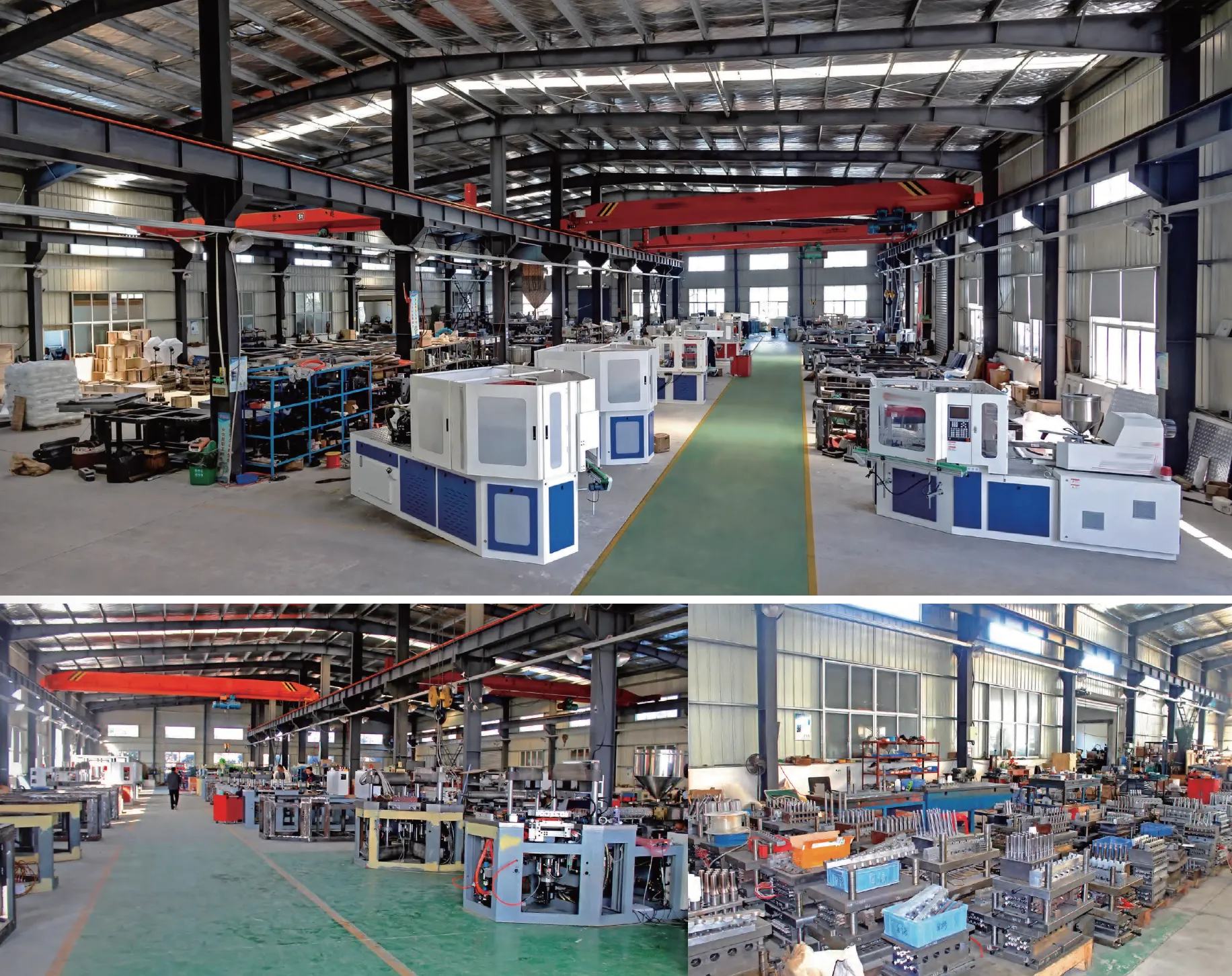
Mexico Ever-Power ISBM Machinery Co., Ltd. is a specialist injection blow molding machine manufacturer primarily engaged in the research, development, production, sales, and global trade of automatic one-step injection-blowing blow molding machines and precision injection-blowing molds. Our product portfolio covers injection blow molding machines, extrusion blow molding machines, injection stretch blow molding machines, and a comprehensive range of auxiliary machines including auto loaders, mold temperature controllers, chillers, screw air compressors, packing machines, and bottle visual inspection systems. The company is located in a nationally recognized manufacturing hub with excellent logistics and transportation infrastructure that supports reliable global delivery timelines for customers worldwide.
Ever-Power maintains an excellent R&D team comprising many senior engineers and technical specialists with deep expertise specifically in injection-blowing machinery and injection-blowing mold technology. With decades of combined theoretical knowledge and hands-on production engineering experience, our team provides detailed and comprehensive pre-sale consultation, in-sale technical support, and post-sale service to every customer who invests in our injection blow molding machines. Our application coverage spans pharmaceutical packaging, food packaging, healthcare product packaging, cosmetic packaging, and all major categories of plastic packaging from 1ml to 1000ml across HDPE, LDPE, PP, PS (including high-transparency lactic acid bacteria grades), ABS, EVA, PCTG, and environmental corn-based biodegradable materials.
Ever-Power adheres firmly to the enterprise development philosophy of self-reliance, integrity, pragmatism, innovation, and responsibility in every aspect of our business. We build complete one-stop turnkey project solutions for injection-blowing production lines, providing everything from initial needs analysis and machine selection guidance through mold design, machine manufacturing, international logistics, on-site installation and commissioning by our experienced senior engineers, operator training, and 24x7 after-sales technical support. Our commitment is to produce IBM machines that deliver user satisfaction through first-class quality, measurable production efficiency advantages, and reliable long-term operational performance for every injection blow molding machine manufacturer customer we serve globally.
Häufig gestellte Fragen
Q1: What is the injection blow molding machine price for the ZQ40, and what factors affect the final cost?
A: The injection blow molding machine price for the ZQ40 varies based on configuration, screw diameter selection (40mm or 45mm), mold cavitation, and any requested customization for specific bottle shapes or downstream automation integration. As a customized injection blow molding machine for sale, the ZQ40 is priced competitively compared to equivalent SUMA, Jomar, and Bloma models at the same clamping tonnage. Contact Ever-Power directly for a formal quotation that includes machine specification, mold cost, shipping, installation, and commissioning for your specific application and destination country.
Q2: Can the ZQ40 directly replace the SUMA 40iB injection blow molding machine in my existing production line?
A: Yes. The ZQ40 is specifically engineered as a direct SUMA 40iB replacement with comparable mold platen dimensions (480 x 340mm versus SUMA's 470 x 350mm), matching clamping force class at 400 kN injection clamping, and compatible bottle height range and diameter specifications. Existing SUMA 40iB molds can be evaluated for direct fit or adapted with bolster plates. Ever-Power's technical team can review your existing SUMA mold drawings before purchase to confirm compatibility or specify any adaptation requirements, reducing your tooling reinvestment cost when transitioning to the ZQ40.
Q3: What materials can the ZQ40 PET injection blow molding machine process?
A: The ZQ40 processes HDPE, LDPE, PP, PS, high-transparency PS, ABS, EVA, PCTG, and environmental corn bioplastic materials in the 1ml to 1,500ml bottle volume range. For PET injection blow molding machine applications specifically, note that PET and rPET processing requires injection stretch blow molding machine (ISBM) technology with a stretch rod mechanism rather than standard IBM equipment. The ZQ40 is not designed for PET stretch blow molding but covers the broadest range of polyolefin and styrenic packaging materials for pharmaceutical, cosmetic, and consumer product applications.
Q4: What is the difference between an injection blow molding machine and an injection stretch blow molding machine?
A: An injection blow molding machine (IBM machine) forms bottles by injecting a preform and blowing it to shape without axial stretching, making it ideal for HDPE, PP, LDPE, and PS bottles with moderate aspect ratios. An injection stretch blow molding machine (ISBM machine) adds a mechanical stretch rod that axially extends the preform before radial blowing, which is required for PET and rPET materials where biaxial orientation is needed to develop the barrier properties and clarity of the final bottle. For pharmaceutical, cosmetic, and household product HDPE and PP bottles, the ZQ40 IBM machine is the appropriate technology choice.
Q5: How does the ZQ40 achieve such low energy consumption compared to conventional injection blow molding machines?
A: The ZQ40's 30% energy reduction compared to conventional hydraulic IBM machines comes from the elimination of the hydraulic power unit entirely. Hydraulic pump motors run continuously at full load during operation, consuming energy even during idle phases of the cycle. The ZQ40's servo motors draw power only when generating torque for actual motion, then return to near-zero consumption during dwell and cooling phases. This on-demand power consumption profile, combined with energy recovery through servo regenerative braking on deceleration, produces the 12 kWh/hour operating figure for 30ml bottle production at a 20 kW total installed power rating.
Q6: Is the ZQ40 suitable for pharmaceutical packaging that requires GMP compliance?
A: The ZQ40's design features directly support GMP-compliant pharmaceutical bottle production. The bottom-up mold architecture eliminates lubricating oil from the mold cavity area, removing a key contamination risk in pharma packaging production. Absolute encoder servo positioning provides the dimensional repeatability and batch-to-batch consistency required for pharmaceutical container qualification. The clean, oil-free mold environment has been accepted by pharmaceutical facility GMP auditors at multiple customer sites globally. For formal GMP compliance assessment, customers should engage their own quality and regulatory teams to validate the ZQ40 against their specific site requirements and dossier submission standards.
Q7: What downstream automation equipment can be integrated with the ZQ40?
A: The ZQ40 conveyor rear is designed for direct integration with visual inspection systems for defect detection, leak testing equipment for seal integrity verification, labeling machines for primary labeling, and automatic packaging equipment for cartoning, bundling, or case packing. This compatibility supports fully unattended production operation without operator intervention between bottle ejection and finished goods packaging. Ever-Power can advise on compatible downstream equipment suppliers and assist with integration planning during the machine commissioning phase to ensure seamless production line connectivity.
Q8: What bottle sizes and cavitations are available with the ZQ40 injection blowing molding machine?
A: The ZQ40 accommodates bottle volumes from 1ml up to 1,000ml within a maximum bottle height of 220mm and a maximum bottle diameter of 120mm. Mold cavitation options are 9 cavities for 10ml, 8 cavities for 30ml, 6 cavities for 60ml, 4 cavities for 100ml, 3 cavities for 250ml, 2 cavities for 500ml, and 1 cavity for 1,000ml containers. Custom bottle shapes within the platen envelope of 480 x 340mm and mold thickness of 180mm can be accommodated with customer-specific mold tooling designed and manufactured by Ever-Power's mold engineering team.
Q9: How long does installation and commissioning take for the ZQ40?
A: For most standard ZQ40 installations, mechanical installation, electrical connection, and initial commissioning are completed within three to five working days by an Ever-Power commissioning engineer. The timeline depends on facility preparation including compressed air availability at 0.7 to 1.2 MPa and 0.7 m³/min capacity, cooling water supply at 3.5 m³/h and 0.3 to 0.4 MPa, and electrical supply for 20 kW total power. Customer site preparation requirements are provided in detail ahead of the shipping date to ensure the facility is ready for the commissioning engineer's arrival and minimize overall installation time.
Q10: Can the ZQ40 produce LED bulb cover shapes in addition to standard cylindrical bottles?
A: Ja. Die ZQ40 kann als Spritzblasformmaschine für LED-Lampenabdeckungen konfiguriert werden und eignet sich zur Herstellung runder, birnenförmiger und anderer nicht-zylindrischer, transparenter oder transluzenter Kunststoffabdeckungen aus PCTG, hochtransparentem PS oder ABS. Das Spritzblasformverfahren ist besonders gut für die Produktion transparenter LED-Lampendiffusoren und -abdeckungen geeignet, da es die für eine gleichmäßige Lichtstreuung erforderliche optische Klarheit und Wandstärkengleichmäßigkeit gewährleistet. Kundenspezifische Werkzeuge für die Herstellung von LED-Lampenabdeckungen können vom Werkzeugbauteam von Ever-Power entsprechend Ihrer spezifischen Lampengeometrie und Materialanforderungen entworfen und gefertigt werden.
Kundenrezensionen
Park Sung-jin, Pharmaverpackung, Südkorea
„Wir haben unsere alte SUMA 40iB vor acht Monaten durch die ZQ40 ersetzt, und der Unterschied ist wirklich enorm. Wir verarbeiten 30-ml-Pharmazeutikaflaschen und konnten die Zykluszeit von etwa 10 Sekunden auf konstant 8,2 Sekunden verkürzen. Allein dadurch konnten wir täglich etwa 20.000 Flaschen mehr produzieren. Der ölfreie Formbereich war eine Anforderung unseres GMP-Audit-Teams und wurde problemlos geprüft. Das Installationsteam von Ever-Power arbeitete professionell und hat die Anlage innerhalb von drei Tagen in Betrieb genommen.“
Rajesh Mehta, Pharmaverpackung, Indien
„Gute Maschine, guter Preis. Wir produzierten 50-ml-HDPE-Flaschen für einen Pharmakunden hier in Mumbai, und die Qualitätsanforderungen waren streng. Vor der ZQ40 wiesen wir bei den Maßkontrollen Abweichungen von 3 bis 41 TP3T pro Flasche auf. Jetzt liegen sie unter 0,51 TP3T. Die Gewindegenauigkeit am Flaschenhals ist hervorragend. Unser Verschlusslieferant bemerkte sogar, dass die Passgenauigkeit konstanter sei als bei anderen Maschinen vergleichbarer Kunden. Wir betreiben die Maschine nun seit etwa sechs Monaten ohne größere Probleme.“
Ahmet Yilmaz, Kosmetikverpackungen, Türkei
„Wir produzieren Kosmetikflaschen aus 100-ml-PP für eine Hautpflegemarke. Aufgrund früherer Erfahrungen mit anderen Anlagen waren wir etwas besorgt, in China zu kaufen, aber das technische Team von Ever-Power war während des gesamten Prozesses sehr hilfsbereit. Sie schickten einen Inbetriebsetzungstechniker, der vier Tage blieb, bis alles perfekt eingestellt war. Die Maschine ist im Vergleich zu den hydraulischen Maschinen, die wir zuvor verwendet haben, leise. Die Energiekosten sanken im ersten Monat spürbar. Wir empfehlen Ever-Power gerne weiter.“
Michail Sorokin, Verpackungen für Haushaltswaren, Russland
„Wir haben die ZQ40 für die Herstellung von 350-ml-Flaschen für Haushaltsprodukte aus HDPE gekauft. Die Maschine kam in einwandfreiem Zustand an und die Lieferzeit wurde eingehalten, was bei Geräten aus Übersee nicht immer der Fall ist. Die Einrichtung war unkompliziert. Überrascht hat uns die hohe Produktionsstabilität; wir können eine ganze Schicht mit nur geringen Gewichtsschwankungen der Flaschen produzieren. Wir haben außerdem einen integrierten Dichtigkeitsprüfer und ein Etikettiergerät, deren Kompatibilität problemlos war. Wir würden die Maschine jederzeit wieder kaufen.“
Thabo Nkosi, Lebensmittelverpackung, Südafrika
„Formosa betreibt seit etwa einem Jahr zwei ZQ60-Maschinen zur Herstellung von 300-ml- und 1-Liter-Flaschen. Als wir uns entschieden, eine weitere Maschine für eine kleinere Flaschenlinie anzuschaffen, haben wir uns direkt wieder an Ever-Power gewandt und die ZQ40 bestellt. Der Kundendienst war hervorragend; bei Fragen während der Inbetriebnahme erhielten wir innerhalb weniger Stunden eine Antwort per WhatsApp. Die Energieeinsparungen im Vergleich zu unserer alten Hydraulikmaschine sind real; wir haben sie selbst gemessen, und die Zahlen entsprechen den Angaben von Ever-Power.“
Luciana Andrade, Kosmetikverpackungen, Brasilien
„Wir haben die ZQ40 gekauft, um 120-ml-Kosmetikflaschen für einen Kunden in São Paulo herzustellen. Wir verarbeiten PCTG für hochtransparente Verpackungen. Die von Ever-Power gefertigte Form ist von ausgezeichneter Qualität. Die Oberflächengüte der Flaschen ist sehr gut und vergleichbar mit der von Maschinen europäischer Marken, jedoch bei deutlich geringeren Gesamtinvestitionskosten. Der Preis der Spritzblasformmaschine in diesem Qualitätsniveau war ein wesentlicher Grund für unsere Entscheidung für Ever-Power. Die Lieferung verzögerte sich aufgrund des Versands etwas, aber die Maschine selbst läuft einwandfrei.“
James Whitfield, Nutraceutical Packaging, USA
„Wir haben mehrere Hersteller von Spritzblasformmaschinen evaluiert, bevor wir uns für Ever-Power für unsere PS-Flaschenlinie entschieden haben. Wir produzieren 100-ml-PS-Flaschen für eine Nahrungsergänzungsmarke, was aufgrund des Konsums des Produkts eine besonders saubere Produktion erfordert. Die ölfreie Formzone war eine unabdingbare Voraussetzung. Die ZQ40 erfüllte diese Anforderung, und die Produktqualität entsprach bereits beim ersten Produktionslauf den Wareneingangsprüfungsstandards unseres Kunden. Die technische Kommunikation vor dem Kauf war umfassend; alle unsere technischen Fragen wurden in aller Ruhe beantwortet.“
Carlos Reyes, Verpackung von Konsumgütern, Mexiko
„Wir produzieren 400-ml-Flaschen aus HDPE für Handseife und Flüssigseife für den Vertrieb in ganz Mexiko. Seit zwei Jahren nutzen wir die ZQ80 von Ever-Power und haben kürzlich die ZQ40 für unsere 150-ml-Handdesinfektionsmittel-Linie angeschafft. Besonders gut gefällt mir, dass die beiden Maschinen in ihrer Bedienungslogik übereinstimmen, sodass sich unsere Techniker schnell einarbeiten konnten. Die Leistung ist gut, und die Integration des nachgelagerten Dichtigkeitsprüfers funktionierte ohne jegliche Anpassung. Der Preis für die Spritzblasformmaschine dieser Klasse ist wettbewerbsfähig im Vergleich zu den Angeboten anderer Anbieter.“
Elena Vasquez, Healthcare Packaging, Mexiko
„Ich war anfangs skeptisch, unsere SUMA 40iB zu ersetzen, die jahrelang zuverlässig lief. Doch unsere Energiekosten stiegen rapide an, und die SUMA benötigte eine umfassende Hydrauliküberholung. Die ZQ40 erwies sich letztendlich als die richtige Entscheidung. Wir sparen monatlich Stromkosten, und unser Wartungsteam verbringt deutlich weniger Zeit mit der Maschine als mit dem alten Hydrauliksystem. Die Flaschenqualität unserer 60-ml-PP-Behälter ist mindestens genauso gut, und die Konsistenz zwischen den Chargen ist sogar besser. Die Vergleichstabellen von Ever-Power für den SUMA-Ersatz erleichterten die interne Rechtfertigung der Entscheidung.“
Zusätzliche Informationen
| Herausgegeben von | Yjx |
|---|