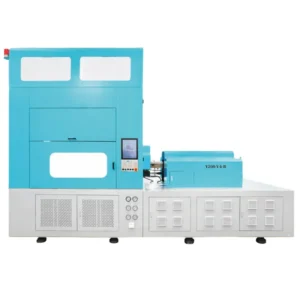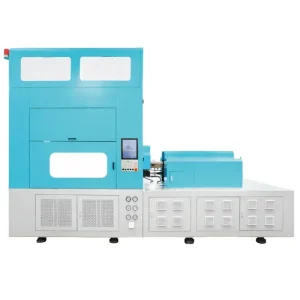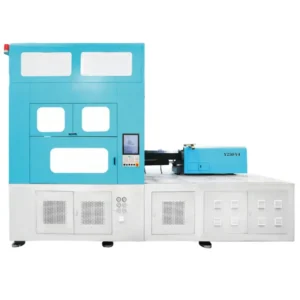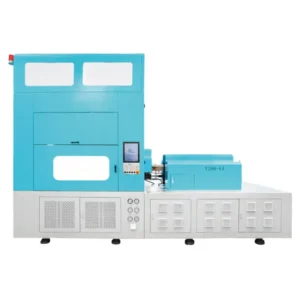
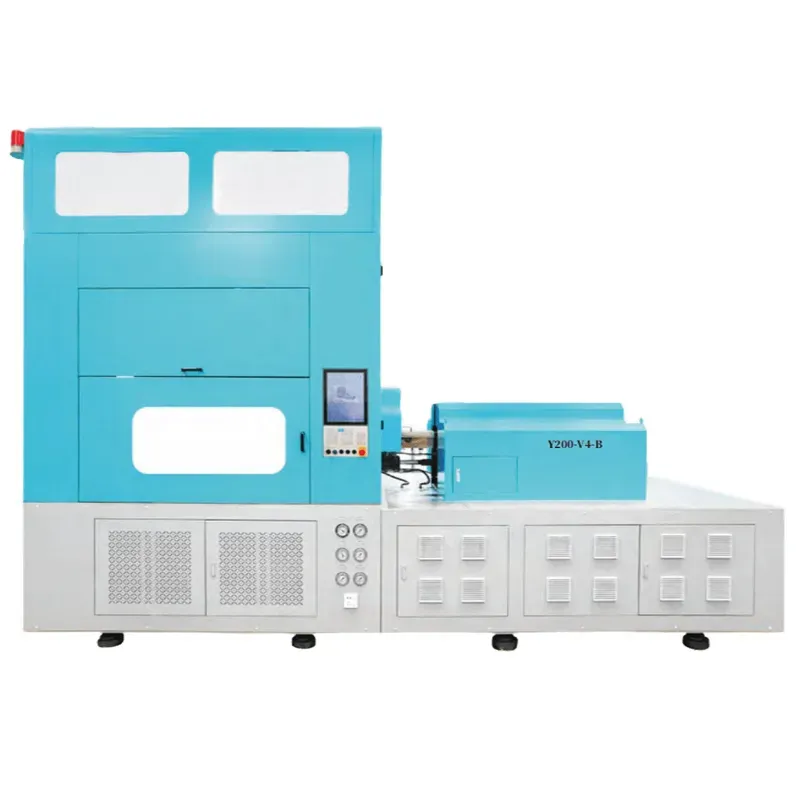
Y200-V4-B Spritzstreckblasformmaschine als Ersatz für die japanische AOKI SBIII-250LL-50S
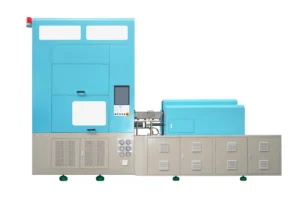
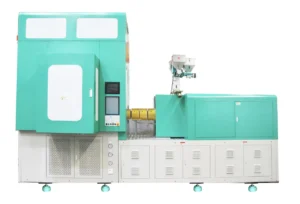
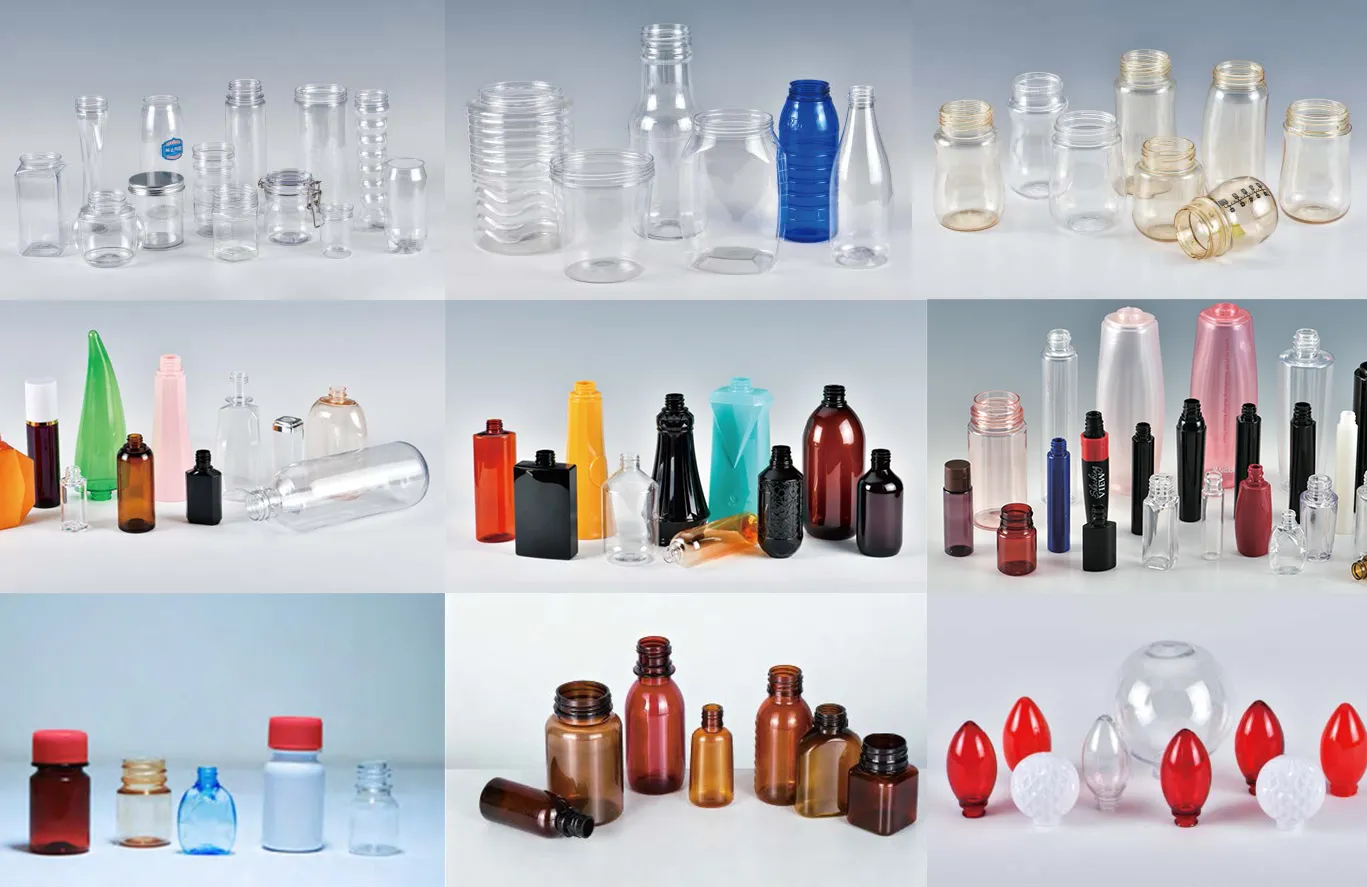
Die Spritzstreckblasformmaschine Y200-V4-B ist der direkte und kostengünstige Ersatz für das japanische Modell AOKI SBIII-250LL-50S. Als führende einstufige Spritzstreckblasformmaschine des mexikanischen Herstellers Ever-Power ISBM Machinery wurde die Y200-V4-B speziell für Hersteller entwickelt, die eine herausragende Produktvielfalt, hohe ästhetische Standards und strenge Hygienevorschriften benötigen. In einem einzigen integrierten Zyklus produziert sie unter anderem Medikamentenflaschen, Kosmetikflaschen, Babyflaschen, Wasserflaschen und Sonderformbehälter.
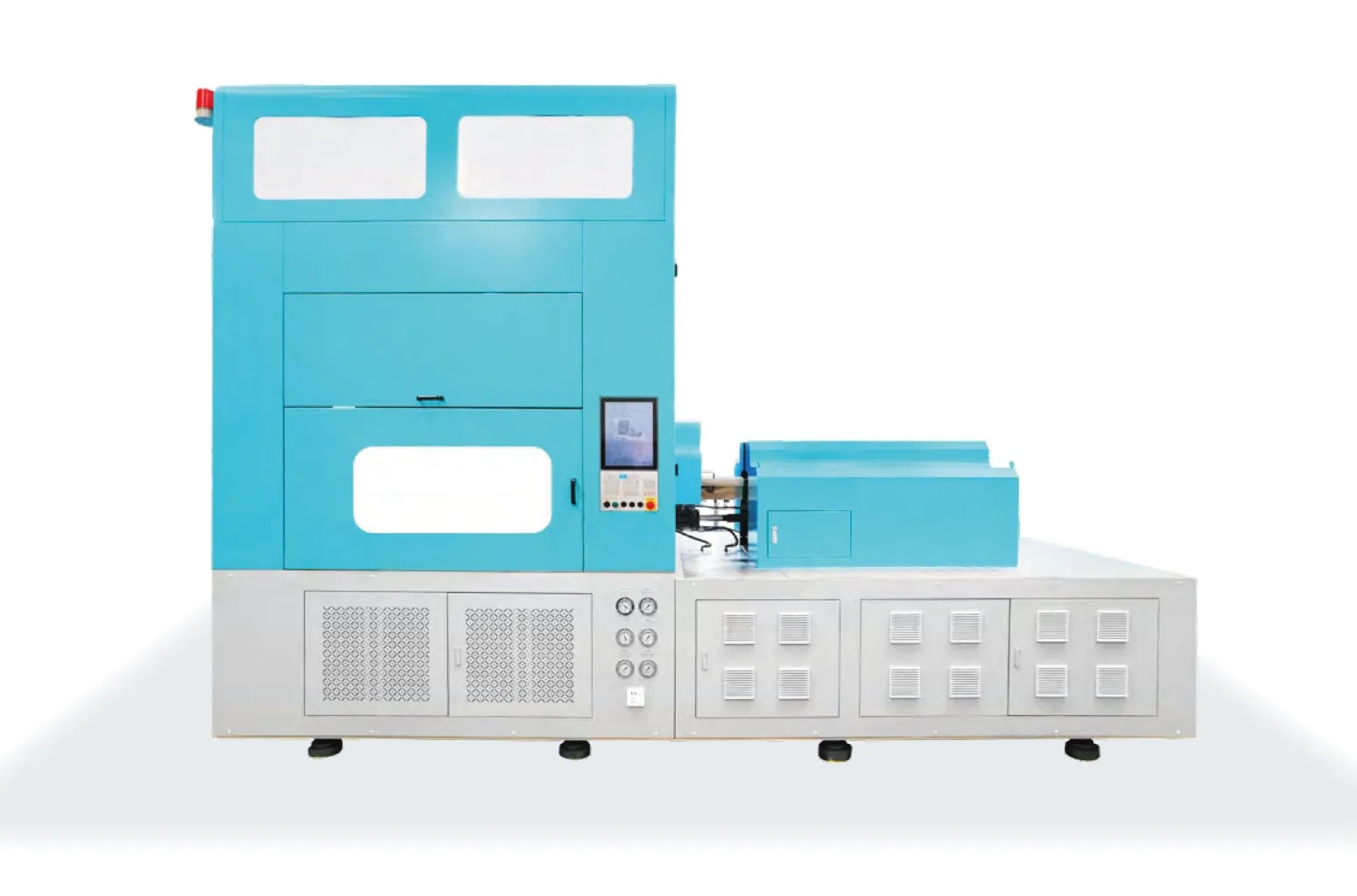
The Y200-V4-B Injection Stretch Blow Molding Machine is the direct, cost-effective replacement for the Japanese AOKI SBIII-250LL-50S model. As a leading one-step injection stretch blow molding machine manufactured by Mexico Ever-Power ISBM Machinery, the Y200-V4-B is purpose-built for manufacturers who require outstanding product diversity, high appearance standards, and strict hygiene compliance. In a single integrated cycle, it produces medicine bottles, cosmetic bottles, baby feeding bottles, water-glass bottles, special-shaped containers, and more, all without any intermediate human contact, fully meeting GMP pharmaceutical packaging production standards. The four-station turntable design operates on PET and PETG resins, handling bottle volumes from 20 ml up to 2,500 ml and output quantities from one to twelve cavities per cycle, making this single-stage injection stretch blow molding machine an outstanding choice for high-mix, high-quality production environments.
Mexico Ever-Power ISBM Machinery adopts a fully standardized design framework for the Y200-V4-B, and every mechanical accessory is sourced from globally trusted imported brands including Inovance / WEICHI servo motors, American Parker high-pressure valves, Airtak air cylinders, Japan Yaskawa or WEICHI servo motors for turntable drive, and YUKEN Taiwan hydraulic control valves. This rigorous component selection dramatically improves operational reliability and long-term stability compared with older-generation Japanese injection stretch blow moulding machine platforms. Whether your facility is producing high-transparency cosmetics flacons, precision pharmaceutical vials, or large-format water containers, the Y200-V4-B delivers consistent output and exceptional surface quality, with mold precision so high that the parting-line mark is virtually invisible, a clear competitive advantage over conventional Japanese mold systems.
Produktmodell-Vergleichstabelle
1. Ersatz für japanisches ASB-Modell
| Y/YS Maschinenmodell | Konfiguration / Anmerkungen | Kompatibles japanisches Modell |
| Y150-V4-2 | Standardkonfiguration | ASB-12M |
| YS150-V4-EV | Vollservo | ASB-12M |
| Y250-V4 | Standardkonfiguration | ASB-70DPH |
| Y250-V4-B | B-Serie | ASB-70DPW |
| Y650-V4 | Großkapazitätsmodell | ASB-650 |
2. Ersatz für das japanische AOKI-Modell
| Y/YS Maschinenmodell | Konfiguration / Anmerkungen | Kompatibles japanisches Modell |
| Y150-V4-B | B-Serie | SBIII-100L-20 |
| Y150-V3-B | 3-Stationen-Modell | SBIII-100L-20 |
| Y200-V4-B | B-Serie | SBIII-250LL-50S |
| Y200-V3 | 3-Stationen-Modell | SBIII-250LL-50S |
| YS350-V4-EV | Vollservo | AL-350LL-40 |
| Standardmodell | Servo-Modell | Vollelektrisches Modell |
 |
 |
 |
Unsere Vorteile
1. Die Qualität ist besser. Die in Japan mit Blasformmaschinen hergestellten Plastikflaschen weisen alle eine Trennlinie auf. Dabei entsteht zwischen den beiden Formteilen auf beiden Seiten ein kleiner Kunststoffüberstand, der eine sichtbare Markierung hinterlässt. Unsere Formen hingegen sind extrem präzise, sodass die Markierung völlig unsichtbar ist.
2. Unsere Produktion ist schnell, dank einer großen Anzahl von Schneckenlösungen und hoher Drehzahl. Während Japan vier Plastikflaschen gleichzeitig herstellen kann, schaffen wir sechs.
3. Energie sparen. Unsere Maschinen verbrauchen 151 bis 251 Tonnen weniger Energie als vergleichbare Maschinen in Japan, Europa und den USA.
4. Zahlreiche elektrische Steuerungstechnologien wurden eingeführt, um hydraulische und pneumatische Komponenten zu ersetzen. Beispielsweise wurden die in Japan im Bodenschneidmechanismus verwendeten pneumatischen Komponenten hier durch Servomotoren ersetzt, deren Drehzahl sich verdoppelt hat. In der pharmazeutischen Industrie und anderen Bereichen können Vollservomotoren ohne Hydrauliksysteme eingesetzt werden, wodurch die Einhaltung der GMP-Standards und ein Betrieb in einer öl- und schadstofffreien Umgebung gewährleistet werden.
Produktspezifikationen
| Artikel | Einheit | Spezifikationen | |||||||||||
| Name | Einstufiges Spritzstreckblasformen Maschine (4 Stationen) |
||||||||||||
| Modell | Y200-V4-B(Compatible with Japanese AOKI SBIII-250LL-50S model.) | ||||||||||||
| Hersteller | Mexiko Ever-Power | ||||||||||||
| Material | PET/PETG | ||||||||||||
| Schraubendurchmesser | MM | 40 | 50 | 55 | 60 | ||||||||
| Theoretisches Injektionsvolumen | CM³ | 240 | 340 | 380 | 480 | ||||||||
| Drehzahl der Schraube (U/min) | r/min | 270 | 180 | 150 | 150–220 | ||||||||
| Einspritzklemmkraft | KN | 300 | |||||||||||
| Blasklemmkraft | KN | 250 | |||||||||||
| Motorleistung | KW | 49.2 | |||||||||||
| Heizleistung | KW | 15 | |||||||||||
| Blasluftdruck | MPa | 2.0-3.5 | |||||||||||
| Kühlwasserdruck | MPa | 0.4-0.6 | |||||||||||
| Maschinenölkühler-Wasserdruck | MPa | 0.3-0.4 | |||||||||||
| Maschinenölkühlerwassertemperatur | ℃ | 20-25 | |||||||||||
| Stromspannung | V | 370-400 | |||||||||||
| (L*B*H) Größe (L*B*H) | MM | 4800x2000x3800 | |||||||||||
| Gewicht | T | 13 | |||||||||||
| Produktabmessungen | |||||||||||||
| Produktmenge | PCS | 1 | 2 | 3 | 4 | 5 | 6 | 7 | 8 | 10 | 12 | ||
| Flaschendurchmesser (BD) | MM | 118 | 110 | 105 | 100 | 68 | 65 | 48 | 45 | 38 | 26 | ||
| Flaschenhöhe (H) | MM | 280 | 150 | 100 | |||||||||
| Halsdurchmesser (E) | MM | 90 | 90 | 90 | 65 | 38 | 32 | 26 | 25 | 23 | 15 | ||
| Maximales Flaschenvolumen (ml) | ML | 2500 | 1500 | 900 | 750 | 350 | 200 | 100 | 50 | 30 | 20 | ||
| Maximales Flaschengewicht (W) | G | 150 | 65 | 45 | 35 | 30 | 28 | 25 | 20 | 15 | 10 | ||
Maschinenparameter
| Kompatibles Modell: | Compatible with the Japanese Aoki SBIII-250LL-50S model |
| Schraubendurchmesser: | 50 mm (optional) |
| Theoretische Einspritzkapazität: | 442 g |
| Einspritzklemmkraft: | 300 kN |
| Hub der oberen Form: | 600 mm |
| Unterer Formhub: | 350 mm |
| TEMP. Regulierung des Herzschlags: | 300 mm |
| TEMP. Regulierung des Zylinderhubs: | 350 mm |
| Ausholschlag: | 175 mm |
| Blasklemmkraft: | 250 kN (einseitig) |
| Schlagkernschlag: | 300 mm |
| Blasform-Schlag: | 75+75 mm |
| Öltank VOL: | 300 l |
| Gewicht: | 13T |
Technischer Standard
| Servo-Steuerungssystem: | Einsatz von 3 Servopumpensystemen. |
| Servomotorleistung: | Inovance/WEICHI Servomotorleistung: 49,2 kW. |
| Computersteuerungssystem: | Verwendung der Inovance/MiRLE SPS. |
| Plattenspielerantrieb: | Der Plattenspieler ist mit einem japanischen Yaskawa-Servomotor oder einem WEICHI-Servomotor mit einem taiwanesischen TSUNTIEN-Untersetzungsgetriebe ausgestattet. |
| Hochdruckventil: | Verwendung des amerikanischen Parker-Hochdruckventils. |
| Luftzylinder: | Verwendung des Aitak-Luftzylinders. |
| Temperaturregelung: | Die Temperaturregelung erfolgt über eine integrierte Steuereinheit, die hochpräzise, stabil und einfach zu bedienen ist; alternativ kann auch das im System integrierte Temperaturregelungssystem genutzt werden. |
| Hydraulisches Druckregelventil: | Verwendung eines hydraulischen Druckregelventils von YUKEN aus Taiwan, China. |
| Schraubenheizung: | Die Heizleistung der Schraube und der Materialrohre beträgt 15 kW. |
| Blasformstruktur: | Die Blasformstruktur verwendet ein hydraulisches Zylinder- oder ein Doppelservomotor-Formschließsystem mit Hochdruckkompensationsfunktion. |
| Injektionseinheit: | Die Einspritzeinheit wird von einem einzelnen Zylinder gesteuert. Der Schmelzmotor kann entweder hydraulisch oder durch einen Servomotor gesteuert werden. |
| Gesamtleistung der Maschine: | Gesamtleistung der Maschine: 64,2 kW. |
Features of Y200-V4-B Injection Stretch Blow Molding Machine
1. Improve Production Efficiency
This PET injection stretch blow molding machine rapidly and precisely manufactures large quantities of plastic containers with production efficiency that far exceeds manual production and traditional two-step molding processes. The high-speed servo-driven turntable and six-cavity output capability (versus four cavities typical of comparable Japanese machines) means more bottles per shift. With the Inovance / WEICHI servo system operating at 49.2 KW motor power, cycle consistency is maintained at high speed, supporting stable mass production of complex bottle geometries across all twelve cavity configurations.
2. Improve Molding Precision
The machine precisely controls the temperature, pressure, and speed of every molding phase, achieving an exceptional degree of consistency in bottle dimensions, wall thickness, and density. Ever-Power's ultra-high-precision mold engineering means the parting-line mark is virtually invisible, a documented improvement over Japanese mold systems where the parting-line protrusion is measurable. This level of dimensional accuracy is critical for pharmaceutical filling lines, cosmetic packaging auto-assembly, and beverages subject to tight volume tolerances on automated filling and capping equipment.
3. Reduce Labor Cost
Fully automated operation from injection through finished bottle ejection eliminates unstable variables introduced by manual handling, reducing human resource requirements on the production floor. The servo-driven blow molding structure, Inovance / MiRLE PLC computer control, and integrated temperature control box allow a minimal crew to oversee multiple simultaneous production lines. In pharmaceutical environments where GMP mandates contactless production, this one-step ISBM machine design is not merely convenient but compliance-essential, removing the risk of operator-contact contamination throughout the entire molding cycle.
4. Shorten Production Cycle
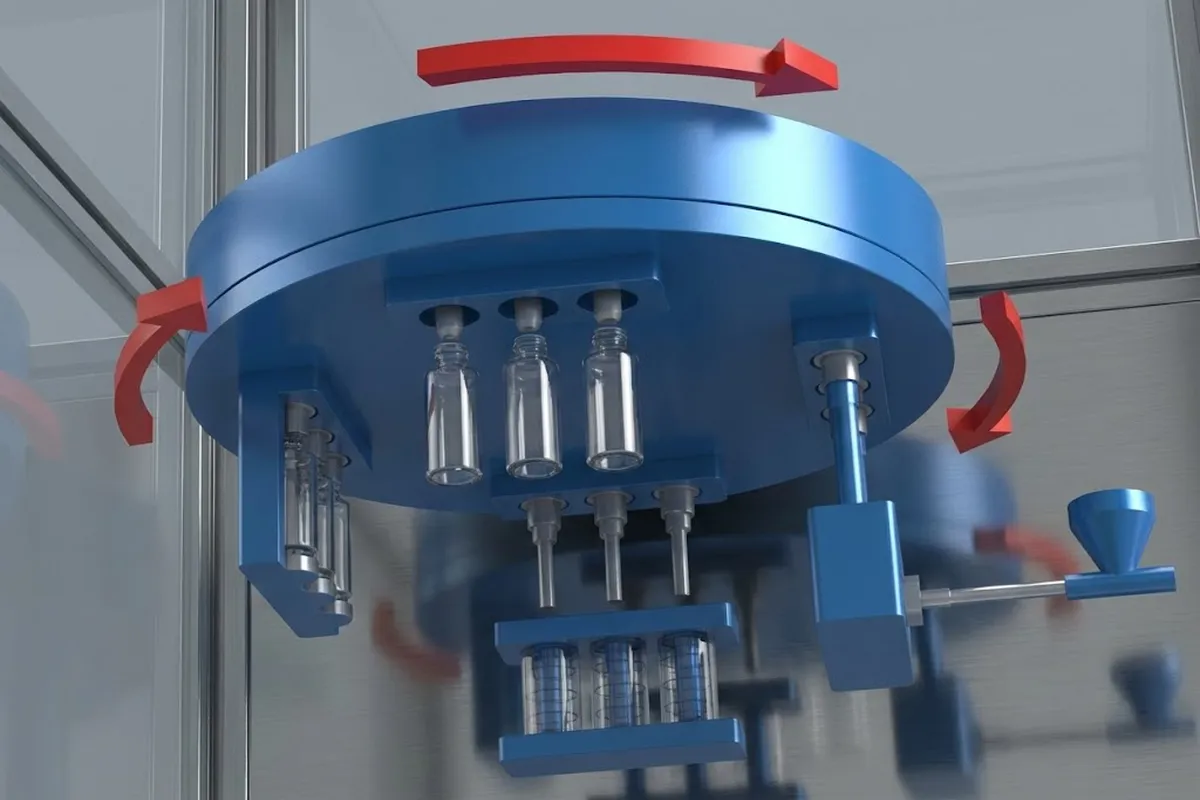
The Y200-V4-B completes every step from injection to finished bottle within one integrated four-station rotary platform, eliminating inter-process material handling and reheating entirely. By combining injection, temperature conditioning, stretch blow molding, and bottle take-out in a single continuous cycle, the machine significantly reduces total processing time per unit, improves throughput, and eliminates the downtime typically associated with two-step injection blow molding machine systems. Manufacturers can achieve consistent daily output volumes without the inefficiencies of offline preform storage or reheating stages.
5. Energieeinsparung sicherstellen
The Y200-V4-B consumes 15% to 25% less energy than equivalent Japanese, European, and American injection stretch blow moulding machine platforms. This is achieved through three servo pump systems, the use of Inovance / WEICHI servo motors across all motion axes, and direct utilization of preform injection heat for the blow stage, eliminating secondary heating. The machine processes only the plastic particles required for output with minimal scrap, reducing material waste and overall environmental impact while lowering per-unit production cost for long-run pharmaceutical and beverage bottle manufacturing.
6. Compact Footprint and AOKI Compatibility
At 4,800 x 2,000 x 3,800 mm and 13 tonnes, the Y200-V4-B maintains a manageable industrial footprint suitable for existing clean-room layouts, pharmaceutical GMP suites, or space-constrained cosmetic manufacturing workshops. Critically for facilities already invested in Japanese AOKI tooling, this machine is fully compatible with Japanese AOKI SBIII-250LL-50S molds, enabling existing AOKI mold assets to be transferred directly to the Y200-V4-B without modification. This makes it the most cost-effective and operationally seamless replacement of AOKI injection stretch blow molding machines available on the market.
How Does the Y200-V4-B ISBM Machine Work
Spritzgießen
The process begins by heating PET or PETG resin to a molten state via the servo-controlled injection unit. Molten resin is injected into the mold cavity to form a precision preform, which is partially cooled to stabilize its shape while retaining enough residual heat to allow uniform stretching in the subsequent stage. The preform's neck finish is formed to its final specification at this station, ensuring reliable sealing geometry and dimensional accuracy for filling and capping downstream. The injection clamping force of 300 KN guarantees cavity integrity across all screw diameter configurations.
Preform Conditioning and Transfer
The Japan Yaskawa or WEICHI servo motor-driven turntable, coupled with a Taiwan TSUNTIEN reducer, smoothly transfers the freshly molded preform from the injection station to the temperature-conditioning zone. The integrated temperature control box, known for its high accuracy and stability, governs the preform's thermal profile throughout this transfer stage. Controlled heating stabilizes the preform's internal temperature distribution and ensures uniform material behavior during the stretch and blow phases, directly improving container wall thickness consistency and reducing the risk of visual defects in finished bottles.
Streckblasformen
At this critical station, the conditioned preform is stretched biaxially: a stretch rod extends the preform axially while high-pressure air at 2.0-3.5 MPa, delivered through the American Parker high-pressure valve system, inflates it radially to the final mold geometry. This dual-direction molecular orientation improves tensile strength, barrier properties against gas transmission, and overall surface clarity. The blow clamping force of 250 KN (single side) and blow core stroke of 300 mm ensure complete mold fill and dimensional stability. Wall thickness uniformity and container transparency are maximized through precise control of stretch speed, timing, and blow pressure at this station.
Kühlung und Ausstoß
Once the finished container has been fully blown to its final shape, the mold's cooling system rapidly extracts heat from the bottle walls, solidifying the container's geometry. Cooling water at 0.4-0.6 MPa circulates through the mold to maintain precise thermal control, while the machine oil cooler water system (0.3-0.4 MPa, 20-25 °C) maintains the hydraulic system at optimal operating temperature. After sufficient cooling, the mold opens automatically and the finished bottle is ejected from the take-out stroke (175 mm), completing the full molding cycle and delivering a ready-to-fill pharmaceutical, cosmetic, or beverage container without any manual intervention.
Anwendungsgebiete
1. Pharmaceutical Bottles
The Y200-V4-B meets GMP pharmaceutical packaging production standards through fully contactless, automated production from injection to bottle ejection. It produces oral liquid bottles, tablet containers, capsule bottles, and dosage form vials in PET or PETG with precise dimensional tolerances, high chemical resistance, and outstanding transparency for visual inspection compliance. The zero-hydraulic-oil-in-product-zone design further supports clean-room requirements in regulated pharmaceutical environments.
2. Chemikalienflaschen
Industrial and household chemical packaging demands containers with robust wall integrity, reliable sealing performance, and resistance to chemical permeation. The biaxial stretching process in the Y200-V4-B aligns PET molecules to improve gas barrier and impact resistance, making it well-suited for detergents, disinfectants, lubricants, and specialty chemical containers. The precise mold engineering ensures consistent neck-finish dimensions critical for pump and trigger-spray closures used throughout the chemical products sector.
3. Getränkeflaschen
As a high-output ISBM machine manufacturer-backed solution, the Y200-V4-B produces mineral water bottles, juice bottles, sports drink containers, and specialty beverage formats with excellent CO2 and O2 barrier performance resulting from biaxial orientation. Output of up to six cavities per cycle, combined with 15-25% energy savings versus Japanese and European counterparts, significantly reduces per-unit production cost for high-volume beverage bottling operations targeting retail and private-label markets.
4. Kosmetikflaschen
High-end cosmetics packaging demands superior surface quality, invisible parting lines, and perfect geometric symmetry - qualities where this customized injection stretch blow molding machine excels. The machine produces toners, serums, lotions, perfumes, and specialty cosmetic flacons with exceptional clarity and intricate body shapes, supporting SKU-level customization through rapid mold changeover. Compatible bottle sizes range from 20 ml (eye-area serums) to 750 ml (body care formats), covering the full cosmetic portfolio in a single platform.
5. Babyflaschen
Baby feeding bottles require materials and manufacturing processes that are fully safe for infant use, with no hydraulic oil contamination risk, no parting-line protrusions that could harbor bacteria, and precise volume accuracy for feeding measurements. The Y200-V4-B's contactless GMP-compliant production process and ultra-precise mold technology make it particularly well-suited for PETG baby bottle manufacturing, where material clarity, safety, and dimensional precision are simultaneously mandated by both parents and regulatory bodies.
6. Body Wash Bottles
Personal care manufacturers rely on high-aesthetic-standard PET containers for shampoo, conditioner, body wash, and hand sanitizer product lines. This injection blow molding machine platform supports complex oval, square, and specialty body-contour bottle profiles with smooth, mark-free surfaces that elevate on-shelf brand presentation. The machine accommodates bottles from 100 ml to 750 ml within this category and allows rapid mold changeover to support seasonal packaging refresh cycles common across major personal care brands.
7. Drinking Water Buckets
The Y200-V4-B's maximum single-cavity bottle volume of 2,500 ml and neck diameter of up to 90 mm make it capable of producing large-format drinking water containers. The high-rigidity blowing clamping force of 250 KN (single side) ensures that large preforms are fully and uniformly expanded to meet the structural demands of water-dispenser-compatible buckets, which require precision neck threads for valve and pump fittings as well as high impact resistance for stack-and-return logistics in the water delivery supply chain.
8. Eye Drop Bottles
Eye drop containers represent among the most demanding pharmaceutical packaging specifications, requiring extremely precise fill volumes, sterile-compatible production, tamper-evident neck geometries, and tip orifice dimensions within micron-level tolerances. The Y200-V4-B's 300 KN injection clamping force and high-precision servo control make it capable of producing small-format pharmaceutical vials as small as 20 ml to 30 ml with neck diameters of 15-23 mm, meeting the dimensional standards required for dropper-tip assembly on ophthalmic packaging lines operating under pharmaceutical cleanroom conditions.
Compatible Materials of Y200-V4-B ISBM Machine
The Y200-V4-B processes materials that can be efficiently handled in the injection stretch blow molding process. Each material requires specific temperature, pressure, and orientation settings. The following materials are compatible with this ISBM mold injection machine:
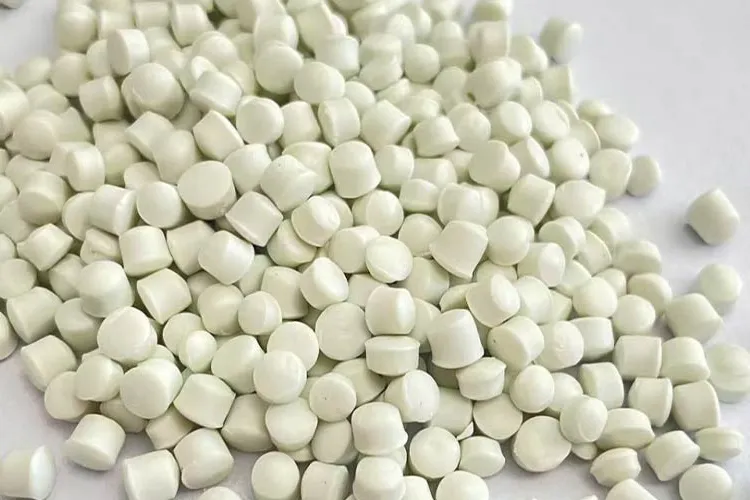
PET (Polyethylenterephthalat)
PET is the primary material for this machine and the optimal choice for the injection stretch blow molding process. Biaxial orientation during stretching dramatically improves PET's tensile strength, gas barrier properties against CO2 and O2 transmission, and optical clarity. PET is widely used in beverage bottles, pharmaceutical containers, cosmetic packaging, and food-contact applications, with excellent recyclability supporting sustainability commitments. Standard process temperature: 260-285 °C.
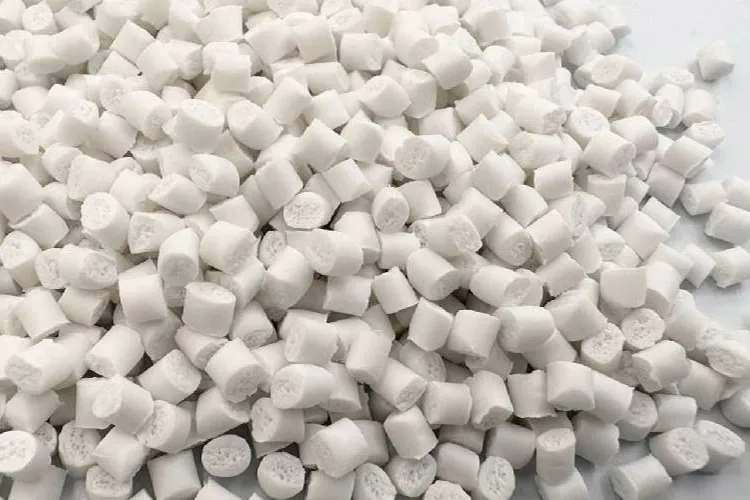
PETG (Glycol-Modified PET)
PETG is also directly specified as a compatible material for the Y200-V4-B. It offers exceptional optical clarity comparable to glass, excellent chemical resistance, and high impact strength without requiring orientation for improved properties. PETG is particularly favored for pharmaceutical containers, baby products, and cosmetic packaging where both transparency and chemical safety are paramount. It has a lower processing temperature than standard PET and produces containers with excellent dimensional stability.
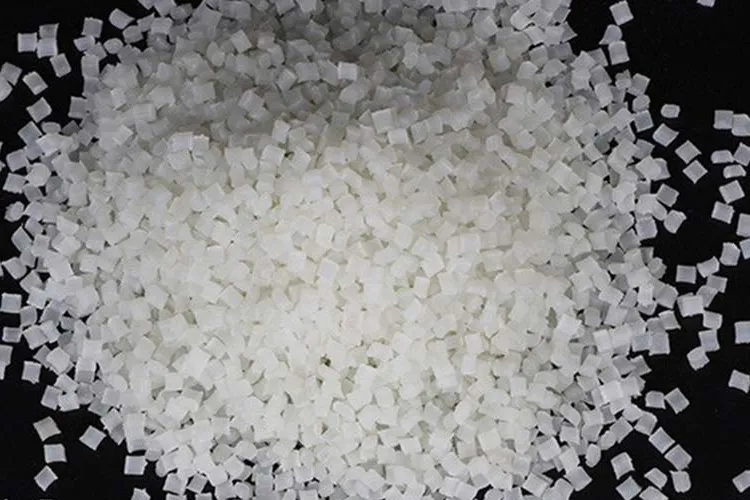
PC (Polycarbonat)
Polycarbonate offers exceptional impact resistance, high-temperature performance, and outstanding optical clarity, making it suitable for reusable water bottles, medical devices, and industrial containers. PC requires higher processing temperatures (around 280-320 °C) and careful moisture control prior to processing, as even slight pre-processing moisture can cause hydrolytic degradation affecting clarity and mechanical properties in the finished container.
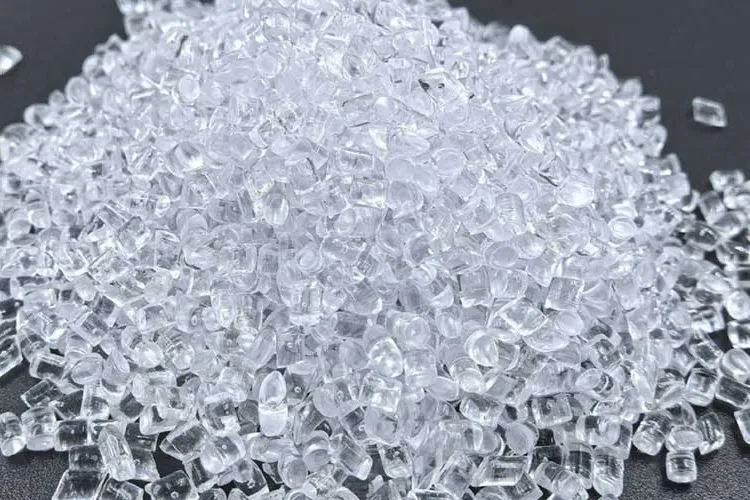
PP (Polypropylen)
Polypropylene offers excellent chemical resistance, good heat resistance (usable up to 100 °C), and FDA-approved food-contact properties, making it suitable for hot-fill containers, medical syringes, and condiment packaging. PP requires precise temperature management during the ISBM process to achieve clarity, as its semi-crystalline nature can cause haziness if cooled too slowly. The machine's precision temperature control system enables successful PP processing.
HDPE (Polyethylen hoher Dichte)
HDPE provides excellent moisture barrier properties and outstanding chemical resistance, making it a standard material for pharmaceutical bottles, household chemical containers, and personal care packaging. While HDPE lacks the optical clarity and gas barrier performance of PET, it offers superior resistance to a wider range of solvents and chemicals. The ISBM machine must adjust temperature and stretching parameters for HDPE to achieve consistent preform behavior during the blow stage.
PCTG / Tritan
PCTG and Tritan copolyesters combine the clarity and processability of PETG with enhanced chemical resistance, making them suitable for medical device containers, baby products, and specialty cosmetic packaging. They are BPA-free and dishwasher-safe, which are growing requirements in health-conscious consumer markets. The Y200-V4-B's flexible temperature control system accommodates the specific processing window for these specialty copolyester materials.
 |
 |
 |
 |
 |
 |
How to Improve Transparency in the Injection Stretch Blow Molding Process
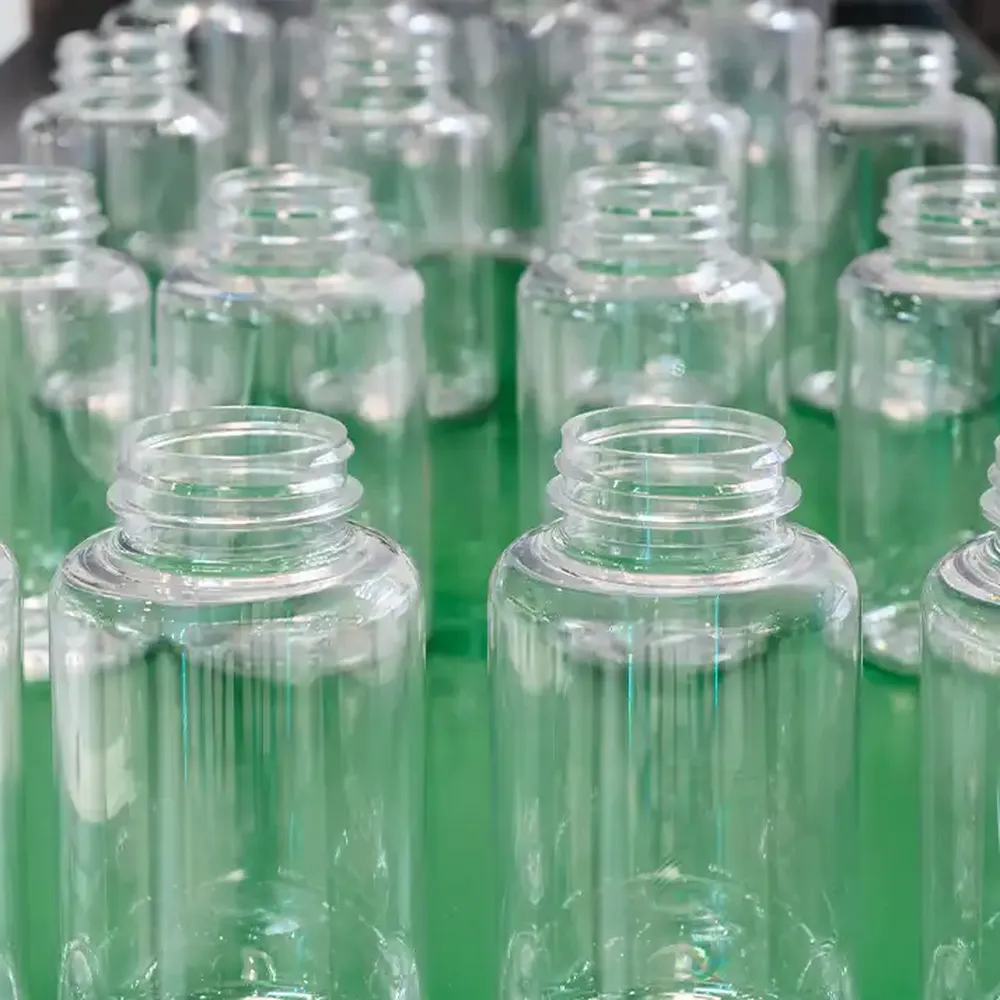
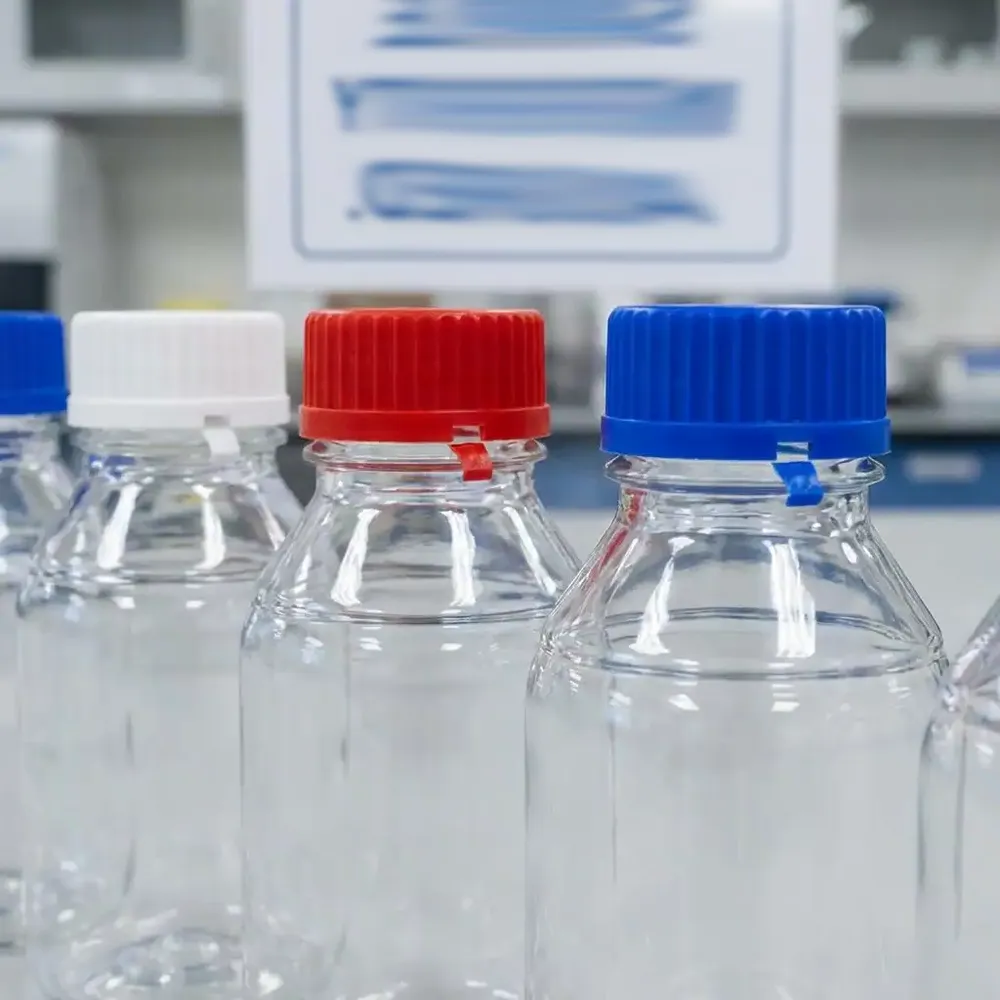
Container transparency is a critical quality indicator for pharmaceutical, cosmetic, and beverage packaging. The Y200-V4-B is engineered with precision control systems that address all major factors affecting PET container clarity.
1. Material Quality and Crystallinity Control
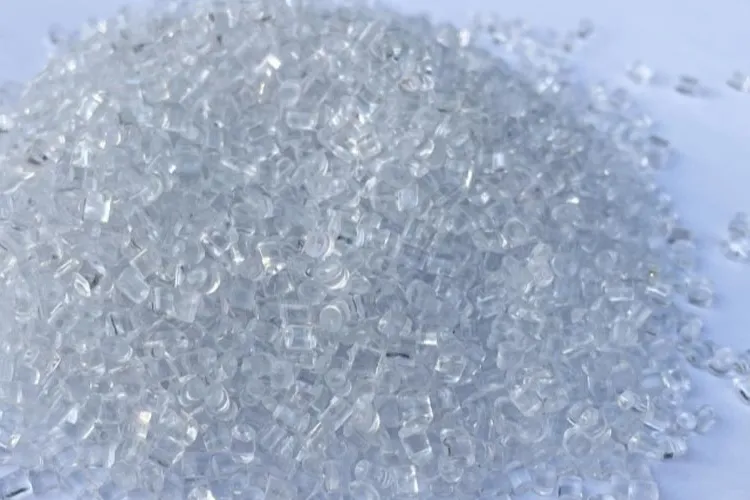
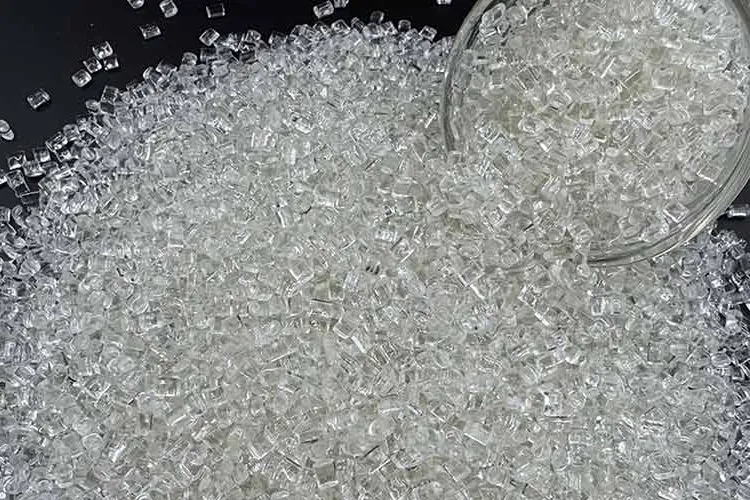
Achieving high transparency begins with selecting PET preforms with low crystallinity. Low crystallinity allows greater light transmission, while high crystallinity produces cloudiness. The Y200-V4-B's rapid cooling system maintains low crystallinity by quickly extracting heat from the container after blowing. PET samples cooled rapidly below 120 °C typically achieve crystallinity under 20% and light transmittance above 90%, while slow cooling at 140-160 °C raises crystallinity above 30% and reduces transmittance to around 70%. Ever-Power's strict quality control protocols include high-grade PET resin sourcing and batch testing to ensure consistent preform quality entering the process.
2. Moisture Control and Preform Drying
Excess moisture in PET preforms is a major transparency-reducing factor in the injection stretch blow molding process. Wet preforms absorb more heat, require longer heating times, and have a lower glass-transition temperature, leading to inconsistent material distribution during stretching and reduced optical clarity in the finished container. Moisture also acts as a plasticizer, enabling unintended over-stretching. Manufacturers must thoroughly dry PET resin before processing, typically to a moisture level below 50 ppm, using dehumidifying dryers to ensure even softening and controlled stretching behavior during the blow stage.
3. Biaxial Stretching Optimization
Biaxial stretching is the most powerful lever for improving both optical properties and structural strength in PET containers. When the preform is stretched simultaneously in axial and radial directions, the PET polymer chains align, reducing light scattering and significantly increasing transparency. Higher stretching ratios produce smaller crystallites, improving clarity, while insufficient stretching leaves polymer chains in a disordered state, causing haze. Operators must optimize stretch rod travel, blow pressure timing, and inflation ratios for each bottle design to achieve the biaxial orientation profile that maximizes transparency and gas barrier performance simultaneously.
4. Machine Settings: Heating Temperature and Time
Precise control of heating temperature and exposure time is critical for achieving uniform transparency across all cavities. Excessive temperature or prolonged heating causes PET to develop pearlescent opacity and lose clarity. Insufficient temperature prevents proper molecular alignment during stretching. The Y200-V4-B's integrated temperature control box maintains heating within the recommended PET range of 100-180 °C with high accuracy across the temperature-conditioning station. Regular monitoring and adjustment of the heating profile for each preform batch ensures consistent transparency results in the finished bottle population.
5. ISBM Machine Calibration
Regelmäßige Kalibrierung der ISBM-Maschine ensures that all parameters remain within optimal ranges for transparency and product quality. This includes verifying temperature sensor accuracy, stretch rod speed consistency, blow pressure response, and mold temperature uniformity. The Inovance / MiRLE PLC control system enables operators to store and recall calibrated process recipes for each product, ensuring repeatable transparency results across production batches. Scheduled calibration intervals should be established and documented as part of the facility's quality management system, particularly in pharmaceutical GMP environments.
6. Cleanliness and Contamination Prevention
Contamination from dust, oil residues, and foreign organic or inorganic substances is a direct cause of surface imperfections and optical defects in injection stretch blow molded containers. Manufacturers must maintain rigorous cleanliness protocols in the processing environment, including regular cleaning of the injection barrel and nozzle, inspection of screw surfaces for wear-induced metal particles, and use of clean, dry raw materials from controlled storage. Contamination from reactive polyester end group transformation, COOH group buildup, or polyfunctional macromolecule accumulation can cause gel formation and branching defects that permanently reduce container transparency.
 |
 |
How the Y200-V4-B Improves Production Speed
1. Faster Cycle Times Through Single-Stage Integration
The most direct speed advantage of this single stage injection stretch blow molding machine is the elimination of intermediate steps between injection and blowing. The four-station rotary platform completes injection, conditioning, blow molding, and ejection in continuous, overlapping cycles. Every station operates simultaneously, meaning a bottle is being ejected at the take-out station while a new preform is being injected at Station 1. This parallel operation enables the machine to produce thousands of bottles per shift without any idle time between stages, a fundamental throughput advantage over two-step processes.
2. Multi-Cavity Output
The Y200-V4-B supports mold configurations of 1 to 12 cavities, with the ability to produce up to six bottles per cycle, double the four-cavity output typical of the Japanese AOKI SBIII-250LL-50S. This multi-cavity capability multiplies production output with minimal proportional increase in energy consumption or floor space. For medium-volume pharmaceutical or cosmetic facilities, a 12-cavity configuration producing small bottles (20-50 ml) delivers dramatically higher throughput per shift compared with single-cavity specialty machines, without requiring additional production floor equipment.
3. Servo-Driven Automation
Three sets of servo pump systems, the Japan Yaskawa or WEICHI servo-driven turntable, and the servo-option melt motor collectively eliminate the response lag associated with conventional hydraulic systems. Servo motors accelerate and decelerate with programmable precision, enabling shorter dwell times at each station and faster overall cycle rotation. The Inovance / MiRLE PLC-managed automation eliminates manual operator intervention in bottle handling, mold operations, and process parameter adjustments, keeping the production line running at optimized speed with minimal downtime for human adjustments.
4. Energy-Efficient Heating Reduces Conditioning Time
The Y200-V4-B uses the residual thermal energy from the injection process for the blow conditioning stage, avoiding secondary reheating delays inherent to two-step systems. This direct heat utilization reduces the conditioning time required for the preform to reach optimal blow temperature, shortening the overall cycle. The integrated 15 KW screw and barrel heating system and the precision temperature control box ensure rapid, stable reaching of target temperatures at startup and consistent maintenance of those temperatures during sustained production runs, minimizing rejects from temperature variation.
5. Rapid Mold Changeover
The Y200-V4-B's compatibility with Japanese AOKI SBIII-250LL-50S molds, combined with Ever-Power's standardized mold interface design, enables facilities to switch between product SKUs without lengthy tooling conversions. For manufacturers producing multiple bottle formats on a shared production schedule, rapid mold changeover directly increases the productive hours available per machine per week, improving overall equipment effectiveness (OEE) and reducing the capital required for dedicated single-product equipment investment.
6. Reduced Reject Rate Maintains Line Speed
Production speed is meaningless without consistent product quality. The Y200-V4-B's ultra-high-precision mold engineering, servo pressure control, and PLC-managed process recipe management result in a significantly lower dimensional reject rate than conventional ISBM platforms. Fewer rejects mean fewer production stoppages for quality investigations, less rework, and higher utilization of each production hour. The machine's consistent performance across all cavity positions further ensures that high-cavity runs do not suffer from cross-cavity quality variation, which is a common speed-limiting issue in conventional multi-cavity blow molding operations.
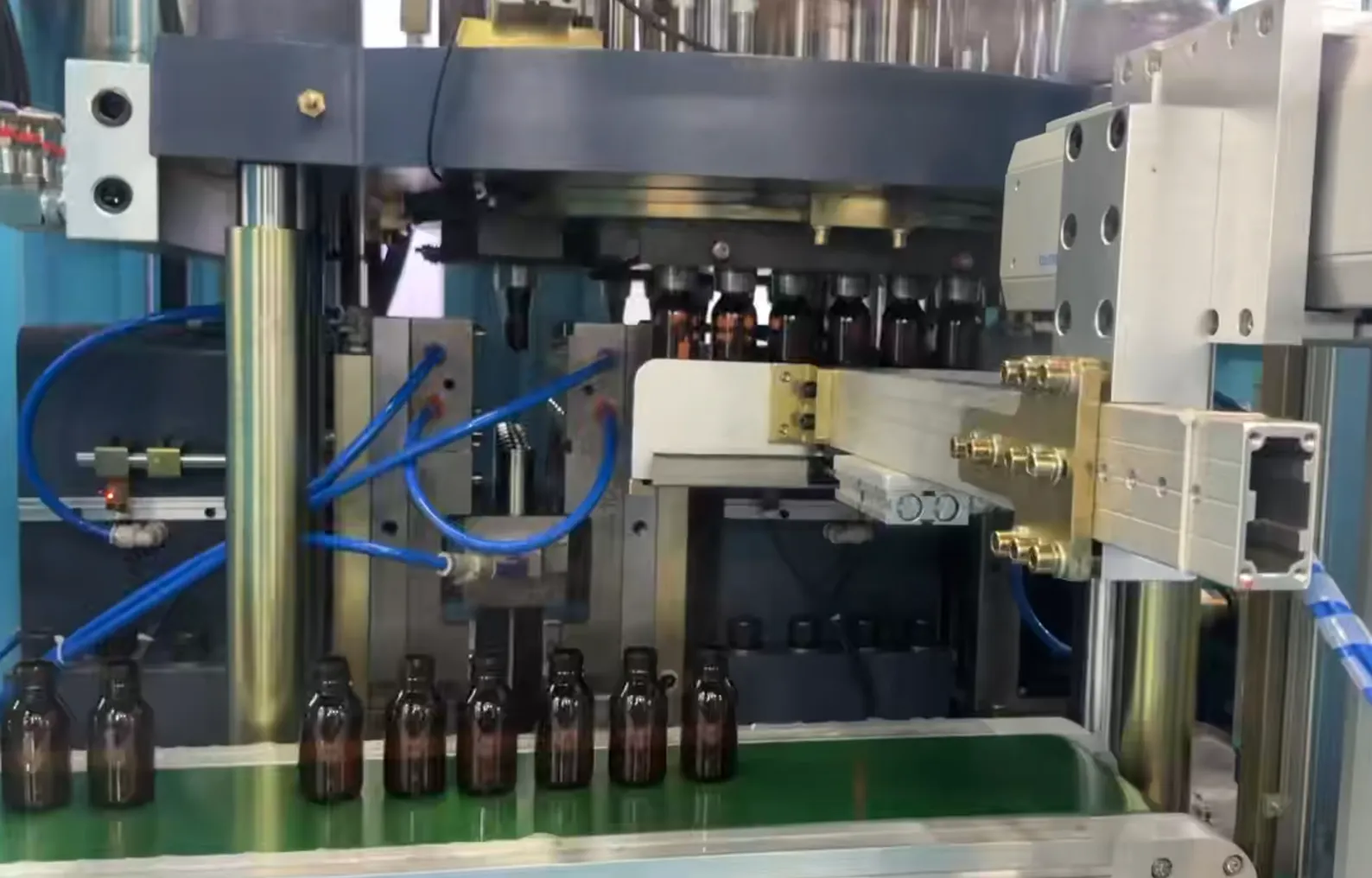
EBM Machine vs ISBM Machine: Which Is Right for You?
Understanding the differences between Extrusion Blow Molding (EBM) and Injection Stretch Blow Molding (ISBM) is essential for selecting the right manufacturing platform for your application.
Understanding ISBM and EBM
ISBM (Spritzstreckblasformen) is a process where plastic is first injection-molded into a precision preform, which is then conditioned and stretch-blown into the final container shape within the same machine. This method is the standard for high-quality PET bottles in beverages, cosmetics, and pharmaceuticals. The Y200-V4-B is a purpose-built one-step injection stretch blow molding machine optimized for this process.
EBM (Extrusionsblasformen) involves extruding a continuous molten plastic parison that is captured by a mold and inflated into shape. EBM is well-suited for containers with handles, asymmetric geometries, and larger volumes such as detergent bottles, automotive fluid reservoirs, and industrial drums, where dimensional accuracy and surface clarity are secondary to design flexibility.
Anfangsinvestition
ISBM: Higher initial investment due to precision injection and blow mold tooling. Both preform molds and blow molds are required, and tooling tolerances are tighter. However, the Y200-V4-B's AOKI mold compatibility allows existing tooling to be reused, reducing the effective capital barrier for facilities upgrading from Japanese machines.
EBM: Lower upfront machine cost and simpler mold design, particularly for basic shapes and larger containers. More accessible for startups or small-batch operations without demanding appearance requirements.
Operating Costs and Material Efficiency
ISBM: Highly energy-efficient per unit, particularly in high-volume runs. The Y200-V4-B uses 15-25% less energy than Japanese and European equivalents. Minimal material waste, as the preform is precisely sized before blowing, with no flash or trim scrap.
EBM: Higher energy consumption per unit, especially for thick-walled or large-format containers. Flash and parison trimming generate scrap material that must be recycled, increasing effective material cost per finished container.
Product Quality and Design Range
ISBM: Produces containers with superior clarity, strength, tight dimensional tolerances, and uniform wall thickness. Biaxial molecular orientation delivers excellent gas barrier properties. Best for lightweight, high-clarity containers in pharmaceutical, cosmetic, and beverage applications.
EBM: Greater design flexibility for containers with handles, undercuts, and complex geometries. Wall thickness may vary, and surface finish is generally less refined. Suited to industrial, household, and automotive applications where structural performance outweighs aesthetics.
| Faktor | ISBM | EBM |
|---|---|---|
| Initial Machine Cost | Hoch | Mäßig |
| Schimmelkosten | High (precise, dual molds) | Untere |
| Materialabfall | Niedrig | Höher |
| Energy Consumption (per unit) | Untere | Höher |
| Clarity and Finish | Exzellent | Gut |
| Wandstärkenkontrolle | Exzellent | Variable |
| Designflexibilität | Beschränkt | Hoch |
| Changeover Speed | Langsamer | Schneller |
For applications demanding high clarity, tight dimensional tolerances, GMP compliance, and energy-efficient high-volume production, the Y200-V4-B ISBM machine is the definitive choice. Ever-Power as a leading injection stretch blow molding machine manufacturer offers both ISBM and EBM solutions, with technical teams available to assist in selecting the optimal platform for your specific production requirements.
Why Choose Ever-Power's Injection Stretch Blow Molding Machine?
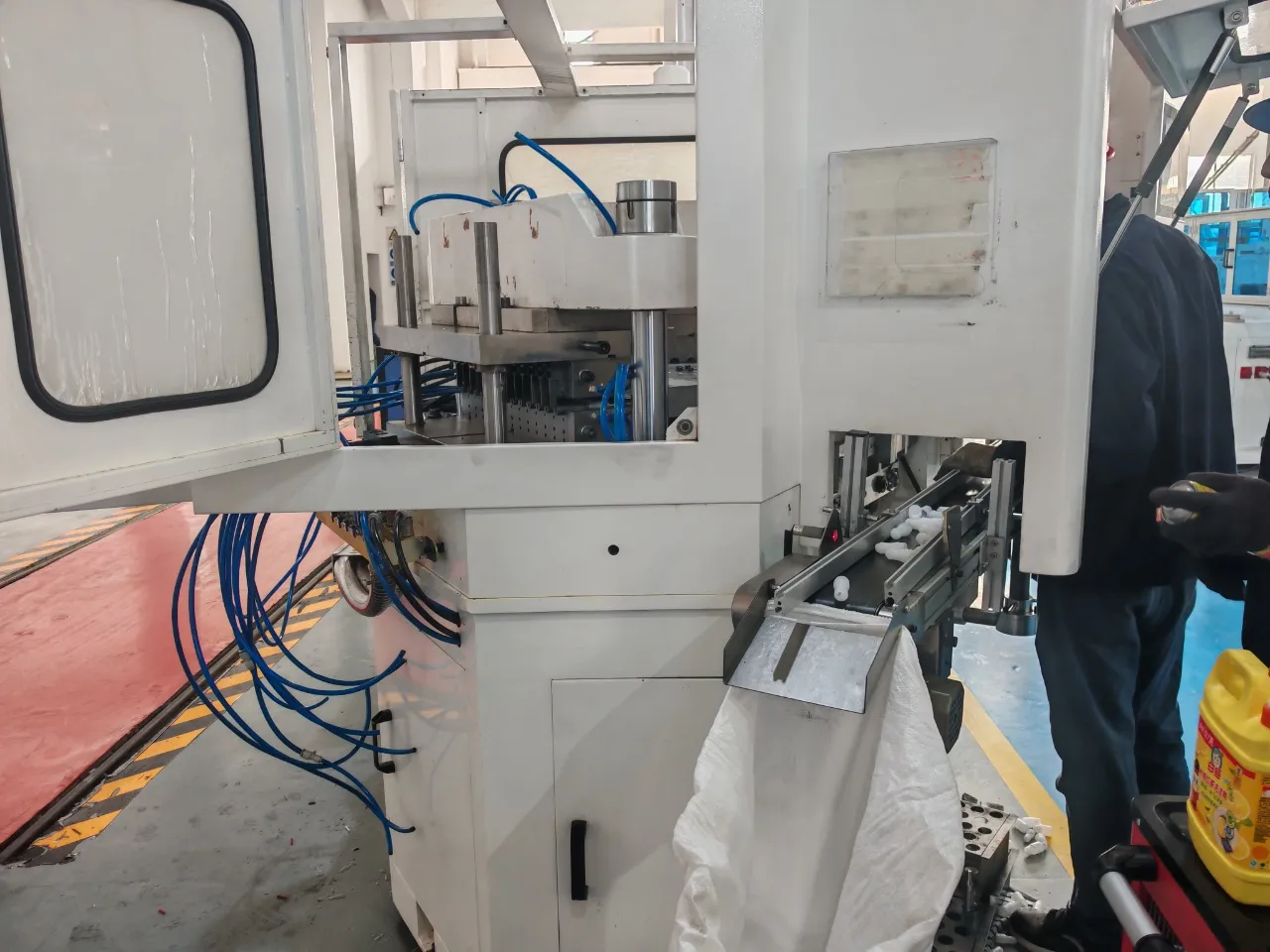
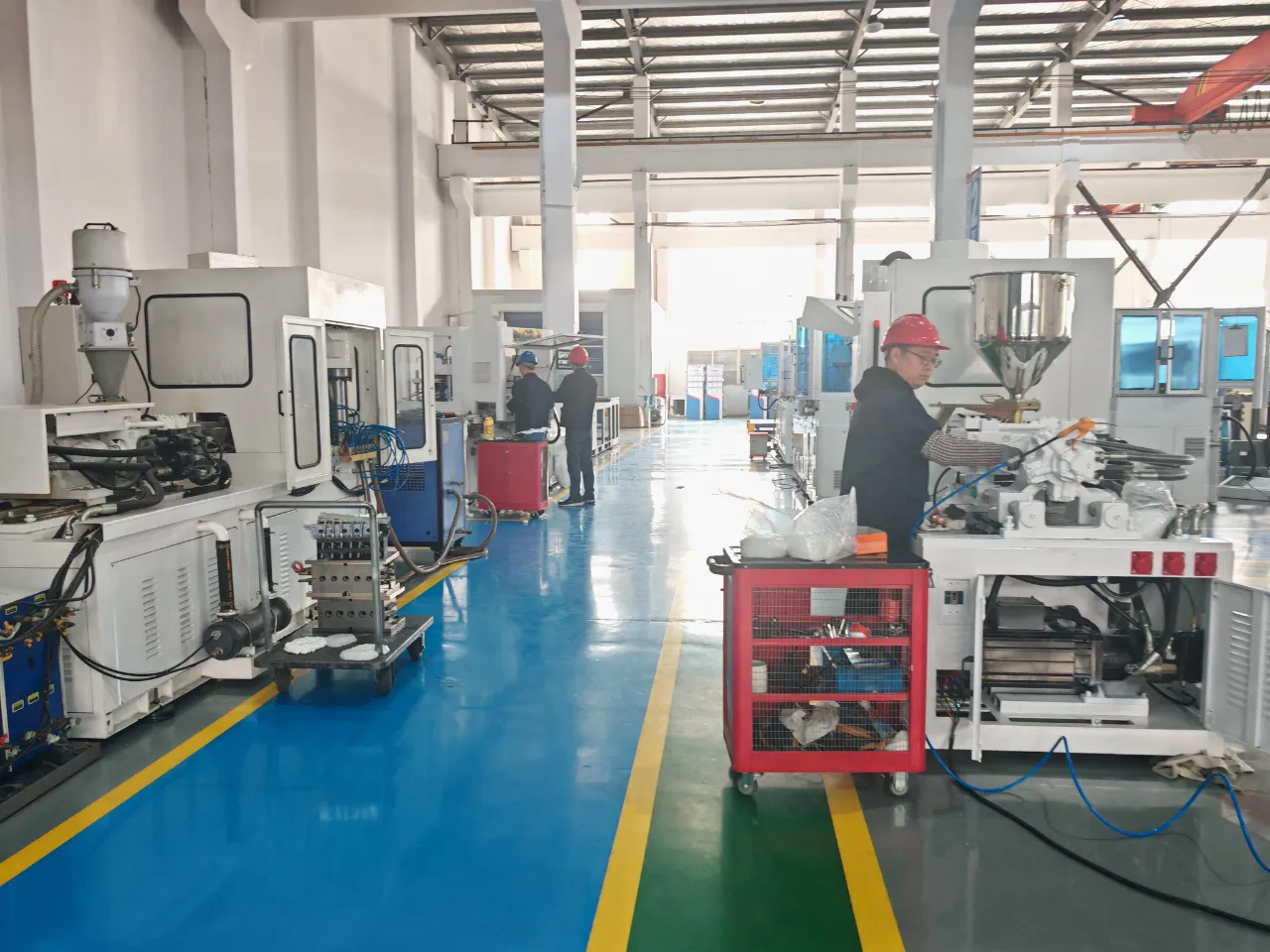
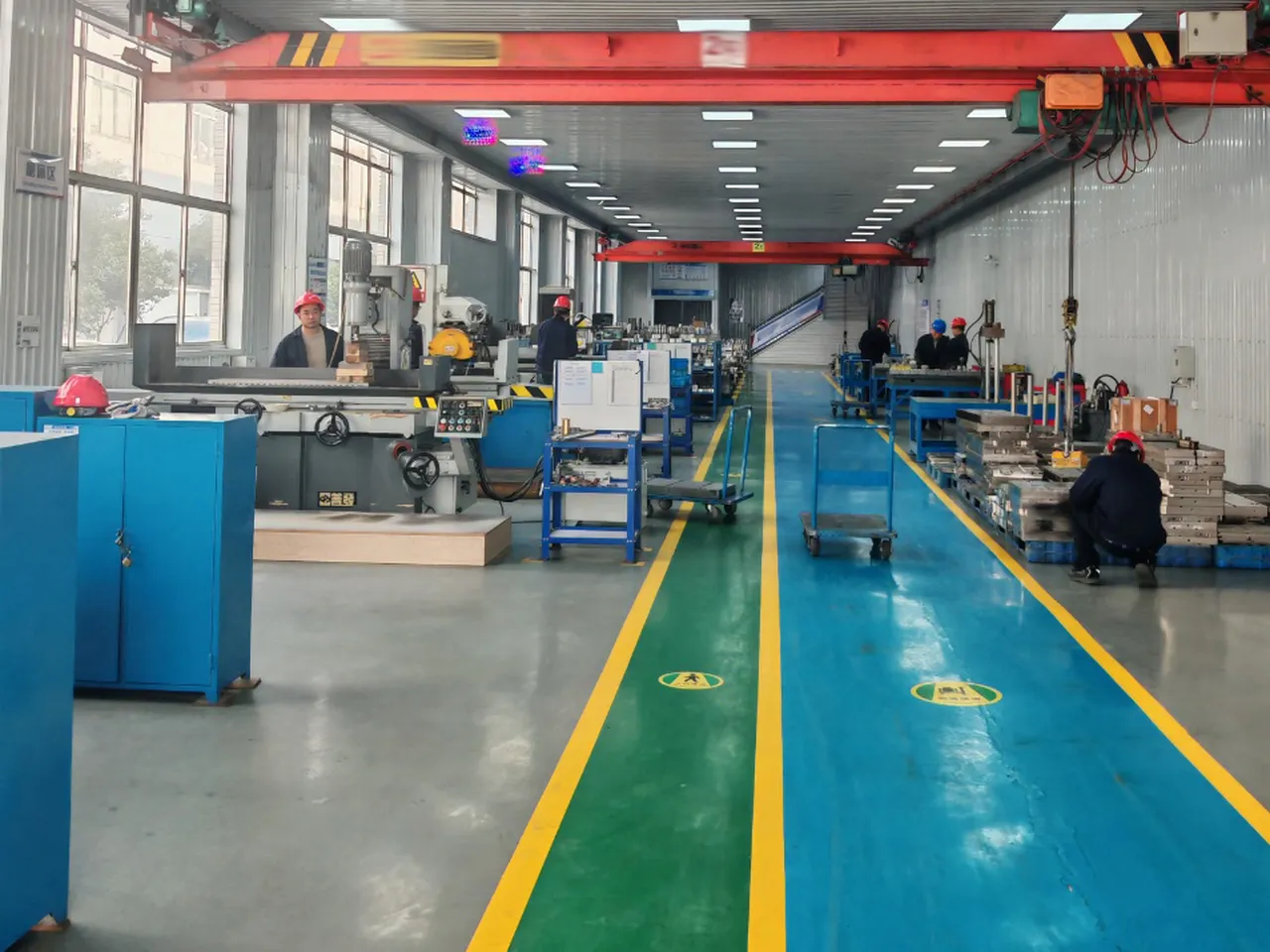
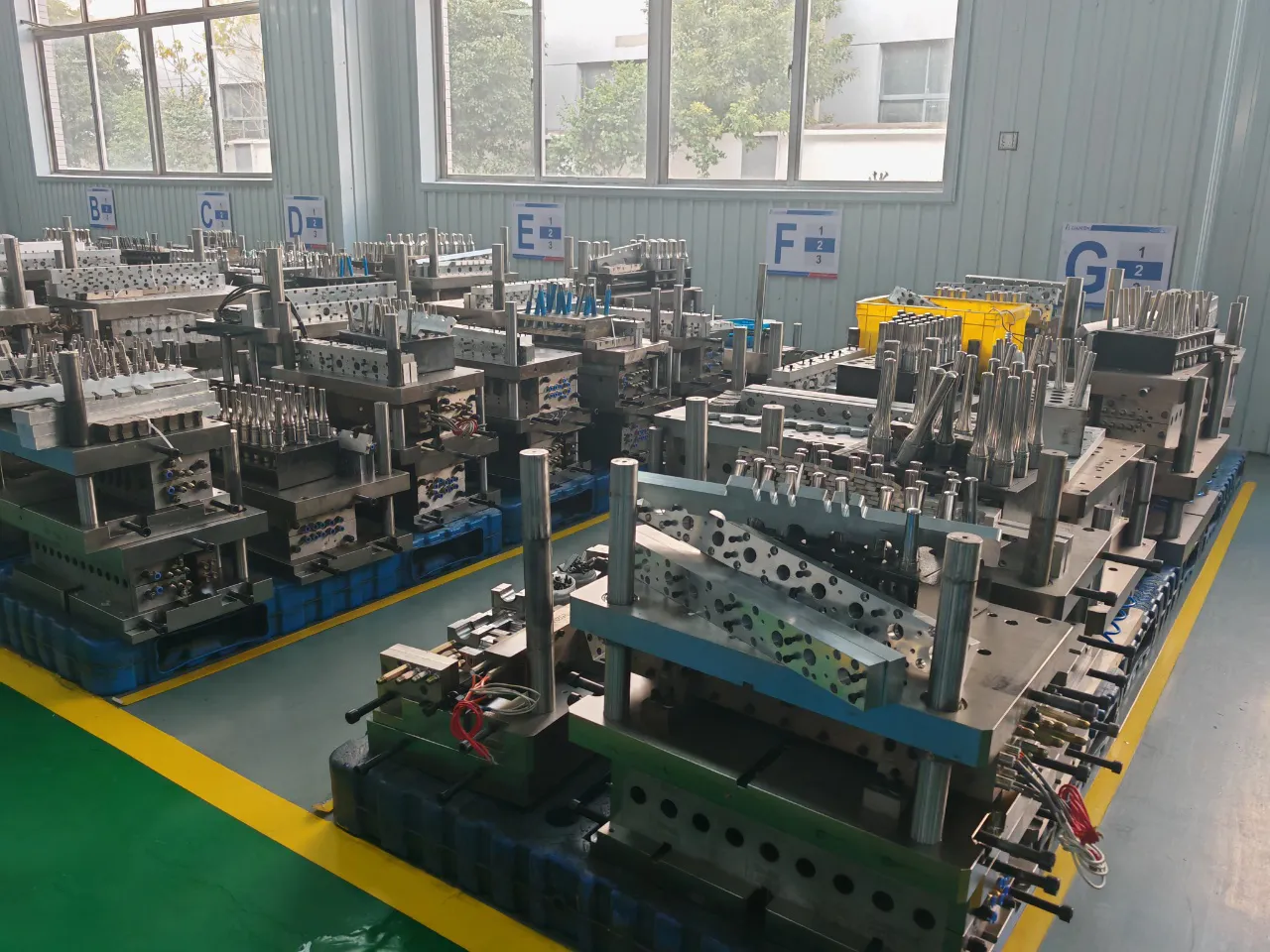
Mexico Ever-Power ISBM Machinery Co., Ltd. is dedicated to the research and development, manufacturing, sales, and global trade of automatic one-step injection blow molding machines and injection stretch blow molding machines. Our product portfolio covers injection blow molding machines, extrusion blow molding machines, injection stretch blow molding machines, and a full range of auxiliary equipment. Ever-Power operates from an advantageously located and well-connected manufacturing facility staffed by a team of highly experienced R&D engineers specializing in injection-blowing machinery and mold engineering.
Our team brings together decades of combined theoretical and practical experience in ISBM machine design, enabling us to provide detailed and responsive pre-sale consultations, installation support, operator training, and long-term after-sale service. We design our machines and service programs around the real production challenges faced by pharmaceutical, cosmetic, beverage, and food packaging manufacturers in global markets.
Ever-Power's product applications span pharmaceutical packaging, food packaging, healthcare packaging, cosmetic packaging, and specialty plastic packaging across multiple material platforms including PET, PETG, PP, PC, Tritan, PCTG, PPSU, PS, ABS, PLA, HDPE, LDPE, EVA, and environmental corn materials, covering containers from 1 ml to 1,000 ml. This breadth of material and application coverage reflects our position as a full-spectrum customized injection stretch blow molding machine provider capable of addressing virtually any hollow container packaging requirement.
Ever-Power adheres to the enterprise development philosophy of self-reliance, integrity, pragmatism, innovation, and responsibility. We are committed to building a one-stop turnkey service model that delivers high-end injection-blowing products with first-class quality at the most competitive pricing available globally. Our customers choose us because we offer the combination of Japanese-equivalent machine quality, European-competitive energy efficiency, and the responsive service of a manufacturer that treats every client as a long-term partner.
 |
 |
 |
 |
Häufig gestellte Fragen
Q: Is the Y200-V4-B a true direct replacement for the Japanese AOKI SBIII-250LL-50S injection stretch blow molding machine?
A: Yes, the Y200-V4-B is specifically engineered as a direct drop-in replacement for the AOKI SBIII-250LL-50S. It is compatible with existing AOKI SBIII-250LL-50S molds without modification, operates on the same PET and PETG materials, and covers the same product dimension range. The Y200-V4-B is positioned as the most cost-efficient and performance-equivalent replacement of AOKI injection stretch blow molding machines available, allowing facilities to migrate their production without replacing their existing mold investment.
Q: What is the maximum bottle volume and minimum bottle volume the Y200-V4-B can produce?
A: The Y200-V4-B handles a wide bottle volume range. The maximum bottle volume in a single-cavity configuration is 2,500 ml, with a bottle diameter of 118 mm, bottle height of 280 mm, and neck diameter of 90 mm. At the opposite end, a 12-cavity configuration supports bottles as small as 20 ml, with a bottle diameter of 26 mm and neck diameter of 15 mm. This broad range makes the machine suitable for applications from large water containers down to small pharmaceutical or cosmetic vials in a single platform.
Q: Does the Y200-V4-B meet GMP standards for pharmaceutical packaging production?
A: Yes. The Y200-V4-B is designed to meet GMP pharmaceutical packaging production standards. The one-step integrated process is entirely contactless from injection through bottle ejection, eliminating the risk of operator-contact contamination at any production stage. The dual servo motor mold clamping option enables fully electric operation with no hydraulic oil in the product zone, which is a key GMP compliance requirement in regulated pharmaceutical manufacturing environments. The machine's full process automation and PLC parameter logging further support the documentation requirements of GMP audit protocols.
Q: How much energy does the Y200-V4-B save compared with the original Japanese AOKI machine?
A: The Y200-V4-B consumes 15% to 25% less energy than comparable Japanese, European, and American injection stretch blow molding machines in equivalent production configurations. This saving is achieved through the three servo pump systems that deliver power only on demand, the servo-driven turntable and motion axes that eliminate hydraulic energy waste, and the direct utilization of preform injection heat for the blow conditioning stage, removing the need for secondary preform reheating that consumes significant energy in two-step systems. At high-volume production rates, this energy saving represents a meaningful reduction in per-unit production cost.
Q: What materials can the Y200-V4-B injection stretch blow molding machine process?
A: The Y200-V4-B is specified for PET (polyethylene terephthalate) and PETG (glycol-modified PET) as primary materials. The machine's servo-controlled injection system and precision temperature control can also be configured for PC, PP, HDPE, PCTG, and Tritan copolyesters with appropriate process parameter adjustments. PET is the optimal material for this type of single stage injection stretch blow molding machine due to the significant strength and barrier improvements achieved through biaxial molecular orientation during the blow stage. Material selection should be confirmed with Ever-Power's technical team for non-standard resin types.
Q: What is the difference between a 3-station and 4-station ISBM machine, and why does the Y200-V4-B use 4 stations?
A: A 3-station ISBM machine combines the preform conditioning and temperature regulation into fewer dedicated positions, while a 4-station machine dedicates separate stations to injection, temperature conditioning, stretch blow molding, and bottle take-out. The Y200-V4-B uses a 4-station design because the dedicated temperature conditioning station allows more precise and uniform thermal treatment of the preform before blowing, which is critical for producing special-shaped bottles, large-volume containers up to 2,500 ml, and pharmaceutical bottles requiring extremely consistent wall thickness and dimensional accuracy. The 4-station design supports the wider bottle dimension range of the Y200-V4-B compared with the Y200-V3 3-station variant.
Q: Can I produce special-shaped or asymmetric bottles on the Y200-V4-B?
A: Yes. The Y200-V4-B is specifically noted as being suitable for special product shapes with high appearance requirements. The four-station design with dedicated temperature conditioning enables more complex preform thermal management required for non-standard bottle geometries. Ever-Power designs and supplies molds for special-shaped bottles as part of its turnkey service offering. Customers with custom bottle designs can work with Ever-Power's mold engineering team to develop molds compatible with the Y200-V4-B platform, supporting cosmetic flacons, specialty pharmaceutical containers, and branded beverage bottle shapes that cannot be produced on standard preform-based two-step systems.
Q: What are the main component brands used in the Y200-V4-B, and why does it matter?
A: The Y200-V4-B uses Inovance or WEICHI servo motors and drives, Inovance or MiRLE PLC control system, Japan Yaskawa or WEICHI servo motor for turntable drive with Taiwan TSUNTIEN reducer, American Parker high-pressure valves, Airtak air cylinders, and YUKEN Taiwan hydraulic control valves. The use of globally recognized component brands ensures that spare parts are internationally available, that the machine meets international performance standards, and that the long-term service life is supported by established supplier ecosystems. This component selection philosophy directly improves machine reliability and serviceability compared with machines using proprietary or unbranded components.
Q: What technical support does Ever-Power provide after purchase of the Y200-V4-B?
A: Mexico Ever-Power ISBM Machinery provides comprehensive after-sale support including on-site installation and commissioning with trained technicians, operator training on PLC operation and process parameter management, a detailed maintenance schedule and spare parts list, remote technical support via video call for troubleshooting, and spare parts supply from an established international logistics network. As a dedicated injection stretch blow molding machine manufacturer with an experienced R&D and service team, Ever-Power maintains support capability in all major export markets, ensuring that production disruptions are minimized and quickly resolved throughout the machine's service life.
Q: How does the ISBM process differ from IBM (Injection Blow Molding) and which is better for PET bottles?
A: IBM (Injection Blow Molding) produces containers by injection-molding a preform and blowing it into a final shape without a stretch rod, relying solely on air pressure to expand the material. ISBM adds a mechanical stretch rod that simultaneously elongates the preform axially while air expands it radially, creating biaxial molecular orientation. This orientation step dramatically increases container strength, clarity, and gas barrier properties compared with IBM, making ISBM the preferred process for PET bottles in applications where these properties are required, such as carbonated beverages, pharmaceutical products, and premium cosmetics packaging. The IBM process is better suited for HDPE, PP, and PC containers where molecular orientation provides less advantage.
Kundenrezensionen
Rajiv Mehta, Pharmaceutical Packaging, India
"We replaced two older Japanese AOKI machines with the Y200-V4-B at our facility in Gujarat, and the improvement has been quite significant. We are running it with a 6-cavity mold producing 100 ml oral suspension PET bottles, and the dimensional consistency is exceptional. The neck finish diameter is spot-on batch after batch, which is what matters for our auto-capping line. What really surprised us was how smooth the installation went. The Ever-Power technicians flew in and spent four days commissioning the machine and training our team on the PLC settings. We have now been running for about eight months with zero major downtime, and the energy bill has noticeably come down. Very solid piece of equipment. Would recommend to any pharma packaging operation looking to move away from Japanese machines."
Sophie Beaumont, Cosmetics Packaging, France
"We had concerns initially about switching from a Japanese brand to a Chinese manufacturer, but after seeing the Y200-V4-B in operation at a trade fair and visiting the factory in Mexico, we decided to order. We are producing cosmetic serum bottles in 30 ml and 50 ml PETG, and the surface quality is honestly better than what we were getting before. The parting line is practically invisible, which is essential for our premium brand presentation. The machine has been running for about six months now and the output quality has been extremely consistent. The Ever-Power after-sales team responds quickly when we have questions, which was one of our biggest concerns buying non-Japanese equipment. A pleasant experience overall."
Ahmed Al-Rashidi, Beverage Production, Saudi Arabia
"I was specifically looking for a direct replacement for our AOKI SBIII-250LL-50S because I wanted to keep using our existing molds. The Y200-V4-B was the only machine I found that was explicitly designed for this, and it worked exactly as advertised. We installed it alongside our existing AOKI and transferred the molds directly, no modifications needed. Running 350 ml PET mineral water bottles with a 5-cavity mold. The cycle time is comparable to the AOKI but the energy consumption is noticeably lower. Shipping took longer than expected due to logistics, but the price was significantly better and the machine quality is comparable. The technical manual could be more detailed in some areas, but the support team fills the gaps well."
Maria Santos, Personal Care Packaging, Brazil
"We are a mid-size personal care contract manufacturer in Sao Paulo and we bought the Y200-V4-B about ten months ago for shampoo and body wash bottles. We produce mostly 200 ml and 350 ml PETG bottles for our retail clients. The bottle clarity is great and our clients have not raised any quality complaints since we switched to this machine. What I appreciate most is how straightforward the PLC interface is. Our operators learned the system within a couple of weeks. We also had a minor issue with the temperature control box in the third month, and the Ever-Power team sent replacement parts within ten days and guided our maintenance crew through the replacement over a video call. Good response, good machine."
Takeshi Yamamoto, Food Packaging, Japan
"It is not common for a Japanese company to buy a replacement for a Japanese machine, but the cost comparison was too significant to ignore. We bought the Y200-V4-B to produce 750 ml PET sauce bottles with a 4-cavity mold. The machine has been operating for about one year now. Honestly the output quality meets our food packaging standards. The bottle weight consistency is within acceptable tolerance. One thing I noticed is that the servo system is very responsive, and the mold changeover time is shorter than our older AOKI. The price difference allowed us to invest in a second machine sooner than we had planned. Ever-Power's pre-sale communication and product documentation were also more thorough than I expected."
Elena Karpova, Chemieverpackung, Russland
„Wir verwenden die Y200-V4-B für 500-ml- und 1000-ml-PET-Flaschen für Haushaltschemikalien. Die Flaschen müssen robust genug sein, um Pump- und Sprühverschlüsse aufzunehmen, und die Abmessungen des Flaschenhalses haben sich in unserer Erfahrung als sehr konstant erwiesen. Wir bestellten die Maschine Anfang 2024 und sie wurde trotz des langen Transportwegs schneller geliefert als erwartet. Die Parker-Hochdruckventile waren ein Kriterium, nach dem wir vor der Bestellung ausdrücklich gefragt hatten, und wir freuen uns, dass es sich um Original-Parker-Ventile aus den USA handelt. Seit der Installation hatten wir keinerlei Probleme mit den Ventilen. Die Maschine hat unsere Produktionserwartungen insgesamt erfüllt, und die Energieeinsparungen im Vergleich zu unserer alten Anlage sind real und messbar.“
Elena Karpova, Chemieverpackung, Russland
„Wir verwenden die Y200-V4-B für 500-ml- und 1000-ml-PET-Flaschen für Haushaltschemikalien. Die Flaschen müssen robust genug sein, um Pump- und Sprühverschlüsse aufzunehmen, und die Abmessungen des Flaschenhalses haben sich in unserer Erfahrung als sehr konstant erwiesen. Wir bestellten die Maschine Anfang 2024 und sie wurde trotz des langen Transportwegs schneller geliefert als erwartet. Die Parker-Hochdruckventile waren ein Kriterium, nach dem wir vor der Bestellung ausdrücklich gefragt hatten, und wir freuen uns, dass es sich um Original-Parker-Ventile aus den USA handelt. Seit der Installation hatten wir keinerlei Probleme mit den Ventilen. Die Maschine hat unsere Produktionserwartungen insgesamt erfüllt, und die Energieeinsparungen im Vergleich zu unserer alten Anlage sind real und messbar.“
David Osei, Wasserverpackung, Ghana
„Wir haben eine neue Wasserabfüllanlage errichtet und uns für die Y200-V4-B für unsere 500-ml-PET-Mineralwasserlinie entschieden. Da es sich um einen Neubau handelte, waren die Kosten entscheidend, aber auch die Zuverlässigkeit, da wir uns während der Anlaufphase keine längeren Ausfallzeiten leisten konnten. Die Maschine wurde mit Unterstützung der Techniker von Ever-Power installiert, und wir konnten innerhalb einer Woche nach Lieferung die volle Produktion aufnehmen. In den letzten sechs Monaten gab es keine ungeplanten Stillstände. Die örtliche Netzspannung kann instabil sein, aber die Maschine kommt damit problemlos zurecht. Dies war ein Anliegen, das wir vor dem Kauf geäußert hatten, und Ever-Power hat es mit einer passenden elektrischen Konfiguration berücksichtigt. Der Durchsatz hat unsere Absatzprognosen erfüllt. Wir sind sehr zufrieden mit unserer Entscheidung.“
Carlos Fuentes, Babyprodukte, Mexiko
„Wir produzieren PETG-Babyflaschen in den Größen 150 ml und 250 ml auf unserer Y200-V4-B und sind mit der Qualität sehr zufrieden. Bei Babyprodukten sind Materialsicherheit und Produktionshygiene unerlässlich, und der kontaktlose Produktionsprozess war ein Hauptgrund für unsere Entscheidung für diese Maschine. Wir betreiben sie seit etwa sieben Monaten und hatten keinerlei Probleme mit Produktverunreinigungen oder Qualitätsmängeln in unserem Sicherheitsprüfungsprogramm. Die Flaschen sind glasklar, was unsere Einzelhandelskunden ausdrücklich wünschen. Die Lieferzeit nach Mexiko betrug etwa acht Wochen und lag damit im von Ever-Power angegebenen Bereich. Die Kommunikation während des gesamten Bestell- und Lieferprozesses war zügig und professionell.“
Priya Nair, Pharmaverpackung, Malaysia
„Unsere Anlage produziert Augentropfenflaschen in 10 ml und 20 ml PET, eine der anspruchsvollsten Anwendungen im Bereich pharmazeutischer Kleinformate. Anfangs war ich mir nicht sicher, ob die Y200-V4-B die kleinen Halsdurchmesser gemäß unseren Spezifikationen verarbeiten könnte, aber das Vertriebsteam hat unsere Anforderungen sehr gründlich geprüft und die Kompatibilität bestätigt. Nach der Installation produziert die Maschine konstant mit dem von uns vorgegebenen Halsdurchmesser von 15–23 mm und die Ausschussrate liegt unter der unseres vorherigen zweistufigen Systems. Die GMP-Konformität war unserem Qualitätsmanager besonders wichtig, und das berührungslose Produktionsdesign erfüllte alle Audit-Anforderungen. Ich kann die Maschine jedem Einkäufer von pharmazeutischen Verpackungen empfehlen, der diese Maschinenklasse in Betracht zieht.“
Zusätzliche Informationen
| Herausgegeben von | Yjx |
|---|