
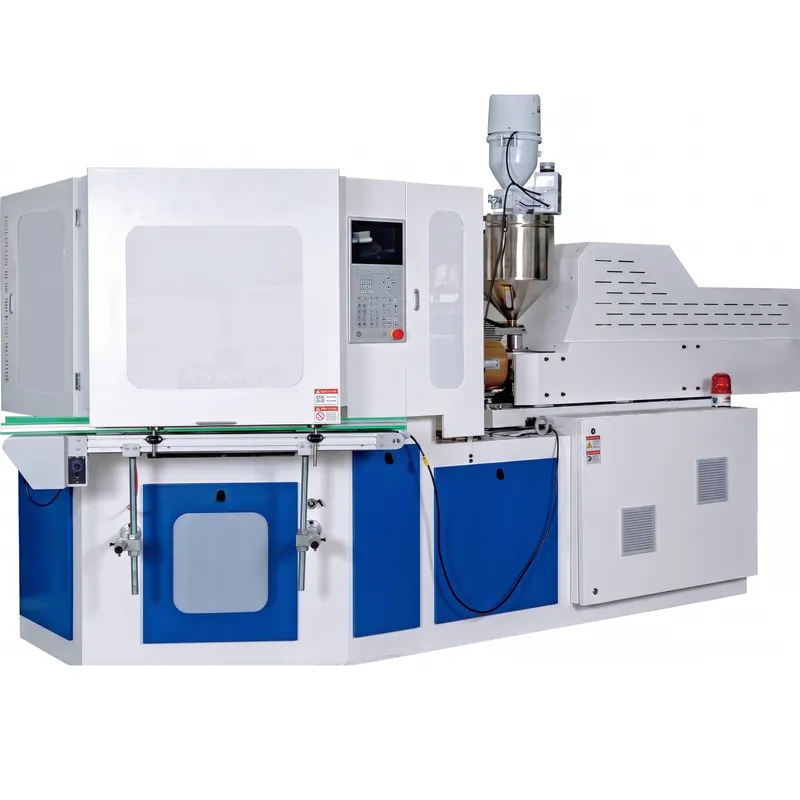
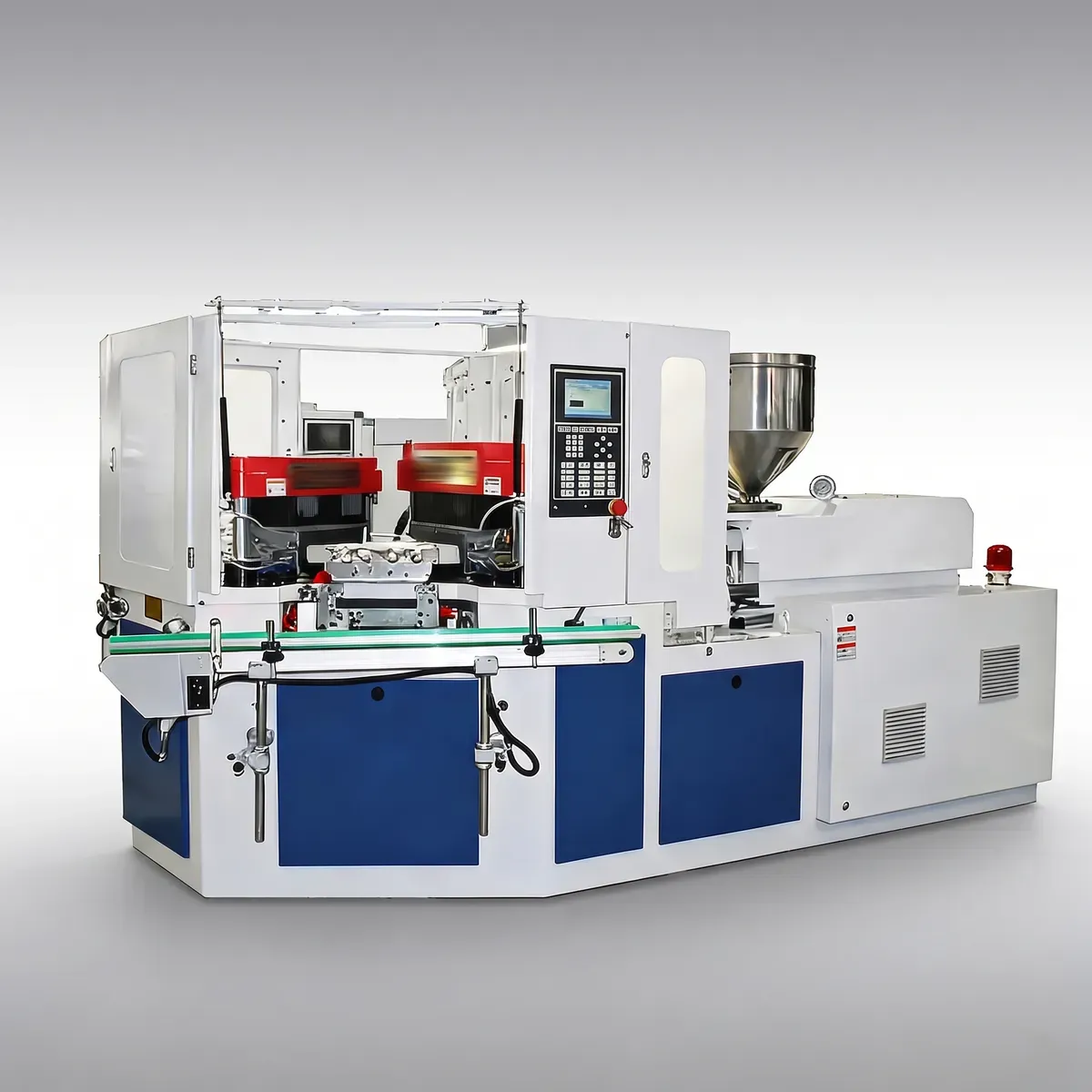
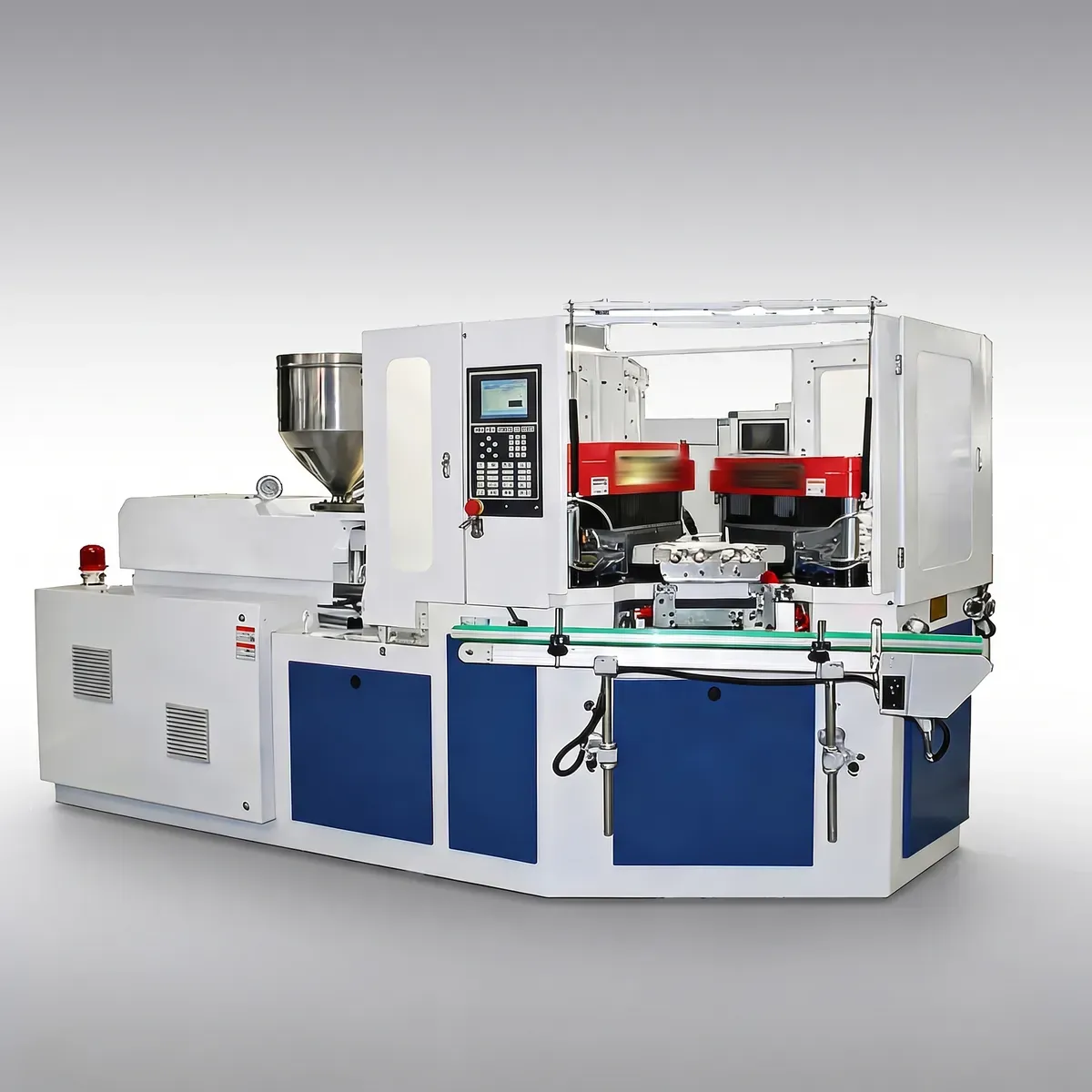
Macchina per stampaggio a iniezione e soffiaggio ZQ40 (europea)
Macchina per stampaggio a iniezione e soffiaggio ZQ40 (europea) Adottando un'autentica struttura interamente in stile europeo, la nostra macchina per stampaggio a iniezione e soffiaggio offre una stabilità strutturale superiore che supera i modelli ordinari. La sua forza di smorzamento è migliorata di 20%-30% rispetto ai concorrenti del settore, sopprimendo efficacemente le vibrazioni operative per uno stampaggio preciso. Dotata di un sistema di rotazione servoassistito standard, vanta una struttura snella e un funzionamento senza problemi. L'esclusiva struttura di serraggio pressurizzato realizza un design rivoluzionario in cui il cilindro di spinta è escluso dal ciclo di apertura/chiusura dello stampo, riducendo il consumo energetico di 10%-20% e creando un'esperienza di produzione ad alta efficienza e basso consumo.
The ZQ40 injection blow molding machine adopts an authentic full European-style structure that delivers superior structural stability, setting it apart from conventional plastic injection blow molding machine designs in the market. Its damping force is enhanced by 20%-30% compared to industry peers, effectively suppressing operational vibration for precise, repeatable molding cycle after cycle. Equipped with a standard servo rotation system, the ZQ40 features a streamlined mechanical layout and hassle-free day-to-day operation. The exclusive pressurized clamping structure introduces a revolutionary design concept: the booster cylinder is completely excluded from the mold opening and closing cycle, cutting energy consumption by 10%-20% versus comparable ibm injection blow molding machine models. This combination of structural rigidity, servo efficiency, and intelligent energy management makes the ZQ40 one of the best injection blow molding machines for mid-scale production lines targeting bottles from 10ml to 1000ml.
Engineered for versatile industrial applications, the ZQ40 one step injection blow molding machine delivers flawless results across beverage, pharmaceutical, cosmetic, chemical, feeding bottle, and personal care packaging segments. Operating on a single-stage process that unites injection, blowing, and stripping in one continuous cycle, this blow injection molding machine eliminates preform handling, reduces contamination risk, and produces bottles with uniform wall thickness, no flash, and near-zero scrap. Whether you are looking for a reliable pet injection blow molding machine, a precise solution for high-clarity PS containers, or a robust workhorse for HDPE chemical bottles, the ZQ40 is a proven performer backed by Mexico Ever-Power ISBM Machinery Co., Ltd., a globally recognized injection blow molding machine manufacturer with decades of engineering expertise.
Mold Cavitation(For Reference)
| Volume approssimativo | 10 ml | 30 ml | 60 ml | 100 ml | 250 ml | 500 ml | 1000 ml |
|---|---|---|---|---|---|---|---|
| Cavitazione massima | 9 | 8 | 6 | 4 | 3 | 2 | 1 |
Main Technical Parameters
| Articolo | Unità | ZQ40 |
|---|---|---|
| Sistema di iniezione | ||
| Diametro della vite | mm | 40/45 |
| Vite L/D | % | 22:1 |
| Peso dell'iniezione! | G | 190/260 |
| Potenza di riscaldamento | KW | 7.5 |
| Numero di zona della canna | 3+N | |
| Ictus da iniezione | mm | 120 |
| Sistema di serraggio | ||
| Forza di serraggio dell'iniezione | KN | 400 |
| Fase di apertura per l'iniezione | mm | 165 |
| Forza di soffiaggio C | KN | 60 |
| Colpo di apertura per soffiare | mm | 140 |
| Altezza di sollevamento della tavola rotante | mm | 70 |
| Muffa | ||
| Dimensioni massime del piatto (LxP) | mm | 480x340 |
| spessore dello stampo | mm | 180 |
| Diametro della bottiglia | mm | 120 |
| Altezza della bottiglia | mm | 220 |
| Altezza della bottiglia adatta | mm | 1-1500 |
| Colpo di stripping | mm | 220 |
| Sistema idraulico | ||
| Pressione idraulica | Mappa | 14 |
| Potenza del motore | KW | 11 |
| Ciclo a secco | S | 3.5 |
| Potenza totale | KW | 20 |
| Potenza operativa | % | 52-70 |
| Altri | ||
| Pressione minima dell'aria compressa | MPa | 0.7- 1.2 |
| capacità dell'aria compressa | M³/min | 0.7 |
| flusso d'acqua | M³/h | 3.5 |
| Pressione dell'acqua di raffreddamento | MPa | 0.3-0.4 |
| Dimensioni (L x P x A) | M | 3.5x1.3x1.7 |
| Peso netto | Tonnellata | 3.8 |
Marca e modello sostituibili
| Ever-Power | Forza di serraggio | Jomar | SUMA | Uniloy | Bloma |
| ZQ40 | 40T | IBM40 | 40iB | UIB70 | IBM45 |
| ZQ60 | 60T | IBM65 | 65iB | UIB90 | IBM50 |
| ZQ80 | 80T | IBM85S | 85iB | UIB120 | IBM85 |
| ZQ110 | 110T | IBM135 | 135iB | UIB150 | IBM135 |
| ZQ135 | 135T | IBM175 | 175iB | UIB180 |
Diametro della vite della macchina IBM
| Ever-Power | Diametro della vite | Jomar | SUMA | Bloma |
| ZQ40 | 40/45 | 35/40 | 40 | 45 |
| ZQ60 | 45/50 | 45 | 40/50 | 50 |
| ZQ80 | 55 | 55 | 50/60 | 50 |
| ZQ110 | 65 | 65 | 65/76 | 70 |
| ZQ135 | 70 | 70 | 65/76 |
Peso di iniezione della macchina IBM
| Ever-Power | Peso dell'iniezione | Jomar | SUMA | Bloma |
| ZQ40 | 190/260 | 180 | 169 | 180 |
| ZQ60 | 260/383 | 205 | 169/264 | 240 |
| ZQ80 | 466 | 300 | 333/480 | 310/280 |
| ZQ110 | 540 | 450/550 | 580/770 | 560 |
| ZQ135 | 650 | 450/550 | 580/770 |
Forza di serraggio dell'iniezione della macchina IBM
| Ever-Power | Forza di serraggio dell'iniezione | Jomar | SUMA | Bloma |
| ZQ40 | 400 kN | 340 kN | 386 kN | 350 kN |
| ZQ60 | 600 kN | 460 kN | 580 kN | 500 kN |
| ZQ80 | 800 kN | 680 kN | 720 kN | 700 kN |
| ZQ110 | 1100 kN | 1210 kN | 1200 kN | 1250 kN |
| ZQ135 | 1350 kN | 1560 kN | 1600 kN |
Dimensioni dello stampo della macchina IBM
| Ever-Power | Dimensioni dello stampo | Jomar | SUMA | Bloma |
| ZQ40 | 480 × 340 | 394 × 508 | 470 × 350 | 450 × 390 |
| ZQ60 | 600 × 390 | 432 × 660 | 620 × 400 | 620 × 430 |
| ZQ80 | 800 × 400 | 464 × 749 | 700 × 400 | 620 × 430 |
| ZQ110 | 1100 × 460 | 559 × 1118 | 1000 × 500 | 900 × 480 |
| ZQ135 | 1300 × 500 | 635 × 1372 | 1200 × 600 |
Dimensioni della macchina IBM
| Ever-Power | Dimensioni dello stampo (M) | Jomar | SUMA | Bloma |
| ZQ40 | 3,8 × 1,3 × 1,7 | 2,72 × 1,9 × 2,75 | 3,8 × 1,5 × 2,3 | 4,05 × 1,52 × 2,55 |
| ZQ60 | 3,8 × 1,4 × 1,8 | 2,92 × 1,98 × 3,41 | 4 × 1,7 × 2,3 | 620 × 430 × 2,55 |
| ZQ80 | 4,5 × 1,6 × 2 | 3,33 × 1,94 × 3,41 | 4,5 × 2 × 2,6 | 620 × 430 × 2,55 |
| ZQ110 | 5 × 1,8 × 2,2 | 3,79 × 2,4 × 3,41 | 5 × 2,4 × 2,7 | 900 × 480 × 2,55 |
| ZQ135 | 5,5 × 2 × 2,4 | 4,22 × 2,67 × 3,58 | 6 × 2,6 × 2,7 |
Nota: i marchi vengono menzionati solo per aiutare i clienti a scegliere i prodotti, non per venderli.
ZQ40 Injection Blow Molding Machine Features
1. Full European-Style Structural Rigidity
The ZQ40 is built on an authentic full European-style frame that provides structural integrity far beyond what standard Asian-market injection blow molding machines typically offer. The heavy-duty base and precision-machined platens eliminate flex under load, while the enhanced damping system absorbs vibration 20%-30% more effectively than industry-average competitors. This translates directly into tighter part tolerances, longer mold life, and consistent cavity-to-cavity uniformity across multi-cavity production runs. For manufacturers who have previously operated replacement of Aoki injection blow molding machine units and seek a European-architecture upgrade, the ZQ40 represents a significant leap in build quality and long-term reliability.
2. Standard Servo Rotation System
The ZQ40 comes standard with a servo-driven rotary table system that synchronizes the injection, blowing, and stripping stations with exceptional repeatability and low energy draw. Unlike hydraulic-only rotary drives found on many older or budget-class injection blowing molding machines, the servo rotation delivers precise angular positioning cycle after cycle, minimizing station-to-station alignment errors. The simplified mechanical layout also reduces maintenance touchpoints, making this single stage injection stretch blow molding machine category product easy to service by in-house technicians. Startup times are shorter, changeovers are smoother, and the overall control feel is responsive and intuitive for machine operators at any skill level.
3. Unique Pressurized Clamping Structure
One of the most technically distinctive features of this injection blow molding machine is its patented pressurized clamping design. The booster cylinder is decoupled from the mold open and close sequence entirely, meaning it only engages at the final clamping moment rather than cycling with every movement. This architectural innovation cuts energy consumption by 10%-20% compared to conventional designs while simultaneously reducing thermal load on hydraulic components and extending seal and valve service intervals. For high-volume operations running 16 to 24 hours per day, these savings accumulate into meaningful reductions in electricity cost and unplanned downtime, making the ZQ40 a cost-efficient choice among injection blow molding machine suppliers worldwide.
4. Zero-Scrap One-Step Production Process
The integrated one-step process of the ZQ40 means that injection, blowing, and ejection occur in three simultaneous stations on a single rotating table without any intermediate handling. There are no sprues to trim, no flash to recycle, and no cut-off mouth defects at the bottle base. This scrap edge injection blow molding machine advantage results in a production scrap rate of effectively 0%, compared to the 20%-40% material waste typical of extrusion blow molding lines. Material yield is maximized, and downstream quality control workload is reduced. For resins such as HDPE, PP, high-clarity PS, and PET, the zero-waste benefit directly strengthens the per-unit economics of every production run.
5. Broad Material and Container Compatibility
The ZQ40 injection system accommodates a wide range of thermoplastic resins including HDPE, LDPE, PP, PS (including lactic acid bacteria-grade), high-transparency PS, ABS, EVA, PCTG, and eco-friendly corn-based materials. The 40/45mm screw diameter and 22:1 L/D ratio provide the plasticizing capacity and residence time distribution needed to process each resin cleanly. Container volumes from 1ml to 1500ml are achievable in a single machine platform. This broad compatibility positions the ZQ40 as a versatile customized injection blow molding machine for sale solution that can pivot between pharmaceutical vials, cosmetic jars, dairy bottles, and household chemical containers without requiring a dedicated machine for each application.
6. Compact Footprint and Environment Stability
At just 3.5 x 1.3 x 1.7 meters and 3.8 tonnes, the ZQ40 occupies significantly less floor space than equivalent-capacity extrusion blow molding systems with their auxiliary equipment trains. The self-contained design means no external parison head, no take-out robot, and no flash granulator are needed. Additionally, the injection blow molding process is inherently less sensitive to ambient temperature and humidity fluctuations than extrusion alternatives, reducing the frequency of process adjustments during seasonal transitions or in facilities without full climate control. This production stability is a critical advantage for manufacturers in developing markets or facilities with variable environmental conditions, establishing the ZQ40 as one of the most reliable and operator-friendly injection blow molding machines in its class.
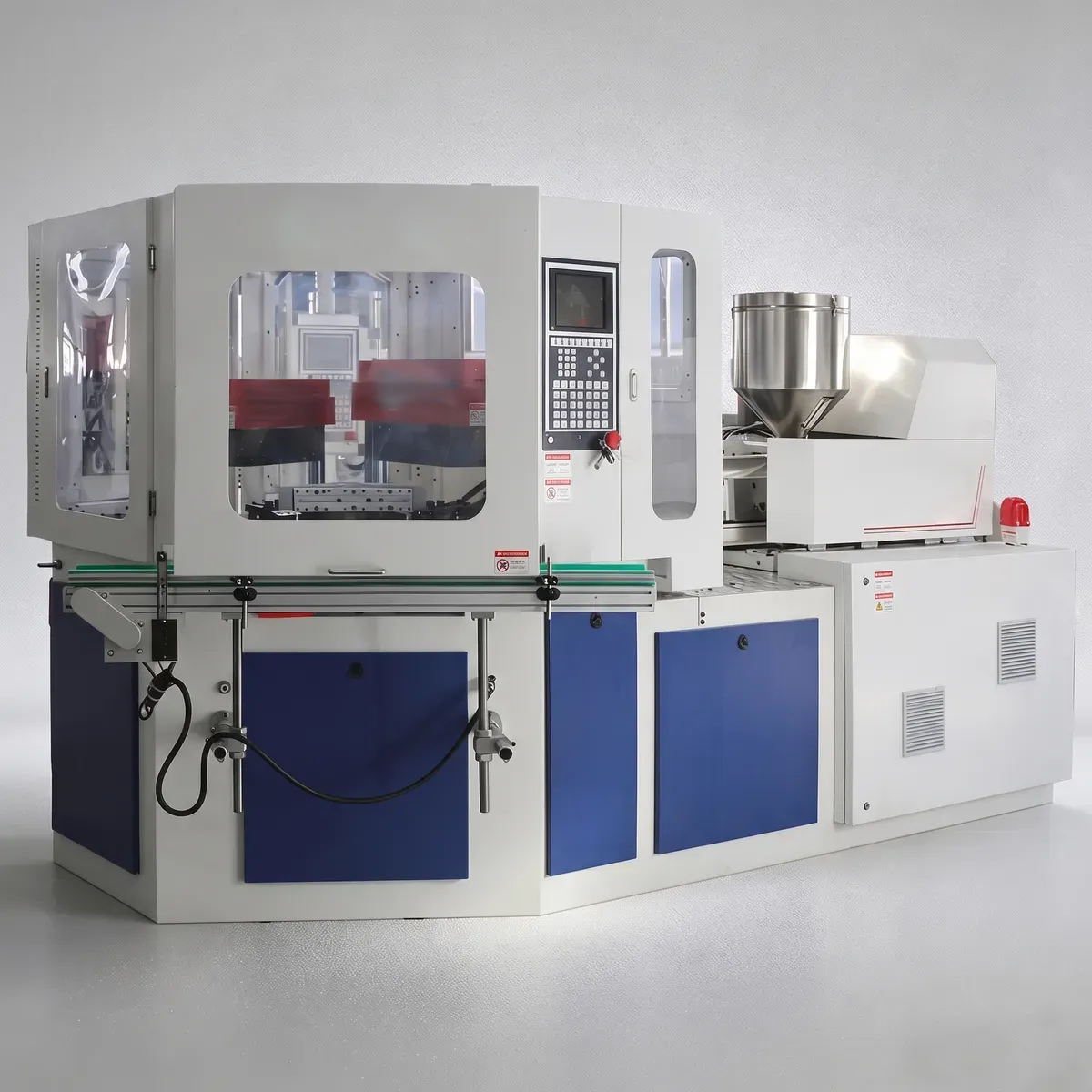
Principio di funzionamento
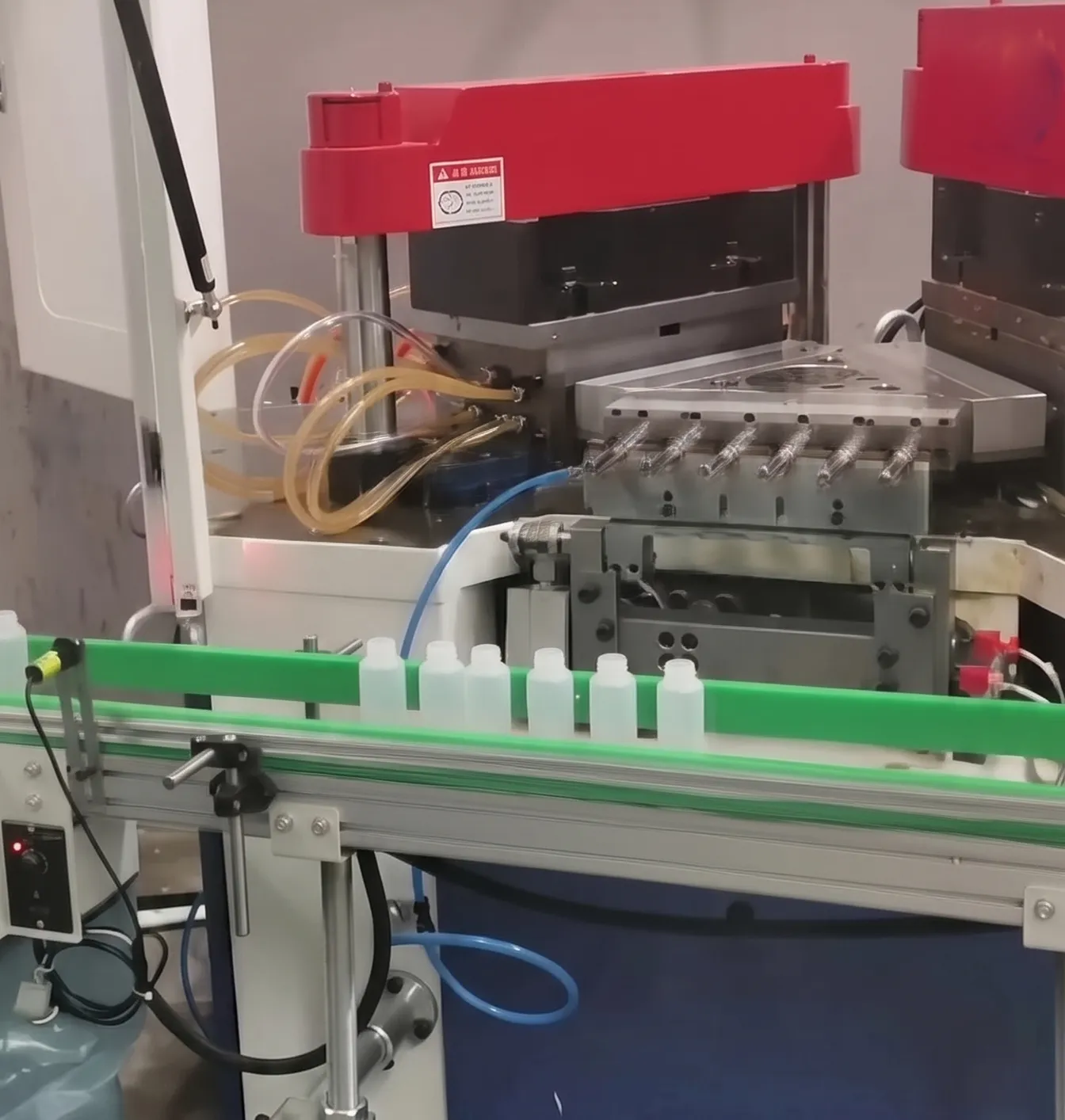
The ZQ40 operates on a proven three-station rotary platform that integrates injection, blowing, and stripping into one continuous cycle. All three actions execute simultaneously on separate stations, achieving maximum throughput with zero idle time between steps.
1. Preform Injection (Injection Station)
At the first station, the thermoplastic resin that has been plasticated in the barrel is injected under controlled pressure into the injection mold cavity, flowing around the core rod to form a precise preform (parison). The bottle neck geometry, including thread profiles, is molded to exact dimensional specifications at this stage because the neck will never be re-formed or trimmed. This is one of the fundamental differences that makes the injection blow molding machine process superior in neck accuracy versus extrusion blow molding alternatives that rely on cut-off trimming and consequently introduce variability in thread pitch and sealing surface flatness.
The injection mold of the ZQ40 uses 4Cr13 stainless steel or imported high-strength S136 alloy steel in cavity and neck insert blocks, providing a polished surface finish that imparts excellent gloss to the preform exterior. The hot runner system is thermally balanced to ensure gram-weight consistency across all cavities per shot, minimizing weight deviation and wall thickness variation from the very first station. Once injection and initial cooling are complete, the injection mold opens and the core rods, with preforms held securely on their tips, rotate 120 degrees to the blow molding station while simultaneously a new injection cycle begins at Station 1. The continuous overlap of all three station cycles is the core reason the ZQ40 achieves its 3.5-second dry cycle time and outstanding output-per-hour figures for a machine of its footprint and power draw. The pressurized clamping system at this station delivers 400KN of clamping force, holding the injection mold closed against cavity pressure without reliance on the booster cylinder during the open/close travel phase, which is the energy-saving innovation at the heart of this ibm injection blow molding machine design.
2. Blow Molding (Blow Station)
After the rotary table indexes, the preform-laden core rods arrive at the blow station where the blow mold closes around the still-warm preform with a 60KN clamping force. Compressed air is introduced through the center bore of the core rod at a pressure of 0.7 to 1.2 MPa, inflating the softened preform outward until it conforms precisely to the interior surface of the blow mold cavity. Because the preform retains its heat from the injection phase and is already held on the core rod in exact orientation, there is no repositioning error and no temperature loss from handling, which is the defining advantage of this one step injection blow molding machine process over two-step reheat-stretch-blow alternatives.
The air pressure is maintained for a controlled dwell time to allow the bottle walls to cool against the mold surface and stabilize their final shape. The blow mold cavity determines the external geometry of the finished bottle. Because no cutting or flash removal occurs here, the bottle bottom convexity is excellent and structurally sound, without the weakening that accompanies the parting line pinch-off in extrusion blow molding. Wall thickness distribution is governed entirely by the preform geometry designed at Station 1, resulting in uniform walls within approximately 1% weight variation per bottle, compared to 10%-20% thickness variation typically observed in extrusion blow molding products.
For this plastic injection blow molding machine, the blow mold material options include 4Cr13 stainless steel as standard, with magnesium-aluminum alloy available as an option for improved cooling performance and reduced mold weight in high-cavitation configurations. Once cooling is complete and the air is vented, the blow mold opens and the rotary table indexes to deliver the finished bottles to the stripping station while the blow station simultaneously receives a fresh batch of preforms from the injection station.
3. Stripping (Ejection Station)
At the third and final station, the finished bottles are automatically ejected from the cold core rods by the stripping mechanism. The stripping stroke on the ZQ40 is 220mm, providing ample clearance to release bottles of varying heights cleanly without risking contact with adjacent components. The ejected bottles fall onto a conveyor belt or collection chute for downstream handling such as leak testing, vision inspection, labeling, filling, and packing. There is no manual unloading step required in normal production, supporting fully automated, unattended operation for extended shifts.
The critical productivity advantage of the three-station simultaneous cycle is that injection at Station 1, blowing at Station 2, and stripping at Station 3 all occur at exactly the same time. The machine never idles between stations; every rotation of the table produces a complete set of finished bottles. This parallel operation philosophy is what separates a true injection blow molding machine from sequential-process alternatives, and it is the reason that even a compact ZQ40 with its 3.8-tonne footprint can achieve output rates that rival much larger and more expensive equipment categories.
Application Fields
1. Bottiglie per bevande
The ZQ40 is widely used to produce dairy product bottles, lactic acid bacteria drinks, juice bottles, and water bottles in PS, PP, and HDPE resins. The ability to achieve up to 9 cavities for 10ml containers and up to 3 cavities for 250ml containers enables high-volume production runs that meet fast-moving consumer goods supply chain demands. Uniform wall thickness ensures consistent top-load performance for stacking in retail and distribution environments.
2. Chemical Bottles
HDPE chemical bottles for agrochemicals, cleaning agents, lubricants, and automotive fluids are a primary application of the ZQ40. The robust injection blow molding process produces thick, uniform walls capable of withstanding chemical exposure and transport stress. The precisely formed bottle neck and 100% sealed thread profile ensure reliable closure engagement critical for hazardous liquid containment and regulatory compliance in chemical packaging markets globally.
3. Flaconi per cosmetici
The cosmetics industry demands exceptional surface finish, precise neck dimensions for pump fitment, and high-clarity aesthetics. The ZQ40 delivers all three through its polished S136 steel injection cavities, controlled preform geometry, and zero-flash blow molding process. Perfume bottle bases, toner bottles, lotion dispensers, and serum vials in PCTG, ABS, and high-transparency PS are produced with the optical clarity and dimensional consistency that luxury cosmetic brands require from their packaging suppliers worldwide.
4. Pharmaceutical Bottles
Pharmaceutical packaging demands the highest standards of dimensional precision, material purity, and contamination control. The ZQ40 meets these requirements through its closed-loop injection blow process, which eliminates all post-mold trimming and secondary contact. HDPE tablet bottles, PP syrup bottles, eye drop vials, and dropper bottles are produced with ISO-grade neck and thread accuracy, meeting the stringent specifications of pharmacopeial packaging standards across regulated markets in Europe, North America, and Asia.
5. Biberon
Baby feeding bottles represent one of the most demanding application categories due to food contact regulatory requirements, clarity standards, and the need for perfectly smooth interior surfaces. The ZQ40 produces PP and PCTG feeding bottles with flawless inner surfaces that prevent bacterial accumulation, precisely molded neck finishes that seat silicone nipple collars with zero gap, and consistent wall thickness distribution that ensures the bottle withstands repeated sterilization cycles without deformation or stress whitening.
6. Hand Wash Bottles
Personal care dispensing containers including hand wash, shampoo, conditioner, and body wash bottles are high-volume, cost-sensitive applications where the ZQ40 excels. The combination of up to 3 cavities for 250ml and 2 cavities for 500ml containers, zero-scrap production, and a fast 3.5-second dry cycle enables competitive per-unit costs at scale. HDPE and PP resins process cleanly on this machine, producing pump-neck bottles and flip-top containers with consistent thread engagement and attractive surface finish.
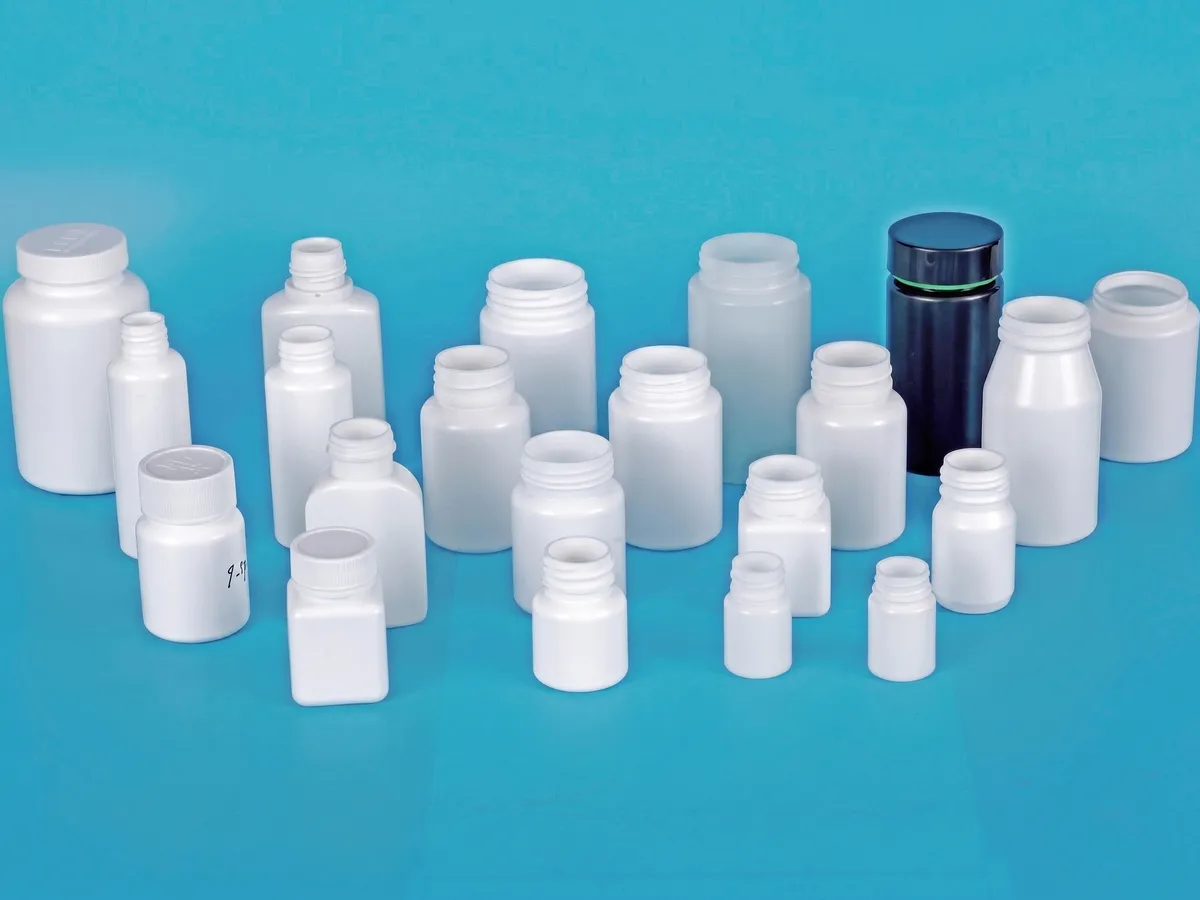 |
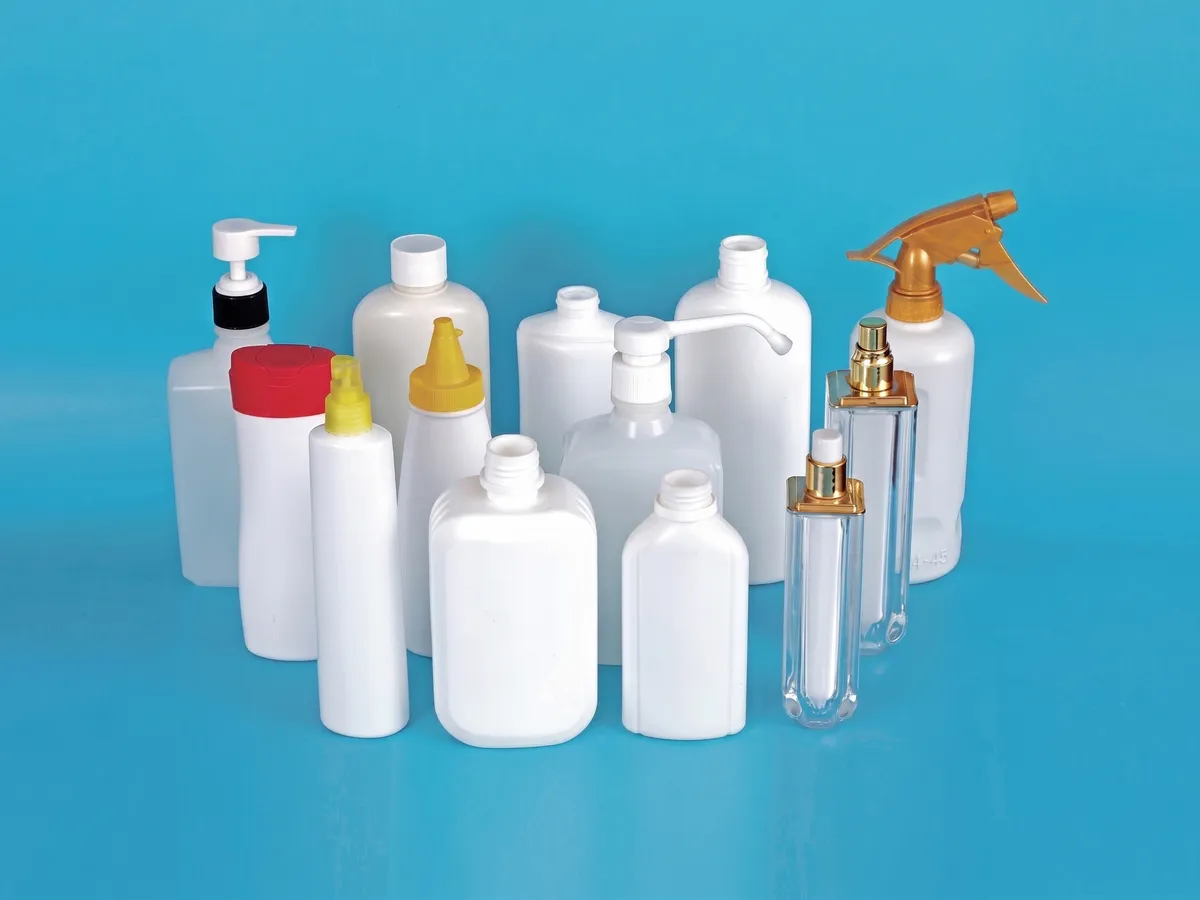 |
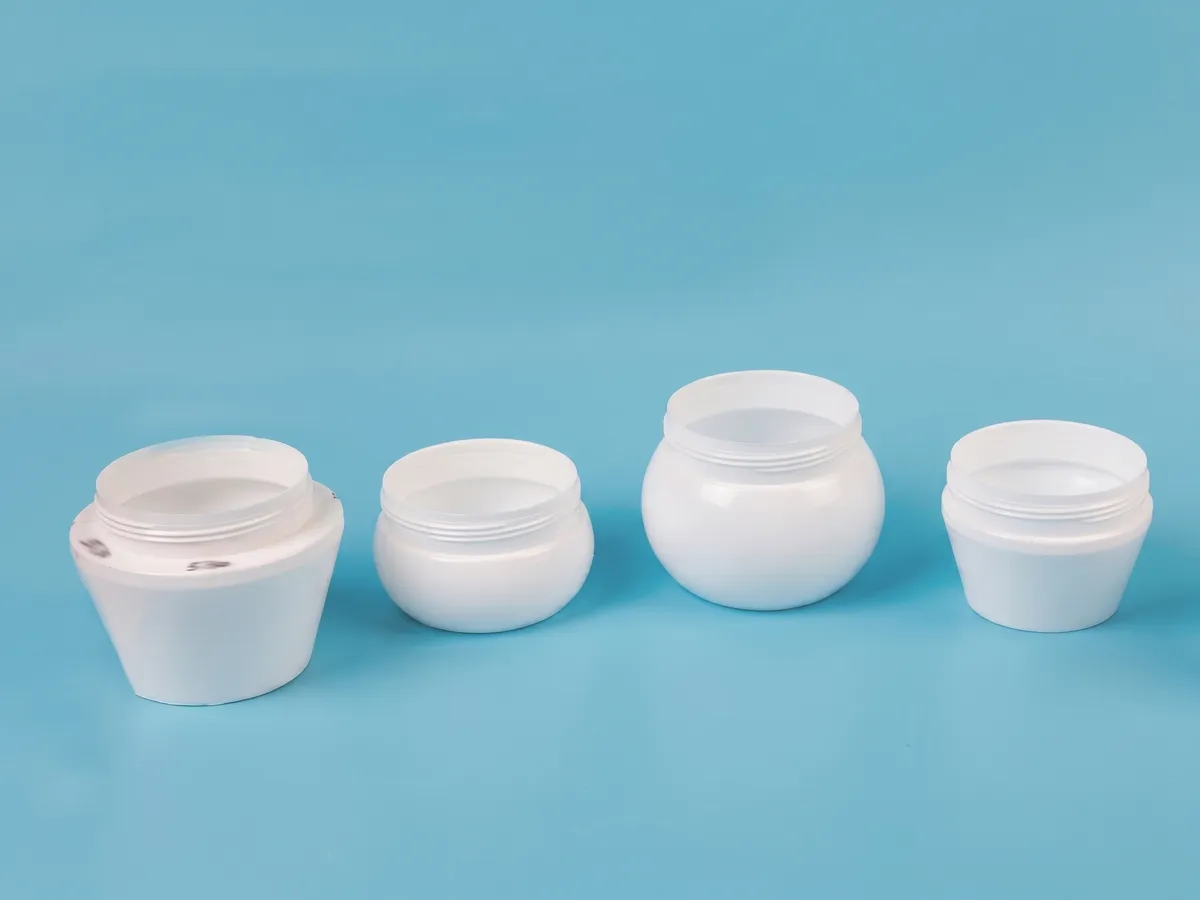
| Flaconi farmaceutici | Flaconi di prodotti chimici per uso quotidiano |
 |
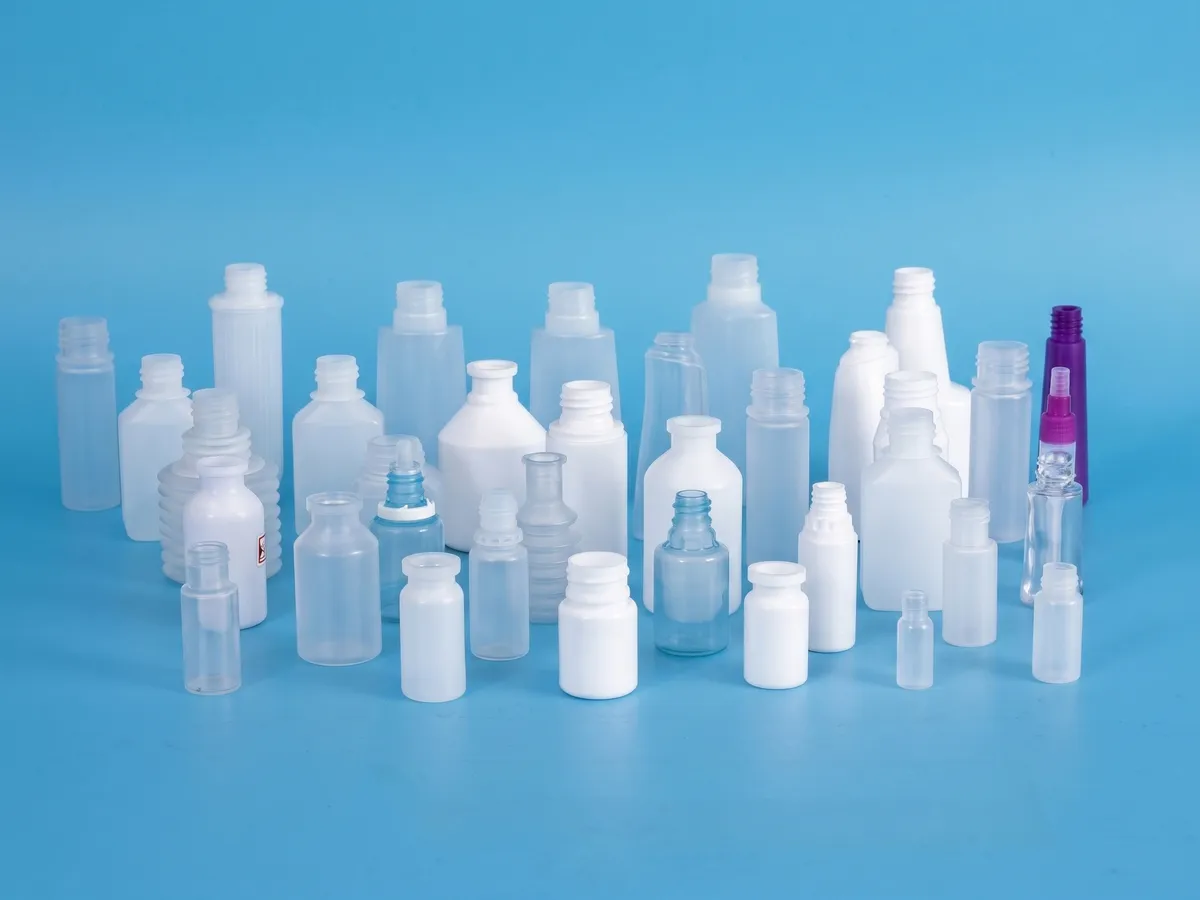 |
| Flaconi per cosmetici | Eyedropper Bottles |
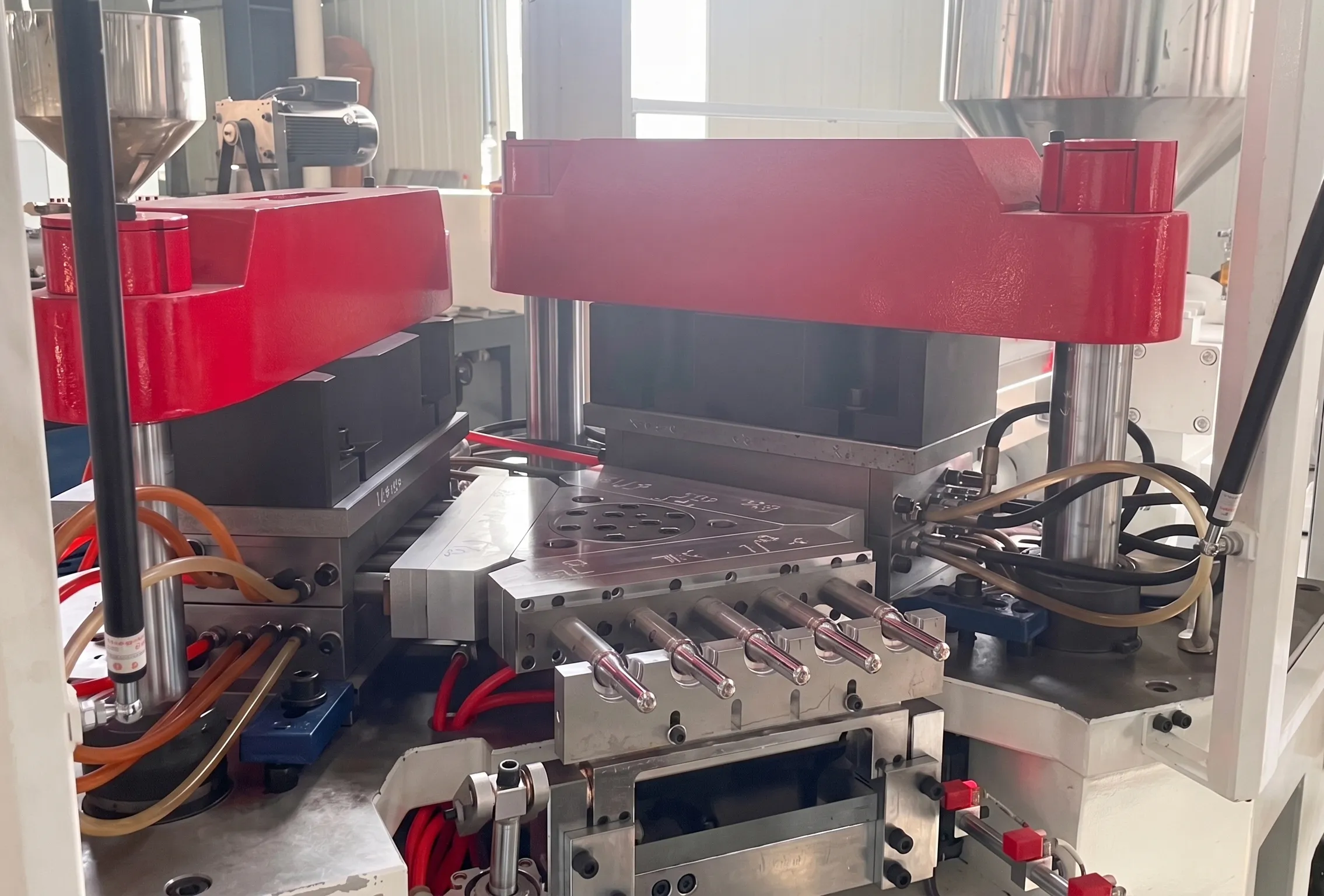
ZQ40 Injection Blow Molding Machine Components
| 1 | Dispositivo per la preparazione/iniezione del stock | 2 | Corridore caldo |
| 3 | Barra centrale | 4 | Preforma per bottiglia |
| 5 | Stampaggio a iniezione | 6 | Stazione di iniezione |
| 7 | Stazione di soffiaggio | 8 | Stampaggio a soffiaggio |
| 9 | Stazione di spogliarello |
1. Stock Preparation / Injection Device
The stock preparation and injection device is the heart of the ZQ40 plasticizing system. The 40/45mm diameter screw with a 22:1 L/D ratio melts, homogenizes, and meters the thermoplastic resin with precise control of temperature across the 3+N barrel heating zones. The injection stroke of 120mm and injection weight of 190g to 260g cover the range needed for multi-cavity preform production. The heating power of 7.5KW is sufficient to maintain stable melt temperature even through material lot changes, ensuring consistent preform weight and viscosity shot after shot.
2. Hot Runner System
The hot runner system on the ZQ40 is thermally balanced to distribute melt evenly to all cavities simultaneously, ensuring that gram-weight deviation and wall thickness variation are minimized across the full cavity count. The optimized runner geometry keeps shear and pressure drop low, protecting shear-sensitive resins and maintaining optical clarity in transparent containers. Independent zone control in the hot runner manifold allows fine-tuning of individual nozzle temperatures, enabling the operator to compensate for minor cavity-to-cavity imbalances and maintain consistent preform quality throughout the production shift.
3. Core Rod
The core rods are precision-machined from special alloy steel using a proprietary structural design that enables rapid cooling, precise air delivery for the blow phase, and smooth preform release at the stripping station. The internal air channel geometry ensures that blowing air reaches the preform tip quickly and distributes evenly across the entire bottle interior surface, which is critical for wall thickness uniformity in narrow-neck containers. The core rods are designed for fast molding cycles with excellent thermal management, maintaining dimensional stability across millions of cycles without wear-induced diameter changes that would degrade neck sealing performance.
4. Bottle Preform (Parison)
The bottle preform is formed at Station 1 and serves as the intermediate form that carries all of the neck and thread geometry from the injection process into the blow station. Because the preform remains on the core rod from injection through blowing, its orientation is precisely controlled and its residual heat is optimally distributed for stretching and inflation. The preform design for each product is engineered to produce the target wall thickness distribution in the final bottle without requiring a separate temperature conditioning step, which distinguishes the macchina per stampaggio a iniezione e soffiaggio process from two-step injection stretch blow alternatives.
5. Injection Mold
The injection mold of the ZQ40 features an activity-designed cavity and neck block configuration that allows easy changeover of tube billet and neck insert sizes without requiring full mold replacement. Cavity and neck materials are 4Cr13 stainless steel as standard, with imported S136 high-strength alloy steel available for extended service life requirements. The precision water circuit routing in the mold body provides rapid and uniform cooling of the preform, shortening cycle time and improving repeatability. The maximum platen size of 480 x 340mm accommodates multi-cavity tooling for all container sizes within the ZQ40 production range.
6. Injection Station
The injection station is where the plasticized resin is metered and injected into the closed injection mold under controlled pressure and speed. The 400KN injection clamping force of the ZQ40 holds the mold securely closed against cavity pressure throughout the fill and pack phases. The pressurized clamping architecture ensures that the booster cylinder only activates at the final lock position, not during mold opening or closing travel, which reduces cycle energy and extends tie-bar and clamping component service intervals significantly compared to conventional toggle or full-hydraulic designs.
7. Blow Station
The blow station applies 60KN of clamping force to close the blow mold around the preform-loaded core rod, then introduces compressed air through the core rod to inflate the preform against the blow mold cavity walls. The 140mm opening stroke for blowing provides sufficient clearance for the rotary table to index smoothly. The blow station operates concurrently with the injection and stripping stations, meaning production output is not limited by blow cycle time as a standalone bottleneck. Cooling water circulates through the blow mold continuously to accelerate bottle solidification and enable rapid mold opening after the air dwell phase.
8. Blow Mold
The blow mold defines the final external shape, surface texture, and geometric features of the finished bottle. For the ZQ40, blow mold bodies are manufactured from 4Cr13 stainless steel as standard, with optional magnesium-aluminum alloy for improved cooling efficiency and lighter weight in high-cavity-count tooling. The mold parting line is engineered to place any residual mark in a non-critical area of the bottle exterior. Since there is no parison pinch-off in injection blow molding, the bottle base and body are free from the structural weakening that characterizes extrusion blow molded containers, resulting in improved drop-test and top-load performance.
9. Stripping Station
The stripping station is where finished bottles are demoulded from the core rods and transferred to the downstream production line. The 220mm stripping stroke on the ZQ40 is sized to accommodate the maximum bottle height of 220mm with margin for clean ejection clearance. The stripper plate or pin mechanism acts uniformly across all cavities simultaneously to prevent tilting or jamming of individual bottles during ejection. Bottles exit the stripping station with no flash, no waste material, and no trimming requirement, proceeding directly to leak testing, visual inspection, filling, or packing operations on the downstream conveyor system.
Soffiaggio a iniezione vs. soffiaggio ad estrusione
1. Weight Consistency
Injection blow molding achieves bottle-to-bottle weight variation of approximately 1%, while extrusion blow molding typically exhibits 3% or higher variation. For pharmaceutical and food packaging where container weight is a critical quality control checkpoint, the tighter tolerance of the injection blow molding machine process provides a significant compliance and quality advantage that reduces rework and rejection rates at filling lines.
2. Wall Thickness Uniformity
Injection blow molded bottles have uniform wall thickness throughout the body and base because the preform geometry controls material distribution before blowing. Extrusion blow molded containers suffer from 10%-20% wall thickness variation because parison inflation introduces uncontrolled stretching. Thin spots in extrusion blow molded walls reduce container strength and can lead to in-field failures under stacking loads or during transit.
3. Neck and Thread Precision
Injection blow molding produces no blank opening because the neck is fully formed by injection in the closed mold. Extrusion blow molding requires a cut-off at the parison pinch point, which creates a seam at the bottle base and potentially weakens the structure. The injection blow molded neck thread is dimensionally identical to the injection mold design, ensuring 100% closure engagement without the trimming variability inherent in extrusion blow molding.
4. Base Convexity and Structural Integrity
The bottom of injection blow molded bottles has excellent convexity because no pinch-off weld line is present. Extrusion blow molded bases are weakened by the parting line pinch, leading to reduced base convexity and lower drop-test performance. This structural difference is especially important for carbonated beverage containers, laboratory sample bottles, and any application where the bottle must maintain a stable base under internal pressure or compressive load.
5. Material Yield and Waste
The injection blow molding process produces zero flash and zero trimming waste. Every gram of resin fed into the machine exits as a finished bottle. Extrusion blow molding generates 20%-40% flash and tail waste that must be granulated, re-dried, and reprocessed, introducing quality risk from regrind contamination and imposing auxiliary equipment costs for granulators. Over a multi-year production horizon, the zero-waste advantage of this injection blow molding machine produces substantial material cost savings and reduces environmental footprint.
6. Production Environment Sensitivity
Injection blow molding is inherently less sensitive to ambient temperature and humidity changes than extrusion blow molding because the process relies on controlled mold temperatures rather than parison hang time and sag dynamics. Extrusion blow molding operators often need to adjust parison programming, tooling temperatures, and cooling parameters when the factory environment changes seasonally. The ZQ40 maintains consistent output quality without frequent operator intervention across a wider range of ambient conditions, reducing product variation and operator fatigue on long shifts.
| NO. | Iniezione e soffiaggio | Estrusione e soffiaggio |
| 1 |
Il peso della bottiglia cambia di circa 1% |
Il peso della bottiglia cambia di circa 3% |
| 2 |
Spessore uniforme della parete |
Lo spessore della parete varia di 10-20% |
| 3 |
Nessuna apertura vuota |
Ha un'apertura tagliata e riduce la resistenza del fondo della bottiglia |
| 4 |
Il fondo della bottiglia è molto convesso |
Scarsa convessità sul fondo della bottiglia |
| 5 |
Il processo produttivo non genera rifiuti |
20-40% scarti |
| 6 |
Non è possibile formare prodotti con pareti di spessore molto sottile |
Lo spessore della parete può essere regolato tramite il controller |
| 7 |
La produzione non è sensibile ai cambiamenti ambientali |
Sono necessari ulteriori aggiustamenti per mantenere la normalità |
| 8 |
Numero elevato di cavità, alta resa, bocca piatta |
meno cavità, bassa produzione, collo di bottiglia irregolare |
| 9 |
La durata dello stampo è lunga, adatta per una produzione a lungo termine a un prezzo conveniente. |
La durata dello stampo è breve, adatto per la produzione a breve termine, il prezzo è basso |
| 10 |
Sistema compatto, ingombro ridotto |
Più ausiliari, più terra |
| 11 |
Prodotti ovali più difficili da modellare |
Più facile da formare |
Common Fault Troubleshooting
1. Inconsistent Bottle Weight (Gram Weight Deviation)
If bottle weight varies beyond the expected 1% range, the most likely causes are material feed instability, screw wear, or hot runner temperature imbalance. First, verify that the hopper dryer is maintaining the correct resin moisture level and that the feeding throat is not bridging. Next, check all barrel zone temperatures and confirm they match the validated process recipe. If deviations persist, inspect the hot runner thermocouples and heater elements for drift or failure. Screw and barrel wear can cause inconsistent back pressure, so measure shot weight with a gram scale across consecutive cycles and correlate to specific cavities to identify if the fault is in the injection system or in individual hot runner nozzles.
2. Short Shot or Incomplete Preform Formation
Incomplete preform filling at the injection station typically results from insufficient injection pressure, inadequate melt temperature, blocked nozzle tip, or excessive cooling that solidifies the gate prematurely. Check that the barrel temperatures are within the specified range for the resin being processed and that the injection speed profile is not overly conservative. Inspect the hot runner nozzle for signs of degraded material or foreign particle blockage by disassembling and cleaning the nozzle tip. If the problem is localized to specific cavities, the corresponding hot runner zone heater or thermocouple may be failing. Increase injection hold pressure in small increments and monitor whether preform fill completeness improves before making larger parameter changes.
3. Bottle Wall Thickness Non-Uniformity
Non-uniform wall thickness in blown bottles from this injection blow molding machine usually originates from uneven preform wall thickness caused by hot runner imbalance, or from eccentricity between the core rod and the blow mold cavity. Measure preform wall thickness before blowing to determine if the fault is in the injection phase. If preforms are uniform but bottles show thickness variation, check core rod concentricity relative to the blow cavity, inspect the rotary table indexing accuracy, and verify that blow air pressure and dwell time are set correctly. Cooling water flow rate and uniformity through the blow mold should also be checked, as localized hot spots in the mold can prevent full consolidation of the wall in those areas.
4. Bottle Neck Dimension Out of Tolerance
Neck thread dimensions that exceed tolerance typically indicate injection mold neck insert wear, incorrect injection mold cooling water temperature, or insufficient packing pressure. The neck geometry is fixed entirely by the injection mold, so start diagnosis at the injection station. Measure the injection mold cooling water inlet and outlet temperature differential to confirm adequate flow. If the neck dimensions are consistently oversized or undersized, check for mold component wear, particularly on the neck ring and thread splits, using gauges against the original engineering drawing dimensions. Replacing worn neck inserts restores dimensional compliance without requiring full mold replacement, representing a cost-effective maintenance approach for high-cycle production.
5. Bottles Not Releasing at Stripping Station
Difficult bottle release at the stripping station is typically caused by insufficient cooling in either the blow mold or the core rod, excessive undercut in the bottle design relative to the draft angle, or worn stripping components. Check that the cooling water temperature and flow rate through the blow mold and core rod circuits meet the process specifications and that no cooling water channels are blocked by scale buildup. If the core rod surface is scored or rough from mechanical contact, polishing or replacing the affected rods will improve release. Review the bottle design with the mold engineer to confirm that all body taper angles are at least 0.5 degrees per side. Lubricating the core rod with a food-grade mold release agent during startup can help establish release while root cause analysis continues.
6. Surface Defects: Sink Marks, Whitening, or Streaks
Surface quality defects on bottles produced by the ZQ40 generally have one of three root causes: resin quality issues (moisture, contamination, or lot variation), process parameter drift (temperature, pressure, or speed), or mold surface condition (polish degradation, condensation, or resin buildup). For stress whitening, reduce cooling speed by slightly increasing mold temperature. For streaks or black specks, purge the barrel thoroughly and inspect the non-return valve and screw tip for degraded material accumulation. For sink marks, increase packing pressure or extend packing time. For all surface defects, verify resin drying parameters first because moisture in hygroscopic resins such as ABS, PCTG, and PS is the single most common root cause of cosmetic defects in injection blow molded containers.
How to Customize Your ZQ40 Injection Blow Molding Machine
Step 1: Define Container Specifications
Provide our engineering team with your container drawings or samples, including volume, height, diameter, neck finish standard (PCO, GPI, or custom), wall thickness target, and appearance requirements. For customized injection blow molding machine for sale projects, our team will review your specifications and confirm whether the ZQ40 platform is the optimal size or whether the ZQ60 or ZQ80 series better suits your required cavity count and container dimensions. We can accept 2D drawings, 3D CAD files, or physical bottle samples as the design basis.
Step 2: Select Resin and Process Requirements
Specify the resin or resins you intend to process, including grade, melt flow index, and any special requirements such as UV stabilization, food contact compliance, or optical clarity targets. Our team will confirm the appropriate screw geometry, barrel temperature profile, and hot runner configuration for your chosen material. For customers considering this machine as a used pet injection blow molding machine alternative or as a platform upgrade from older equipment, we provide comparative process validation data to support the investment justification.
Step 3: Configure Mold Tooling
Our in-house mold engineering team designs injection molds, blow molds, and core rods as an integrated tooling package engineered specifically for the ZQ40 platform. Customers specify cavity count, container design, and target cycle time, and we optimize the preform geometry, hot runner balance, and cooling circuit layout to achieve the specified output rate and quality targets. Mold materials are selected based on production volume: 4Cr13 stainless for standard runs and imported S136 alloy steel for high-volume or abrasive resin applications. All mold packages come with complete dimensional inspection reports and process setup documentation.
Step 4: Specify Auxiliary Equipment
Depending on your production environment, we can supply or recommend compatible auxiliary equipment for the ZQ40 line, including screw air compressors, hopper dryers, mold temperature controllers, chillers, auto-loaders, conveyor systems, bottle visual inspection machines, and packing machines. Specifying the complete auxiliary equipment package at the time of ZQ40 order ensures that all utilities are correctly sized and that the installation project proceeds without delays caused by undersized compressed air supply or inadequate cooling water flow. Our turnkey project capability covers everything from factory layout planning through production qualification.
Step 5: Review and Confirm Technical Proposal
Before order confirmation, our team prepares a full technical proposal covering machine configuration, mold tooling specifications, process parameters, expected output rates per hour at the target quality level, utility consumption figures, floor plan layout, and delivery and commissioning schedule. This documentation ensures complete alignment between your production targets and the proposed solution. Any modifications to the standard ZQ40 configuration, such as special control features, modified platen sizes, or non-standard voltage specifications, are confirmed and priced at this stage to eliminate surprises during manufacturing.
Step 6: Installation, Commissioning, and Training
Mexico Ever-Power dispatches experienced senior engineers for on-site installation and commissioning of every ZQ40 shipped. The installation team handles mechanical assembly, electrical connection, utility hookup, mold mounting, process parameter setup, trial production runs, and acceptance testing. Operator training is conducted on-site in parallel with commissioning, covering machine operation, process adjustment, routine maintenance procedures, mold change protocol, and basic fault diagnosis. Training is conducted in English or can be supported in the local language where technically feasible. Remote technical support via video call is available 24 hours a day, 7 days a week after commissioning is complete.
Perché scegliere le macchine per lo stampaggio a iniezione e soffiaggio di Ever-Power?
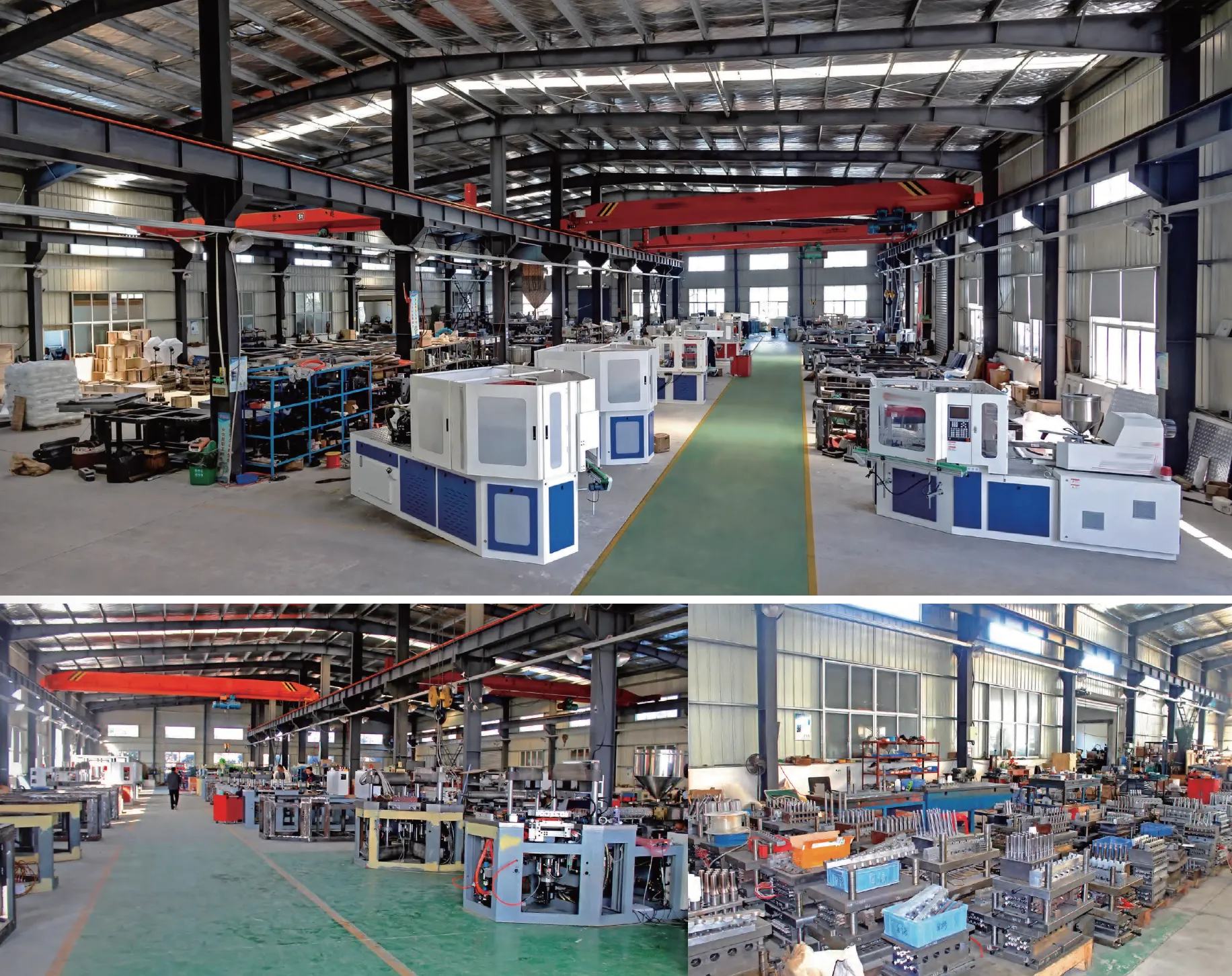
Mexico Ever-Power ISBM Machinery Co., Ltd. is a specialized manufacturer primarily engaged in the research, development, production, sales, and trade of automatic one-step injection-blowing blow molding machines and supporting injection-blowing mold tooling. Our product portfolio spans the full range of injection blow molding machines, extrusion blow molding machines, injection stretch blow molding machines, and auxiliary machines required for complete production line integration. The company benefits from a strategically advantageous geographic location with convenient logistics access to major international shipping routes, supporting reliable delivery timelines for customers across all global markets.
Mexico Ever-Power ISBM Machinery Co., Ltd. has assembled an outstanding research and development team comprising experienced engineers and technical personnel with deep expertise in injection-blowing machinery and injection-blowing mold engineering. Our team brings together rich theoretical knowledge and extensive practical experience accumulated through thousands of customer projects across pharmaceutical, food, cosmetic, chemical, and healthcare packaging sectors. This expertise enables us to provide comprehensive pre-sale technical consultation, in-sale engineering support, and thorough after-sale service to every customer, from initial application feasibility review through long-term production support.
Our product applications cover pharmaceutical packaging, food packaging, healthcare product packaging, cosmetic packaging, and other plastic packaging categories. The machines we produce can process HDPE, LDPE, PP, PS (including lactic acid bacteria grades), high-transparency PS, ABS, environmentally friendly corn-based material, EVA, PCTG, and other resins to produce containers from 1ml to 1000ml. This broad material and application coverage makes us the preferred partner for buyers seeking injection blow molding machine manufacturers who can support diverse product portfolios from a single supplier relationship.
Mexico Ever-Power ISBM Machinery Co., Ltd. adheres to the enterprise development principle of self-reliance, integrity, pragmatism, innovation, and responsibility. We build one-stop turnkey project capabilities that deliver high-end injection-blowing products meeting the quality expectations and production efficiency targets of our customers worldwide. From factory layout planning through machine commissioning, mold qualification, operator training, and ongoing maintenance support, Ever-Power is the injection blow molding machine supplier that stays with you throughout the complete lifecycle of your investment. Contact our team today to discuss your project requirements and receive a customized proposal for your production line.
Domande frequenti
Q1: What is the difference between a one step injection blow molding machine and a two-step injection stretch blow molding machine?
A: A one step injection blow molding machine like the ZQ40 performs preform injection, blowing, and ejection in a single continuous cycle on one machine, with the preform transferred directly from the injection station to the blow station while retaining its process heat. A two-step injection stretch blow molding machine (ISBM) first produces a cooled preform that is stored and later reheated in a separate machine before stretch-blow molding. The one-step process eliminates the reheating energy cost and preform storage handling, making it ideal for small-to-medium volume containers with complex neck requirements. The two-step ISBM process is preferred for very high volumes of PET bottles where the stretch orientation provides clarity and barrier properties not achievable in one-step processing.
Q2: What resins can the ZQ40 process and which applications are they suited to?
A: The ZQ40 processes HDPE (chemical, pharmaceutical, food bottles), LDPE (squeeze bottles, dropper bottles), PP (food packaging, feeding bottles, autoclavable containers), PS (dairy drinks, lactic acid bacteria beverages, cosmetic containers), high-transparency PS (optical-quality cosmetic and personal care packaging), ABS (cosmetic jars, industrial components), EVA (soft-touch squeeze containers), PCTG (high-clarity cosmetic and pharmaceutical packaging), and eco-friendly corn-based bioplastic resins. The 40/45mm screw and 22:1 L/D ratio are well-matched to the melt characteristics of these materials. For glass-fiber reinforced or mineral-filled resins, contact our engineering team to confirm compatibility.
Q3: How does the injection blow molding machine price for the ZQ40 compare to extrusion blow molding machines of similar output capacity?
A: The ZQ40 injection blow molding machine price is typically higher than a basic single-head extrusion blow molding machine of similar bottle volume capacity. However, the total cost of ownership comparison strongly favors the ZQ40 when accounting for zero flash waste and its associated granulator and re-processing costs, lower energy consumption due to the pressurized clamping design, longer mold service life from higher quality tooling materials, higher output rate from simultaneous three-station operation, and lower per-unit quality control costs from inherent neck precision. For applications requiring pharmaceutical-grade or cosmetic-grade neck accuracy, the IBM process eliminates a class of defects that would require 100% inspection in extrusion blow molding, further improving the economic comparison. Request a quote from our team to receive a complete cost-of-ownership analysis tailored to your production scenario.
Q4: Can the ZQ40 be used as a replacement of an Aoki injection blow molding machine?
A: Yes, the ZQ40 is a proven and frequently selected replacement of Aoki injection blow molding machine installations worldwide. The ZQ40 matches or exceeds Aoki equipment in structural rigidity, neck thread precision, and production consistency, while offering significant advantages in energy efficiency through its pressurized clamping innovation, lower spare parts costs, more accessible global service network, and competitive pricing for both the machine and the matched mold tooling. Customers transitioning from Aoki platforms benefit from the ZQ40 offering production capability for the same container specifications with reduced operating costs per thousand bottles produced. Our engineers can review your current Aoki mold designs and confirm compatibility or provide adaptation recommendations.
Q5: What is the minimum and maximum container size the ZQ40 can produce?
A: The ZQ40 is designed to produce containers from 1ml to 1500ml in a single machine platform. The maximum bottle diameter is 120mm and the maximum bottle height is 220mm. For containers larger than 1000ml, the cavity count per shot is limited to 1 cavity. The machine accommodates multi-cavity tooling up to 9 cavities for 10ml containers and up to 3 cavities for 250ml containers. If your application requires container sizes outside this range, our ZQ60, ZQ80, or ZQ110 series machines may be more appropriate, and we recommend contacting our technical team with your specific container dimensions for a model recommendation.
Q6: What compressed air and utility connections are required to install the ZQ40?
A: The ZQ40 requires a compressed air supply at 0.7 to 1.2 MPa with a minimum capacity of 0.7 cubic meters per minute. Cooling water must be supplied at 0.3 to 0.4 MPa with a flow rate of 3.5 cubic meters per hour. Total electrical power requirement is 20KW. The machine should be connected to a properly earthed three-phase power supply at the local standard voltage. The factory footprint required for the machine body is approximately 3.5 x 1.3 meters floor area plus access clearance around all sides. Our installation engineers will prepare a full utility connection drawing and floor plan layout as part of the pre-installation documentation package for your facility team.
Q7: How long does mold changeover take on the ZQ40 injection blow molding machine?
A: Full mold changeover from one container size to another on the ZQ40 typically takes 2 to 4 hours depending on operator experience and the degree of difference between the old and new container specifications. The activity-designed cavity and neck block system allows the injection mold neck inserts and cavity liners to be changed independently of the mold base, which significantly reduces changeover time when only switching between different neck finishes or container sizes within the same mold base footprint. Mexico Ever-Power provides detailed written changeover procedures and on-site training during commissioning that enables your production team to execute changeovers efficiently and consistently.
Q8: Is the ZQ40 suitable for producing LED bulb cover injection blow molding applications?
A: Yes, the ZQ40 can be configured for LED bulb cover injection blow molding using high-transparency PS or PCTG resins. LED bulb covers require excellent optical clarity, precise outer diameter tolerances for housing fitment, and thin uniform wall thickness for light transmission efficiency. The ZQ40 delivers all of these requirements through its precision injection mold neck and cavity engineering, uniform preform wall distribution, and controlled blow molding process. For LED cover applications, the mold tooling is engineered with polished optical-grade cavity surfaces and the hot runner system is fine-tuned for the shear sensitivity of the transparent resins used. Contact our engineering team with your specific bulb cover dimensions for a feasibility assessment.
Q9: What warranty and after-sales service does Mexico Ever-Power provide for the ZQ40?
A: Mexico Ever-Power provides a 12-month warranty on the ZQ40 machine body and mechanical systems from the date of commissioning acceptance. The warranty covers manufacturing defects in the machine structure, hydraulic system components, electrical control components, and servo rotation system. Normal wear parts including screw, barrel, non-return valve, and seals are consumable items not covered under warranty. After warranty expiry, ongoing support is available through our 24/7 service hotline, spare parts inventory, and scheduled preventive maintenance visit programs. Our engineering team also provides remote diagnostic assistance via video call for rapid fault identification and resolution to minimize production downtime for all ZQ40 customers globally.
Q10: Can the ZQ40 process PET resin for PET injection blow molded containers?
A: The ZQ40 as a standard IBM machine is optimized for resins such as HDPE, PP, PS, ABS, PCTG, and EVA. PET processing in a single-step injection blow molding machine requires specific design considerations for PET crystallinity control, screw design for shear-sensitive PET melt, and precise preform temperature management to achieve the biaxial orientation needed for optimal PET bottle properties. For high-clarity PET containers, customers typically use a two-step injection stretch blow molding machine process. If your application requires a pet injection blow molding machine, please contact our technical team to discuss the specific container requirements and we will recommend the appropriate equipment configuration from our full product range.
Recensioni dei clienti
Rajesh, Pharmaceutical Packaging Manager, India
"We have been running the ZQ40 injection blow molding machine in our pharmaceutical packaging line for about eight months now and honestly the consistency it delivers is remarkable. We are producing 60ml HDPE tablet bottles at 6-cavity and the weight variation between bottles has stayed well under 1% every single shift. The technical team from Ever-Power came on site for installation and stayed until everything was running exactly to spec. Before this we had a lot of rework from our old machine. Now we basically have zero."
Li Wei, Direttore di Produzione, Vietnam
"La ZQ40 ha sostituito una macchina più vecchia nella nostra linea di flaconi per cosmetici e la differenza nella precisione della filettatura del collo è immediatamente visibile. Produciamo flaconi da 100 ml in PS ad alta trasparenza per lozioni e ora l'accoppiamento del collare della pompa è perfetto su ogni singolo flacone. Niente più scarti dovuti a ispezione manuale per filettature non compatibili. La macchina stessa è molto robusta, diversa dalle altre che abbiamo usato. La rotazione del servomotore è fluida e silenziosa. Il prezzo era giusto per quello che offre. La consegna ha richiesto circa 75 giorni dalla conferma dell'ordine, quindi nei tempi previsti."
Ibrahim, proprietario di fabbrica, Egitto
"Ci riforniamo da diversi produttori di macchine per lo stampaggio a iniezione e soffiaggio e Ever-Power è tra i migliori per il segmento di media capacità. Abbiamo acquistato la ZQ40 per la nostra linea di flaconi di sapone liquido in PP da 250 ml e da sei mesi funziona su due turni giornalieri senza alcun arresto imprevisto. I costi energetici si sono ridotti notevolmente rispetto alla nostra macchina precedente, che non disponeva del sistema di chiusura pressurizzato. L'assistenza post-vendita tramite WhatsApp è rapida, di solito si riceve una risposta entro un paio d'ore, nonostante il fuso orario."
Carlos, distributore di attrezzature, Brasile
"La mia azienda importa e distribuisce attrezzature per il confezionamento di prodotti lattiero-caseari in Brasile e abbiamo consigliato la ZQ40 a un nostro cliente che necessitava di una macchina per lo stampaggio a iniezione-soffiaggio in un'unica fase per bottiglie di bevande a base di batteri lattici in PS ad alta trasparenza. La macchina è in funzione da quasi un anno e il cliente è molto soddisfatto. La produzione è costantemente superiore a quanto preventivato nella proposta tecnica. Il ciclo di asciugatura di 3,5 secondi è preciso. L'assenza di scarti di processo è stata un grande vantaggio per il nostro cliente, stanco della granulazione delle bave dalla sua vecchia linea di estrusione-soffiaggio."
Ayse, Responsabile Qualità, Turchia
"Gestiamo una linea di produzione di biberon in Turchia e abbiamo scelto la ZQ40 dopo aver confrontato diverse macchine per lo stampaggio a iniezione-soffiaggio IBM. I fattori decisivi sono stati la rigidità del telaio in stile europeo e la comprovata assenza di scarti. I biberon in PP prodotti con questa macchina hanno superato tutti i test di migrazione a contatto con gli alimenti e la precisione della finitura del collo è costantemente entro 0,05 mm dal valore nominale, il che, come confermato dal nostro fornitore di tappi, garantisce un tasso di compatibilità 100%. Il tecnico incaricato della messa in servizio è rimasto per 10 giorni e ha formato il nostro team in modo molto approfondito. A due anni dall'installazione, la macchina funziona ancora come nuova."
Ahmed, responsabile delle operazioni, Arabia Saudita
"La ZQ40 che abbiamo ricevuto è arrivata nei tempi previsti, l'installazione è andata liscia e la macchina ha raggiunto la piena velocità di produzione entro tre giorni dal primo avvio. La utilizziamo per flaconi di collirio in HDPE da 30 ml a 8 cavità. La produzione oraria supera le nostre specifiche iniziali. Ciò che mi ha colpito di più è stata la silenziosità della macchina durante il funzionamento, rispetto a quanto mi aspettassi. Il sistema di rotazione servoassistito è molto fluido. Abbiamo avuto un piccolo problema con una guarnizione idraulica al terzo mese e il pezzo di ricambio è stato spedito ed è arrivato entro una settimana. Nel complesso, siamo molto soddisfatti."
Kim, Direttore Acquisti, Corea del Sud
"Stavamo valutando i prezzi delle macchine per lo stampaggio a iniezione-soffiaggio di diversi fornitori quando abbiamo scoperto Ever-Power. La ZQ40 aveva un prezzo competitivo, ma soprattutto l'assistenza tecnica pre-acquisto è stata eccellente. Il tecnico commerciale ha risposto a ogni domanda in modo dettagliato e ci ha aiutato a comprendere le differenze tra questo modello e la ZQ60 per la nostra applicazione. Abbiamo scelto la ZQ40 per la nostra linea di confezionamento cosmetico da 500 ml e, dopo nove mesi di produzione, possiamo affermare che la macchina mantiene tutte le promesse. Lo spessore delle pareti delle nostre bottiglie in PCTG è incredibilmente uniforme."
Olumide, Direttore di stabilimento, Nigeria
"Per anni abbiamo utilizzato macchine equivalenti ad Aoki e, quando una di queste ha raggiunto la fine del suo ciclo di vita, abbiamo deciso di valutare produttori alternativi di macchine per lo stampaggio a iniezione e soffiaggio di materie plastiche. La ZQ40 ci ha convinto grazie alla sua superiore qualità costruttiva e al risparmio energetico derivante dal sistema di chiusura a pressione. Dopo 14 mesi di utilizzo per la produzione di fiale farmaceutiche da 10 ml e 30 ml, possiamo affermare che la ZQ40 rappresenta un vero e proprio passo avanti. L'equilibrio delle cavità è migliore, le temperature dello stampo sono più stabili su tutta la superficie e il costo dei ricambi per la manutenzione ordinaria è molto più contenuto rispetto alle nostre macchine precedenti."
Piotr, Amministratore Delegato, Polonia
"Ottima macchina, ottimo servizio. Siamo un'azienda di confezionamento conto terzi in Polonia e utilizziamo la ZQ40 per diversi clienti nei settori del confezionamento di cosmetici, prodotti farmaceutici e integratori alimentari. Il cambio di stampo è più semplice del previsto grazie al design modulare dell'inserto del collo. La logistica dalla Cina alla Polonia ha richiesto circa 35 giorni via mare, un tempo accettabile. La documentazione doganale fornita da Ever-Power era completa e precisa, il che ha velocizzato lo sdoganamento all'importazione. Sulla base della nostra esperienza finora, prevediamo di ordinare una seconda ZQ40 entro la fine dell'anno."
Informazioni aggiuntive
| A cura di | Yjx |
|---|
Prodotti correlati
-
Macchina per stampaggio a iniezione e soffiaggio ZQ60, ricambio per il modello Bloma IBM50.
-
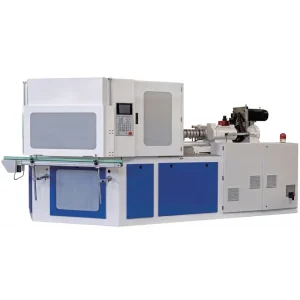
Macchina per stampaggio a iniezione e soffiaggio ZQ80 (europea)
-
Macchina per stampaggio a iniezione e soffiaggio ZQ60, ricambio per il modello Uniloy UIB90.
-
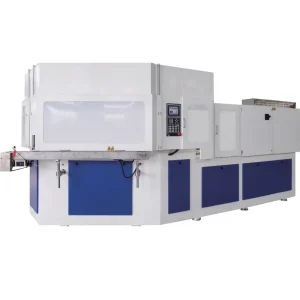
Macchina per stampaggio a iniezione e soffiaggio ZQ110 (versione europea)