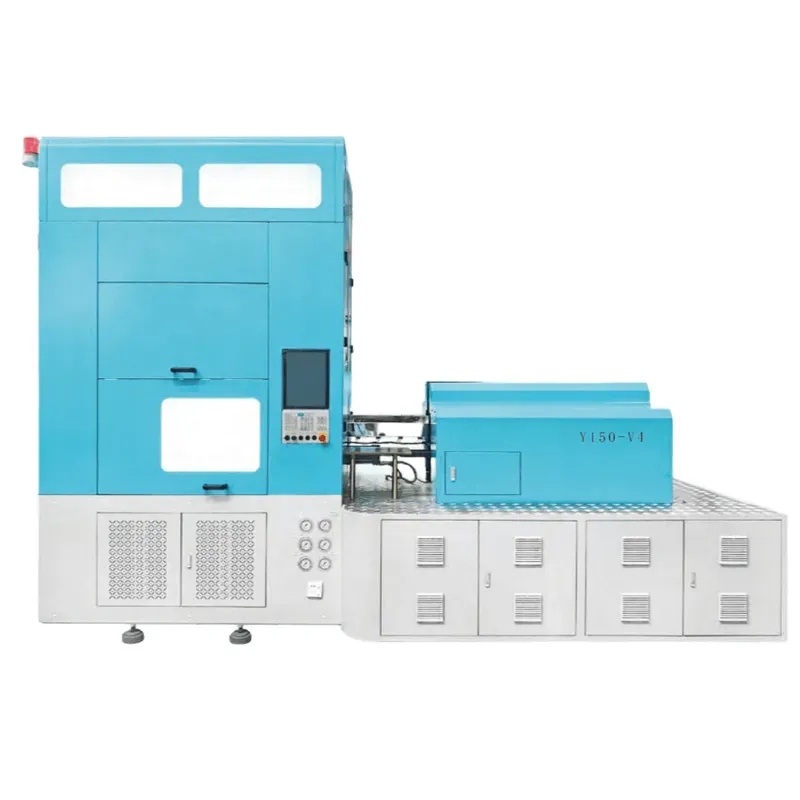
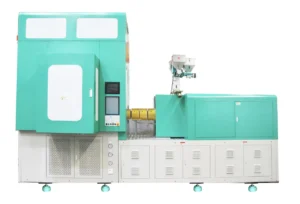
Wtryskarka z rozciąganiem i rozdmuchiwaniem Y150-V4-B zastępuje japońską maszynę AOKI SBIII-100L-20
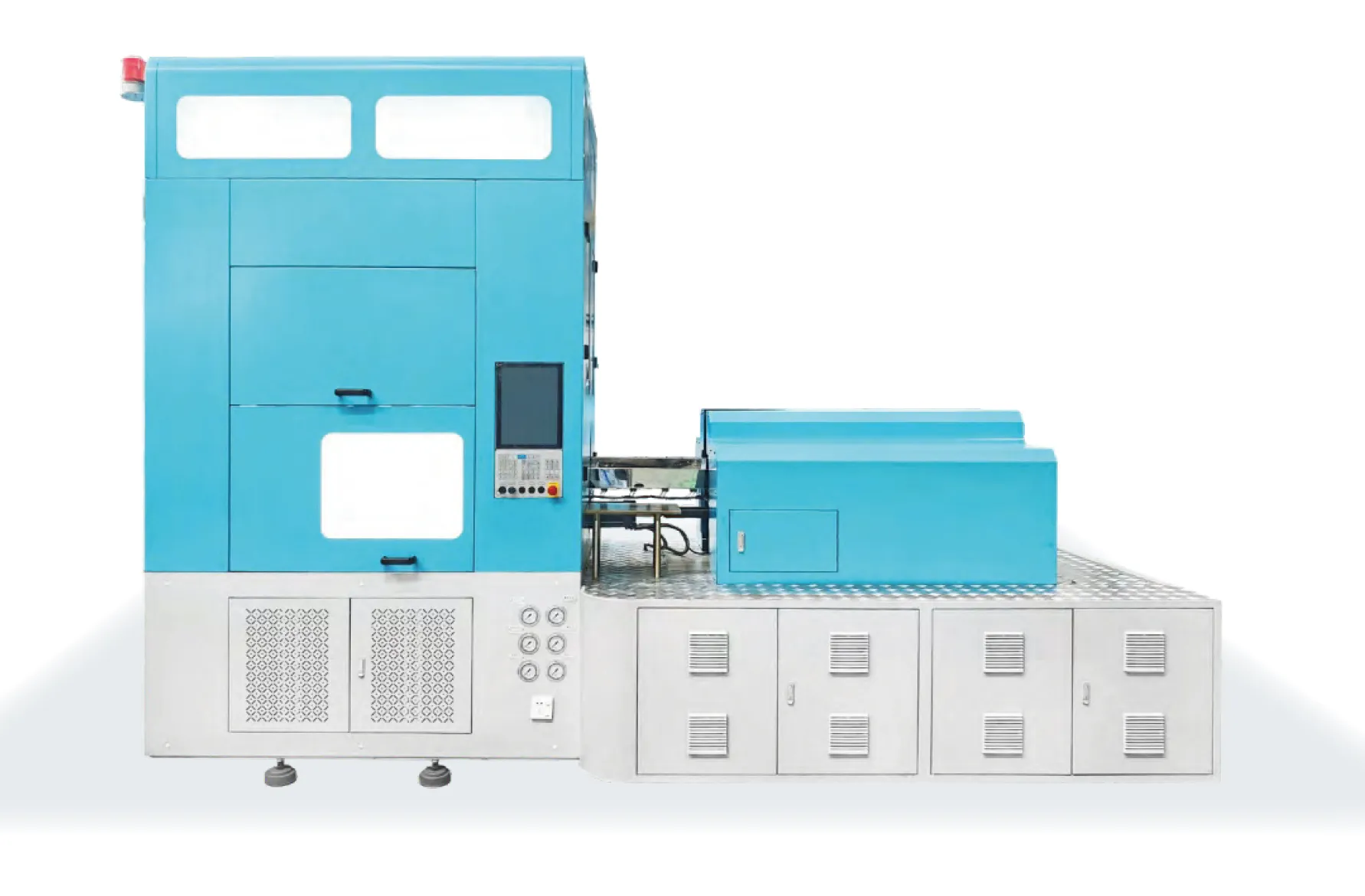
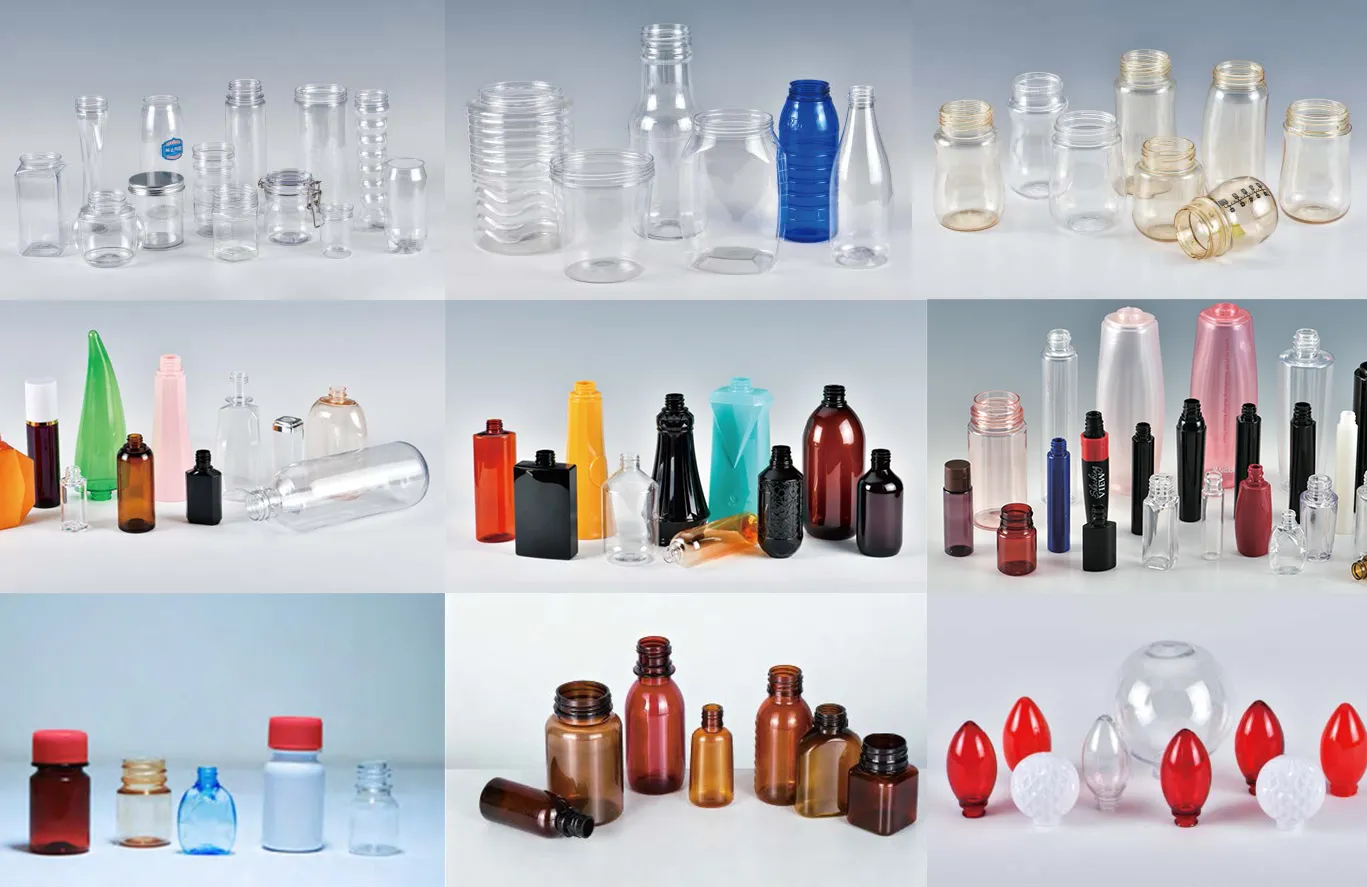
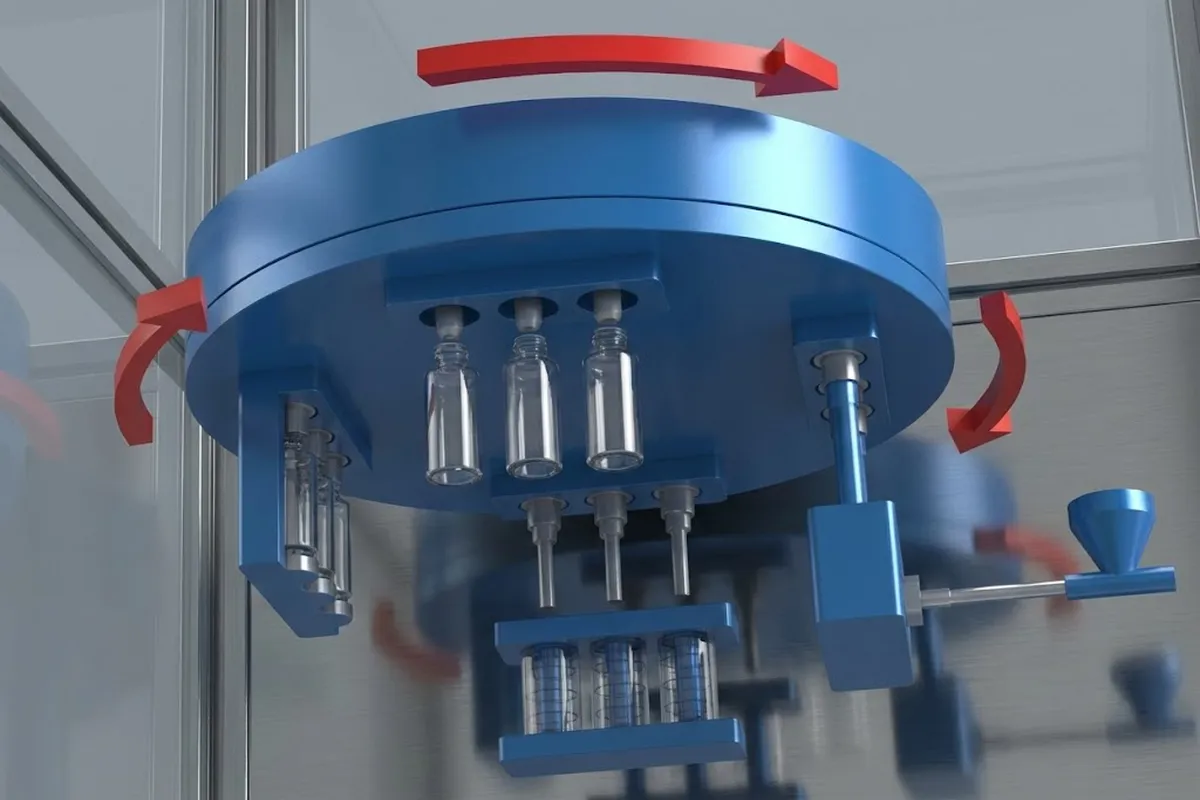
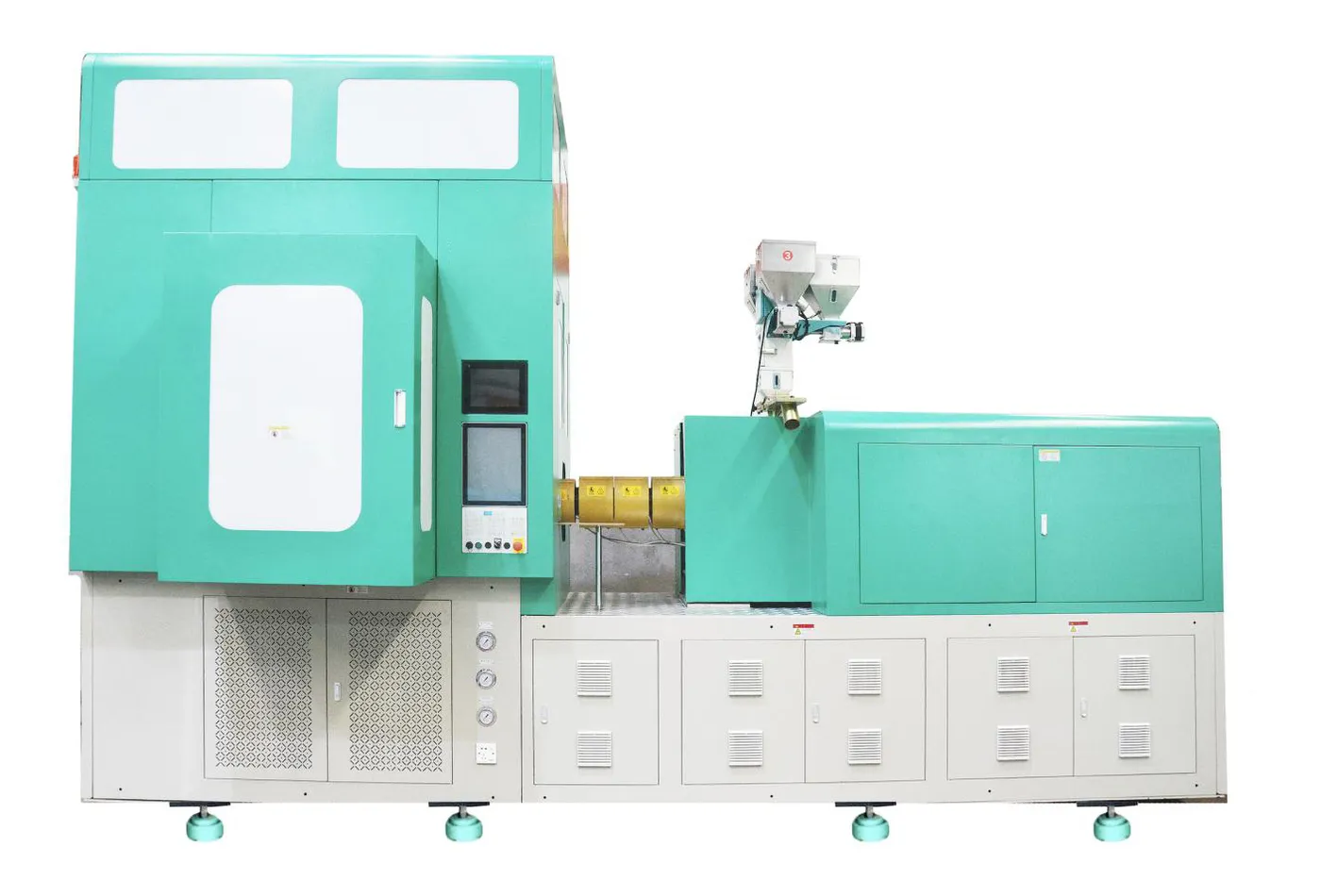
Y150-V4-B to wysokowydajna, jednoetapowa maszyna do formowania wtryskowego z rozciąganiem i rozdmuchem, opracowana przez Mexico Ever-Power ISBM Machinery jako bezpośredni i ekonomiczny zamiennik japońskiej maszyny AOKI SBIII-100L-20. Zbudowana w oparciu o 4-stanowiskową konstrukcję obrotową, ta jednoetapowa maszyna do formowania wtryskowego z rozciąganiem i rozdmuchem łączy wtrysk, regulację temperatury, formowanie z rozciąganiem i rozdmuchiwaniem oraz wyjmowanie butelek w jednym, płynnym, zautomatyzowanym cyklu. Została zaprojektowana dla producentów, którzy wymagają różnorodności produktów bez utraty precyzji, i umożliwia produkcję butelek na leki, kosmetyków, butelek dla niemowląt, butelek szklanych na wodę, butelek o niestandardowych kształtach i innych z materiałów PET i PETG.
The Y150-V4-B is a high-performance one-step injection stretch blow molding machine engineered by Mexico Ever-Power ISBM Machinery as a direct, cost-effective replacement for the Japanese AOKI SBIII-100L-20. Built around a 4-station rotary design, this single stage injection stretch blow molding machine consolidates injection, temperature regulation, stretch blow molding, and bottle take-out into one seamless automated cycle. It is designed for manufacturers who demand product diversity without sacrificing precision, capable of producing medicine bottles, cosmetics bottles, baby bottles, water glass bottles, special-shaped bottles, and more from PET and PETG materials. Because the entire production process occurs within a single enclosed machine, there is zero human contact with the preform between stations, meeting the GMP pharmaceutical packaging production standards required by regulated industries worldwide.
Mexico Ever-Power's ISBM machine adopts a standardized mechanical architecture with imported-brand components throughout: American Parker high-pressure valves, Airtak air cylinders, Japan Yaskawa or WEICHI servo motors paired with Taiwan TSUNTIEN reducers, Italy-sourced hydraulic tubing, NSK lead screws from Japan, YUKEN hydraulic control valves from Taiwan, and an Inovance or MiRLE PLC control system. The screw is heated by a nano far-infrared energy-saving heating ring delivering 10 kW, while three sets of servo pump systems drive the machine at 43.2 kW total motor power. The result is a customized injection stretch blow molding machine platform that exceeds Japanese OEM output rates, reduces energy consumption by 15-25%, and delivers seamless mold-line quality that conventional 2-step systems simply cannot match. Application sectors include pharmaceutical packaging, cosmetic packaging, food and beverage packaging, daily-use chemical packaging, and specialty industrial bottle production.
Tabela porównawcza modeli produktów
1. Zamiennik japońskiego modelu ASB
| Model maszyny Y/YS | Konfiguracja / Uwagi | Kompatybilny model japoński |
| Y150-V4-2 | Konfiguracja standardowa | ASB-12M |
| YS150-V4-EV | Pełne serwo | ASB-12M |
| Y250-V4 | Konfiguracja standardowa | ASB-70DPH |
| Y250-V4-B | Seria B | ASB-70DPW |
| Y650-V4 | Model o dużej pojemności | ASB-650 |
2. Zamiennik japońskiego modelu AOKI
| Model maszyny Y/YS | Konfiguracja / Uwagi | Kompatybilny model japoński |
| Y150-V4-B | Seria B | SBIII-100L-20 |
| Y150-V3-B | Model 3-stanowiskowy | SBIII-100L-20 |
| Y200-V4-B | Seria B | SBIII-250LL-50S |
| Y200-V3 | Model 3-stanowiskowy | SBIII-250LL-50S |
| YS350-V4-EV | Pełne serwo | AL-350LL-40 |
| Model standardowy | Model serwa | Model w pełni elektryczny |
 |
 |
 |
Nasze zalety
1. Jakość jest lepsza. Wszystkie plastikowe butelki produkowane przez japońskie maszyny do formowania rozdmuchowego mają linię podziału. Pośrodku obu form, po obu stronach, wystaje kawałek plastiku, co powoduje powstanie znaku. Jednak nasze formy charakteryzują się niezwykle wysoką precyzją, a znak jest całkowicie niewidoczny.
2. Nasza produkcja jest szybka, z dużą ilością rozwiązań śrubowych i dużą prędkością. Podczas gdy Japonia może produkować cztery plastikowe butelki jednocześnie, my jesteśmy w stanie wyprodukować ich sześć.
3. Oszczędzaj energię. Nasze maszyny zużywają od 15% do 25% mniej energii niż te w Japonii, Europie i Stanach Zjednoczonych.
4. Zastosowano szeroką gamę technologii sterowania elektrycznego w celu zastąpienia komponentów hydraulicznych i pneumatycznych. Na przykład, komponenty pneumatyczne stosowane w mechanizmie tnącym dno w Japonii są zastępowane silnikami serwo, co podwaja ich prędkość. W przemyśle farmaceutycznym i innych branżach, silniki serwo mogą być stosowane bez żadnych układów hydraulicznych, co zapewnia zgodność ze standardami GMP i pracę w środowisku wolnym od oleju i zanieczyszczeń.
Specyfikacja produktu
| Przedmiot | Jednostka | Specyfikacje | |||||||
| Nazwa | Formowanie wtryskowe z rozciąganiem i rozdmuchiwaniem w jednym kroku Maszyna (4-stanowiskowa) |
||||||||
| Model | Y150-V4-B (Compatible with Japanese AOKI SBIII-100L-20 model) | ||||||||
| Producent | Meksyk Ever-Power | ||||||||
| Tworzywo | PET/PETG | ||||||||
| Średnica śruby | MM | 40 | 50 | 55 | 60 | ||||
| Teoretyczna objętość wtrysku | CM³ | 188 | 310 | 380 | 480 | ||||
| Prędkość obrotowa śruby (obr./min) | obr./min | 270 | 180 | 150 | 150–220 | ||||
| Siła zacisku wtrysku | KN | 150 | |||||||
| Siła zacisku dmuchawy | KN | 200 | |||||||
| Moc silnika | KW | 43.2 | |||||||
| Moc grzewcza | KW | 10 | |||||||
| Ciśnienie powietrza dmuchanego | MPa | 2.0-3.5 | |||||||
| Ciśnienie wody chłodzącej | MPa | 0.4-0.6 | |||||||
| Ciśnienie wody w chłodnicy oleju maszynowego | MPa | 0.3-0.4 | |||||||
| Temperatura wody w chłodnicy oleju maszynowego | ℃ | 20-25 | |||||||
| Woltaż | V | 370-400 | |||||||
| (Dł.*Sz.*Wys.) Rozmiar(Dł.*Sz.*Wys.) | MM | 4200x1400x2900 | |||||||
| Waga | T | 6 | |||||||
| Wymiary produktu | |||||||||
| Ilość produktu | PCS | 1 | 2 | 3 | 4 | 5 | 6 | 7 | 8 |
| Średnica butelki | MM | 118 | 80 | 66 | 56 | 54 | 45 | 28 | 26 |
| Wysokość butelki | MM | 210 | 150 | 100 | |||||
| Średnica szyjki | MM | 83 | 62 | 48 | 38 | 32 | 25 | 17 | 15 |
| Maksymalna objętość butelki | ML | 2500 | 1500 | 900 | 400 | 250 | 100 | 30 | 20 |
| Maksymalna waga butelki | G | 130 | 65 | 43 | 32 | 26 | 22 | 18 | 16 |
Parametr maszyny
| Kompatybilny model: | Compatible with Japanese AOKI SBIII-100L-20 model |
| Średnica śruby: | 50 mm (opcjonalnie) |
| Teoretyczna wydajność wtrysku: | 310g |
| Siła zacisku wtrysku: | 150 kN |
| Skok górnej formy: | 250 mm |
| Dolny skok formy: | 205 mm |
| TEMP. Regulacja rdzenia: | 250 mm |
| Regulacja temp. skoku lufy: | 230 mm |
| Uderzenie wyjmujące: | 170 mm |
| Siła zacisku dmuchawy: | 200 kN (jednostronnie) |
| Uderzenie rdzenia: | 250 mm |
| Skok formy rozdmuchowej: | 75+75 mm |
| Pojemność zbiornika oleju: | 300L |
| Rozmiar (dł. × szer. × wys.): | 4,2*1,4*2,9 m |
| Waga: | 6T |
Norma techniczna
| Układ sterowania serwomechanizmem: | Zastosowanie 3 zestawów układów pomp serwo. |
| Moc serwosilnika: | Moc serwosilnika Inovance/WEICHI: 43,2 kW. |
| System sterowania komputerowego: | Korzystanie ze sterownika PLC Inovance/MiRLE. |
| Napęd gramofonu: | Gramofon wyposażony jest w serwomotor japońskiej firmy Yaskawa lub serwomotor firmy WEICHI z reduktorem TSUNTIEN z Tajwanu. |
| Zawór wysokiego ciśnienia: | Zastosowanie amerykańskiego zaworu wysokociśnieniowego Parker. |
| Cylinder pneumatyczny: | Korzystanie z cylindra pneumatycznego Aitak. |
| Kontrola temperatury: | Do kontrolowania temperatury stosuje się zintegrowaną skrzynkę sterowniczą, która jest niezwykle dokładna, stabilna i łatwa w obsłudze; alternatywnie można wybrać wbudowany w system system kontroli temperatury. |
| Zawór sterujący ciśnieniem hydraulicznym: | Korzystając z hydraulicznego zaworu sterującego ciśnieniem firmy YUKEN z Tajwanu, Chiny; |
| Rurka olejowa: | Rurka olejowa wykonana jest z materiału importowanego z Włoch. |
| Śruba: | Ślimak jest podgrzewany za pomocą energooszczędnego pierścienia grzewczego wykorzystującego nanocząstkę podczerwieni (10 kW). |
| Struktura formowania rozdmuchowego: | Struktura formowania rozdmuchowego wykorzystuje układ zacisku formy z cylindrem hydraulicznym lub podwójnym serwosilnikiem z funkcją kompensacji wysokiego ciśnienia. |
| Jednostka wtryskowa: | Jednostka wtryskowa jest sterowana za pomocą jednego cylindra. Silnik topiący może być sterowany hydraulicznie lub za pomocą serwomotoru. |
| Całkowita moc maszyny: | Całkowita moc maszyny: 53,2 kW. |
Key Features of the Y150-V4-B ISBM Machine
1. Skrócony cykl produkcyjny
The Y150-V4-B completes the entire journey from raw PET resin to finished bottle inside a single 4-station machine with no intermediate transfers or reheating stages. Injection, temperature conditioning, stretch blow molding, and bottle take-out all happen within one continuous rotary cycle. This integrated one-step approach eliminates handling delays, reduces changeover time between runs, and allows operators to achieve higher output rates per shift compared with equivalent two-step or three-step systems. Manufacturers in pharmaceutical and cosmetic sectors particularly benefit from the dramatically reduced batch turnaround time.
2. Superior Production Efficiency
Where the Japanese AOKI SBIII-100L-20 is limited to four cavities per cycle, the Y150-V4-B's enlarged screw solution volume and optimized clamping architecture allow six plastic bottles to be produced simultaneously. This 50% capacity advantage translates directly into lower unit costs and faster order fulfillment. The machine's three-set servo pump system delivers rapid, repeatable hydraulic response, maintaining consistent cycle times even during extended production runs at rated capacity, making this single-stage injection stretch blow molding machine ideal for high-volume manufacturing lines.
3. Improved Molding Precision
The Inovance or MiRLE PLC control system precisely regulates injection speed, injection pressure, mold temperature, blow pressure, and stretch rod speed at every station. High-precision mold tooling eliminates the visible parting-line protrusion that is a known limitation of Japanese-origin machines. The integrated temperature-control box manages each zone independently with high accuracy and stability, ensuring that every bottle produced meets tight dimensional tolerances on neck diameter, wall thickness, and bottle height. This level of precision is critical for pharmaceutical clients subject to GMP inspection and for cosmetic brands with strict visual quality standards.
4. Reduced Labor Cost and Automation
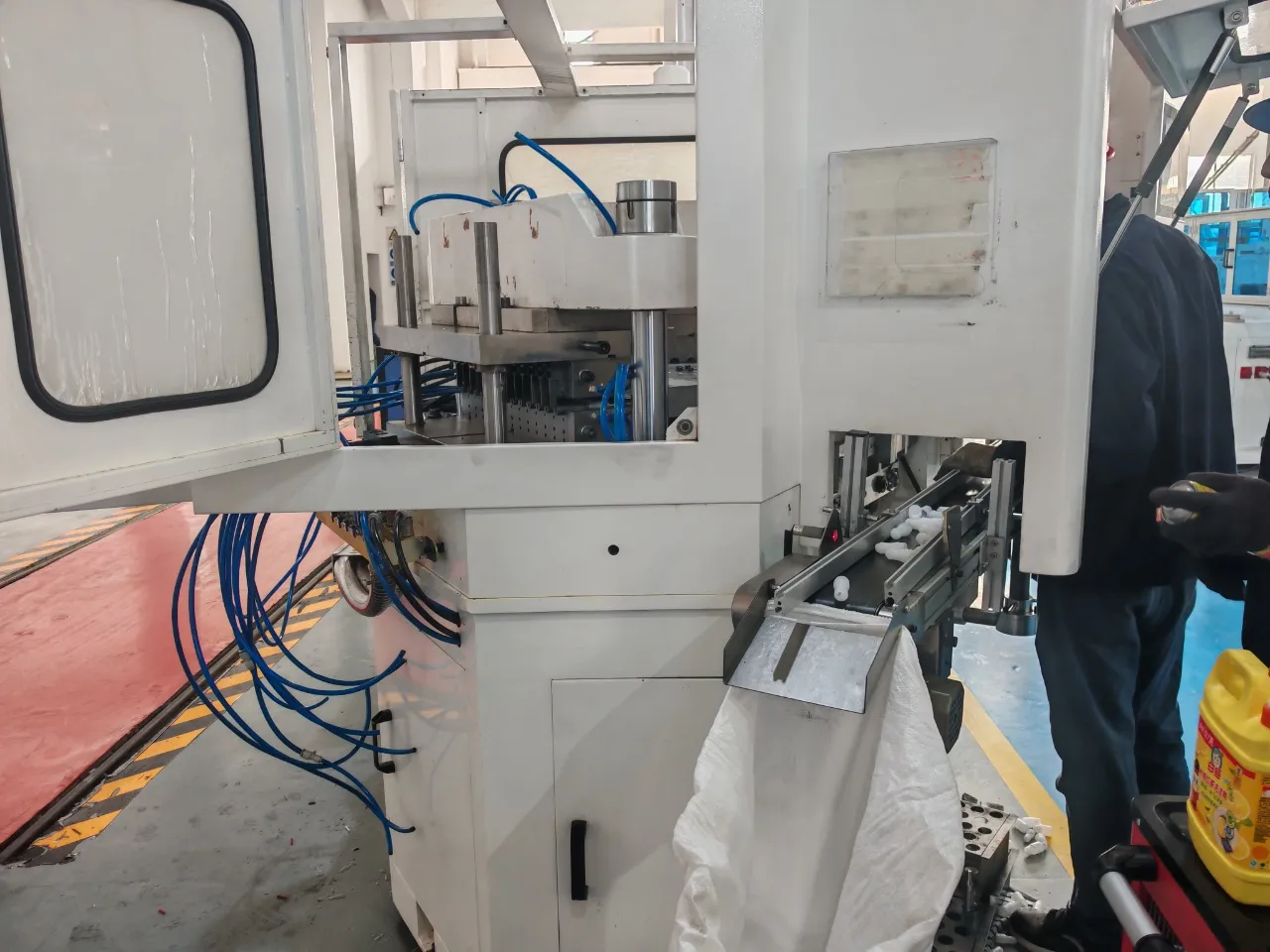
Full process automation runs from PET pellet loading through bottle discharge with zero manual intervention at any intermediate stage. Human contact with the preform is entirely eliminated, which is a regulatory requirement for GMP-certified pharmaceutical packaging lines. The servo motor-driven bottom-cutting mechanism replaces the pneumatic components used in Japanese machines and operates at double the speed. In pharmaceutical and other regulated fields, the fully servo configuration removes hydraulic systems entirely, ensuring an oil-free, contamination-free environment. Fewer operators per machine and lower rejection-driven rework together deliver measurable reductions in per-bottle labor cost.
5. Energy Conservation of 15-25%
The one-step process retains the heat of the injection-molded preform directly through to the blow station, eliminating the secondary reheating step that two-step machines require. This architectural advantage reduces total energy consumption by 15% to 25% versus equivalent Japanese, European, and American machines. The nano far-infrared energy-saving heating ring on the screw barrel further optimizes energy delivery. The three servo pump systems operate only under load, avoiding the constant energy draw of fixed-displacement hydraulic circuits. PET material is processed cleanly with minimal sprue waste, reducing raw material cost per bottle and overall environmental impact per unit produced.
6. Compact Footprint and AOKI Mold Compatibility
At 4,200 x 1,400 x 2,900 mm and 6 tonnes, the Y150-V4-B fits within the floor plan of a standard clean room or compact production workshop. Facilities that previously operated the Japanese AOKI SBIII-100L-20 can adopt the Y150-V4-B without retooling their mold inventory, as the machine is fully compatible with existing AOKI SBIII-100L-20 molds. This direct mold compatibility dramatically reduces the total cost of transition and shortens the commissioning timeline, making this replacement of AOKI injection stretch blow molding machines one of the most cost-effective upgrade paths available to existing AOKI users globally.
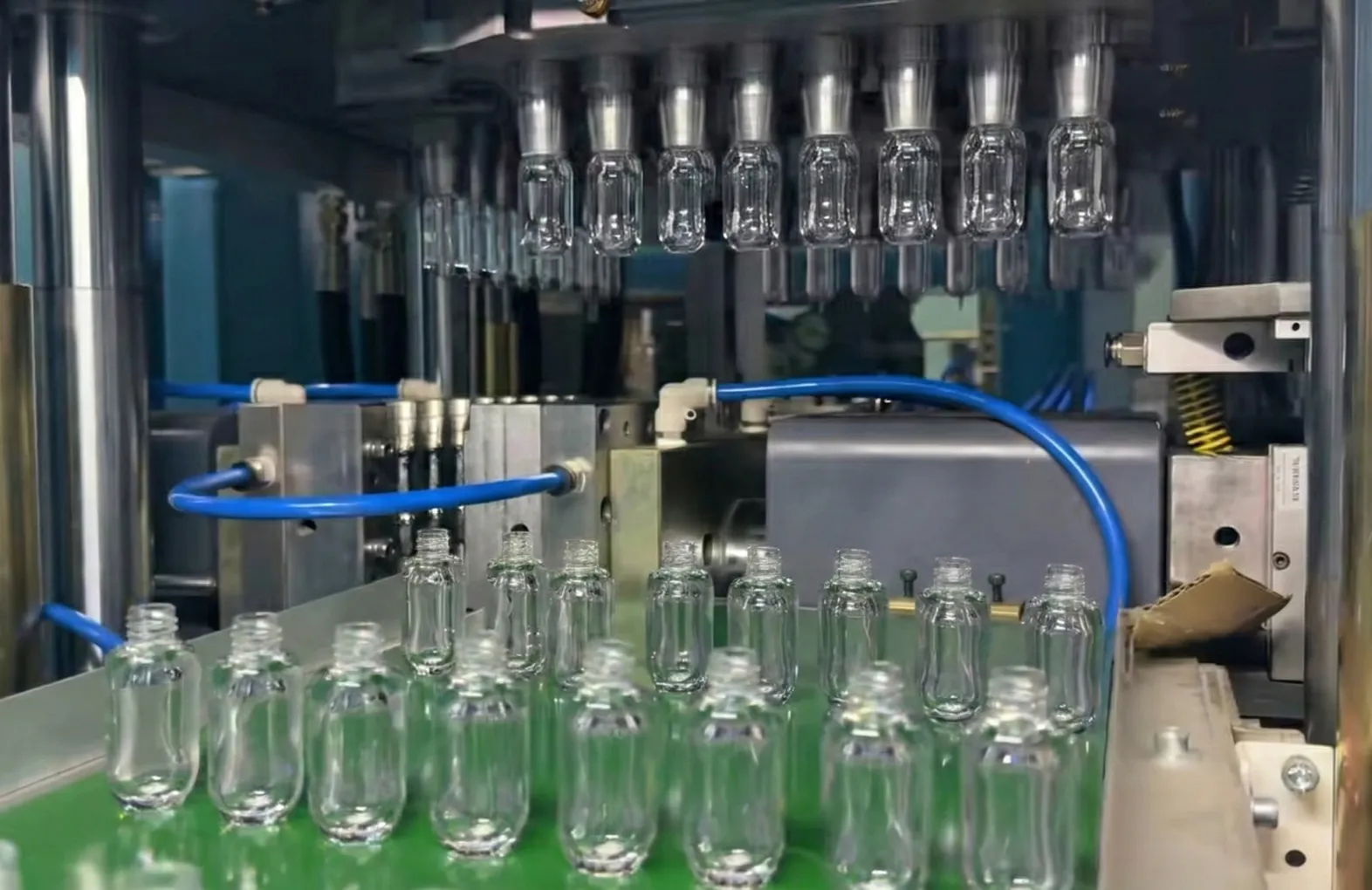
Zasada działania
Krok 1: Proces wtrysku
Molten PET material is injected into the preform mold under controlled high temperature and pressure. The PLC precisely governs injection speed, injection pressure, and mold temperature to ensure the molten plastic fills the cavity uniformly, producing a preform with consistent wall thickness and optimal density. Accurate parameter control at this stage is the foundation for transparency and structural integrity in the final bottle.
Krok 2: Proces rozciągania
The injection-molded preform passes to the temperature-conditioning station, where it is reheated to the precise stretching temperature. The stretch rod then elongates the preform axially, inducing biaxial molecular orientation. This stretching causes PET polymer chains to align, which significantly improves the compression resistance, barrier properties, and optical transparency of the finished bottle. Cooling time and heating temperature are closely monitored throughout to ensure dimensional stability and surface quality.
Krok 3: Proces dmuchania
After stretching, the preform enters the blow mold station. Compressed air at 2.0-3.5 MPa is introduced through the blow pin, expanding the softened preform radially until it conforms precisely to the inner wall of the mold cavity. The American Parker high-pressure valve ensures accurate and repeatable blow pressure delivery at every cycle. The dual servo motor or hydraulic cylinder mold-clamping system with high-pressure compensation function holds the mold firmly shut during this critical stage, defining the final bottle shape and ensuring consistent wall distribution.
Step 4: Molding and Take-Out
Once the blow-formed bottle achieves its shape, the mold cooling system rapidly extracts heat through the mold's internal cooling channels, solidifying the PET and locking in dimensional accuracy, surface finish, and the required wall-thickness distribution. After sufficient cooling, the mold opens and the ejection system conveys finished bottles to the collection point without any manual contact. Uniform cooling temperature, controlled cooling speed, and precise cooling duration are all managed automatically by the control system to maximize bottle quality and production efficiency.
Branże aplikacji
1. Butelki kosmetyczne
High-appearance cosmetics packaging such as serum bottles, lotion containers, toner bottles, and luxury personal care vessels demands seamless surfaces and invisible parting lines. The Y150-V4-B's ultra-precision molds produce cosmetic bottles with crystal-clear walls and flawless finishes that match the visual standards required by premium global beauty brands.
2. Butelki po chemikaliach
Household and industrial chemical packaging including detergent, cleaning agent, and solvent bottles requires excellent barrier properties and chemical resistance. PET and PETG bottles produced on this injection blow molding machine offer outstanding oxygen and moisture barrier performance, protecting product integrity across the supply chain and shelf life.
3. Butelki na napoje
Water bottles, juice containers, sports drink bottles, and other beverage packaging benefit from the machine's high throughput, precise neck-dimension control, and the excellent CO2 and oxygen barrier properties of biaxially oriented PET. The Y150-V4-B handles bottle volumes from 20 ml to 2,500 ml within a single platform, giving beverage producers versatile SKU coverage from a compact machine footprint.
4. Butelki farmaceutyczne
Oral liquid bottles, tablet containers, and syrup bottles for pharmaceutical use require GMP-compliant zero-contamination production. The Y150-V4-B's no-human-contact architecture and optional fully servo configuration make it the preferred ISBM machine for licensed drug manufacturers in regulated markets including Europe, North America, and Southeast Asia.
5. Food Bottles
Edible oil bottles, sauce containers, condiment bottles, and food-grade wide-mouth jars require food-safe materials and impeccable cleanliness standards. The Y150-V4-B's fully enclosed, automated production environment prevents contamination at every stage. The machine's compatibility with PETG broadens material options for food contact applications that require enhanced clarity and impact resistance.
6. Butelki do mycia rąk
Liquid hand soap, sanitizer, and personal hygiene product bottles are produced in high volumes with consistent pump-neck dimensions. The Y150-V4-B accommodates bottles with neck diameters from 15 mm to 83 mm, covering the full range of pump, disc-top, and flip-cap fitments used in personal care packaging. High cavity output per cycle keeps unit costs competitive for fast-moving consumer goods manufacturers.
7. Butelki na pestycydy
Agricultural chemical containers must resist aggressive solvents and maintain tight closure-compatibility tolerances. PET bottles from the Y150-V4-B offer proven chemical resistance and the dimensional precision required for tamper-evident and child-resistant closure systems used in crop protection product packaging. The machine handles special-shaped bottle designs that differentiate pesticide brands on agricultural retail shelves.
8. Buteleczki z kroplami do oczu
Ophthalmic packaging represents among the most demanding applications for any PET injection stretch blow molding machine. Eye drop bottles require GMP-grade cleanliness, exact volume control, and sterile-compatible materials. The Y150-V4-B's enclosed zero-contact production process, precise PLC control of every parameter, and optional full servo configuration satisfy the stringent requirements of ophthalmic pharmaceutical manufacturers and contract packaging organizations.
Core Components and System Structure
Jednostka wtryskowa
The injection unit uses a single-cylinder controlled injection platform with a 50 mm screw diameter as standard configuration, delivering a theoretical injection capacity of 310 g per cycle. The screw is heated by a nano far-infrared energy-saving heating ring rated at 10 kW, providing uniform melt temperature across the full screw length. The melt motor can be configured for hydraulic control or servo motor control, offering flexibility to match GMP requirements. The injection clamping force of 150 KN ensures consistent preform quality across all eight cavity positions.
Jednostka zaciskowa
The blow-side clamping unit generates 200 KN of force per single side through a hydraulic cylinder or optional dual servo motor mold-clamping system equipped with high-pressure compensation function. This high-pressure compensation actively corrects for any mold-flash tendency during the blow stage, ensuring clean parting lines and accurate bottle dimensions on every cycle. The clamping unit's robust construction supports mold weights typical of the AOKI SBIII-100L-20 format, enabling direct mold reuse without modification.
System precyzyjnej formy
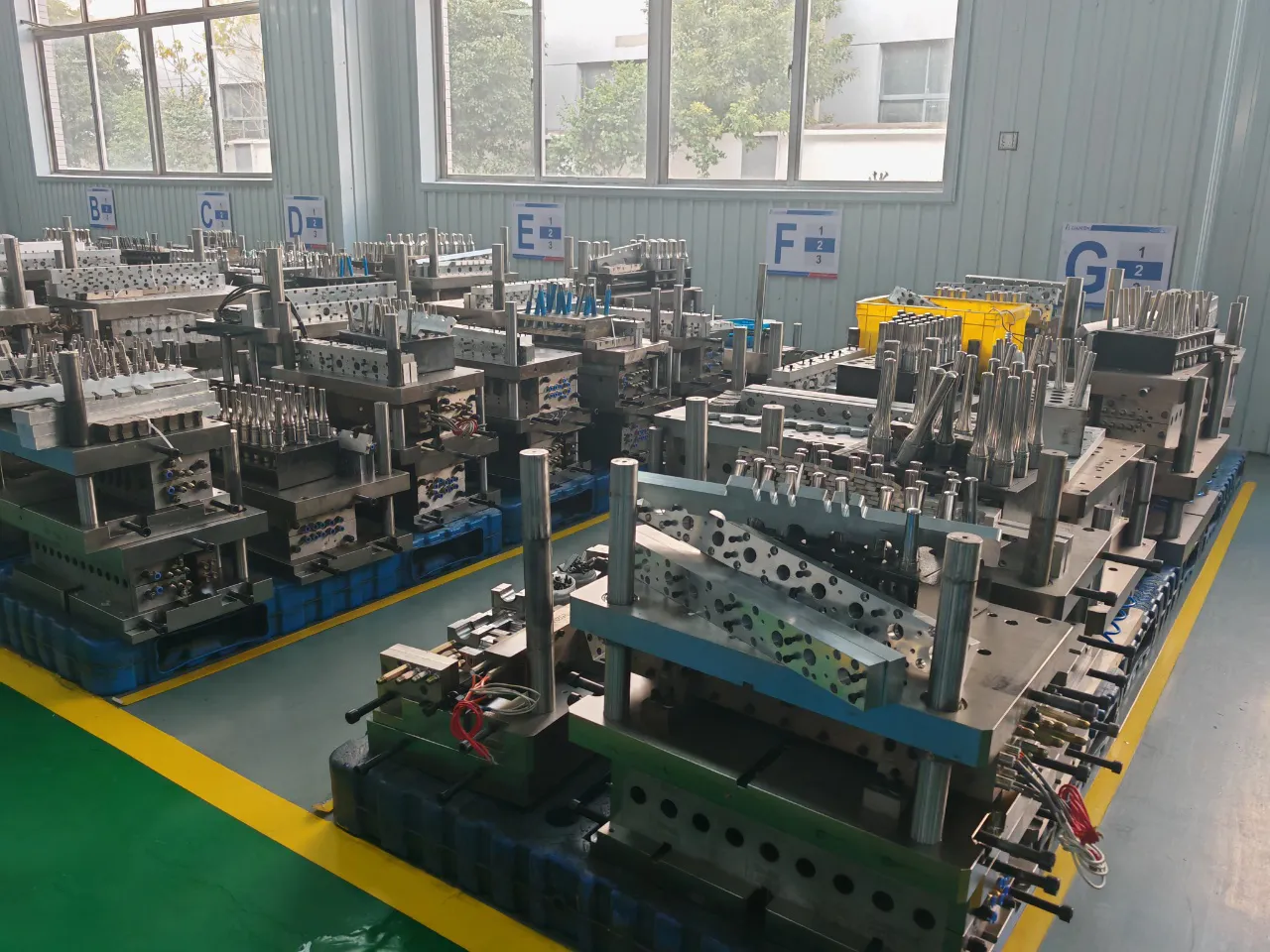
Ever-Power's high-precision molds for the Y150-V4-B are manufactured to tolerances that eliminate visible parting-line protrusions, a recognized quality limitation of legacy Japanese machine molds. The mold system accommodates up to eight cavities and supports bottle volumes from 20 ml to 2,500 ml. The mold is directly compatible with AOKI SBIII-100L-20 tooling, allowing existing AOKI customers to transition to the Y150-V4-B without capital investment in new mold sets, significantly reducing the payback period of the machine upgrade.
Blow Pin and Air Valve System
The blow core travels 250 mm and delivers compressed air at 2.0-3.5 MPa through the American Parker high-pressure valve. Parker valves are specified for their proven reliability and precise flow control, ensuring repeatable blow pressure delivery cycle after cycle. The blow mold stroke of 75+75 mm provides sufficient clearance for the full range of bottle shoulder geometries. Airtak air cylinders manage auxiliary pneumatic functions throughout the machine, combining responsive actuation with low maintenance requirements.
Układ chłodzenia
The machine cooling system requires water supply at 0.4-0.6 MPa, with the oil cooler loop operating at 0.3-0.4 MPa and maintaining a water temperature of 20-25 degrees Celsius. The integrated cooling channels within the mold rapidly extract heat from each bottle after blow molding, ensuring dimensional stability and consistent surface finish without extending cycle time. The oil tank with 300 L capacity maintains hydraulic fluid temperature within the operating range, protecting the servo pump systems and hydraulic control valves during continuous production.
Control and Drive System
The turntable is powered by a Japan Yaskawa servo motor or WEICHI servo motor combined with a Taiwan TSUNTIEN reducer, providing precise rotational indexing between stations. The Inovance or MiRLE PLC control system governs all motion axes, temperature zones, and pressure parameters from a single integrated interface. The YUKEN hydraulic pressure control valve from Taiwan manages the hydraulic circuit, while Italy-sourced hydraulic tubing and NSK Japan lead screws ensure long-term reliability in continuous industrial operation. Three servo pump systems rated at 43.2 KW total drive the machine efficiently under load.
Temperature Control System
Temperature management uses an integrated control box that delivers high accuracy, stability, and simple operator interface across all heating zones. Operators can alternatively select the system's built-in temperature control configuration depending on process requirements. Precise temperature regulation of the preform at the conditioning station is critical for achieving the optimal PET molecular orientation during stretching, which directly determines bottle transparency, wall uniformity, and barrier performance. The system maintains tight temperature uniformity across all cavities to ensure consistent bottle quality batch after batch.
System wyrzutu
The bottle take-out station operates with a 170 mm take-out stroke, efficiently transferring finished bottles from the mold to the collection conveyor without any manual handling. The servo motor-driven bottom-cutting mechanism replaces the pneumatic components used in the original Japanese machine design and operates at twice the cutting speed, improving cycle efficiency and reducing the risk of tail-flash defects. The smooth, controlled ejection sequence prevents bottle marking or deformation during the take-out phase, preserving the surface quality achieved during blow molding.
Formowanie wytłaczane a formowanie wtryskowe
Przegląd formowania wytłaczanego
Formowanie ekstruzyjne formuje tworzywa sztuczne w ciągłe, jednolite profile. W tym procesie stopione tworzywo sztuczne jest przetłaczane przez matrycę, formując produkty takie jak rury, przewody i arkusze. Maszyny pracują w trybie ciągłym, co czyni je idealnym rozwiązaniem do produkcji wielkoseryjnej prostych, liniowych kształtów. Większość zastosowań formowania ekstruzyjnego wykorzystuje tworzywa termoplastyczne, takie jak polipropylen, polietylen i polistyren. Materiały te oferują elastyczność, odporność chemiczną i trwałość, co sprawdza się w wielu gałęziach przemysłu.
Wiele branż wykorzystuje formowanie ekstruzyjne ze względu na jego wydajność i wszechstronność. Na przykład, przemysł solarny wykorzystuje je do produkcji ram paneli, a sektor motoryzacyjny do produkcji uszczelek i uszczelek chroniących przed warunkami atmosferycznymi. Producenci urządzeń AGD wytwarzają energooszczędne uszczelki i uchwyty, a przemysł budowlany wykorzystuje formowanie ekstruzyjne do produkcji okien i drzwi. Firmy produkujące sprzęt medyczny produkują rurki i cewniki, a przemysł opakowaniowy produkuje folie i arkusze.
Poniższa tabela przedstawia materiały powszechnie stosowane w formowaniu wytłaczanym i ich właściwości:
| Tworzywo | Kluczowe właściwości | Aplikacje |
|---|---|---|
| Polipropylen | Wysoka wytrzymałość na zginanie, odporność na wilgoć | Rury, elementy wykończeniowe, wymiana elementów metalowych |
| Nylon | Wysoki stosunek wytrzymałości do masy, odporność chemiczna | Zbiorniki, rury w silnikach samochodowych |
| Akryl | Przejrzystość, przepuszczalność światła, odporność na uderzenia | Zastosowania optyczne |
| Polietylen | Elastyczność, wytrzymałość, odporność chemiczna | Folie opakowaniowe, rury, pojemniki |
| Polistyren | Doskonała izolacja, lekkość | Izolacja budowlana |
| Poliwęglan | Odporność na uderzenia, przejrzystość optyczna | Komponenty samochodowe, obudowy elektroniczne |
| ABS | Wytrzymałość, odporność na ścieranie | Rury elektryczne, obudowy urządzeń, listwy wykończeniowe |
Przegląd formowania wtryskowego
Formowanie wtryskowe pozwala na tworzenie złożonych, trójwymiarowych elementów poprzez wtryskiwanie stopionego tworzywa sztucznego do gniazda formy. W procesie tym wykorzystywane są specjalistyczne maszyny, które mogą obsługiwać szeroką gamę tworzyw termoplastycznych i termoutwardzalnych. Metoda ta pozwala na wytwarzanie wyrobów o skomplikowanych wzorach, ścisłych tolerancjach i wysokiej jakości wykończeniach powierzchni. Producenci często wybierają formowanie wtryskowe w przypadku produktów wymagających precyzji i szczegółowych cech.
Wybór materiałów w procesie formowania wtryskowego odgrywa kluczową rolę w określaniu złożoności i wydajności produktu. Niektóre tworzywa sztuczne pozwalają na uzyskanie drobnych detali i skomplikowanych geometrii, podczas gdy inne ograniczają możliwości projektowe ze względu na swoje właściwości płynięcia. Wybór odpowiedniego materiału wpływa nie tylko na trwałość i koszt produktu końcowego, ale także na czas produkcji i możliwą do uzyskania złożoność.
Formowanie wtryskowe jest wykorzystywane w wielu branżach. Producenci wytwarzają ramy okienne i drzwiowe, armaturę wodno-kanalizacyjną, skrzynki elektryczne, modułowe elementy konstrukcyjne, opakowania do żywności, urządzenia medyczne, części obronne, narzędzia rolnicze, podzespoły elektroniczne i elementy mebli, wykorzystując ten proces. Maszyna ISBM (Maszyna do formowania wtryskowego z rozciąganiem i rozdmuchiwaniem) stanowi specjalistyczną formę formowania wtryskowego. Formuje puste pojemniki z tworzywa sztucznego, takie jak butelki, poprzez rozciąganie i rozdmuchiwanie wtryśniętego preformy do jego ostatecznego kształtu. Technologia ta podkreśla wszechstronność formowania wtryskowego w produkcji zarówno elementów pełnych, jak i pustych w środku.
Główne różnice między formowaniem wytłaczanym a formowaniem wtryskowym
Główne różnice między formowaniem ekstruzyjnym a formowaniem wtryskowym dotyczą kształtu produktu, jego złożoności, kosztów i zastosowań. Formowanie ekstruzyjne pozwala uzyskać ciągłe, jednolite profile, co czyni je idealnym rozwiązaniem dla wyrobów takich jak rury i ramy. Formowanie wtryskowe natomiast doskonale sprawdza się w tworzeniu złożonych, szczegółowych, trójwymiarowych elementów, takich jak komponenty samochodowe i urządzenia medyczne.
Poniższa tabela podsumowuje różnice techniczne:
| Aspekt | Formowanie wtryskowe | Formowanie wytłaczane |
|---|---|---|
| Maszyneria | Specjalistyczne maszyny do wtryskiwania materiału do form | Proces ciągły z wykorzystaniem matrycy do kształtowania materiału |
| Wytrzymałość stopu | Wyższa wytrzymałość stopu w przypadku złożonych kształtów | Niższa wytrzymałość stopu, odpowiednia do prostszych profili |
| Rozszerzenie punktu sprzedaży | Może wystąpić znaczne pęcznienie matrycy | Minimalne pęcznienie matrycy, większa kontrola nad wymiarami |
| Materiały obsługiwane | Szeroka gama tworzyw termoplastycznych i termoutwardzalnych | Głównie tworzywa termoplastyczne, ograniczone do określonych typów |
| Złożoność części | Możliwość tworzenia skomplikowanych projektów | Najlepiej nadaje się do prostszych, jednolitych kształtów |
| Wykończenie powierzchni | Możliwość uzyskania wysokiej jakości wykończenia powierzchni | Wykończenie powierzchni może być różne, często mniej wyrafinowane |
| Wolumen produkcji | Nadaje się do produkcji wielkoseryjnej | Idealny do ciągłej produkcji |
| Czas cyklu | Dłuższe cykle dzięki chłodzeniu i krzepnięciu | Krótsze czasy cykli, ciągły przepływ |
| Koszty narzędzi | Wyższe początkowe koszty oprzyrządowania | Niższe koszty narzędzi, ale mogą się różnić w zależności od projektu |
| Odpady materiałowe | Więcej odpadów materiałowych z powodu wlewów i kanałów | Ogólnie rzecz biorąc, mniejsze marnotrawstwo materiałów |
| Precyzja | Możliwa wysoka precyzja i ścisłe tolerancje | Umiarkowana precyzja, mniejsza kontrola nad wymiarami |
| Ograniczenia rozmiaru produktu | Ograniczone rozmiarem formy | Ograniczone rozmiarem matrycy, może wytwarzać dłuższe, ciągłe kształty |
Formowanie wytłaczane i formowanie wtryskowe różnią się także pod względem typów produktów:
- Ekstruzja doskonale sprawdza się w przypadku elementów ciągłych lub powtarzalnych części, takich jak rury i ramy z tworzywa PVC.
- Formowanie wtryskowe jest preferowaną metodą wytwarzania skomplikowanych i precyzyjnych części.
Porównanie procesów
Jak działa formowanie wytłaczane?
Extrusion molding shapes plastic into continuous profiles using a streamlined process. The method begins when operators feed raw plastic pellets into a hopper. The material moves into a heated barrel, where it melts and becomes more fluid. A rotating screw pushes the molten plastic forward, ensuring even melting and consistent flow. The plastic then passes through a die, which determines the final shape. As the product exits the die, it cools and solidifies. Workers or automated systems pull the product to the desired length and cut it to size. Extrusion molding operates as a continuous process. This feature allows manufacturers to produce long, uniform items efficiently. Cycle times depend on factors such as material type, die design, and cooling speed.
Jak działa formowanie wtryskowe?
Injection molding creates complex, three-dimensional parts by injecting molten plastic into a mold. The process starts with careful material selection. Operators choose plastics that meet strength and durability requirements. The plastic pellets enter a heated barrel, where they melt. A screw or plunger injects the molten plastic into a closed mold at high pressure. The mold shapes the plastic into the desired form. After injection, the mold cools to solidify the part. Cooling time is critical for maintaining the shape and structural integrity. Once the part cools, the mold opens, and an ejection system pushes the finished product out. Workers or machines then inspect and finish the parts as needed.
ISBM Machine Achieving High Transparency in PET Bottles
1. Material Selection and Resin Quality
The foundation of PET bottle transparency begins with resin grade selection. High-quality PET resin with consistent intrinsic viscosity and minimal contamination is essential for achieving excellent clarity. The Y150-V4-B's precise screw temperature control and nano far-infrared heating ring ensure the resin is melted uniformly to the correct melt temperature without thermal degradation, which would cause yellowing and haze. Starting with premium-grade PET and processing it correctly is the first step every ISBM machine manufacturer must get right.
2. Crystallinity Control
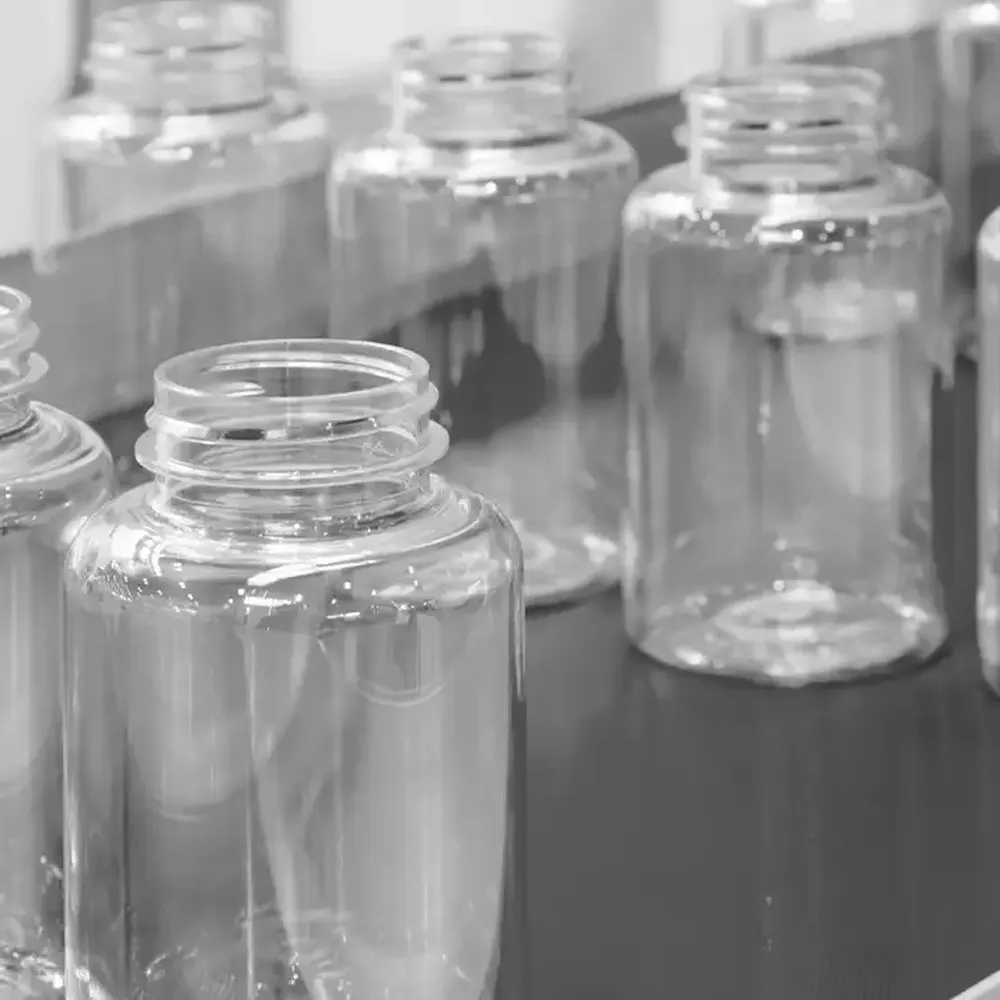
PET transparency is inversely related to crystallinity. Spherulitic crystallization above approximately 120 degrees Celsius causes haziness as crystallite size approaches the wavelength of visible light. The one-step process retains the preform in its amorphous state by keeping it at elevated temperature continuously from injection through to blow molding, preventing the secondary crystallization that occurs when a two-step machine reheats a cold preform. Evidence shows that PET samples cooled rapidly below 120 degrees Celsius maintain crystallinity under 20% and light transmittance above 90%.
3. Moisture Control and Drying
Excess moisture in PET resin or preforms is a primary cause of transparency loss. Wet PET absorbs more heat during preform conditioning, slows infrared energy transmission, lowers the glass-transition temperature, and acts as a plasticizer that disrupts molecular orientation during stretching. Moisture also degrades PET through hydrolytic chain scission, reducing molecular weight and causing haze. Proper pre-drying of PET resin before processing is mandatory, and the machine's sealed barrel design minimizes moisture absorption between drying and injection.
4. Biaxial Stretching Optimization
Biaxial stretching during the injection stretch blow molding process aligns PET polymer chains in both the axial and radial directions, reducing light scattering and dramatically increasing transparency. The stretch rod of the Y150-V4-B travels 250 mm with servo-controlled speed, enabling precise stretching ratios tailored to each bottle geometry. Higher stretching ratios produce smaller crystallites and greater transparency. Operators optimize the axial stretch ratio in combination with the blow pressure to balance transparency, wall thickness uniformity, and mechanical performance across the full bottle height.
5. Machine Settings and Calibration
Precise control of heating temperature (typically 100-180 degrees Celsius for PET), blow pressure (2.0-3.5 MPa), mold temperature uniformity (maintained within plus or minus 1 degree Celsius), and stretch rod speed are all managed by the Inovance or MiRLE PLC. Regular calibration of sensors and actuators ensures that every production cycle stays within the optimal parameter window for transparency. Insufficient stretch or low blow pressure leaves polymer chains disordered, causing haze. Excessive stretch may introduce microfractures. The Y150-V4-B's advanced control architecture maintains the narrow operating envelope required for consistently high transparency.
6. Czystość i zapobieganie zanieczyszczeniom
Contamination from dust, oil, foreign particles, or reactive polyester end groups degrades both the transparency and the structural integrity of PET bottles. The Y150-V4-B's enclosed machine design and zero-contact preform transfer eliminate exposure to airborne particles between stations. Regular cleaning of the mold cavity surfaces, screw barrel, and temperature-conditioning components prevents resin buildup and degradation byproducts from introducing color or haze into subsequent production runs. Strict cleanliness protocols are especially important when producing pharmaceutical and food-contact packaging where contamination carries regulatory consequences.
How to Choose the Right Injection Stretch Blow Molding Machine
1. Production Volume Requirements
Determine your required daily or monthly output volume in bottles before selecting any machine. The Y150-V4-B with up to six cavities per cycle is designed for medium-to-high volume production runs in pharmaceutical, cosmetic, and food-grade applications. If you need extremely high throughput, consider multi-machine installations or the six-station HGYS280-V6 platform. If your production volumes are smaller, a three-station configuration may deliver better economics. Match machine cycle time and cavity count to your contracted demand, allowing a 20-30% capacity buffer for production peaks and maintenance downtime.
2. Zakres rozmiarów i kształtów butelek
Verify that the machine's product dimension envelope covers all current and foreseeable future bottle sizes. The Y150-V4-B handles bottles from 20 ml to 2,500 ml with diameters from 26 mm to 118 mm and heights up to 210 mm. Special-shaped bottles and bottles with tight neck tolerances are well within its capability. If you need wider bottles, larger volumes above 2.5 litres, or a dual-row production configuration, the Y200-V4-B or Y250-V4-B models may be more appropriate. Always share your bottle drawings and mold details with the Ever-Power engineering team before finalizing machine selection.
3. Material Type and Regulatory Requirements
The Y150-V4-B processes PET and PETG. If your application requires PP, PC, PPSU, Tritan, or other engineering resins, discuss material compatibility with the Ever-Power technical team, as screw geometry and temperature profiles may need adjustment. Pharmaceutical manufacturers should specify GMP compliance requirements upfront, including whether a fully electric servo configuration is mandatory for oil-free operation. Food contact applications may require specific certifications for materials and machine surfaces that need to be confirmed during the inquiry stage with your ISBM machine manufacturer.
4. Automation Level
Standard Y150-V4-B uses three servo pump systems with servo motor turntable drive, offering a high degree of automation suitable for most commercial applications. For pharmaceutical lines subject to GMP audit or for operations targeting zero hydraulic oil in the production environment, the fully servo YS150-V4-EV variant eliminates the hydraulic system entirely and adds ten servo motor control axes. Evaluate your plant's regulatory environment, labor cost structure, and maintenance capability when deciding between standard servo-pump and full-servo configurations.
5. Energy Efficiency
Long-term energy cost is a significant factor in machine total cost of ownership, particularly in markets with high electricity tariffs. The Y150-V4-B consumes 15-25% less energy than comparable Japanese, European, and American machines by eliminating the secondary preform reheating step inherent to two-step systems. The servo pump systems only draw full power under load rather than running continuously at rated power. Calculate your expected annual energy cost at your local kWh rate using the machine's rated power of 53.2 KW and your expected utilization rate to quantify the long-term operating cost advantage versus competing OEM machines.
6. After-Sales Support and Spare Parts
Reliable after-sales support is critical for maintaining machine uptime in a production environment. Mexico Ever-Power maintains a comprehensive service team and spare parts inventory covering all major imported components used in the Y150-V4-B, including Parker valves, Airtak cylinders, Yaskawa servo motors, NSK lead screws, and YUKEN control valves. Request information on commissioning support timeline, remote diagnostic capability, recommended spare parts stocking list, and local service partner availability in your region before placing any order with any injection stretch blow molding machine manufacturer.
Dlaczego warto wybrać maszynę ISBM marki Mexico Ever-Power?
Mexico Ever-Power ISBM Machinery Co., Ltd. is a dedicated manufacturer and global supplier of automatic one-step injection blow molding machines and injection stretch blow molding machines, with product lines encompassing IBM machines, extrusion blow molding machines, ISBM machines, and auxiliary equipment. The company operates from an advantageous geographical location with convenient international shipping access to markets across the Americas, Europe, Southeast Asia, the Middle East, and Africa.
Ever-Power's core strength is its R&D team, which brings together senior engineers and technical personnel with deep specialization in injection-blow machinery design, preform mold engineering, and blow mold tooling. This combined expertise allows Ever-Power to provide customers with genuinely informed and detailed pre-sale consultation, responsive during-sale technical support, and reliable post-sale after-sales service. The company's approach to machine design is one of continuous improvement: new models incorporate lessons learned from field performance feedback, ensuring that each generation of customized injection stretch blow molding machine advances on the last in energy efficiency, control precision, and mechanical reliability.
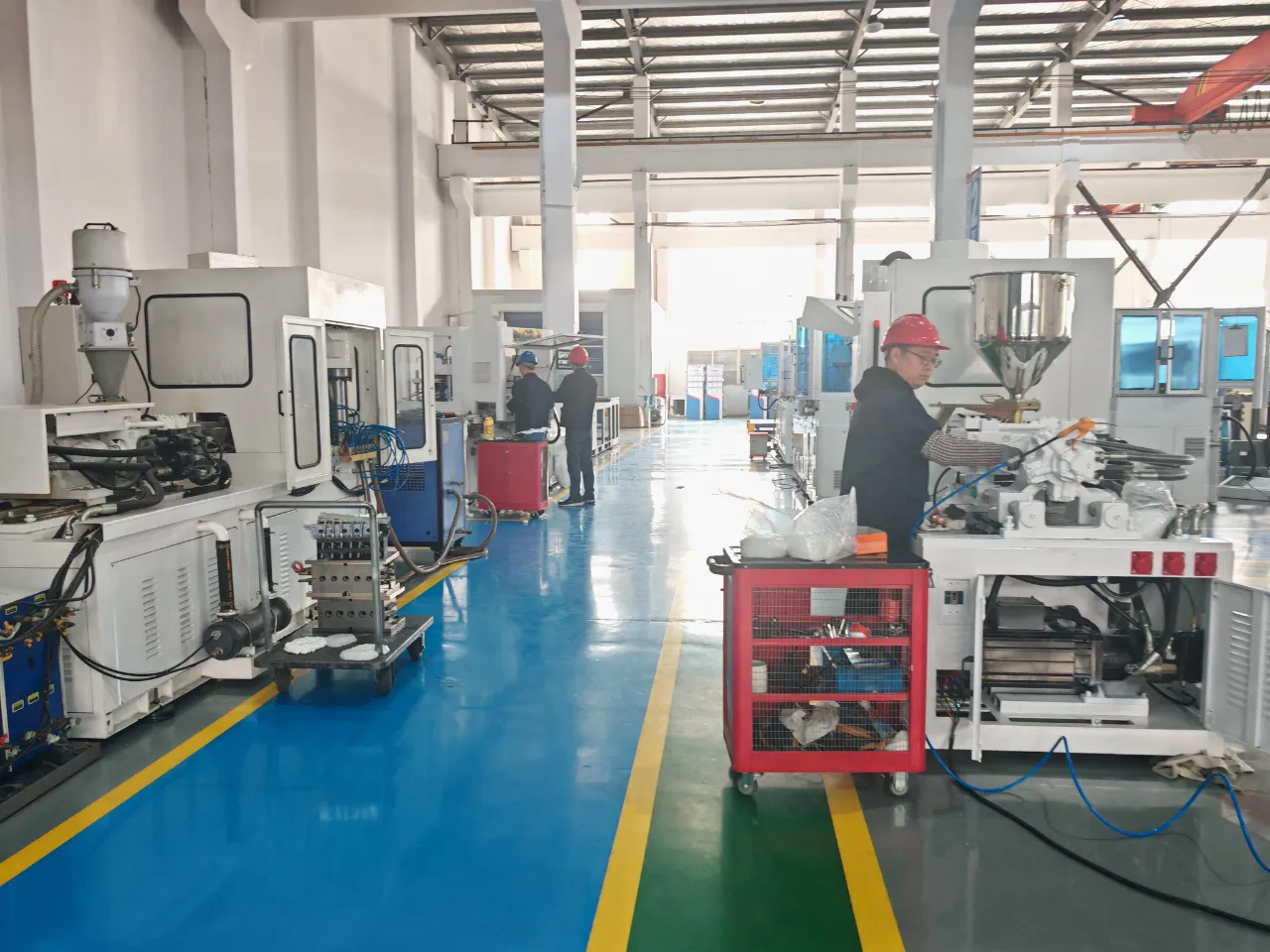
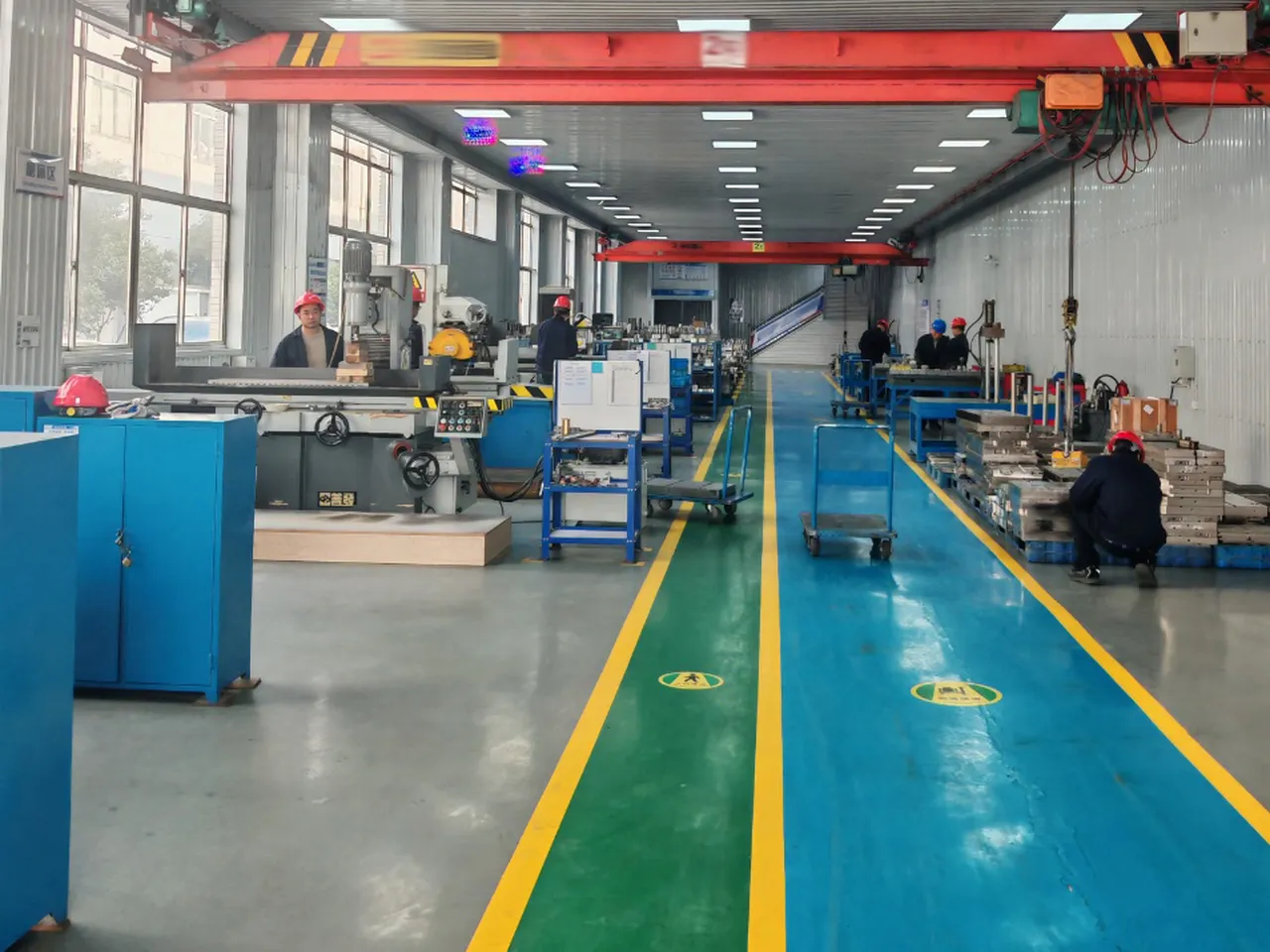
The company's product applications cover pharmaceutical packaging, food packaging, healthcare packaging, cosmetic packaging, and all major categories of rigid plastic container production. Machine platforms process HDPE, LDPE, PET, PETG, PP, PS, PPSU, PC, Tritan, ABS, PLA, EVA, PCTG, and environmental corn-based materials in bottle volumes from 1 ml to 1,000 ml and beyond. Ever-Power adheres to the enterprise development tenet of self-reliance, integrity, pragmatism, innovation, and responsibility, building a one-stop turnkey project framework for customers who require complete packaging system solutions from machine supply through mold tooling, commissioning, and operator training. The company's goal is to deliver the best price-to-performance ratio of any single-stage injection stretch blow molding machine available to international buyers, backed by a service level that earns long-term customer relationships and repeat orders across every region it serves.
 |
 |
 |
 |
Często zadawane pytania
Q1: What is the difference between a one-step injection stretch blow molding machine and a two-step machine?
A: A one-step ISBM machine like the Y150-V4-B completes preform injection, temperature conditioning, stretch blow molding, and bottle take-out inside a single machine in a continuous cycle. No preform is transported, stored, or reheated between stations. A two-step system uses a separate injection molding machine to produce cold preforms, which are then stored and reheated in a standalone stretch blow molding machine. The one-step process eliminates the reheating energy cost, reduces contamination risk, and generally delivers better transparency and dimensional consistency, but requires a higher initial machine investment per production line.
Q2: Is the Y150-V4-B compatible with existing AOKI SBIII-100L-20 molds?
A: Yes. The Y150-V4-B is specifically engineered as a direct replacement for AOKI injection stretch blow molding machines and accepts AOKI SBIII-100L-20 molds without modification. This means buyers who already own AOKI mold sets can transition to the Y150-V4-B without incurring additional tooling costs, which significantly reduces the total investment required for the machine upgrade. Please confirm your specific mold dimensions with the Ever-Power engineering team before finalizing the order to ensure full dimensional compatibility.
Q3: What materials can the Y150-V4-B process?
A: The standard Y150-V4-B processes PET (polyethylene terephthalate) and PETG (glycol-modified PET). PET is the most widely used material for pharmaceutical, food, beverage, and cosmetic bottles globally. PETG offers enhanced clarity, toughness, and chemical resistance for specialized applications. If your production requirement involves PP, PC, PPSU, Tritan, or other engineering thermoplastics, discuss material compatibility with the Ever-Power technical team, as the machine may require screw geometry or heating profile adjustments to accommodate alternative resins.
Q4: How does the Y150-V4-B achieve GMP compliance for pharmaceutical bottle production?
A: GMP compliance in pharmaceutical packaging requires that the production process eliminates human contact with the product-contacting surfaces of bottles between injection and final packaging. The Y150-V4-B achieves this through its fully enclosed, automated one-step process in which preforms transfer between stations mechanically via the rotary turntable with zero manual handling. For facilities requiring oil-free environments, the optional fully servo YS150-V4-EV configuration removes the hydraulic system entirely, eliminating any risk of hydraulic oil contamination. The machine's integrated temperature control and PLC parameter logging also support the batch record documentation requirements typical of pharmaceutical GMP audits.
Q5: How many bottles can the Y150-V4-B produce compared to the Japanese AOKI SBIII-100L-20?
A: The AOKI SBIII-100L-20 produces four plastic bottles per cycle. The Y150-V4-B's enlarged screw solution volume and optimized clamping system support up to six bottles per cycle, representing a 50% output increase from the same machine footprint and operator allocation. For high-volume pharmaceutical, cosmetic, or beverage applications, this throughput advantage translates directly into lower cost per bottle and the ability to meet larger order volumes from a smaller number of machines, improving factory space utilization and reducing overall capital investment per unit of output.
Q6: What bottle sizes can be produced on the Y150-V4-B?
A: The machine accommodates bottles from 20 ml up to 2,500 ml maximum volume, with bottle diameters from 26 mm to 118 mm and heights up to 210 mm depending on cavity configuration. Neck diameters range from 15 mm to 83 mm, covering the full spectrum of standard pharmaceutical, cosmetic, and food-grade closure fitments from mini eye-drop size to large-format wide-mouth containers. Special-shaped bottles and bottles with non-circular cross-sections are also within the machine's capability subject to mold design confirmation by the Ever-Power engineering team.
Q7: What is the energy consumption of the Y150-V4-B?
A: The Y150-V4-B has a rated total power of 53.2 KW, comprising 43.2 KW motor power from three servo pump systems and 10 KW heating power from the nano far-infrared energy-saving heating ring. In practice, the servo pump systems only draw full rated power under peak load; average energy consumption during normal production cycles is significantly lower than rated. This machine consumes 15-25% less energy than equivalent Japanese, European, and American injection stretch blow molding machines, primarily because the one-step process eliminates the secondary preform reheating energy required by two-step systems.
Q8: What are the key imported components in the Y150-V4-B?
A: The Y150-V4-B uses American Parker high-pressure valves, Airtak air cylinders, Japan Yaskawa servo motors or WEICHI servo motors with Taiwan TSUNTIEN reducers for the turntable drive, NSK Japan lead screws, YUKEN hydraulic control valves from Taiwan, Italy-sourced hydraulic tubing, and an Inovance or MiRLE PLC control system. The screw is heated by a nano far-infrared energy-saving heating ring. This specification of internationally recognized component brands ensures reliable long-term machine operation and means that most key components are globally sourced and serviceable in any major market.
Q9: Can the Y150-V4-B be configured as a fully electric injection stretch blow molding machine?
A: The standard Y150-V4-B uses a servo pump hydraulic system. For customers requiring a full electric injection stretch blow molding machine with no hydraulic components, the YS150-V4-EV variant is available. The fully electric version uses ten sets of servo motor control systems with a total motor power of 102.8 KW, eliminates the hydraulic circuit entirely, and is specifically suited to pharmaceutical facilities under GMP audit where oil-free production is a mandatory regulatory requirement. The fully electric variant occupies a larger footprint of 5,200 x 1,800 x 3,300 mm and weighs 7 tonnes.
Q10: How long does installation and commissioning take?
A: Typical on-site commissioning for the Y150-V4-B takes three to five working days depending on local infrastructure readiness, mold availability, and operator experience. Ever-Power provides experienced commissioning engineers who conduct machine installation, initial parameter setup, mold tryout, and operator training during the commissioning visit. Remote support via video call is available for parameter fine-tuning and troubleshooting after the commissioning engineer departs. Customers should ensure that utilities (power supply at 370-400 V, compressed air, cooling water at the specified pressures) are installed and ready before the commissioning engineer arrives to avoid delays.
Opinie klientów
Rajesh Mehta, Opakowania Farmaceutyczne, Indie
"We switched from a Japanese AOKI SBIII-100L-20 to the Y150-V4-B about eight months ago at our pharma packaging plant in Mumbai. Honestly the transition was smoother than I expected because the molds we already had fit straight onto the new machine. We are running 30 ml oral suspension bottles with six cavities now, and the neck dimension consistency is noticeably better than what we were getting before. The parting line issue that always bothered our QC team is completely gone. Energy bills are also down which makes our operations manager very happy. The commissioning engineer from Ever-Power stayed on site for four days which was more than enough to get our team fully trained."
Chen Wei, Cosmetics Packaging, China
"I manage production at a mid-size cosmetics manufacturer in Guangzhou and we have been running the Y150-V4-B for about a year now producing 100 ml serum bottles. The surface quality is really at another level compared to what I have seen from other Chinese-made blow molding machines in this price range. No parting line marks at all, the clarity is excellent, and the cycle time is very stable. We had one issue in month three where a temperature sensor gave a fault alarm and the Ever-Power technical team resolved it remotely within two hours by walking our maintenance guy through the diagnostic process over video call. That kind of response time matters a lot when you are running on tight production schedules."
Piotr Kowalski, Food Packaging, Poland
"We are a contract packaging company in Warsaw specializing in food and pharmaceutical bottles and we ordered a Y150-V4-B as a direct replacement for an aging Japanese machine we had been running for eleven years. From inquiry to delivery took about 14 weeks which was acceptable for us. The machine arrived in good condition and was as described in the specification. What surprised me most was the build quality of the imported components inside. Parker valves, Yaskawa motor, NSK lead screw, you can see the machine is built with proper parts not cheap substitutes. We have been producing 250 ml food-grade PET bottles for six months with no major downtime. Very satisfied with this ISBM machine supplier."
Kim Soo-Jin, Pharmaceutical Packaging, South Korea
"I was initially worried about buying a machine of this type from a manufacturer I had not dealt with before, but the pre-sale technical support from Ever-Power was genuinely impressive. They answered every question I had about the servo control system, the mold compatibility, and the GMP compliance status in detail with actual documentation. We are based in Seoul and manufacture eye drop bottles at a licensed pharmaceutical facility. The Y150-V4-B has been running for ten months and our in-process rejection rate on bottle dimension checks is under 0.4%, which is excellent for our quality system requirements. The machine met all the cleanliness standards our facility audit required."
Carlos Ferreira, Hand Wash Packaging, Brazil
"We produce hand sanitizer and hand wash bottles at our plant in Sao Paulo and went through a detailed evaluation of three different injection stretch blow molding machine manufacturers before choosing the Y150-V4-B. The deciding factors were the mold compatibility with our existing tooling, the six-cavity output versus the four on competitive machines, and the pricing which was significantly better than European alternatives. The machine has been in production for seven months and is producing 500 ml PET bottles consistently. Logistics from China to Brazil took about five weeks by sea which was within the timeline quoted. The only minor issue was a slight language barrier during the initial training but the technical manuals in English are detailed and our team figured things out quickly."
Sophie Laurent, Cosmetics Packaging, France
"Running the Y150-V4-B for a high-end cosmetics brand in Paris has been a great decision for us. We produce bespoke 50 ml and 75 ml special-shaped perfume accessory bottles with very strict appearance requirements and the machine handles these shapes without any issue. The surface finish is flawless and we have had zero complaints from the brand owner about visual quality in six months of supply. What I also appreciate is that the energy consumption is genuinely lower than our previous machine. We measured a 19% reduction in electricity cost per 1000 bottles produced compared to our old two-step process. That adds up over a full year of production. Overall this is a very reliable and well-built PET injection stretch blow molding machine."
James Ochieng, Agrichemical Packaging, Kenya
"We are a pesticide and agrichemical bottling company in Nairobi and recently installed the Y150-V4-B to replace an older Japanese machine. The primary reason for choosing Ever-Power was cost. The price for an equivalent performance level from a Japanese OEM was more than twice as much. After nine months of operation I can say the machine has delivered what was promised. The bottles we produce are 1 litre and 500 ml PETG chemical containers and the quality has been consistent. Spare parts availability has been good so far, we ordered two replacement seals at month six and they arrived within three weeks from China which is acceptable. The after-sales support team responds to WhatsApp queries quickly which suits how we communicate."
Apinya Thongchai, Food Packaging, Thailand
"My company in Bangkok produces food bottles and sauce containers for local and export markets. We bought the Y150-V4-B about a year ago and it has been running almost continuously since commissioning. The machine is very stable once you have dialed in the parameters for each bottle program and saving those recipes in the PLC makes changeovers between different bottle types much faster than I expected. I also want to mention that the pre-sale team at Ever-Power helped us redesign one of our bottle neck dimensions slightly to improve compatibility with our capping line, without any additional charge. That kind of collaborative approach to technical support is not something you always get from machine manufacturers. We will definitely order another unit next year."
Diego Ramirez, Beverage Bottling, Mexico
"We have been using the Y150-V4-B at our beverage bottling facility in Mexico City for about eleven months now, producing 330 ml and 500 ml PET water bottles. Throughput is excellent. The six-cavity configuration gives us the volume we need to keep pace with our filling line. We also appreciate that the machine footprint is small enough to fit within our existing clean room layout without any civil work modification. One thing that initially concerned us was ongoing support given the supplier is based in China, but in practice the remote support via video call has been very effective for the two minor calibration questions we had in the first few months. The machine itself is solid, well assembled, and clearly made with quality components throughout."
Informacje dodatkowe
| Edytowane przez | Yjx |
|---|
Powiązane produkty
-
YS150-V4-EV Wtryskarka z rozdmuchem i rozciąganiem zamiennik japońskiej maszyny ASB-12M
-
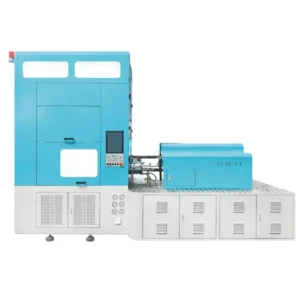
Y150-V4 Jednoetapowa maszyna do formowania wtryskowego z rozciąganiem i rozdmuchiwaniem (4 stanowiska)
-
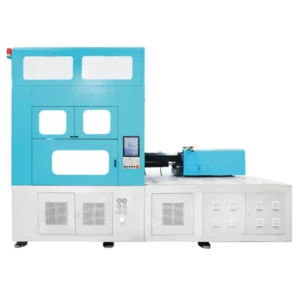
Wtryskarka z rozdmuchem i rozciąganiem Y650-V4 zastępuje japońską maszynę ASB-650
-
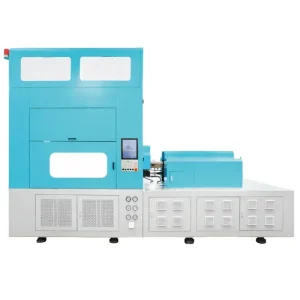
Wtryskarka z rozdmuchem i rozciąganiem Y200-V3 zastępuje japońską maszynę AOKI SBIII-250LL-50S