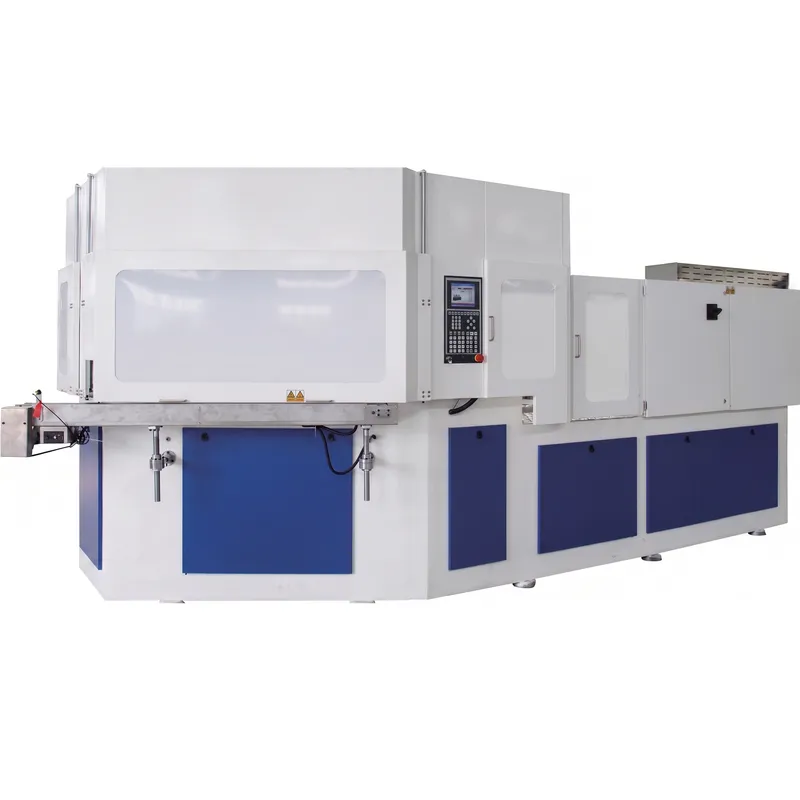
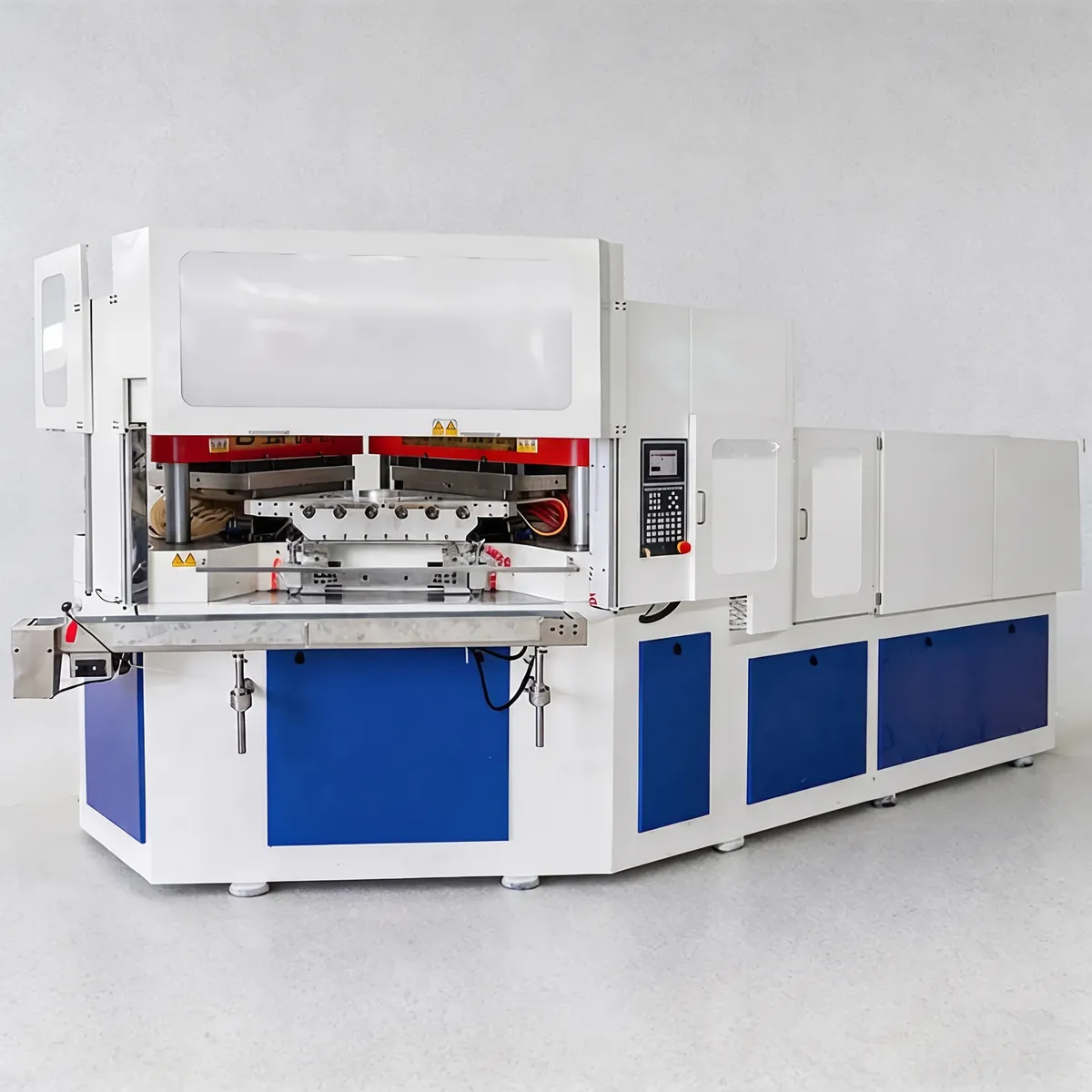
Máquina de Moldagem por Injeção e Sopro ZQ110 (Europeia)
A ZQ110 é uma máquina de moldagem por injeção e sopro de alta qualidade, projetada de acordo com as normas estruturais europeias, oferecendo uma força de fechamento de 1.100 kN (20%-30%), superior à de máquinas similares da mesma categoria. Concebida como uma verdadeira máquina de moldagem por injeção e sopro em uma única etapa, ela integra a injeção da pré-forma, a moldagem por sopro e a remoção do molde em um ciclo contínuo, com um tempo de secagem de 4 segundos, tornando-a uma das máquinas de moldagem por injeção e sopro de plástico mais produtivas disponíveis para produção de médio a grande volume.
The ZQ110 is a premium injection blow molding machine engineered to the full European structural standard, delivering a clamping force of 1,100 KN , 20%-30% greater than comparable machines in the same class. Designed as a true one step injection blow molding machine, it integrates preform injection, blow molding, and stripping into a single seamless cycle with a 4-second dry cycle time, making it one of the most productive plastic injection blow molding machines available for mid-to-large volume production. The standard servo rotation system ensures smooth, repeatable operation, and the precision 65 mm screw with 22:1 L/D ratio provides an injection weight of 540 g , ideal for processing a wide range of thermoplastic resins including HDPE, LDPE, PP, PS, PVC, ABS, and PCTG.
As a leading injection blow molding machine manufacturer, Ever-Power engineered the ZQ110 with a unique pressurized clamping structure in which the booster cylinder does not participate in mold opening or closing, achieving 20%-30% lower energy consumption versus industry peers , a genuine advantage for pharmaceutical packaging lines, cosmetics factories, food-grade bottle production, and chemical container manufacturing. Whether you are seeking a reliable IBM injection blow molding machine for high-cavitation pharmaceutical vials, a customized injection blow molding machine for sale in beverage or personal care, or a direct replacement of Aoki injection blow molding machine capacity, the ZQ110 delivers proven performance, long mold life, and zero-scrap production in every cycle.
Cavitação em moldes (para referência)
| ApproxVolume | 10ml | 30ml | 60ml | 100ml | 250ml | 500ml | 1000ml |
| Cavitação máxima | 20 | 18 | 14 | 12 | 8 | 5-6 | 3-4 |
Especificações técnicas
| Item | Unidade | ZQ110 |
| Injection System | ||
| Diâmetro do parafuso | mm | 65 |
| Parafuso L/D | % | 22:1 |
| Injection weight | g | 540 |
| Potência de aquecimento | KW | 20 |
| Número de zonas de barril | 5+N | |
| acidente vascular cerebral por injeção | mm | 200 |
| Sistema de fixação | ||
| Força de fechamento da injeção | KN | 1100 |
| Golpe inicial para injeção | mm | 140 |
| Clamping force of blowing | KN | 150 |
| Golpe inicial para soprar | mm | 140 |
| Lifing height of rotary table | mm | 70 |
| Mofo | ||
| Tamanho máximo do prato (C x L) | mm | 1100x460 |
| Espessura do molde | mm | 280 |
| Diâmetro da garrafa | mm | 120 |
| Bottle height | mm | 220 |
| Altura adequada da garrafa | mm | 1-2000 |
| Golpe de despojamento | mm | 260 |
| Sistema hidráulico | ||
| Pressão hidráulica | Mapa | 14 |
| Potência do motor | KW | 22+22 |
| Ciclo de secagem | S | 4 |
| Potência Total | KW | 80 |
| Potência operacional | % | 52-70 |
| Outros | ||
| Min.Air pressure of compressed air | MPa | 0.7-1.2 |
| capacidade de ar comprimido | M³/min | 0.7 |
| Fluxo de água | M³/h | 4 |
| Pressão da água de refrigeração | MPa | 0.3-0.4 |
| Dimension(Lx W x H ) | M | 5x1.8x2.2 |
| Peso líquido | Tonelada | 15 |
Marca e modelo substituíveis
| Ever-Power | Força de aperto | Jomar | SUMA | Uniloy | Bloma |
| ZQ40 | 40T | IBM40 | 40iB | UIB70 | IBM45 |
| ZQ60 | 60T | IBM65 | 65iB | UIB90 | IBM50 |
| ZQ80 | 80T | IBM85S | 85iB | UIB120 | IBM85 |
| ZQ110 | 110T | IBM135 | 135iB | UIB150 | IBM135 |
| ZQ135 | 135T | IBM175 | 175iB | UIB180 |
Diâmetro do parafuso da máquina IBM
| Ever-Power | Diâmetro do parafuso | Jomar | SUMA | Bloma |
| ZQ40 | 40/45 | 35/40 | 40 | 45 |
| ZQ60 | 45/50 | 45 | 40/50 | 50 |
| ZQ80 | 55 | 55 | 50/60 | 50 |
| ZQ110 | 65 | 65 | 65/76 | 70 |
| ZQ135 | 70 | 70 | 65/76 |
Peso de injeção da máquina IBM
| Ever-Power | Peso da Injeção | Jomar | SUMA | Bloma |
| ZQ40 | 190/260 | 180 | 169 | 180 |
| ZQ60 | 260/383 | 205 | 169/264 | 240 |
| ZQ80 | 466 | 300 | 333/480 | 310/280 |
| ZQ110 | 540 | 450/550 | 580/770 | 560 |
| ZQ135 | 650 | 450/550 | 580/770 |
Força de fechamento da injeção da máquina IBM
| Ever-Power | Força de fechamento da injeção | Jomar | SUMA | Bloma |
| ZQ40 | 400 kN | 340 kN | 386 kN | 350 kN |
| ZQ60 | 600 kN | 460 kN | 580 kN | 500 kN |
| ZQ80 | 800 kN | 680 kN | 720 kN | 700 kN |
| ZQ110 | 1100 kN | 1210 kN | 1200 kN | 1250 kN |
| ZQ135 | 1350 kN | 1560 kN | 1600 kN |
Tamanho do molde da máquina IBM
| Ever-Power | Tamanho do molde | Jomar | SUMA | Bloma |
| ZQ40 | 480 × 340 | 394 × 508 | 470 × 350 | 450 × 390 |
| ZQ60 | 600 × 390 | 432 × 660 | 620 × 400 | 620 × 430 |
| ZQ80 | 800 × 400 | 464 × 749 | 700 × 400 | 620 × 430 |
| ZQ110 | 1100 × 460 | 559 × 1118 | 1000 × 500 | 900 × 480 |
| ZQ135 | 1300 × 500 | 635 × 1372 | 1200 × 600 |
Tamanho da máquina IBM
| Ever-Power | Tamanho do molde (M) | Jomar | SUMA | Bloma |
| ZQ40 | 3,8 × 1,3 × 1,7 | 2,72 × 1,9 × 2,75 | 3,8 × 1,5 × 2,3 | 4,05 × 1,52 × 2,55 |
| ZQ60 | 3,8 × 1,4 × 1,8 | 2,92 × 1,98 × 3,41 | 4 × 1,7 × 2,3 | 620 × 430 × 2,55 |
| ZQ80 | 4,5 × 1,6 × 2 | 3,33 × 1,94 × 3,41 | 4,5 × 2 × 2,6 | 620 × 430 × 2,55 |
| ZQ110 | 5 × 1,8 × 2,2 | 3,79 × 2,4 × 3,41 | 5 × 2,4 × 2,7 | 900 × 480 × 2,55 |
| ZQ135 | 5,5 × 2 × 2,4 | 4,22 × 2,67 × 3,58 | 6 × 2,6 × 2,7 |
Nota: As marcas são mencionadas apenas para ajudar os clientes a escolher os produtos, não para vender os produtos dessas marcas.
ZQ110 Injection Blow Molding Machine Features
1. Estrutura totalmente em estilo europeu
The ZQ110 adopts a complete European-standard machine architecture, delivering a clamping force of 1,100 KN that surpasses comparable injection blow molding machines in the same tonnage category by 20%-30%. This structural advantage provides exceptional dimensional stability across all supported materials, reduces vibration-induced defects during high-speed cycling, and extends the operational lifespan of both the machine frame and the molds. For factories running long-shift production, this structural robustness translates directly into fewer unplanned stoppages and lower total cost of ownership.
2. High-Precision Angle Divider
The standard high-precision angle divider enables perfect synchronization between mold opening/closing actions and turret lifting, eliminating the micro-timing errors that cause flash, misalignment, or thread defects in the finished bottle neck. This synchronized control is especially critical for pharmaceutical packaging factories where thread precision and seal integrity are non-negotiable. Operators of all skill levels can manage the system effectively, as the servo rotation parameters are clearly defined and easily repeatable without manual recalibration between production runs.
3. Estrutura de Fixação Pressurizada Exclusiva
The ZQ110 features a patented pressurized clamping design in which the booster cylinder does not participate in the mold opening and closing action, with a hydraulic dual system as standard. This decoupled approach reduces energy consumption by 20%-30% versus industry peers, lowering the electricity cost per 10,000 bottles significantly. For any factory evaluating injection blow molding machine price on a total-cost basis, this energy saving translates to a measurable return within the first year of operation, making the ZQ110 a smart long-term investment.
4. High-Capacity Multi-Cavity Performance
With up to 20 cavities for 10 ml bottles and 12 cavities for 100 ml containers, the ZQ110 supports serious volume throughput without compromising wall thickness uniformity. The 4-second dry cycle is among the fastest in its class for an IBM injection blow molding machine at this clamping force level. Combined with zero-scrap production , a core advantage of injection blow molding over extrusion blowing , the output efficiency and material yield of this machine make it the preferred choice for cosmetics and pharmaceutical packaging factories focused on per-unit cost reduction.
5. Versatile Material Compatibility
The ZQ110's precision screw geometry (65 mm diameter, 22:1 L/D, 5+N heating zones) accommodates a broad range of resin types including HDPE, LDPE, PP, PS, PVC, ABS, PCTG, EVA, and environmental corn-based bioplastics. This material flexibility allows one machine to serve multiple production lines across pharmaceutical, cosmetics, food, and chemical packaging without hardware changeover. Whether you need a dedicated PET injection blow molding machine or a multi-resin production platform, the ZQ110 delivers consistent melt quality and stable processing across all supported grades.
6. Compact Footprint, Operator-Friendly Design
At 5 x 1.8 x 2.2 m and 15 tons net weight, the ZQ110 is a compact, self-contained system that requires no external preform oven, no separate stretch rod assembly, and minimal auxiliary equipment compared to equivalent-output extrusion blow lines. The integrated servo rotation system simplifies parameter setting, making training time for new operators short. This is particularly valued by injection blow molding machine suppliers and end users operating in markets like India, Turkey, Korea, and South Africa where technician availability may be limited.
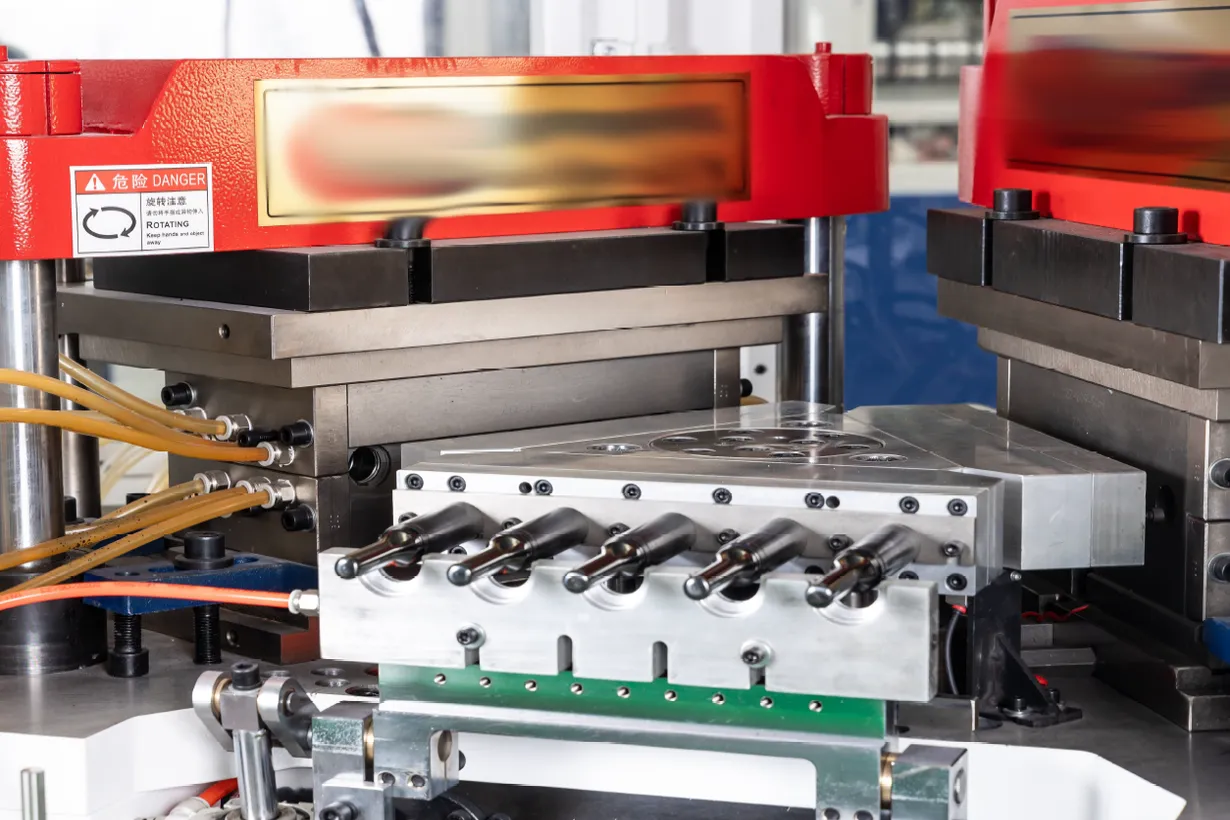
IBM Machine Components
| 1 | Dispositivo para preparação/injeção de estoque | 2 | Corredor Quente |
| 3 | Haste central | 4 | Pré-forma de garrafa |
| 5 | Molde de Injeção | 6 | Posto de Injeção |
| 7 | Estação de Sopro | 8 | Moldagem por sopro |
| 9 | Estação de strip-tease |
1. Dispositivo de Preparação/Injeção de Solução Estoque
The stock preparation and injection device is the starting point of the production cycle. It includes the hopper, the 65 mm precision screw, barrel, and all heating zones, which collectively plasticize raw resin pellets and deliver measured shots of molten material into the injection mold. The 5+N heating zone configuration gives operators fine-grained temperature control across the barrel length to optimize melt homogeneity for each resin type.
2. Sistema de canais quentes
The optimized hot runner system channels molten resin from the injection device into each individual cavity with minimal pressure drop and temperature variation. A well-designed hot runner is critical for achieving equal filling balance across all cavities simultaneously, ensuring that gram weight deviation and wall thickness deviation are minimized across the entire mold. The ZQ Series hot runner is engineered specifically for the preform geometry requirements of injection blow molding.
3. Haste central (mandril)
The mandrel is the central mechanical carrier of the ZQ110 process, serving simultaneously as the inner mold surface for preform formation, the transport mechanism between stations, and the air channel for bottle blowing. Its special internal structure enables rapid thermal cycling: it retains enough heat during injection to keep the preform formable, then delivers cooling air efficiently during blow molding. Short molding cycle times of 4 seconds are possible in large part because of the mandrel's superior cooling performance.
4. Pré-forma de garrafa
The bottle preform is the intermediate product formed at Station 1 before blow molding. Unlike ISBM processes, the preform in an IBM machine does not need to cool and be reheated, as it transfers directly to the blow station while still thermally conditioned. The preform design, including wall thickness distribution and neck geometry, is engineered in the injection mold to ensure that blow molding produces the intended final bottle shape with correct shoulder, body, and base geometry.
5. Molde de Injeção
The injection mold on the ZQ110 accommodates platens up to 1,100 x 460 mm with a mold thickness of 280 mm. The cavity and neck inserts are made from imported S136 steel alloy or 4Cr13 stainless steel for long service life, with activity-designed cavity and neck blocks that can be replaced independently when worn. The injection mold forms the bottle neck to 100% dimensional accuracy, including thread pitch and diameter, which determines cap sealing performance.
6. Posto de Injeção
The injection station is the structural assembly that holds the injection mold under 1,100 KN clamping force during the preform formation phase. The ZQ110's pressurized clamping mechanism ensures that the mold parting line remains tightly closed throughout the injection phase, preventing flash formation even at the highest injection pressures required for thick-walled containers or highly viscous resins. The station operates simultaneously with Stations 2 and 3, contributing to the machine's continuous-cycle efficiency.
7. Estação de Sopro
The blow station receives the mandrel carrying the thermally conditioned preform and encloses it within the blow mold under 150 KN blowing clamping force. Compressed air at 0.7-1.2 MPa is then delivered through the mandrel to expand the preform into the full bottle shape. The blow station includes dedicated cooling circuits that solidify the bottle wall rapidly and consistently, enabling the machine to maintain its 4-second cycle time even for containers up to 220 mm in height.
8. Moldagem por sopro
The blow mold defines the final exterior geometry of the bottle, including all surface detail, body curvature, shoulder shape, and bottom profile. ZQ Series blow molds for the ZQ110 are available in aluminum magnesium alloy (for improved cooling efficiency) or S136/4Cr13 stainless steel for maximum service life. The mold is engineered with no parting line at the bottle mouth or bottom, so finished bottles exit without any burr, flash, or waste material requiring secondary trimming operations.
9. Estação de striptease
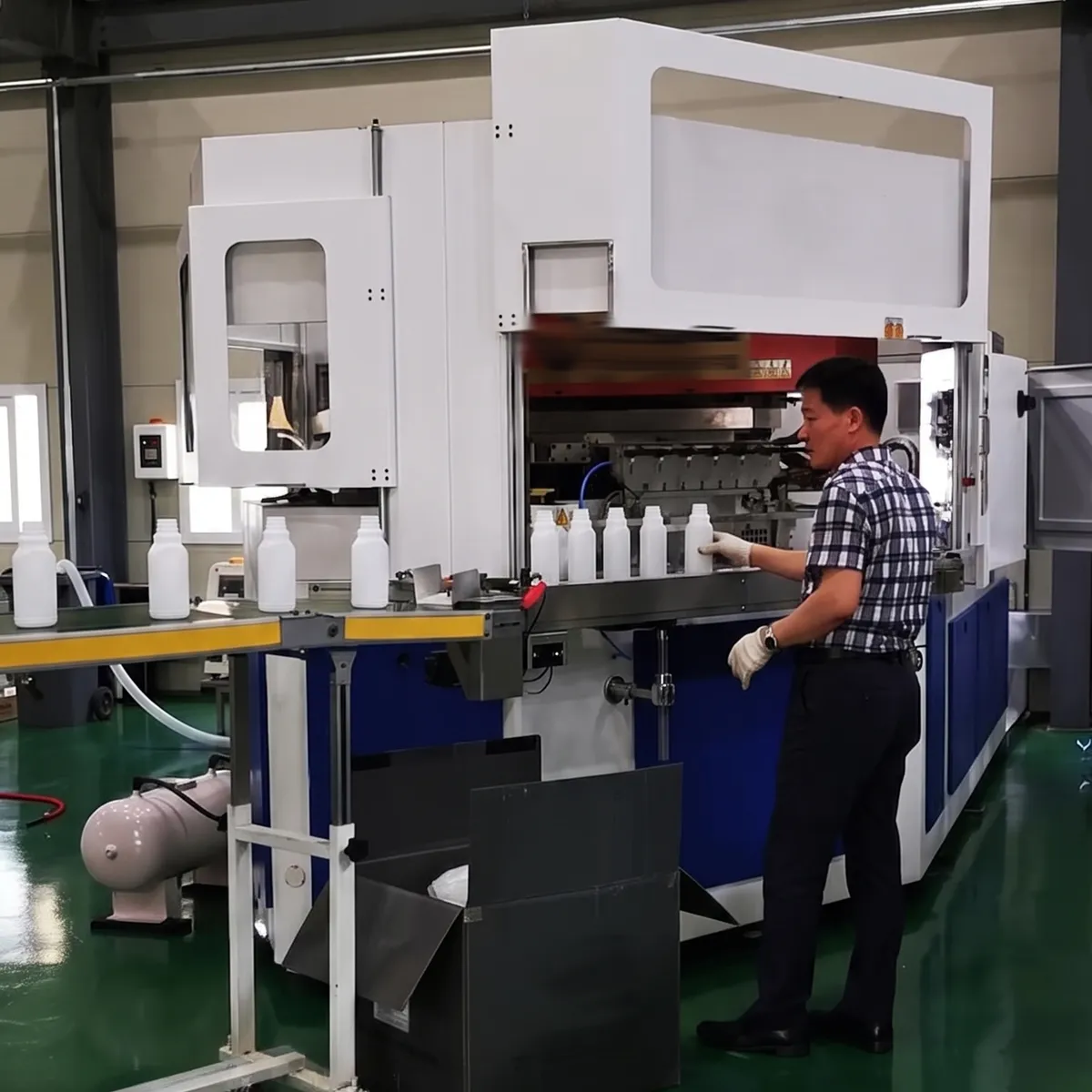
The stripping station is the final stage where finished, fully formed bottles are automatically ejected from the mandrels and transferred to the conveyor belt for downstream filling, labeling, or packaging. The stripping stroke of 260 mm is designed to accommodate bottle heights up to 220 mm without mechanical interference. Because the three stations operate simultaneously, stripping at Station 3 runs in parallel with injection at Station 1 and blowing at Station 2, which is why the ZQ110 achieves zero dead-cycle time between consecutive bottle outputs.
Princípio de funcionamento
Estação 1: Injeção de pré-formas
At Station 1, molten thermoplastic resin is injected under controlled pressure into the injection cavity, simultaneously forming the precise bottle neck geometry, thread profile, and preform body. The injection pressure and temperature are independently controlled through the 5+N barrel zones, ensuring a uniform melt distribution and accurate gram weight. Once the dwell time and cooling phase are complete, the mold opens and the mandrel carries the preform, still hot and dimensionally stable, to the blow molding station. The accuracy of the neck formation at this stage determines the thread precision and cap sealing performance of every finished bottle, which is why the ZQ110 injection system is engineered to exceptionally tight tolerances.
Estação 2: Moldagem por Sopro
At Station 2, the preform arrives on the mandrel and is enclosed within the blow mold cavity. High-pressure air (0.7-1.2 MPa) is introduced through the mandrel's internal channel, inflating the preform outward so that it conforms precisely to the contours of the blow mold. The cavity shape fully determines the final bottle geometry, including diameter, shoulder taper, and body profile. Cooling water circulating in the mold walls solidifies the bottle rapidly and uniformly. Once the cooling phase is complete, the blow mold opens and the mandrel, now bearing a fully formed bottle, rotates to the stripping station. The simultaneous operation of all three stations means this step runs in parallel with injection and stripping, contributing to the machine's high-efficiency 4-second dry cycle.
Estação 3: Desnudamento
At Station 3, the finished bottles are automatically stripped from the cold mandrels and discharged to the conveyor for downstream packaging or filling operations. Because the process produces no flash, no blank opening, and no cut-off waste, the output at this station is 100% usable finished product , a significant material cost advantage over extrusion blow molding, where 20%-40% of raw material becomes scrap. The three-station cycle of injection, blowing, and stripping operates fully in parallel and simultaneously, which is the key structural reason why the one step injection blow molding machine achieves such high output efficiency with minimal labor and energy input per unit produced.
Application Fields
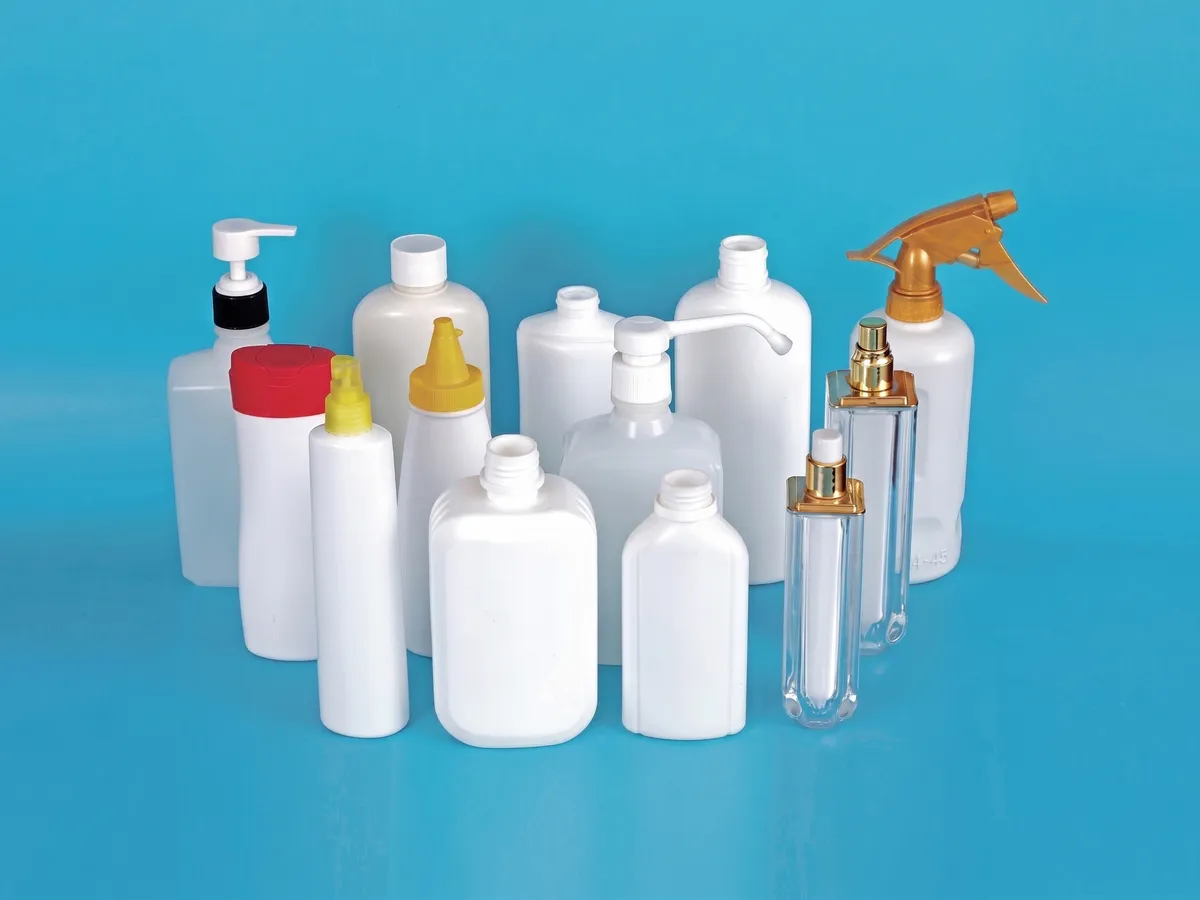
1. Chemical Bottles
The ZQ110 excels at producing HDPE and PP chemical bottles with uniform wall thickness and robust base convexity. These containers withstand exposure to solvents, cleaning agents, and industrial fluids, making this blow injection molding machine ideal for chemical packaging factories requiring zero-pinhole, high-integrity bottle walls.
2. Beverage Bottles
For still water, juice, and flavored drink lines, the ZQ110 produces food-grade PP and PS beverage bottles with consistent gram weight deviation below 1% per batch. High cavitation counts (up to 12 for 100 ml) support significant throughput volumes without secondary trimming or quality sorting operations downstream.
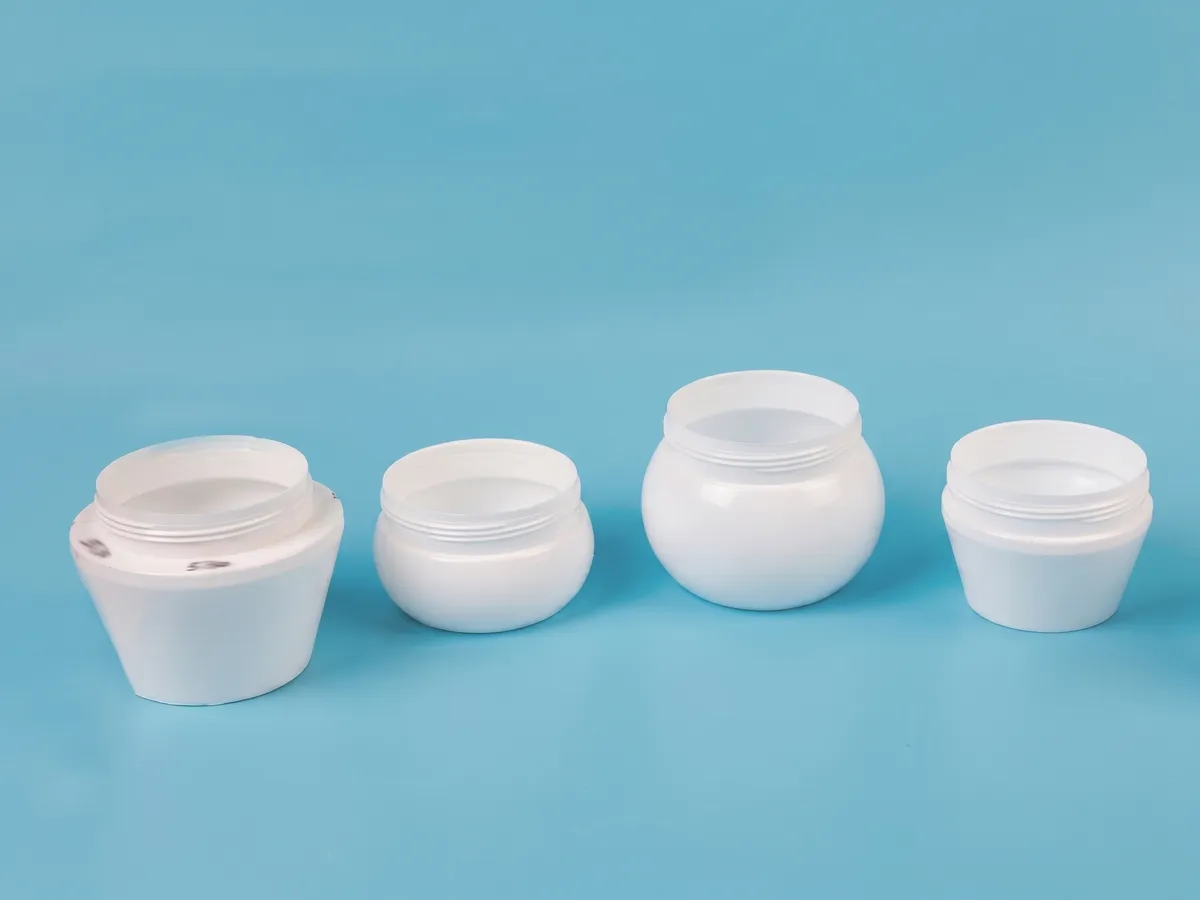
3. Frascos de cosméticos
Cosmetics brands demand near-optical clarity, smooth surface finish, and precise thread sealing. The ZQ110 processes high-transparency PS, ABS, PCTG, and EVA resins to produce premium lotion, serum, and toner bottles with 100% cap-to-thread sealing , no leakage, no burrs, and no waste material at the bottle mouth or base.
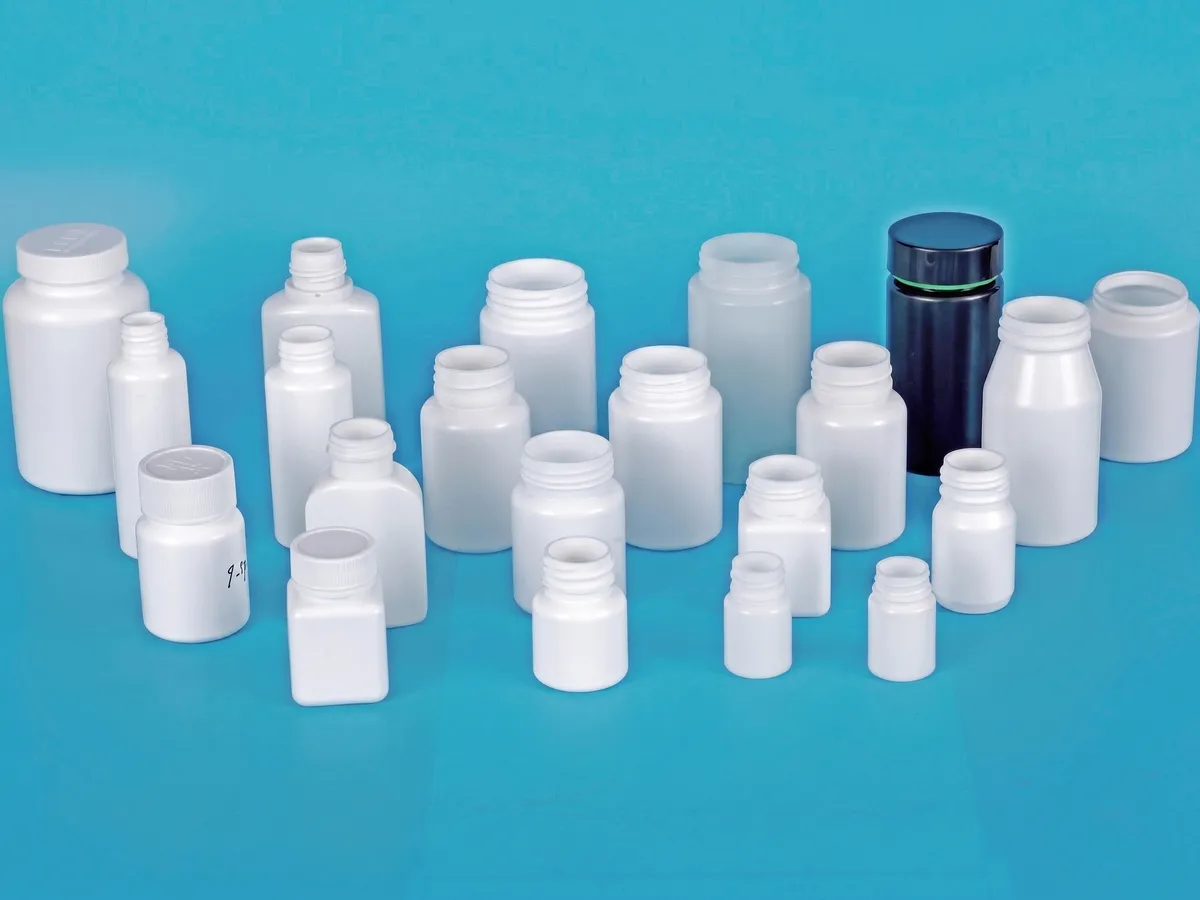
4. Frascos Farmacêuticos
GMP pharmaceutical lines require absolutely consistent bottle weight, uniform wall thickness, and a precisely formed neck that accepts child-resistant closures reliably. The ZQ110 produces compliant HDPE and PP medicine bottles, vitamin containers, and supplement jars with tightly controlled dimensions in every cavity across every production shift.
5. Mamadeiras
Baby feeding bottle production demands BPA-free resin compatibility, high optical clarity, and thread precision for leak-free nipple attachment. The ZQ110 processes food-safe PP and environmental corn-based bioplastics at high cavitation rates, allowing infant care brands to meet volume demands while maintaining the strict quality and safety standards required in this category.
6. Frascos conta-gotas
The led bulb cover máquina de moldagem por injeção e sopro concept shares the same precision optics challenge as eyedropper bottle production: thin walls, precise neck diameter, and optical-grade surface finish. The ZQ110 handles LDPE and HDPE eyedropper bottles from 5 ml to 30 ml with up to 18 cavities per shot, supporting high-volume ophthalmic and cosmetic dropper lines economically.
7. Frascos de sabonete líquido corporal
Body wash and shower gel bottles in the 250 ml to 500 ml range are a primary production target for the ZQ110, which achieves 5-8 cavities at these volumes. Bottles produced exhibit uniform side-wall thickness across the full body height, excellent base convexity for stable stacking, and a flat, burr-free mouth for reliable pump or cap fitment in automated filling lines.
8. Shampoo Bottles
Personal care brands producing shampoo, conditioner, and hair treatment bottles benefit from the ZQ110's ability to maintain consistent shoulder taper geometry across multi-cavity molds. Bottles exit stripping with no bottom weld line, no seam weakness, and weight variation below 1% per cycle, supporting premium brand packaging requirements in competitive retail and professional beauty markets worldwide.
 |
 |
| Frascos farmacêuticos | Frascos de cosméticos |
 |
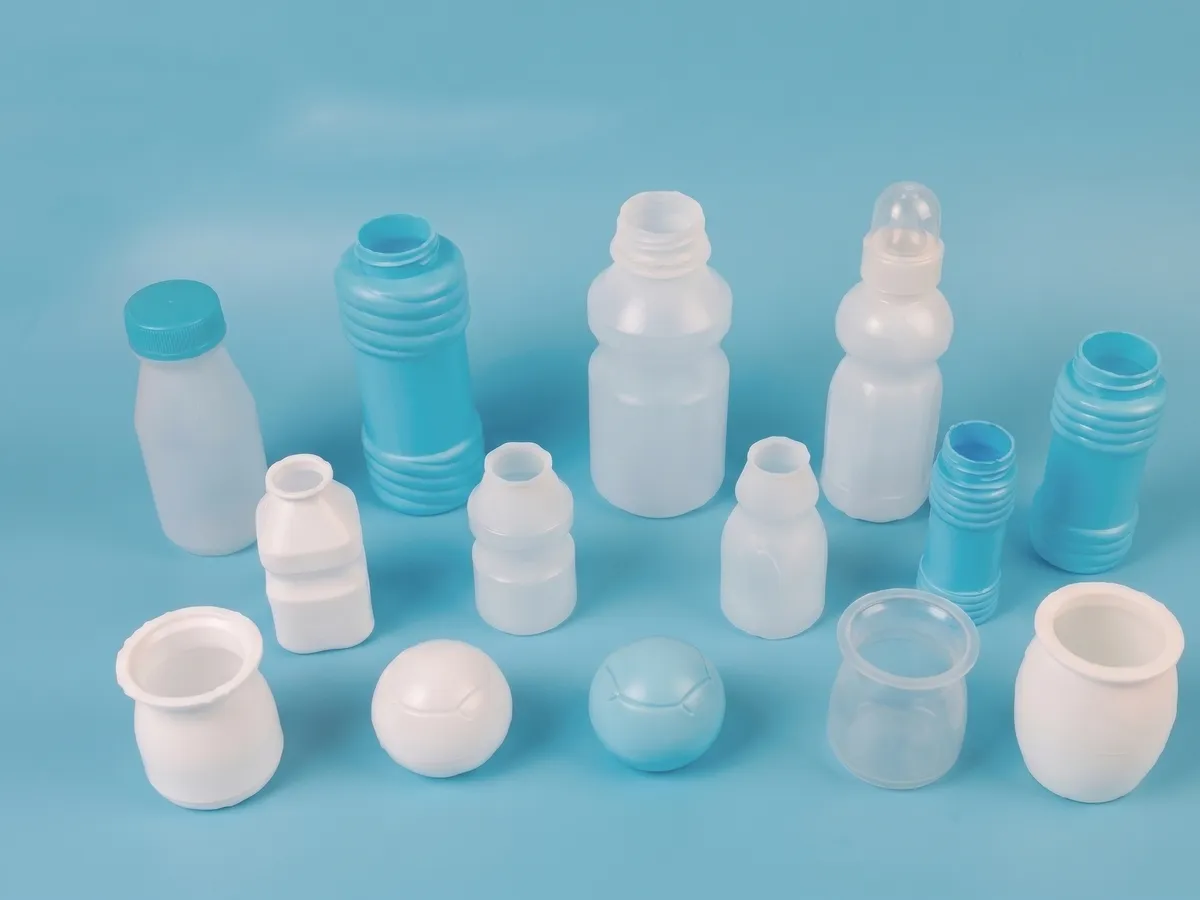 |
| Frascos de produtos químicos diários | Mamadeiras |
Máquina ISBM vs. Máquina IBM
Processo de trabalho
An ISBM machine (injection stretch blow molding machine) adds a mechanical stretching rod step between injection and blowing, which biaxially orients the polymer chains and is essential for producing PET carbonated beverage bottles with high strength. An IBM injection blow molding machine like the ZQ110 uses injection followed directly by blow molding without stretching, making it ideal for producing PP, HDPE, PS, and PVC containers where biaxial orientation is not required but where uniform wall thickness and zero-waste output are priorities.
Molding Principle and Material Performance
The injection stretch blow molding machine principle stretches the preform both axially (via stretch rod) and radially (via air pressure), enhancing the tensile strength, barrier properties, and optical clarity of PET through biaxial orientation. The IBM process , as executed by the ZQ110 , relies on direct inflation without stretching, producing containers with excellent uniform wall thickness, strong convex bases, and consistent gram weight across all cavities, which are the defining quality attributes for pharmaceutical, cosmetic, and personal care packaging.
Product Shape and Complexity
A single stage injection stretch blow molding machine is capable of forming large, complex bottle shapes such as wide-body carbonated beverage containers and mineral water bottles with high aspect ratios. An IBM machine such as the ZQ110 is optimized for smaller, simpler bottle shapes in the 10 ml to 1,000 ml range , the sweet spot for pharmaceutical vials, cosmetic jars, eyedroppers, shampoo bottles, and household chemical containers , where dimensional precision and output volume matter most.
Application Scenarios and Market Fit
Injection stretch blow molding machine manufacturers primarily target carbonated beverage, mineral water, and edible oil production lines where PET is the dominant material and large container sizes are standard. The ZQ110 IBM machine targets pharmaceutical companies, cosmetics brands, personal care manufacturers, food supplement packagers, and specialty chemical bottlers , industries where the combination of high cavity count, zero scrap, 100% sealed bottle necks, and multi-material capability gives it a decisive competitive advantage over both ISBM and extrusion blow alternatives.
Tabela de comparação
| Recurso | Máquina ISBM | IBM Machine (ZQ110) |
|---|---|---|
| Processo de trabalho | Injeção, estiramento, moldagem por sopro | Moldagem por injeção e sopro |
| Princípio de Moldagem | Enhance material via biaxial stretching | Direct blow molding without stretching |
| Desempenho do produto | Alta resistência e excelente clareza. | Uniform wall thickness, zero scrap |
| Formato do produto | Formato de garrafa complexo e grande | Precise small-to-mid size bottles |
| Material de moldagem | Principalmente PET | PE, PP, PVC, PS, ABS, PCTG, EVA |
| Cenários de aplicação | Carbonated beverage, mineral water | Pharmaceuticals, cosmetics, packaging |
|
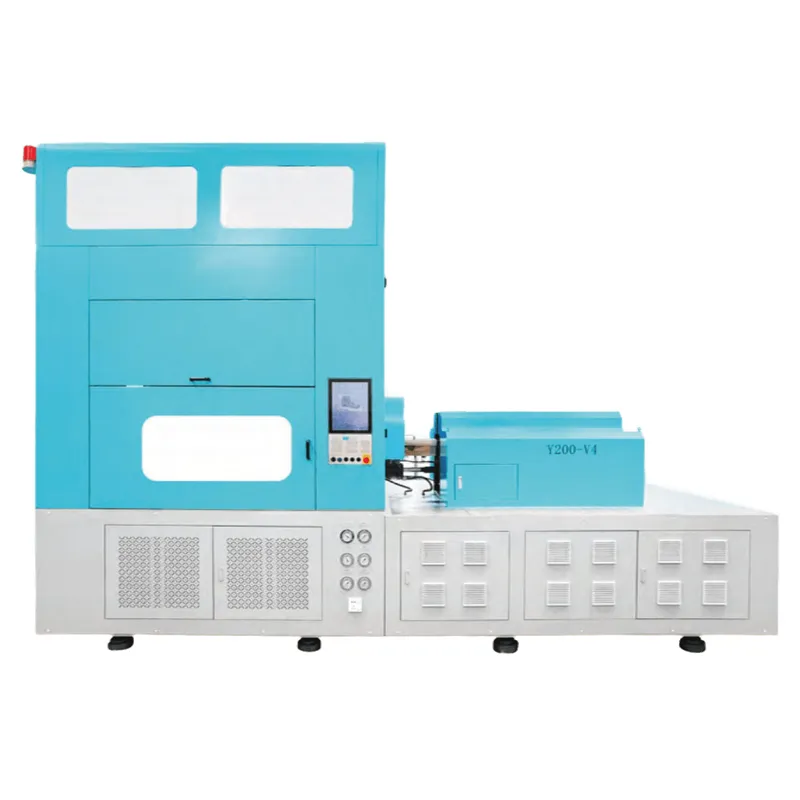 |
| Máquina IBM | Máquina ISBM |
Características do molde automático da série ZQ
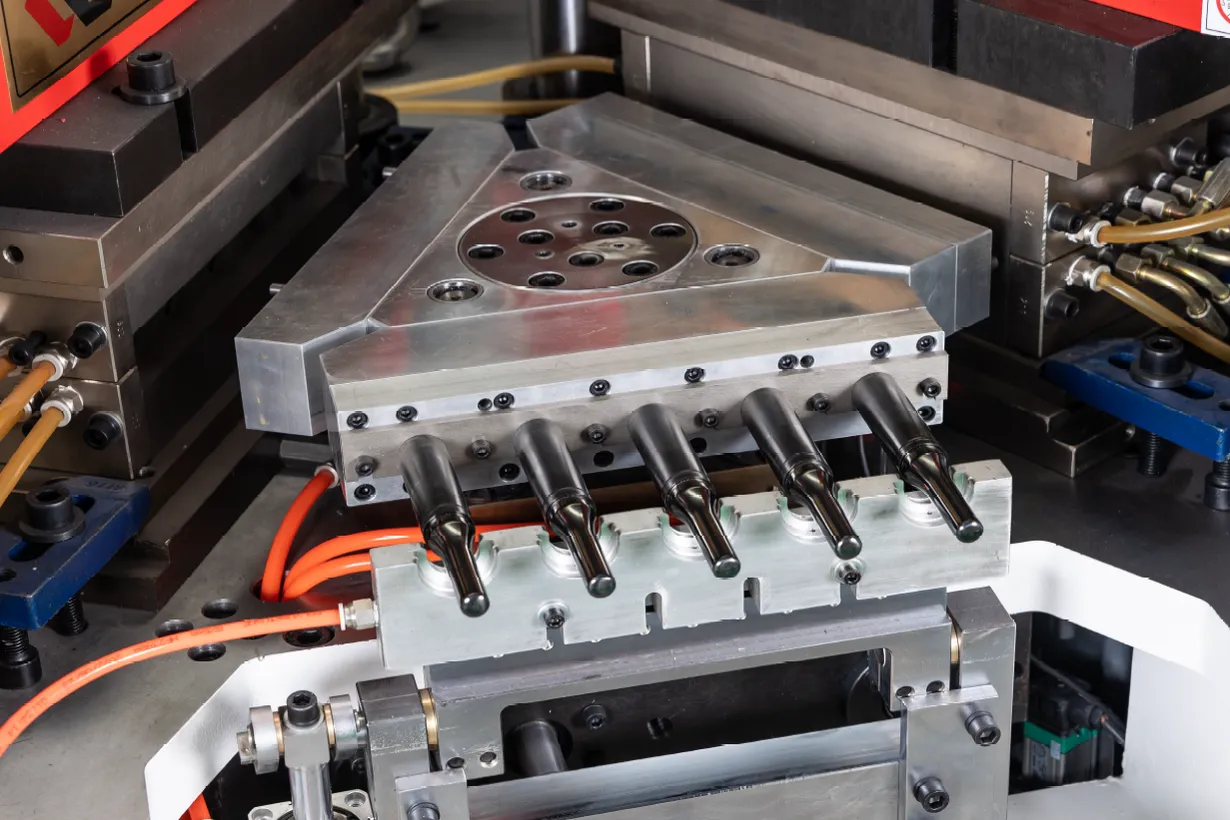
1. Activity-Designed Cavity and Neck Blocks
The injection mold cavity and neck blocks on ZQ Series tooling are independently movable by design, allowing worn or damaged inserts to be replaced without dismounting the entire mold assembly. A specially designed oil and water circuit layout maintains stable, precise temperature distribution throughout the mold, ensuring consistent tube billet (preform) dimensions from the first shot to the millionth. This interchangeability reduces mold maintenance downtime significantly and keeps long-run production costs predictable.
2. Premium Steel Alloy Construction
All injection mold bodies and blow mold components are manufactured from either imported S136 high-grade steel alloy or 4Cr13 stainless steel. These materials combine high surface hardness with excellent corrosion resistance, extending mold service life to several million cycles under normal production conditions. Blow mold bodies can also be fabricated in aluminum magnesium alloy for faster thermal cycling, offering a practical trade-off between cycle time improvement and total lifespan depending on the production schedule and resin type.
3. Optimized Hot Runner and Preform System
The ZQ Series mold features an optimized hot runner system and preform geometry that minimizes gram weight deviation and wall thickness deviation to near-zero tolerances across all cavities simultaneously. The mandrel's special internal cooling channel structure maintains a short molding cycle while delivering effective and uniform core cooling across the full cavity count. This combination ensures that every preform entering the blow station is thermally and dimensionally identical, which is the foundation of consistent finished bottle quality.
4. 100% Sealed Thread and Mouth Accuracy
The neck inserts in ZQ Series molds are machined and inspected to exacting dimensional tolerances so that the bottle thread profile is accurate and the fit between bottle and cap achieves 100% hermetic sealing in every shot across the full production run. This is a non-negotiable requirement in pharmaceutical packaging (where leakage can destroy product sterility) and in liquid personal care packaging (where leakage represents a direct product loss and liability risk during retail distribution).
5. Zero Burrs, Zero Waste at Mouth and Base
Because the ZQ110 injection blow molding process forms the bottle neck at the injection station and the bottle body at the blow station without any trimming operation, both the bottle mouth and the bottle base exit the stripping station with no burrs, no flash, and no waste material whatsoever. There is no equivalent to the extrusion blow molding pinch-off seam at the base or the cut-off trim at the neck , which means zero secondary trimming operations, zero labor for deflashing, and zero raw material waste in every production cycle.
6. Consistent Product Dimensions Across All Cavities
ZQ Series mold engineering ensures that all finished bottles produced from a multi-cavity tool , whether 8, 12, 14, or 20 cavities , are dimensionally identical in size, weight, mold parting line location, and wall thickness. This cavity-to-cavity consistency is essential for automated downstream operations including high-speed filling, capping, labeling, and cartoning machines, which require absolutely uniform bottle geometry to operate reliably at full rated speed without manual intervention or jam clearance.
Matérias-primas compatíveis
One of the most significant commercial advantages of the ZQ110 plastic injection blow molding machine is its broad raw material compatibility, which allows a single machine to serve multiple product categories and packaging specifications. The following resins are fully supported by the ZQ110 injection system, and each offers distinct performance characteristics suited to different end-use applications.
High-Density Polyethylene (HDPE) is the most widely used resin on IBM machines and is the standard choice for pharmaceutical bottles, household chemical containers, and personal care packaging. HDPE offers excellent chemical resistance, FDA-compliant food safety, and high stiffness-to-weight ratio, making it ideal for caps, squeezy bottles, and eyedropper containers produced on the ZQ110. Low-Density Polyethylene (LDPE) provides greater flexibility and squeeze-ability, commonly used for eyedropper bottles and tubes where the user applies manual pressure to dispense product. Its low melt viscosity processes smoothly through the ZQ110's 65 mm screw at standard temperatures.
Polypropylene (PP) is preferred for food packaging, infant feeding bottles, and medical containers because it withstands autoclave sterilization temperatures and is free of BPA and plasticizers. The ZQ110 processes PP reliably across a wide melt flow index range, producing bottles with excellent hinge fatigue resistance and high heat tolerance. Polystyrene (PS), including high-transparency PS and lactic acid bacteria (PS-LA) grades, is used for clear cosmetic containers, yogurt drinks, and specialty food packaging where optical clarity and smooth surface finish are essential marketing requirements. The ZQ110 handles both standard and high-clarity PS grades.
Polyvinyl Chloride (PVC) finds application in pharmaceutical blister packaging and specialty liquid containers where high clarity combined with excellent barrier properties is required. Acrylonitrile Butadiene Styrene (ABS) offers superior impact strength and a premium cosmetic surface finish, used for high-end perfume caps, compact containers, and electronic accessory housings produced via injection blow molding. PCTG (glycol-modified polycyclohexylene terephthalate) combines glass-like clarity with excellent chemical resistance and is increasingly used for premium cosmetic and medical device packaging on injection blow moulding machines like the ZQ110. EVA (ethylene-vinyl acetate) provides rubber-like flexibility and UV stability, used in specialty squeeze containers and tube-bottle hybrids. Finally, Environmental Corn Material (PLA-based bioplastics) from sustainable sources can also be processed on the ZQ110 for brands committed to reducing petrochemical resin usage in their packaging, supporting circular economy packaging initiatives across all end-use sectors.
 |
 |
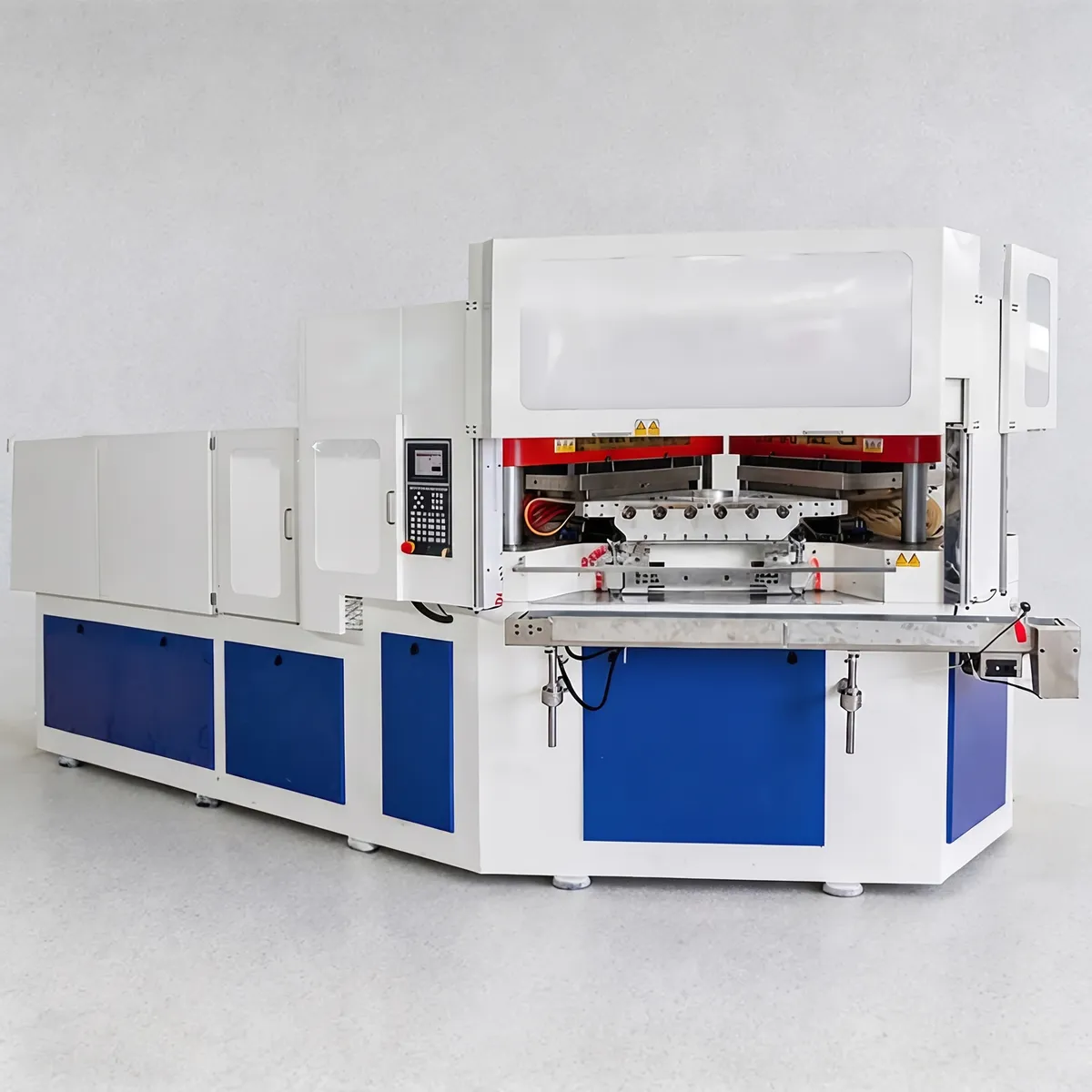
Injection Blow Molding Machine Maintenance
1. Daily Lubrication and Inspection
Before each production shift, operators should inspect and lubricate all moving components including the rotary table bearing, tie rod threads, mandrel guide rails, and mold platen slides using the specified lubricant grades listed in the ZQ110 maintenance manual. Checking that oil levels in the hydraulic reservoir are within the correct operating range, and confirming that the hydraulic dual-system pressure reads correctly on both circuit gauges, takes less than 10 minutes and prevents the majority of unplanned mechanical stoppages that could otherwise occur mid-production.
2. Hydraulic System Maintenance
The hydraulic dual system on the ZQ110 should be serviced at regular intervals: hydraulic oil should be replaced every 2,000-3,000 running hours or annually (whichever comes first), and hydraulic filter elements should be inspected every 500 hours and replaced if contaminated. Maintaining clean hydraulic oil is critical for the performance of the pressurized clamping mechanism, which relies on precise pressure differentials to achieve its 20%-30% energy saving over conventional single-system designs. Any unusual noise, pressure drop, or slow cycle response should be investigated and corrected promptly.
3. Barrel and Screw Maintenance
The 65 mm injection screw and barrel should be purged with a compatible purging compound whenever switching between resin types, and thoroughly cleaned during any extended shutdown period exceeding 48 hours. Regular dimensional inspection of screw flight clearance against the barrel bore identifies wear before it affects injection weight repeatability. Barrel heating zones should be verified for temperature uniformity using a calibrated pyrometer at least quarterly, as heating element degradation can cause localized cold spots that produce unmixed resin and cosmetic defects in finished bottles.
4. Mold Maintenance and Cleaning
Injection and blow molds should be removed from the machine for thorough cleaning and inspection at intervals matching the production volume of the resin being run. Cavity surfaces should be polished to remove resin deposits, and all cooling water channels should be flushed and descaled to maintain thermal transfer efficiency. Neck inserts and cavity blocks showing dimensional wear should be replaced before tolerances drift outside the specification limits that guarantee 100% cap sealing. Properly maintained ZQ Series molds achieve service lives of several million cycles.
5. Cooling Water System Maintenance
The ZQ110 cooling system (water flowage 4 M3/h, pressure 0.3-0.4 MPa) requires monthly inspection of all water hose connections, flow control valves, and the chiller or cooling tower performance to confirm that inlet temperature and flow rate remain within specified limits. Cooling water quality should be treated with corrosion inhibitors appropriate for aluminum and steel cooling channels, and water pH should be monitored to prevent scale buildup that reduces cooling efficiency and causes inconsistent bottle wall thickness from cycle to cycle.
6. Servo Motor and Electrical System Checks
The servo rotation system and all electrical control components should be inspected quarterly by a qualified technician. Servo motor encoder cables should be checked for wear and secure connection, as loose encoder signals can cause mistimed rotation steps that produce misaligned preforms at the injection station. Control panel cooling fans, contactors, and relay terminals should be cleaned of dust buildup that can cause overheating in warm factory environments. All parameter backups should be saved to external storage before any electrical maintenance work is performed.
Como escolher a máquina de moldagem por injeção e sopro adequada
Match Machine Tonnage to Your Bottle Volume
Clamping force is the primary sizing factor for an injection blow molding machine. Larger bottles (250 ml - 1,000 ml) require higher clamping force to prevent the mold from opening under injection pressure, while smaller bottles (5 ml - 100 ml) can be produced efficiently on mid-tonnage machines like the ZQ60 (600 KN) or ZQ80 (800 KN). The ZQ110 at 1,100 KN is the optimal choice for production lines running 100 ml to 500 ml containers at high cavitation counts, or for lines needing flexibility across a wide bottle size range.
Define Your Required Output Volume
Before requesting an injection blow molding machine price, calculate your required annual output in bottles per year and divide by your planned production hours. This gives you the minimum output rate (bottles per hour) your machine must achieve. Then select the machine model and mold cavitation count that meets or exceeds this rate at a realistic cycle time. The ZQ110 with 12 cavities at a 4-second cycle produces approximately 10,800 bottles per hour for 100 ml containers , use this calculation method for your own target volume and bottle size.
Confirm Resin Compatibility
Confirm that the machine's screw diameter, L/D ratio, and barrel heating zone configuration are appropriate for the specific resin grades you plan to process. PVC requires corrosion-resistant barrel and screw materials and careful purging procedures. High-viscosity resins like ABS require higher injection pressure capacity and precise temperature control. The ZQ110's 65 mm screw, 22:1 L/D, and 5+N barrel zones make it suitable for the full range of commonly used IBM resins without special modifications, which is why it is favored by multi-product packaging factories.
Evaluate Total Cost of Ownership, Not Just Machine Price
When comparing injection blow molding machine suppliers, include energy consumption, mold life, spare parts availability, and after-sales support in your evaluation alongside the initial machine purchase price. The ZQ110's 20%-30% energy advantage and long mold life (owing to S136/4Cr13 steel construction) both contribute to a significantly lower total cost per 10,000 bottles produced over a 5-7 year machine life. Request energy consumption data and mold life guarantees in writing from all suppliers during your selection process.
Assess After-Sales Support Capability
For buyers in markets like Korea, India, Turkey, Brazil, Russia, South Africa, Mexico, or the USA who are considering a customized injection blow molding machine for sale from overseas, after-sales support infrastructure is as important as machine specifications. Verify that the manufacturer has experienced installation engineers available for on-site commissioning, that spare parts (especially mandrels, screw tips, and barrel heater bands) can be shipped within an acceptable lead time, and that remote diagnostic support is available in your time zone.
IBM vs. ISBM vs. Extrusion Blow: Choose the Right Process
If your primary products are PET carbonated drink or mineral water bottles requiring biaxial orientation, an injection stretch blow molding machine is the correct technology. If your products are PP, HDPE, or PS bottles for pharmaceutical, cosmetic, or personal care use, an IBM machine like the ZQ110 offers superior quality (uniform wall, zero scrap, sealed thread) at a lower total cost. Extrusion blow molding is typically only chosen for large containers, asymmetric shapes, or very short production runs where mold cost is the overriding factor.
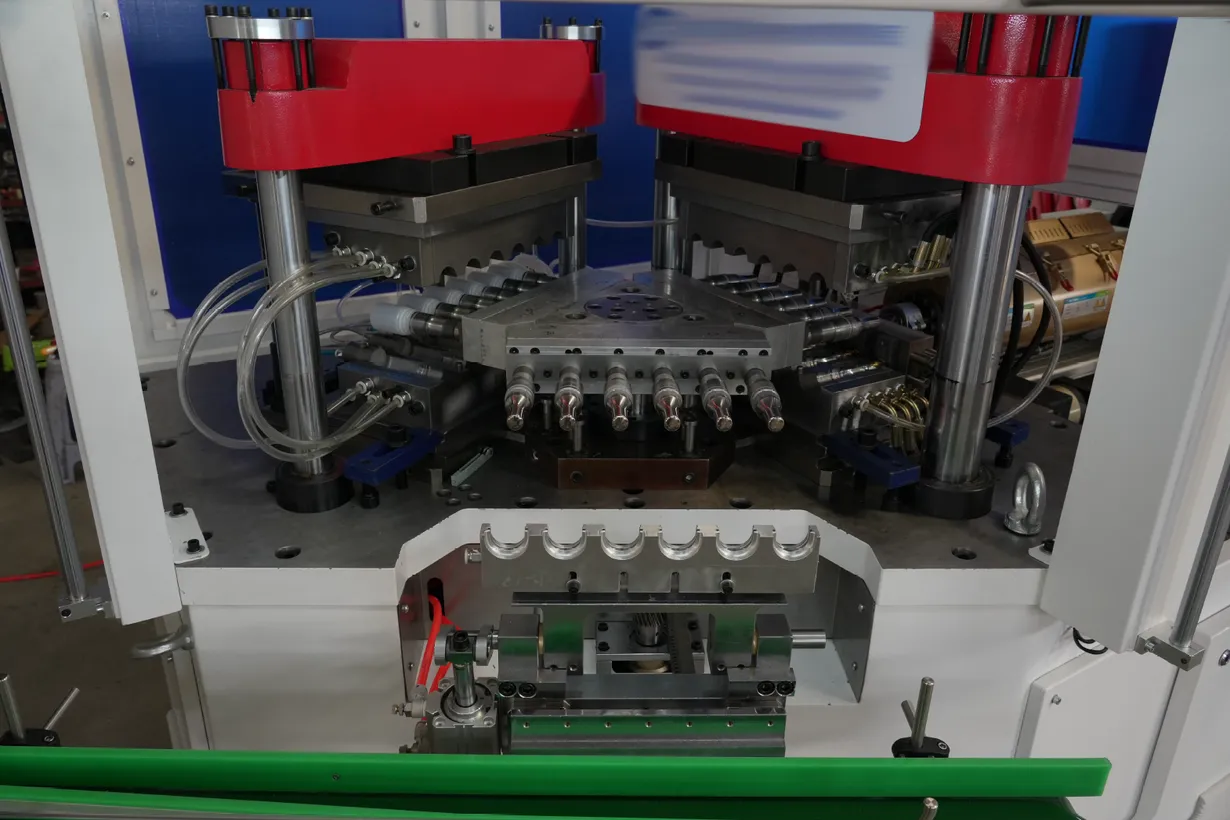
Por que escolher as máquinas de moldagem por injeção e sopro da Ever-Power?
Mexico Ever-Power ISBM Machinery Co., Ltd. is a specialized manufacturer primarily engaged in the research, development, production, sales, and trade of automatic one-step injection-blowing hollow molding machines and supporting injection-blowing molds. Our product range encompasses injection blow molding machines, extrusion blow molding machines, injection stretch blow molding machines, and full auxiliary equipment systems. The company is strategically located with excellent transportation access, enabling efficient domestic and international logistics.
Ever-Power maintains an outstanding R&D team composed of senior engineers and technical specialists with extensive hands-on experience in both injection-blowing machinery and precision injection-blowing mold design. This dual expertise allows us to offer customers truly integrated solutions: not just a machine, but a complete production system in which the IBM machine, the mold, and the auxiliary equipment are engineered and optimized together. Our engineers have accumulated deep practical knowledge across pharmaceutical packaging, food packaging, healthcare packaging, cosmetics packaging, and specialty plastic packaging applications.
We provide customers with detailed and thorough pre-sale consultation, in-sale project management, and comprehensive after-sale technical support. The company's products can process HDPE, LDPE, PP, PS (including lactic acid bacteria grades), high-transparency PS, ABS, environmental corn material, EVA, and PCTG resins, producing 1 ml - 1,000 ml plastic containers for markets worldwide. As leading injection blow molding machine manufacturers committed to the ZQ Series European structural standard, we guarantee that every machine leaving our facility meets the clamping force, energy efficiency, and dimensional precision specifications that have made the ZQ110 the trusted choice for injection blow molding machine suppliers and end users across Korea, India, Turkey, Brazil, Russia, South Africa, Mexico, the USA, and beyond.
Ever-Power adheres to the enterprise development philosophy of self-reliance, integrity, pragmatism, innovation, and responsibility. We build one-stop turnkey project capability so that customers from machine selection through installation, operator training, production ramp-up, and long-term maintenance have a single accountable partner. Whether you are evaluating your first plastic injection blow molding machine, upgrading aging capacity, seeking a direct replacement of Aoki injection blow molding machine performance, or scaling to multi-line production, Ever-Power has the engineering depth, manufacturing capability, and global service reach to support your project successfully.
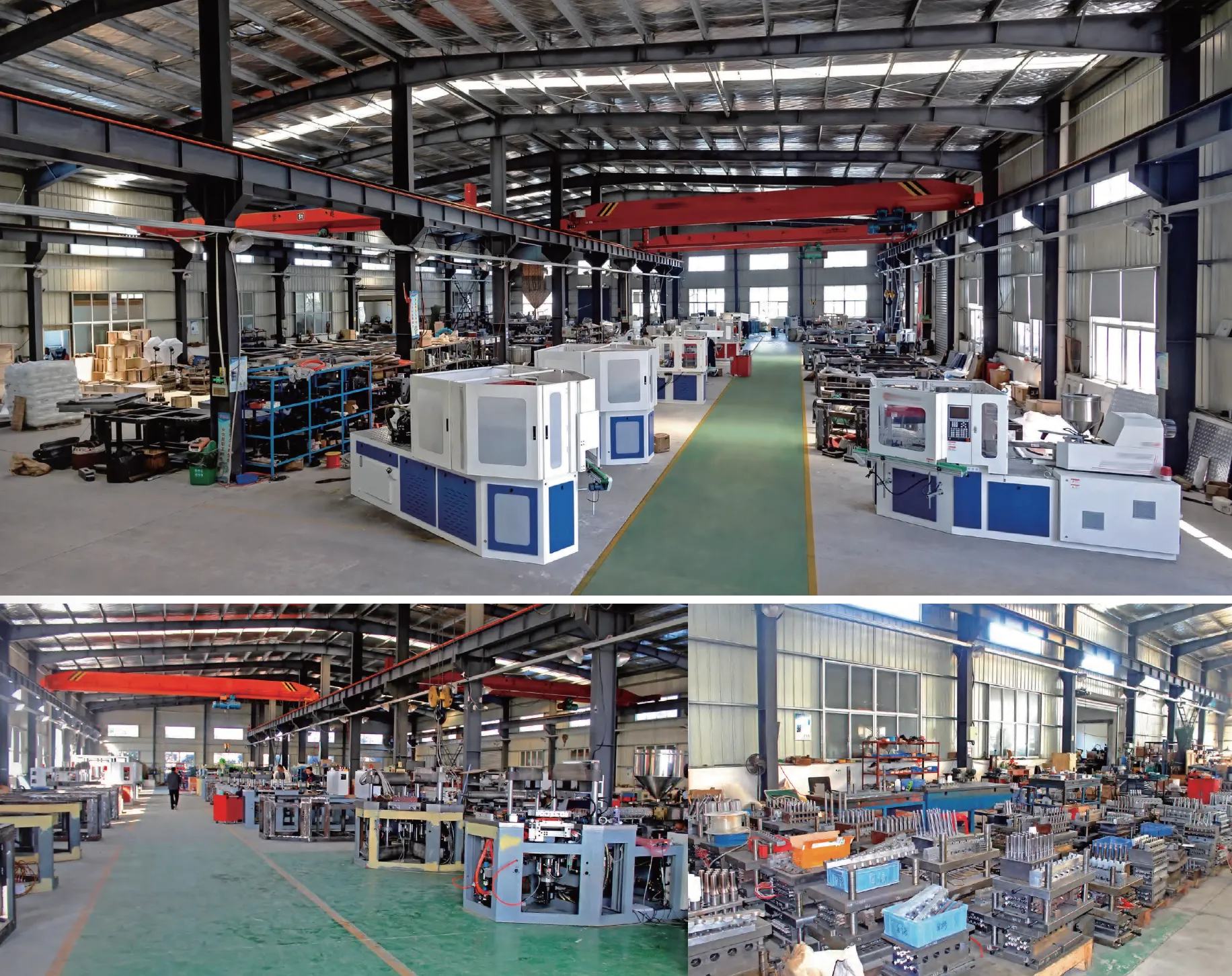
Perguntas frequentes
Q: What is the difference between an injection blow molding machine and an injection stretch blow molding machine?
A: An IBM injection blow molding machine uses two stations: injection (preform formation) and blow molding (final bottle formation), without any mechanical stretching step. An injection stretch blow molding machine adds a stretch rod that elongates the preform axially before radial inflation, orienting the PET polymer chains to enhance strength and clarity. IBM is best for PP, HDPE, PS, and PVC bottles in pharmaceutical, cosmetic, and personal care packaging. ISBM is the standard process for PET carbonated beverage and mineral water bottles.
Q: What bottle sizes can the ZQ110 injection blow molding machine produce?
A: The ZQ110 plastic injection blow molding machine supports bottle heights from 1 mm to 2,000 mm (suitable bottle height range) with a maximum bottle diameter of 120 mm. In practical production terms, it is most commonly used for containers from 10 ml to 1,000 ml, covering the full range of pharmaceutical vials, cosmetic bottles, personal care containers, and food supplement jars. Mold cavitation is highest for smaller bottles (20 cavities at 10 ml) and lowest for larger containers (3-4 cavities at 1,000 ml).
Q: How does the ZQ110 achieve 20%-30% energy savings compared to other injection blow molding machines?
A: The energy saving comes from the ZQ110's unique pressurized clamping structure: the booster cylinder is decoupled from the mold opening and closing action, so it only engages when high clamping force is needed (during injection and blowing), not during the travel phase. Combined with the hydraulic dual-system configuration and the servo rotation drive, the machine avoids the constant high-pressure hydraulic losses that occur in conventional single-system designs. This results in 20%-30% lower electricity consumption per production hour versus comparable injection blow molding machines from industry peers.
Q: What raw materials does the ZQ110 IBM machine support?
A: The ZQ110 injection blow molding machine is compatible with HDPE, LDPE, PP, PS (including high-clarity and lactic acid bacteria grades), PVC, ABS, PCTG, EVA, and environmental corn-based bioplastics. The 65 mm screw with 22:1 L/D ratio and 5+N independent heating zones ensure optimal melt quality across all supported resin grades. If you are looking for a PET injection blow molding machine, note that PET is not the primary target material for IBM; PET is better processed on an ISBM machine for stretch-oriented bottles.
Q: Is the ZQ110 a good replacement for Aoki injection blow molding machine models?
A: Yes, the ZQ110 is frequently selected as a replacement of Aoki injection blow molding machine capacity in factories seeking a modern, energy-efficient European-structure IBM machine at a competitive price point. While Aoki machines are well-regarded in the industry, the ZQ110 offers 20%-30% higher clamping force, standardized servo rotation, and a pressurized clamping system that results in measurably lower energy costs. Mold compatibility should be evaluated on a case-by-case basis, and Ever-Power's engineering team can assist with mold adaptation or new mold design for customers transitioning from Aoki to ZQ110.
Q: What is the typical lead time and delivery process for the ZQ110 injection blow molding machine?
A: Standard lead time for the ZQ110 machine body is typically 6-8 weeks from order confirmation, depending on current production schedule. Molds ordered together with the machine may have a 10-14 week lead time depending on cavitation count and complexity. Ever-Power handles full export documentation, packing list, commercial invoice, and can assist with customs clearance documentation for customers in Korea, India, Turkey, Brazil, Russia, South Africa, Mexico, the USA, and other markets. Contact us for a specific delivery schedule quotation for your destination country.
Q: How does the ZQ110 compare to scrap-edge injection blow molding machine designs?
A: A scrap edge injection blow molding machine based on the extrusion blow principle generates 20%-40% material waste in the form of flash and pinch-off trims that require grinding and reprocessing. The ZQ110 IBM process produces zero scrap in normal production because the bottle neck is formed by injection (not by cut-off) and the bottle base is formed by blow molding (not by pinch-off welding). This zero-waste characteristic means 100% of the raw material input becomes saleable product, which is a significant material cost advantage that compounds with production volume over time.
Q: What installation and training support does Ever-Power provide for the ZQ110?
A: Ever-Power provides on-site installation and commissioning service by experienced senior engineers who are responsible for machine leveling, hydraulic and pneumatic connection, mold installation, initial parameter setting, first-article production approval, and operator training. Training covers machine operation, mold changeover procedure, parameter optimization for the target resin, daily maintenance routines, and basic fault diagnosis. Training duration is typically 5-7 days on-site for a standard installation. Remote technical support is available 24/7 after installation for any operational questions that arise during production ramp-up.
Q: Can the ZQ110 produce LED bulb covers or specialty transparent parts?
A: A aplicação da máquina de moldagem por injeção e sopro para capas de lâmpadas LED exige alta transparência óptica, paredes finas e uniformes e geometria precisa. A ZQ110 pode processar resinas de PS, PCTG e ABS de alta transparência que atendem a esses requisitos para determinados formatos de capas difusoras de LED, dentro da faixa dimensional da máquina (diâmetro máximo do frasco de 120 mm, altura máxima de 220 mm). Para clientes com requisitos de produção de capas de LED, recomendamos consultar nossos engenheiros de aplicação para avaliar se a contagem de cavitação e os parâmetros de geometria do frasco da ZQ110 correspondem ao seu projeto específico de capa de LED antes de fazer o pedido.
P: Como faço para solicitar um orçamento personalizado para uma máquina de moldagem por injeção e sopro da Ever-Power?
R: Para receber um orçamento preciso para uma máquina de moldagem por injeção e sopro personalizada, por favor, prepare as seguintes informações antes de nos contatar: faixa de volume de garrafa desejada (ml), altura e diâmetro da garrafa, tipo(s) de resina a ser(em) processada(s), produção necessária por hora (garrafas/hora) e quaisquer requisitos especiais referentes ao material do molde, número de cavitações ou equipamentos auxiliares. Nossa equipe de engenharia utilizará essas informações para recomendar o modelo de máquina e a configuração de molde ideais, fornecer um preço detalhado para a máquina de moldagem por injeção e sopro e o pacote de molde, e propor um cronograma do projeto desde o pedido até a entrega e o comissionamento da máquina em sua fábrica.
Avaliações de clientes
Park Ji-ho, gerente de produção, Coreia
"Substituímos duas máquinas antigas de fabricação asiática por uma única ZQ110 e a diferença na estabilidade de fechamento foi notável desde o primeiro dia. Produzimos frascos farmacêuticos de HDPE de 100 ml em um molde de 12 cavidades e estamos obtendo um peso consistente em gramas, com variação de no máximo 0,5 g em todas as 12 cavidades. Isso é melhor do que jamais conseguimos antes. A máquina está funcionando há cerca de oito meses com praticamente zero tempo de inatividade. A equipe de instalação chegou no horário previsto e o comissionamento foi concluído em menos de uma semana."
Rajesh Mehta, proprietário de fábrica, Índia
"Inicialmente, eu estava preocupado com o preço da máquina de moldagem por injeção e sopro, mas depois de calcular a economia de energia ao longo de 12 meses, ficou muito claro que este era o melhor investimento a longo prazo. Produzimos frascos cosméticos de PP de 30 ml a 250 ml e a troca entre moldes é razoavelmente rápida. O suporte técnico tem sido muito prestativo sempre que tivemos alguma dúvida durante os primeiros meses após a instalação. No geral, a qualidade dos frascos produzidos por esta máquina é significativamente melhor do que a da linha de extrusão e sopro que usávamos antes."
Ahmet Yildirim, Diretor de Operações, Turquia
"Precisávamos de uma máquina que pudesse processar tanto frascos transparentes de PS para nossa linha de cosméticos quanto frascos de HDPE para nossa linha de produtos de limpeza, utilizando a mesma plataforma de equipamentos. A ZQ110 faz ambas as coisas muito bem. A troca de resinas requer purga e alteração de parâmetros, mas é administrável. A estrutura de estilo europeu confere uma sensação de robustez e a qualidade de construção é visivelmente superior à das máquinas chinesas que vi na mesma faixa de preço. Já encomendamos uma segunda ZQ110 para nosso novo pavilhão de produção."
Dmitri Volkov, Gerente de Fábrica, Rússia
"A coordenação logística para o envio da ZQ110 para nossa fábrica na Rússia foi feita com profissionalismo pela equipe da Ever-Power. Eles providenciaram toda a documentação de exportação e a máquina chegou em perfeitas condições. Nossa equipe de manutenção considerou o sistema hidráulico muito fácil de reparar, pois o layout de circuito duplo é bem documentado. Produzimos frascos de xampu de 500 ml em PEAD com molde de 5 cavidades e os frascos saem com excelente convexidade da base e sem variação na espessura da parede. Estamos muito satisfeitos com o investimento."
Themba Nkosi, Diretora de Compras, África do Sul
"O que me convenceu a escolher a Ever-Power em vez de outros fabricantes de máquinas de moldagem por injeção e sopro foi a presteza da sua equipe de vendas. Eles responderam a todas as minhas perguntas técnicas detalhadamente, forneceram dados reais de produção de instalações semelhantes e foram honestos quanto ao prazo de entrega. A ZQ110 chegou sete semanas após a confirmação do pedido, o que é rápido para um equipamento deste porte. Ela está em operação na nossa fábrica de embalagens farmacêuticas há quatro meses, produzindo frascos de medicamentos de 60 ml em polipropileno. A qualidade é consistentemente excelente e o treinamento dos operadores foi tranquilo."
Carlos Souza, Supervisor de Produção, Brasil
"Usávamos uma antiga máquina de moldagem por injeção e sopro da Aoki há muitos anos e, quando chegou a hora de substituí-la, várias pessoas do nosso setor recomendaram que considerássemos a Ever-Power como uma alternativa à capacidade da máquina de moldagem por injeção e sopro da Aoki, com uma melhor relação custo-benefício. A ZQ110 nos impressionou na comparação técnica. O divisor de ângulo de precisão para sincronização da torre é visivelmente mais suave do que qualquer coisa que tínhamos visto antes. Após nove meses de operação, podemos afirmar que foi a decisão certa. O tempo de atividade da produção tem sido excelente e o fornecimento de peças de reposição tem sido confiável."
Michael Thompson, Engenheiro de Manufatura, EUA
"Nossa fábrica utiliza um molde de 20 cavidades para frascos conta-gotas de 10 ml em LDPE, e a ZQ110 dá conta do recado perfeitamente. Com um ciclo de 4 segundos, estamos produzindo cerca de 18.000 frascos por hora, exatamente o que nosso plano de produção exigia. Inicialmente, tivemos algumas dúvidas sobre a conexão do sistema de refrigeração a água em nossa fábrica, e a equipe técnica nos ajudou a resolvê-las remotamente com muita rapidez. O aspecto de zero desperdício do processo da IBM também reduziu significativamente nosso consumo de matéria-prima em comparação com nossa antiga configuração de extrusão. Estamos muito satisfeitos tanto com a máquina quanto com o serviço."
Maria Gonzalez, Supervisora de Produção, México
"Estamos usando a ZQ110 em nossa linha de cosméticos há mais de dez meses, produzindo frascos de loção corporal de 250 ml em PCTG. O molde de 8 cavidades nos proporciona uma taxa de produção confortável para o nosso volume atual, e a transparência dos frascos de PCTG que saem desta máquina é impressionante; nossos clientes já comentaram sobre isso. A equipe de instalação da Ever-Power do México chegou pontualmente e o comissionamento levou apenas cinco dias, incluindo o treinamento dos operadores. Quaisquer dúvidas após o início da produção foram resolvidas rapidamente. Eu recomendaria esta máquina para qualquer fábrica de embalagens de cosméticos."
Priya Sharma, Gerente de Logística e Compras, India
"Sou responsável pela logística do nosso grupo de fábricas de embalagens e a entrega da ZQ110 foi feita de forma excelente. Recebemos toda a documentação de envio antecipadamente, oferecemos suporte para o desembaraço aduaneiro e a máquina foi embalada com segurança para o transporte marítimo. Na chegada, não havia nenhum dano. O molde que encomendamos junto com a máquina para frascos de suplemento alimentar de 30 ml em PP também era de excelente qualidade, a precisão da rosca era perfeita e a vedação da tampa passou no teste 100% na primeira verificação. Para quem estiver procurando fornecedores de máquinas de moldagem por injeção e sopro, eu diria que a combinação de qualidade da máquina, qualidade do molde e suporte logístico da Ever-Power é difícil de igualar."
Informação adicional
| Editado por | Yjx |
|---|
Produtos relacionados
-
Máquina de moldagem por injeção e sopro ZQ60, substituta do modelo Bloma IBM50.
-
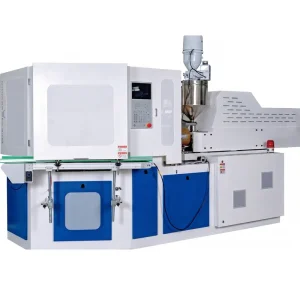
Máquina de moldagem por injeção e sopro ZQ40 - Substituta do modelo SUMA 40iB
-
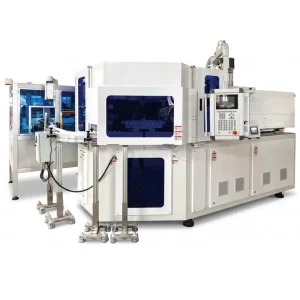
Máquina de moldagem por injeção e sopro totalmente elétrica de alta velocidade ZQ60HE (Europa)
-
Máquina de moldagem por injeção e sopro ZQ40 - Substituta para o modelo Jomar IBM40